What is IC Engine? and It’s type
Dec 13, 2025

Deepak Choudhary
Learn What Industry Wants
Lead the CHANGE in Mechanical Engineering
Upskill with 40+ courses in Design/CAD, Simulation, FEA/CFD, Manufacturing, Robotics & Industry 4.0.
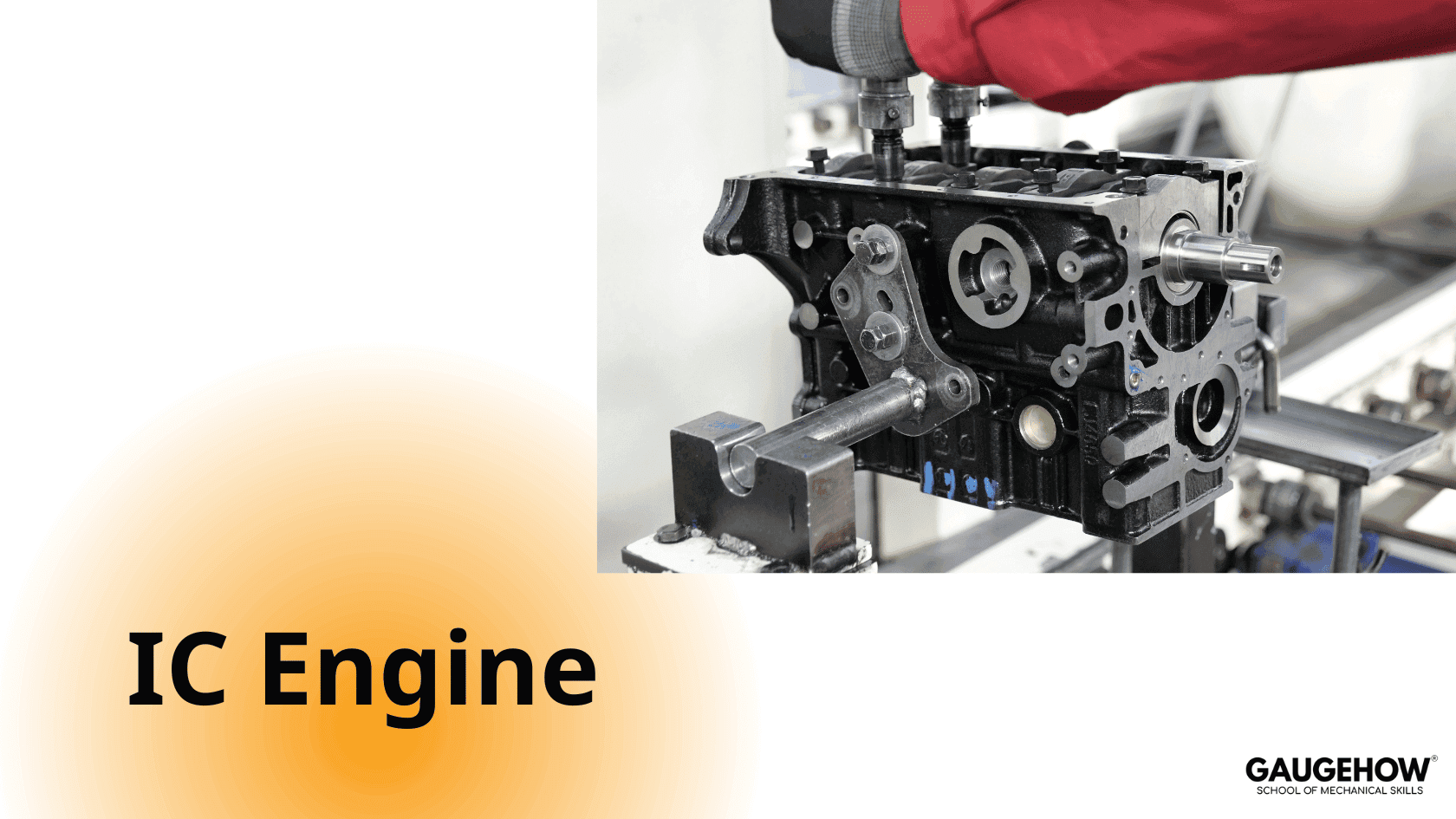
An internal combustion engine (I.C. engine) is an engine in which the ignition and combustion of fuel take place inside the engine cylinder. It works on the principle that a fuel–air charge is ignited inside a combustion chamber at high pressure, and the energy released during combustion is converted into mechanical work.
Basics of I.C. Engine
In primitive times, human muscle power was the primary source of energy. Later, animals were domesticated and used for performing work. With technological development, humans learned to convert energy from one form to another using machines called engines.
An engine is a mechanical device that converts heat energy into mechanical energy. Engines that operate on this principle are known as heat engines.
Broadly, heat engines are classified into:
External Combustion (E.C.) Engines
Internal Combustion (I.C.) Engines
Both E.C. and I.C. engines can further be classified as:
Reciprocating engines
Rotary engines
An I.C. engine is one in which combustion occurs inside the engine cylinder itself, unlike an E.C. engine where combustion occurs externally (e.g., steam engines).
A diesel engine is a common example of an I.C. engine, where air acts as the working fluid. I.C. engines are widely used in:
Automobiles
Aviation
Power generation
Agricultural and industrial applications
Main Components of an I.C. Engine
Cylinder
Piston
Piston rings
Connecting rod
Crankshaft
Valves
Spark plug (SI engine)
Fuel injector (CI engine)
Oil sump
Major Classification of I.C. Engines
1. Based on Type of Ignition
(a) Spark Ignition (SI) Engine
In SI engines, a pre-mixed charge of air and fuel is drawn into the cylinder during the intake stroke. The mixture is compressed and ignited by a spark plug.
Example: Petrol (gasoline) engine
(b) Compression Ignition (CI) Engine
In CI engines, only air is drawn into the cylinder and compressed to a high pressure and temperature. Fuel is then injected into the hot compressed air, causing self-ignition.
Example: Diesel engine
2. Based on Number of Strokes per Cycle
(a) Four-Stroke Engine
A four-stroke engine completes one cycle in four piston strokes:
Intake
Compression
Power
Exhaust
It requires two crankshaft revolutions (720°) per cycle and is the most widely used engine in automobiles.
(b) Two-Stroke Engine
A two-stroke engine completes one cycle in two piston strokes:
Compression
Power
Only one crankshaft revolution (360°) is required.
(c) Six-Stroke Engine
This is an advanced concept engine designed to improve fuel efficiency and reduce emissions. It combines features of both two-stroke and four-stroke engines, resulting in six strokes per cycle.
3. Based on Thermodynamic Cycle
(a) Otto Cycle Engine
The Otto cycle is an ideal cycle for spark ignition engines. It consists of:
Two isentropic processes
Two constant-volume (isochoric) processes
(b) Diesel Cycle Engine
The diesel cycle is the ideal cycle for CI engines, consisting of:
Two isentropic processes
One constant-pressure (isobaric) process
One constant-volume process
(c) Dual Cycle Engine
The dual (or mixed) cycle is a combination of Otto and Diesel cycles, where heat addition occurs partly at constant volume and partly at constant pressure.
4. Based on Type of Fuel Used
(a) Petrol (Gasoline) Engine
Uses petrol as fuel, ignited by a spark plug.
(b) Diesel Engine
Uses diesel fuel and operates on compression ignition.
(c) Bi-Fuel Engine
Can operate on two different fuels, commonly natural gas and petrol, using a dual-fuel system.
5. Based on Method of Ignition
Spark Ignition (SI) Engine – ignition by spark plug
Compression Ignition (CI) Engine – self-ignition due to compression
CI engines operate at high compression ratios (up to 22:1).
6. Based on Number of Cylinders
(a) Single-Cylinder Engine
Uses only one cylinder. Simple, compact, and economical.
(b) Multi-Cylinder Engine
Uses multiple cylinders (commonly 2, 4, 6, or 8) to provide smooth and continuous power output.
7. Based on Cylinder Arrangement
Horizontally Opposed (Boxer) Engine
Vertical Engine
V-Type Engine (60°–90° V angle)
Radial Engine (star-shaped arrangement)
Inline Engine
X Engine (used historically in aircraft engines)
Opposed Piston Engine (two pistons per cylinder)
W Engine (multiple cylinder banks)
8. Based on Cooling System
(a) Air-Cooled Engine
Heat is dissipated through airflow over cooling fins.
(b) Water-Cooled Engine
Uses water or coolant circulated through water jackets to remove heat.
(c) Oil-Cooled Engine
Uses engine oil as a cooling medium, often combined with an oil cooler.
Modern Advancements in I.C. Engines
Modern I.C. engines incorporate:
Advanced fuel injection systems
Lightweight materials
Improved combustion chamber design
Emission control technologies
These advancements aim to achieve:
Higher fuel efficiency
Reduced emissions
Lower vehicle weight
Improved engine performance
Our Courses
Complete Course Library
Access to 40+ courses covering various fields like Design, Simulation, Quality, Manufacturing, Robotics, and more.