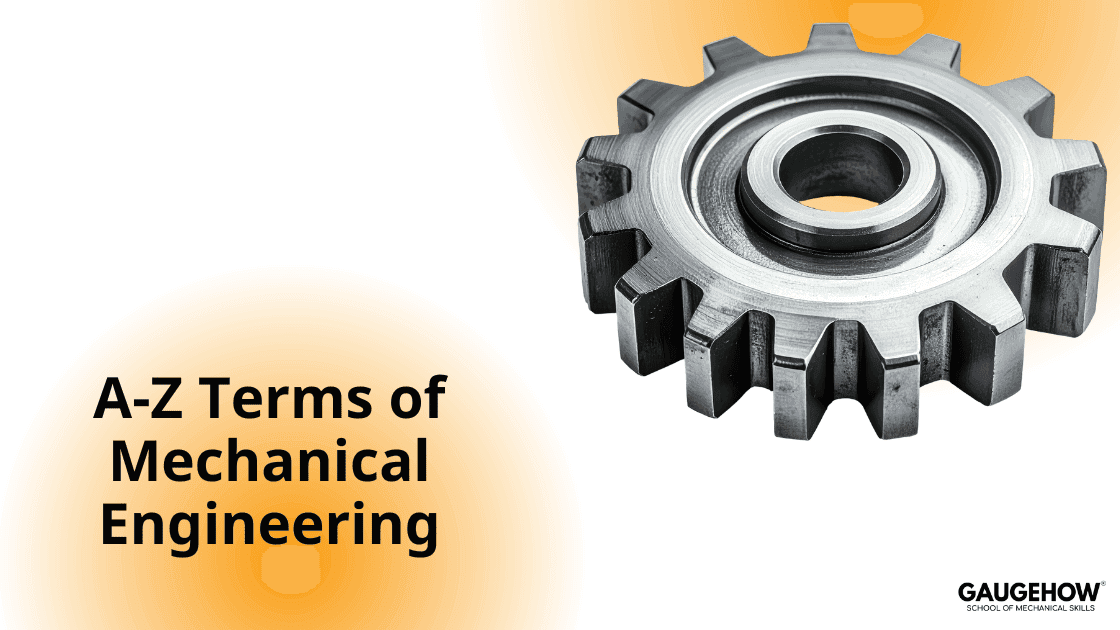
A-Z Technical Terms in Mechanical Engineering
Learn More in This Video
Subscribe to GaugeHow for More
This list covers a broad range of mechanical engineering terms and should be a good reference
A
Acceleration: Rate of change of velocity.
Adiabatic Process: A process where no heat is transferred to or from the system.
Aerospace Engineering: Field focused on the design and development of aircraft and spacecraft.
Alloy: A mixture of metals or a metal and a non-metal.
Ammeter: Instrument for measuring electric current.
B
6. Bearing: A machine element that supports rotating shafts.
7. Bending Moment: The internal moment that induces bending of a beam.
8. Bolted Joint: A connection using bolts to fasten components.
9. Boiler: A device for generating steam or hot water.
10. Brake: A mechanism used to slow down or stop a vehicle.
C
11. Camshaft: A shaft with cams that controls the timing of valve openings in an engine.
12. Compression Ratio: Ratio of the maximum to minimum volume in a combustion chamber.
13. Centrifugal Force: Force that acts outward on a body moving in a circular path.
14. Coolant: A fluid used to remove heat from an engine or machine.
15. Crankshaft: A shaft that converts reciprocating motion to rotational motion.
D
16. Dynamics: Study of forces and motion in mechanical systems.
17. Deformation: Change in shape or size of a material under applied forces.
18. Design Engineering: Discipline focused on designing and optimizing mechanical systems.
19. Drilling Machine: Equipment used for drilling holes in materials.
20. Dynamic Balance: Condition where the center of mass is aligned with the axis of rotation.
E
21. Efficiency: Ratio of useful work output to total energy input.
22. Engine: A machine that converts fuel into mechanical energy.
23. Exhaust System: Components that channel exhaust gases away from the engine.
24. Elasticity: Ability of a material to return to its original shape after deformation.
25. Entropy: Measure of disorder or randomness in a system.
F
26. Friction: Resistance to motion between two surfaces in contact.
27. Fuel Injector: Device that introduces fuel into the combustion chamber.
28. Fan: A device used to move air or gases.
29. Fluid Dynamics: Study of fluids in motion and their interactions.
30. Flywheel: A rotating wheel used to store rotational energy.
G
31. Gear: A rotating machine part with cut teeth that meshes with another gear to transmit torque.
32. Gasket: A seal used to prevent leakage between two mating surfaces.
33. Gravitation: Force of attraction between two masses.
34. Gauge: Instrument used to measure physical quantities.
35. Gearbox: A mechanical device that changes the speed and torque of a machine.
H
36. Heat Exchanger: Device for transferring heat between two or more fluids.
37. Hydraulics: Study of fluid mechanics involving liquid pressure and flow.
38. Hysteresis: Lag between input and output in a material or system.
39. Heat Transfer: Movement of thermal energy from one body or material to another.
40. Hypoid Gear: A type of gear where the axes do not intersect.
I
41. Inertia: Resistance of an object to changes in its state of motion.
42. Internal Combustion Engine: Engine where combustion occurs inside the engine.
43. Isothermal Process: A process occurring at a constant temperature.
44. Instrumentation: Tools and devices used to measure and control physical quantities.
45. Impeller: A rotating component used to move fluids in pumps and turbines.
J
46. Jig: A tool used to guide the movement of tools or workpieces.
47. Jet Engine: Engine that propels an aircraft by expelling jet streams of gases.
48. Joint: A connection between two mechanical components.
49. Jack: A device used to lift heavy loads.
50. Joule: A unit of energy in the International System of Units (SI).
K
51. Kinematics: Study of motion without considering forces.
52. Kinetic Energy: Energy possessed by an object due to its motion.
53. Kinematic Pair: Two links or components that are connected in a mechanical system.
54. Kinetic Theory: Theory that explains the behavior of gases based on their molecular motion.
55. Key: A component that transmits torque between shafts and gears.
L
56. Lubrication: Application of a substance to reduce friction between surfaces.
57. Lever: A simple machine used to amplify force.
58. Load: The force or weight supported by a structure or component.
59. Linear Actuator: Device that creates motion in a straight line.
60. Lathe: Machine tool used for shaping materials by rotating them against a cutting tool.
M
61. Mechanical Advantage: Ratio of output force to input force in a machine.
62. Moment of Inertia: Measure of an object’s resistance to rotational motion.
63. Manifold: A component that distributes fluids or gases to multiple outlets.
64. Motor: A device that converts electrical energy into mechanical motion.
65. Machining: Process of shaping materials using cutting tools.
N
66. Newton’s Laws: Three fundamental laws describing the relationship between motion and forces.
67. Nozzle: A device that controls the direction or characteristics of a fluid flow.
68. Nomenclature: System of naming or labeling parts and processes in engineering.
69. Noise: Unwanted sound or vibrations in a mechanical system.
70. Nuclear Engineering: Discipline involving the study and application of nuclear processes.
O
71. Orifice: An opening or hole in a mechanical component for fluid flow.
72. Oscillation: Repeated back-and-forth movement around a central point.
73. Output Shaft: The shaft that transmits power from a machine to its load.
74. Overhaul: Comprehensive inspection and repair of a machine or system.
75. Offset: A displacement of a component from its usual position.
P
76. Piston: A cylindrical component that moves back and forth in a cylinder to convert energy.
77. Pump: A device used to move fluids by mechanical action.
78. Pressure: Force exerted per unit area.
79. Power: Rate at which work is done or energy is transferred.
80. Pulley: A wheel with a grooved rim for supporting a belt or rope.
Q
81. Quantitative Analysis: Measurement and analysis of quantities and numerical data.
82. Quenching: Rapid cooling of metal to harden it.
83. Quality Control: Process of ensuring products meet specified standards.
84. Quick Return Mechanism: A mechanical device that alters the speed of motion in one direction.
85. Quadrant: A quarter of a circle, used in mechanical systems for rotation.
R
86. Rotor: A rotating part of a machine, such as a motor or turbine.
87. Refrigeration: Process of removing heat from a space to lower its temperature.
88. Radiator: Device used to dissipate heat from a fluid.
89. Resistance: Opposition to the flow of electric current.
90. Roller Bearing: A type of bearing that uses rolling elements to reduce friction.
S
91. Stress: Force per unit area within materials.
92. Strain: Deformation experienced by a material in response to stress.
93. Shaft: A rotating machine element that transmits power.
94. Spring: An elastic device that stores and releases energy.
95. Servo Motor: A motor used in control systems for precise movement.
T
96. Torque: Rotational force applied to an object.
97. Turbine: A machine that converts fluid energy into mechanical energy.
98. Thermodynamics: Study of heat and energy transfer.
99. Transmission: System that transmits power from the engine to the wheels.
100. Temperature: Measure of thermal energy within a system.
U
101. Uniform Stress: Stress that is distributed evenly across a material.
102. Ultimate Tensile Strength: Maximum stress a material can withstand while being stretched.
103. Universal Joint: A joint that allows rotational motion between shafts at an angle.
104. Under-reaming: Enlarging a hole or cavity to create a better fit.
105. Ultrasonic Testing: Non-destructive testing method using high-frequency sound waves.
V
106. Velocity: Speed in a given direction.
107. Vibration: Oscillatory motion around an equilibrium point.
108. Valve: A device used to control the flow of fluids.
109. Venturi Meter: Device used to measure fluid flow rate using pressure differences.
110. Vacuum: Space devoid of matter, often used to refer to low-pressure environments.
W
111. Weld: A process of joining two materials by melting and fusing them together.
112. Work: Energy transferred by a force over a distance.
113. Water Hammer: Pressure surge caused by a sudden change in fluid flow.
114. Watt: Unit of power equal to one joule per second.
115. Worm Gear: A gear that meshes with a worm to provide high torque.
X
116. X-Ray Inspection: Non-destructive testing method using X-rays to examine internal structures.
117. X-Y Table: A table that moves in two perpendicular directions, often used in machining.
118. Xenon Lamp: High-intensity light source used in various applications.
119. Xenon Flash Lamp: A lamp used to produce short bursts of high-intensity light.
120. Xenon Arc Lamp: A type of lamp used in photometric testing and high-intensity lighting.
Y
121. Yield Strength: The stress at which a material begins to deform plastically.
122. Yaw: Rotational movement around a vertical axis.
123. Yoke: A component used to connect and transfer motion between parts.
124. Yellow Metal: A term often used to refer to brass or bronze.
125. Yardstick: A measuring stick used to gauge length or distance.
Z
126. Zero-Point Calibration: Calibration process to set a reference point for measurements.
127. Zener Diode: A diode used to maintain a constant voltage.
128. Zigzag Pattern: A pattern of alternating angles or directions, often used in stress analysis.
129. Zinc Plating: Process of coating metal with zinc to prevent corrosion.
130. Zone of Influence: The area affected by a force or load in a mechanical system.
Mechanical Engineering Courses That Industry Actually Uses
Learn Tools of Design & CAD, Analysis & Simulation, Automation & Robotics, and Industry 4.0 used in modern factories.
Join 40+ Mech Courses like GD&T, Siemens NX, SolidWorks, CATIA V5, AutoCAD, ANSYS (FEA & Fluent), ABAQUS, Creo, Fusion 360, CNC Programming, Digital Twins, Python for Mechanical, and Industry 4.0.
Our Courses
Complete Course Library
Access to 40+ courses covering various fields like Design, Simulation, Quality, Manufacturing, Robotics, and more.