Aerospace Engineering Subjects: What You'll Learn Throughout the Degree
Learn More in This Video
Subscribe to GaugeHow for More
Curious about aerospace engineering subjects? Discover the complete subject list, semester-wise syllabus, and what you need after 12th to get started.
Overview
Aerospace engineering is the branch that deals with everything that flies aircraft, spacecraft, satellites, and missiles and the systems that make them work. It splits into two overlapping streams: aeronautical engineering (machines that fly within Earth's atmosphere) and astronautical engineering (spacecraft that operate beyond it).
Most students enter through a four-year B.Tech / B.E. in Aerospace Engineering, spread across eight semesters. The curriculum is built like a pyramid. The first year lays a broad foundation of science and engineering basics. From the second year onward, you climb into the core aerospace subjects aerodynamics, propulsion, structures, flight mechanics. By the final year, you're choosing electives, specializing, and working on a real design or research project.
The exact subject list varies a little from college to college (an IIT's syllabus won't be identical to a private university's), but the backbone is remarkably consistent everywhere. Master the fundamentals early, and the advanced subjects stop feeling intimidating.
Key Features
Before the full breakdown, here's a quick snapshot of what the aerospace engineering curriculum looks like at a glance.
Feature | Details |
|---|---|
Degree | B.Tech / B.E. Aerospace Engineering (4 years, 8 semesters) |
Eligibility | 10+2 with Physics, Chemistry & Mathematics (PCM) |
Foundation subjects | Maths, Physics, Engineering Mechanics, Materials Science |
Core subjects | Aerodynamics, Propulsion, Flight Mechanics, Aerospace Structures, Avionics |
Specializations | Aerodynamics, Propulsion, Avionics, Space Technology, Aircraft Design |
Practical work | Labs, workshops, internships, final-year project |
Entrance exams | JEE Main/Advanced (UG), GATE (PG) |
Think of this as the map. Now let's zoom into each region.
Aerospace Engineering Subjects List
Here's a proper aerospace engineering subjects list, grouped by category so you can see how the pieces fit together. These are the subjects that show up across most B.Tech aerospace programs in India and beyond.
Foundation subjects
Engineering Mathematics (I, II & III)
Engineering Physics & Chemistry
Engineering Mechanics
Mechanics of Solids
Fluid Mechanics
Thermodynamics & Heat Transfer
Materials Science
Engineering Graphics / Aircraft Component Drawing
Computer Programming
Core aerospace subjects
Elements of Aeronautics
Aerodynamics (Low Speed & High Speed)
Gas Dynamics
Aerospace Propulsion / Aircraft Propulsion
Flight Mechanics
Aircraft Structures / Aerospace Structural Mechanics
Aircraft Stability and Control
Avionics
Aircraft Systems and Instruments
Automatic Control Systems
Flight Testing
Advanced & elective subjects
Rocket Propulsion
Space Mechanics / Orbital Mechanics
Aeroelasticity
Spacecraft Design
Satellite Systems
Hypersonic Aerodynamics
Aircraft Design
Computational Fluid Dynamics (CFD)
Unmanned Aerial Vehicles (UAVs)
It looks like a lot and it is but remember you're never tackling all of it at once. It's spread sensibly across eight semesters, which brings us to the next part.
Aerospace Engineering Subjects Semester Wise
This is the section most students actually come for: the aerospace engineering subjects semester wise. The table below shows a representative B.Tech structure.
Treat it as a reliable template rather than an exact match for any single college the sequence and naming shift slightly between universities, but the progression is the same everywhere.
Year | Semester | Key Subjects |
|---|---|---|
1st Year | Sem 1 & 2 | Engineering Mathematics, Physics, Chemistry, Engineering Mechanics, Engineering Graphics, Computer Programming, Basic Electrical & Electronics |
2nd Year | Sem 3 & 4 | Fluid Mechanics, Thermodynamics, Mechanics of Solids, Aircraft Materials & Production, Elements of Aeronautics, Aero-thermodynamics |
3rd Year | Sem 5 & 6 | Aerodynamics, Aerospace Propulsion, Flight Mechanics, Aircraft Structures, Control Systems, Avionics, first elective subjects |
4th Year | Sem 7 & 8 | Aircraft/Spacecraft Design, Aeroelasticity, Rocket Propulsion, advanced electives, internship, final-year project |
Notice the rhythm: build foundations → learn the core → specialize → apply it all in a project. The first year can feel a bit generic (you'll share many classes with other engineering branches), but stick with it the genuinely aerospace-flavoured subjects kick in hard from the third semester, and the final year is where you get to pick your own direction.
What Subjects Are Needed for Aerospace Engineering?
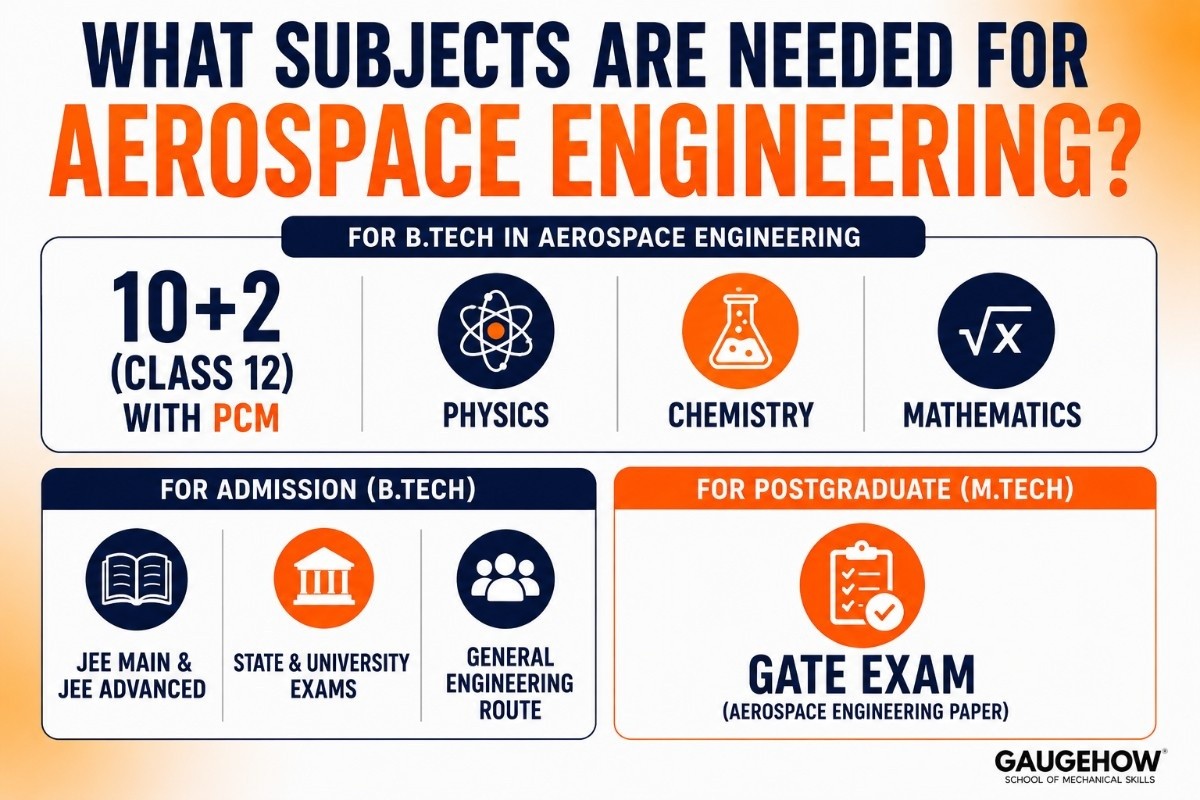
A slightly different question, and an important one if you're still in school: what subjects are needed for aerospace engineering to even get in?
The answer is refreshingly simple. To pursue a B.Tech in aerospace engineering, you need 10+2 (Class 12) with Physics, Chemistry, and Mathematics the standard PCM combination.
Mathematics isn't optional here; it's the backbone of the entire field, so strong calculus and physics skills will genuinely make your degree easier later on.
For admission, most students sit a common engineering entrance exam JEE Main and JEE Advanced for the top institutes like the IITs and IIST, plus various state and university-level exams for other colleges.
There's no separate "aerospace-only" entrance test at the undergraduate level; you compete through the general engineering route and then choose the branch.
For postgraduate study (M.Tech), GATE becomes the key exam, and it does have a dedicated aerospace engineering paper.
So the short version: focus on PCM in school, build a solid maths and physics base, clear your entrance exam, and you're in.
Aerospace vs Aeronautical Subjects
People mix these two up constantly, so let's settle the aerospace vs aeronautical subject question clearly.
Aeronautical engineering is actually a branch within aerospace engineering so their syllabi overlap heavily in the early years. The split shows up in the specialized subjects.
Aspect | Aerospace Subjects | Aeronautical Subjects |
|---|---|---|
Aircraft and spacecraft | Mainly aircraft (within the atmosphere) | |
Shared core | Aerodynamics, Propulsion, Flight Mechanics, Structures | Same shared core |
Distinctive subjects | Rocket Propulsion, Space Mechanics, Spacecraft & Satellite Design | Jet Propulsion, Aircraft Design, Flight Vehicle Design |
Best for | Students drawn to both aviation and space | Students focused purely on aircraft |
In practice, if you study aeronautical engineering you'll go deep on atmospheric flight, while aerospace adds the space side orbital mechanics, rocket propulsion, satellite systems.
For the first two years, an aerospace and an aeronautical student are basically reading the same books. The divergence happens later, in the electives.
FAQ
What are the main subjects in aerospace engineering? The main subjects include Aerodynamics, Aerospace Propulsion, Flight Mechanics, Aircraft Structures, Avionics, and Aircraft Stability and Control, all built on a foundation of mathematics, fluid mechanics, and thermodynamics.
Is mathematics compulsory for aerospace engineering? Yes, absolutely. You need Mathematics with Physics and Chemistry (PCM) in Class 12, and maths remains central throughout the degree from aerodynamics calculations to orbital mechanics.
Which is the hardest subject in aerospace engineering? Most students find Aerodynamics or Propulsion the toughest, since they combine heavy maths with abstract physics. With strong fundamentals and consistent practice, though, they become very manageable.
How many subjects are there in aerospace engineering? A typical 4-year B.Tech spreads roughly 40–50 subjects across eight semesters, including core subjects, electives, labs, and project work though the exact count varies by college.
What subjects are needed for aerospace engineering after 12th? You need Physics, Chemistry, and Mathematics (PCM) in Class 12, followed by a qualifying score in an engineering entrance exam such as JEE Main.
Are aerospace and aeronautical engineering subjects the same? They share most core subjects, but aerospace adds space-focused subjects like rocket propulsion and spacecraft design, while aeronautical stays focused on aircraft and atmospheric flight.
Conclusion
The aerospace engineering subjects you'll study are demanding, varied, and if flight genuinely excites you deeply rewarding.
The degree is built to take you from broad first-year fundamentals all the way to specialized final-year topics like rocket propulsion and spacecraft design, with plenty of hands-on labs and projects along the way.
If you remember the overall shape foundation first, core subjects next, specialization and projects to finish the curriculum stops looking like an intimidating wall of subjects and starts looking like a clear, climbable path.
Get your maths and physics solid, stay curious through the tougher subjects like aerodynamics and propulsion, and you'll be well prepared for a career designing the machines that fly through our skies and beyond.
Resources
The following resources provide reliable information on aerospace engineering, admissions, research, and industry developments:
ISRO – India's official space agency for information on launch vehicles, satellites, missions, and aerospace careers.
NASA – Educational resources covering aerodynamics, propulsion, spacecraft, and space exploration.
AIAA (American Institute of Aeronautics and Astronautics) – Technical publications, aerospace research, and professional development.
NPTEL Aerospace Engineering – Free IIT lectures on aerodynamics, flight mechanics, propulsion, and aerospace structures.
JEE Main & JEE Advanced – Official entrance examinations for admission to B.Tech Aerospace Engineering programs in India.
GATE Aerospace Engineering (AE) – National entrance examination for M.Tech and higher studies in aerospace engineering.
Mechanical Engineering Courses That Industry Actually Uses
Learn Tools of Design & CAD, Analysis & Simulation, Automation & Robotics, and Industry 4.0 used in modern factories.
Join 40+ Mech Courses like GD&T, Siemens NX, SolidWorks, CATIA V5, AutoCAD, ANSYS (FEA & Fluent), ABAQUS, Creo, Fusion 360, CNC Programming, Digital Twins, Python for Mechanical, and Industry 4.0.
Our Courses
Complete Course Library
Access to 40+ courses covering various fields like Design, Simulation, Quality, Manufacturing, Robotics, and more.