Difference Between Aeronautical And Aerospace Engineering
Learn More in This Video
Subscribe to GaugeHow for More
Confused between aeronautical and aerospace engineering? Compare scope, subjects, salary, and which is better to find the right fit for your career goals.
overview
If you've ever stood at a crossroads wondering whether to chase a career building aircraft or designing spacecraft, you're in good company. Thousands of students hit this exact fork every year and most of them are quietly confused about what really separates the two paths.
Here's the thing: the difference between aeronautical and aerospace engineering is real, but it's also widely misunderstood. The two fields share a huge amount of common ground, which is exactly why people mix them up.
This guide clears the fog. We'll break down the scope, subjects, salaries, and the all-important question of which one is right for you in plain English, no jargon overload.
What Is the Difference Between Aeronautical and Aerospace Engineering?
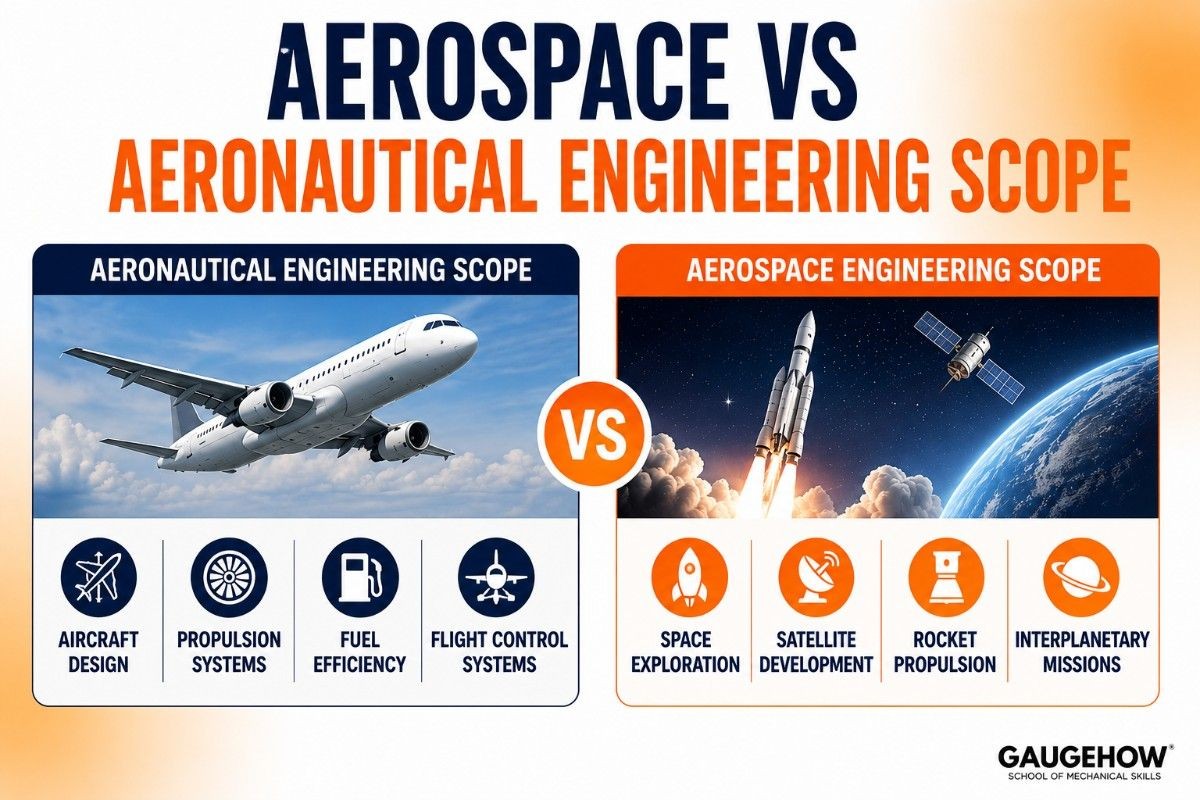
Many students use aeronautical engineering and aerospace engineering interchangeably, but they are not the same. While both disciplines focus on designing and developing flight vehicles, their scope is different.
In simple terms, aeronautical engineering deals with aircraft that fly within Earth's atmosphere, whereas aerospace engineering covers both aircraft and spacecraft.
This means aeronautical engineering is a branch of aerospace engineering.
If a vehicle operates only in the Earth's atmosphere such as an airplane, helicopter, or drone it falls under aeronautical engineering.
If it is designed to travel in space, like a satellite, rocket, or spacecraft, it comes under aerospace engineering.
Aeronautical vs Aerospace Engineering: Key Differences
Aspect | Aeronautical Engineering | Aerospace Engineering |
|---|---|---|
Definition | Focuses on designing, developing, and maintaining aircraft that operate within Earth's atmosphere. | Covers the design, development, and testing of both aircraft and spacecraft. |
Specialized field focused only on aviation. | Broader field that includes both aviation and space technology. | |
Primary Focus | Airplanes, helicopters, drones, gliders, fighter jets | Aircraft, rockets, satellites, spacecraft, launch vehicles, and space systems |
Operating Environment | Earth's atmosphere | Earth's atmosphere and outer space |
Core Subjects | Aerodynamics, aircraft structures, propulsion, flight mechanics | Aerodynamics, propulsion, orbital mechanics, spacecraft design, flight dynamics, space systems |
Industries | Aviation, commercial airlines, aircraft manufacturing, defense | Aviation, defense, satellite technology, space exploration, launch systems |
Career Opportunities | Aircraft Design Engineer, Flight Test Engineer, Maintenance Engineer, Aerodynamics Engineer | Aerospace Engineer, Rocket Propulsion Engineer, Satellite Systems Engineer, Spacecraft Design Engineer |
Typical Employers | Airbus, Boeing, Embraer, airlines, aviation companies, defense organizations | NASA, ISRO, SpaceX, Blue Origin, Boeing, Lockheed Martin, defense organizations |
Which One Should You Choose?
Choose Aeronautical Engineering if your dream is to work on aircraft, commercial aviation, fighter jets, helicopters, or drones. The curriculum is dedicated to solving challenges related to flight within Earth's atmosphere.
Choose Aerospace Engineering if you want broader career opportunities that include both aviation and space technology. Along with aircraft, you'll also study rockets, satellites, spacecraft, orbital mechanics, and space missions.
Bottom Line
The easiest way to remember the difference is this:
Aeronautical Engineering = Aircraft only
Aerospace Engineering = Aircraft + Spacecraft
Think of it as a circle within a circle. Aeronautical engineering is a specialized branch, while aerospace engineering is the broader discipline that includes both aviation and space exploration.
Is Aeronautical Engineering a Branch of Aerospace?
Short answer: yes. Aeronautical engineering is a branch of aerospace engineering and so is astronautical engineering. This is the single most useful fact for cutting through the confusion.
Aerospace engineering is the parent discipline, and it splits into two specialized streams:
Aeronautical engineering — the study of flight within Earth's atmosphere (aircraft).
Astronautical engineering — the study of flight beyond Earth's atmosphere (spacecraft).
So when people debate "aeronautical vs aerospace," they're really comparing a specialized branch against the whole field it belongs to. That's why the two overlap so heavily in their early coursework and why an aeronautical degree is often described as a more focused version of aerospace.
The term "aerospace" itself was coined back in 1958 precisely to treat the atmosphere and outer space as a single continuous realm bundling "aero" (air) and "space" together under one word.
Understanding this hierarchy makes everything that follows scope, subjects, salaries far easier to make sense of.
Aerospace vs Aeronautical Engineering Scope
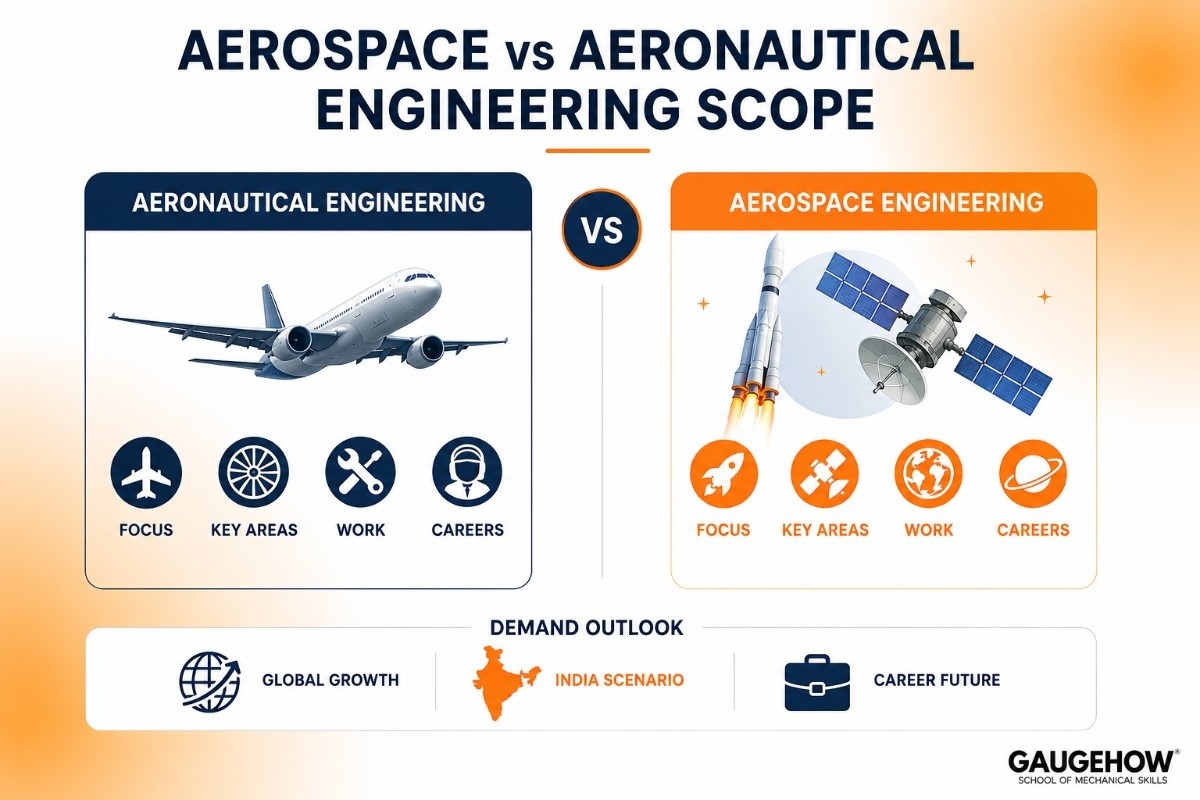
Now let's talk about the aerospace vs aeronautical engineering scope, because this is where the practical career differences show up.
Aeronautical engineering has a focused but deep scope. You'll work on the design, development, testing, and maintenance of aircraft improving aerodynamics, propulsion, fuel efficiency, and flight control systems.
Career opportunities concentrate in commercial aviation, military and defense aviation, and civil aviation authorities. If your passion is firmly grounded in flight through air, this focus is a strength, not a limitation.
Aerospace engineering has a broader scope by definition. Because it spans both aircraft and spacecraft, it opens doors to space agencies, satellite development, rocket propulsion, and interplanetary missions on top of everything aeronautical engineers do.
This wider reach is why aerospace tends to be seen as the more flexible of the two.
In terms of demand, both fields are healthy. Globally, the aerospace sector is growing on the back of private space ventures, drones, and green aviation.
In India specifically, aviation is booming the country is now one of the largest aviation markets in the world which keeps demand strong for aeronautical talent, while organizations like ISRO and HAL drive aerospace opportunities. Wherever you are, neither field is a dead end.
Aerospace vs Aeronautical Engineering Subjects
Here's where the two paths look most alike. When you compare aerospace vs aeronautical engineering subjects, the first couple of years are nearly identical both build on the same foundation of mathematics, physics, fluid mechanics, thermodynamics, and materials science.
The divergence appears in the specialized subjects:
Shared Core Subjects | Aeronautical-Leaning Subjects | |
|---|---|---|
Aerodynamics | Aircraft Design | Spacecraft Design |
Propulsion | Jet Propulsion | Rocket Propulsion |
Flight Mechanics | Aircraft Structures | Orbital / Space Mechanics |
Thermodynamics | Flight Vehicle Design | Satellite Systems |
Avionics | Aircraft Stability & Control | Astrodynamics |
Materials Science | Aeroelasticity | Hypersonic Aerodynamics |
Notice the pattern: aeronautical subjects drill into atmospheric flight and aircraft systems, while aerospace adds the space-focused topics orbital mechanics, rocket propulsion, satellite design.
If you study aeronautical engineering, you'll go deep on aircraft. If you study aerospace, you'll cover aircraft and gain exposure to spacecraft.
For the first two years, though, an aeronautical and an aerospace student are basically reading the same textbooks.
Aerospace vs Aeronautical Engineering Salary
Money matters, so let's look honestly at the aerospace vs aeronautical engineering salary picture and the headline here is that the two are surprisingly close.
In the US, the Bureau of Labor Statistics groups aeronautical engineers within the broader aerospace category, and the median annual wage sits around $134,830, with top earners in research, development, and defense crossing $160,000.
Because the roles overlap so much, salary differences tend to come down to location, sector, and specialization rather than the degree title itself.
Here's a simplified comparison:
Salary Factor | Aeronautical Engineering | Aerospace Engineering |
|---|---|---|
US median (approx.) | Comparable, ~$120k–$135k | ~$134,830 |
India average (approx.) | ₹5–8 LPA (entry to mid) | ₹5–9 LPA (entry to mid) |
Top sectors for pay | Commercial & defense aviation | Space, defense, R&D |
Key salary drivers | Experience, location, employer | Specialization (space/propulsion), sector |
The takeaway: don't pick between these two purely on salary, because the gap is small and inconsistent.
Your earning potential will be shaped far more by where you work, how you specialize, and how much experience you build than by whether your degree says "aeronautical" or "aerospace."
Which Is Better: Aeronautical or Aerospace Engineering?
The honest answer to "which is better aeronautical or aerospace engineering" is the one nobody loves: it depends on you.
there's no universally superior choice only the one that fits your goals. Here's a framework to actually decide instead of going in circles.
Choose aeronautical engineering if:
You're passionate specifically about aircraft planes, helicopters, drones
You want to work in commercial aviation, airlines, or defense aviation
You prefer to specialize deeply in atmospheric flight
Your dream job sits in the aviation industry
Choose aerospace engineering if:
You're excited by both aircraft and spacecraft
You're drawn to satellites, rockets, or space exploration
You want the broader, more flexible option that keeps space careers open
You'd love to work at organizations like NASA, ISRO, or SpaceX
One practical tip if you're genuinely torn: aerospace is the slightly safer, wider net, since its curriculum usually covers aeronautical topics too and leaves the space door open.
But if you already know aircraft are your calling, a focused aeronautical degree is a perfectly strong, direct route. Both lead to rewarding, future-facing careers there's no wrong turn here.
FAQ
What is the main difference between aeronautical and aerospace engineering? Aeronautical engineering focuses on aircraft that fly within Earth's atmosphere, while aerospace engineering covers both aircraft and spacecraft including vehicles that operate in outer space.
Is aeronautical engineering a branch of aerospace engineering? Yes. Aerospace engineering is the broader field, and it includes two branches: aeronautical engineering (aircraft) and astronautical engineering (spacecraft).
Which pays more, aerospace or aeronautical engineering? Their salaries are very similar. Pay differences usually come down to location, industry sector, and specialization rather than the specific degree, with space and defense roles often at the higher end.
Do aeronautical engineers work on spacecraft? Generally no. Aeronautical engineers focus on atmospheric flight, while spacecraft fall under astronautical engineering another branch of the broader aerospace field.
Are the subjects the same in aeronautical and aerospace engineering? The core subjects overlap heavily, especially in the early years. The difference appears later: aeronautical adds aircraft-specific subjects, while aerospace includes space-focused topics like orbital mechanics and rocket propulsion.
Which is better for the future, aeronautical or aerospace engineering? Both have strong prospects. Aerospace offers broader, more flexible opportunities including space, while aeronautical lets you specialize deeply in aviation. The "better" choice depends on whether you're drawn to aircraft, space, or both.
Conclusion
The difference between aeronautical and aerospace engineering really comes down to one idea: scope.
Aeronautical engineering keeps you focused on aircraft and atmospheric flight, while aerospace engineering broadens the horizon to include spacecraft and space exploration.
They share most of their foundation, overlap in subjects, and offer comparable salaries so the decision is less about which is "better" and more about which excites you.
If aircraft are your passion, aeronautical gives you a direct, specialized path. If you want to keep both the skies and the stars within reach, aerospace is your wider runway.
Either way, you're stepping into a field that's shaping the future of how humanity moves through air and space. Figure out what genuinely thrills you, and let that guide the choice.
Resources
For deeper research before you commit, these are reliable, authoritative places to explore:
U.S. Bureau of Labor Statistics (BLS) — official salary, job outlook, and role data for aerospace and aeronautical engineers.
Wikipedia: Aerospace Engineering — a solid overview of the field's history, branches, and core disciplines.
AIAA (American Institute of Aeronautics and Astronautics) — professional body with resources, scholarships, and industry insight.
Royal Aeronautical Society (RAeS) — accreditation information and career guidance, useful for UK and international students.
University engineering department pages — accredited programs (e.g., IITs, IIST in India; major aerospace schools globally) for actual curriculum and eligibility details.
ISRO and HAL careers pages — for students in India exploring aerospace and aeronautical opportunities directly.
Mechanical Engineering Courses That Industry Actually Uses
Learn Tools of Design & CAD, Analysis & Simulation, Automation & Robotics, and Industry 4.0 used in modern factories.
Join 40+ Mech Courses like GD&T, Siemens NX, SolidWorks, CATIA V5, AutoCAD, ANSYS (FEA & Fluent), ABAQUS, Creo, Fusion 360, CNC Programming, Digital Twins, Python for Mechanical, and Industry 4.0.
Our Courses
Complete Course Library
Access to 40+ courses covering various fields like Design, Simulation, Quality, Manufacturing, Robotics, and more.