Scope of Aerospace Engineering: Complete Career Guide
Learn More in This Video
Subscribe to GaugeHow for More
If you have ever looked up at a plane or watched a rocket launch and thought, "I want to build that," then you have probably wondered about the scope of aerospace engineering. Is it actually a good career? Are there enough jobs? Can you work at big places like ISRO or NASA? And what does the future really look like?
This guide answers all of that in plain, simple language no confusing jargon. Whether you just finished your 12th, you are choosing a BTech branch, or you are already studying and feeling unsure, this post will give you a clear picture of where aerospace engineering can take you.
Let's break it all down.
Overview: What Is Aerospace Engineering?
Aerospace engineering is the branch of engineering that deals with designing, building, testing, and maintaining things that fly aircraft, spacecraft, satellites, missiles, and drones.
It is usually split into two close cousins:
Aeronautical engineering — focuses on machines that fly inside Earth's atmosphere, like aeroplanes and helicopters.
Astronautical engineering — focuses on machines that fly outside the atmosphere, like rockets, satellites, and spacecraft.
Think of it simply: if it leaves the ground, an aerospace engineer probably had a hand in making it work. The field mixes physics, maths, materials, and a lot of problem-solving, which is exactly why it feels exciting to so many students.
The short version of the scope of aerospace engineering: it is wide, it is growing, and it stretches across both India and the rest of the world. Now let's look at the details.
Key Features of Aerospace Engineering as a Career
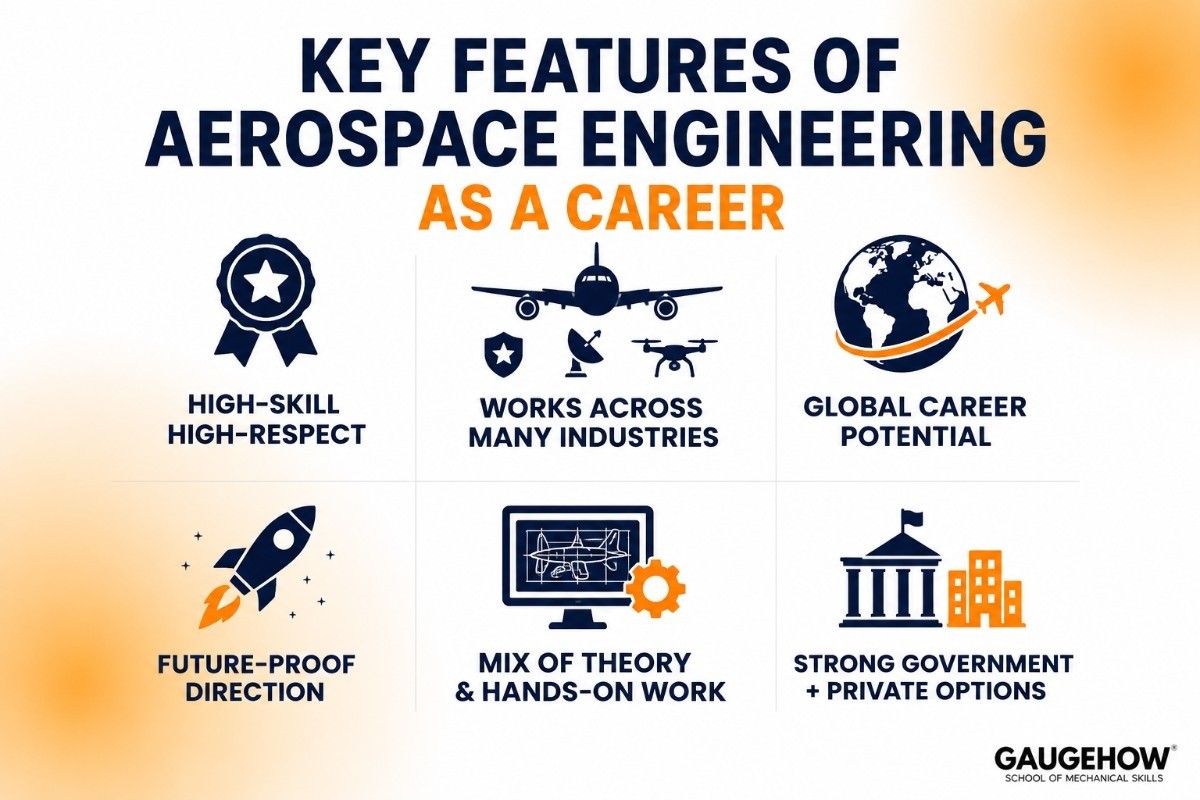
Before jumping into jobs and salaries, here are the standout features that make this field special:
High-skill, high-respect field — it is considered one of the tougher engineering branches, which means skilled engineers are valued and well paid.
Works across many industries — aviation, defence, space, drones, and even automobile and renewable energy sectors use aerospace skills.
Global career potential — the laws of physics are the same everywhere, so your skills can travel with you to other countries.
Future-proof direction — space missions, electric aircraft, and drone technology are all booming right now.
Mix of theory and hands-on work — you study design and also work on real prototypes, software, and testing.
Strong government + private options — you can aim for ISRO and DRDO, or private giants like Boeing, Airbus, and SpaceX.
In short, the scope of aerospace engineering is not just about planes it is a launchpad into many high-tech careers.
Scope of Aerospace Engineering After BTech
This is the question most students actually care about: what happens after my degree?
After a BTech in aerospace engineering, you have three main paths and you can mix them.
1. Get a job straight away. Common entry-level roles include:
Aerospace / Aircraft Design Engineer
Avionics Engineer
Propulsion Engineer
Aerodynamics Engineer
Maintenance / Systems Engineer
Quality and Testing Engineer
Entry-level salaries in India typically range from around ₹4–8 LPA, and they climb to ₹15 LPA and beyond as you gain experience and specialise. Niche skills like avionics and propulsion tend to pay more.
2. Study further (higher education). Many students do an MTech or MS to specialise and unlock better roles. Popular options:
MTech / MS in Aerospace, Propulsion, or Avionics
MS abroad (USA, Germany, the Netherlands, and more)
PhD for research and academic careers
Higher studies are especially useful if you want R&D roles at places like ISRO, DRDO, or top private labs.
3. Branch into related tech. Because aerospace builds a strong foundation in maths, coding, and problem-solving, graduates often move into nearby fields like data science, AI in aviation, drone technology, or CFD (computational fluid dynamics) work.
So the scope after BTech is flexible you are not locked into one path.
Scope of Aerospace Engineering Abroad
The scope of aerospace engineering abroad is genuinely strong, and this is one of the biggest attractions of the field.
Countries like the USA, Germany, the UK, Canada, France, and the UAE have large, mature aerospace industries. They hire skilled engineers from around the world, and salaries are often much higher than entry-level pay in India.
For example, in the United States, aerospace engineers earn a median salary of roughly $134,830 per year (2024 data), with experienced engineers earning even more. Global private companies like Boeing, Airbus, SpaceX, Lockheed Martin, GE Aerospace, and Honeywell all recruit talented engineers.
How students usually go abroad:
MS / Master's degree at a strong university (this is the most common route).
Research positions and PhD programs.
Work transfers through multinational companies that have offices in India and abroad.
One honest tip: many top international roles prefer or require a Master's degree, so if working abroad is your dream, planning for higher studies early is smart.
Can an Aerospace Engineer Work in ISRO/DRDO/NASA?
Short answer: yes for ISRO and DRDO, and partly for NASA. Let's clear up the confusion, because students ask this all the time.
ISRO (Indian Space Research Organisation). Absolutely yes. ISRO is one of the top space agencies in the world and a dream workplace for Indian aerospace engineers.
Recruitment usually happens through the ICRB / ISRO Centralised Recruitment Board exam, and roles cover satellites, propulsion, launch vehicles, and more. A strong academic record and relevant specialisation help a lot.
DRDO (Defence Research and Development Organisation). Yes again. DRDO works on missiles, UAVs (drones), fighter aircraft, and defence systems. Many aerospace engineers join through exams like GATE or the DRDO recruitment (RAC/CEPTAM) process. It is a great fit if defence technology excites you.
HAL (Hindustan Aeronautics Limited) is another major government recruiter worth knowing it builds and maintains aircraft for India.
NASA. Here is the honest part students often miss: NASA's civil-servant (direct employee) jobs generally require U.S. citizenship, so an Indian citizen usually cannot be hired as a regular NASA employee directly.
But there are still ways to be involved through universities and research labs, international collaborations, internships open to certain visa holders, or by becoming a U.S. citizen/permanent resident later. Many Indian-origin engineers and scientists do work at NASA after settling in the US.
So if your dream is space, ISRO is your most direct path in India, and NASA is reachable through a longer route abroad.
Future Scope of Aerospace Engineering in India 2026
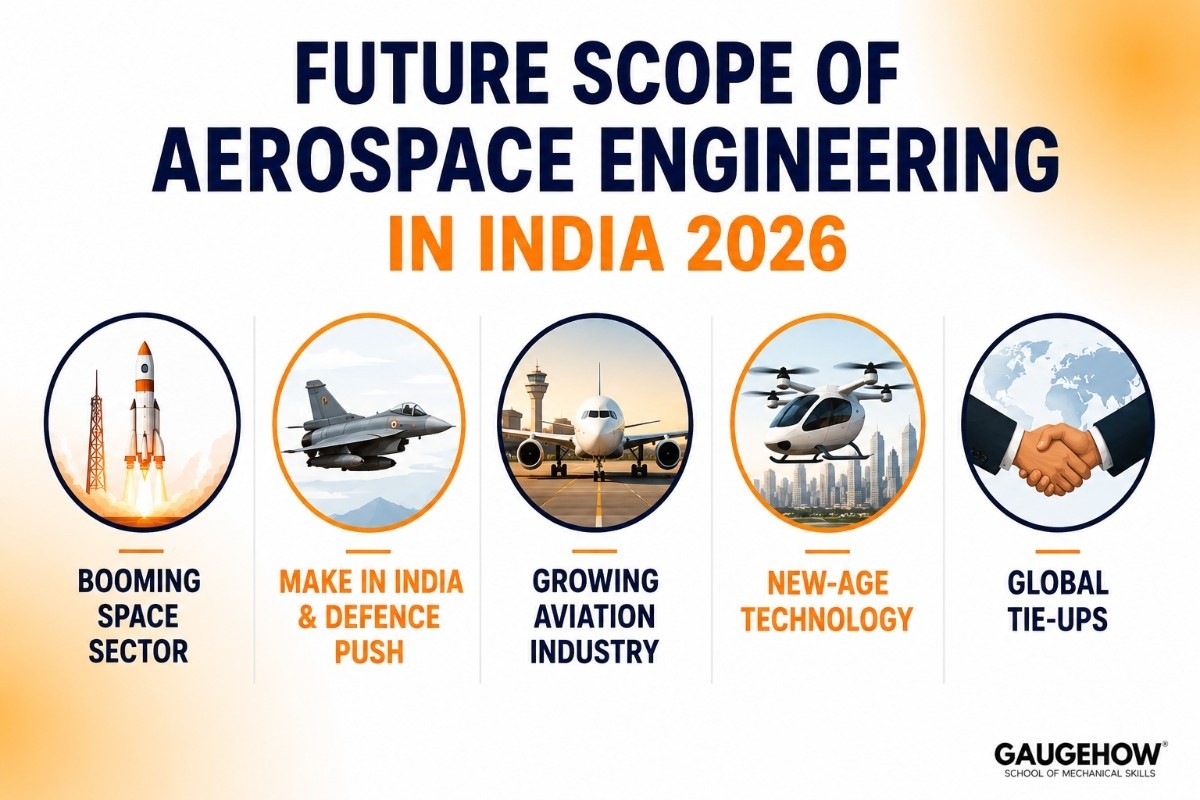
The future scope of aerospace engineering in India in 2026 looks bright, and it is easy to see why.
India is now one of the biggest players in global aviation and space. A few reasons the field is taking off:
Booming space sector. ISRO's missions (like Chandrayaan and Mangalyaan) plus a wave of private space startups mean more demand for engineers than ever.
"Make in India" and defence push. The government is investing heavily in building aircraft, drones, and defence systems within the country.
Growing aviation industry. More people are flying, more airports are being built, and airlines are buying more aircraft all of which need engineers.
New-age technology. Reusable rockets, electric and hybrid aircraft, drones, space tourism, and "flying taxi" (urban air mobility) projects are creating fresh job roles.
Global tie-ups. Companies like Boeing and Airbus are expanding their presence in India, opening doors for local talent.
Industry estimates suggest steady job growth in the sector over the coming years. In simple words: the demand for skilled aerospace engineers in India is expected to keep rising, making 2026 a good time to enter the field if you are willing to study seriously and build real skills.
FAQ: Scope of Aerospace Engineering
Q1. Is aerospace engineering a good career in 2026? Yes. With growth in space exploration, defence, aviation, and drones, the demand for skilled engineers is rising both in India and abroad.
Q2. Is aerospace engineering hard? It is one of the more challenging branches because it relies heavily on physics and maths. But if you enjoy those subjects and problem-solving, it is very doable and rewarding.
Q3. What is the salary after aerospace engineering in India? Freshers usually earn around ₹4–8 LPA. With experience, specialisation, or government roles (ISRO, DRDO), this can grow to ₹15 LPA and beyond.
Q4. Can I work abroad after aerospace engineering? Yes. The USA, Germany, UK, Canada, and others actively hire aerospace engineers. Doing a Master's abroad is the most common path.
Q5. Which is better aerospace or aeronautical engineering? Aerospace is broader (covers both aircraft and spacecraft), while aeronautical focuses mainly on aircraft within the atmosphere.
If you want to keep both air and space options open, aerospace gives wider scope.
Q6. What should I study in 12th to become an aerospace engineer? Take the Science stream with Physics, Chemistry, and Maths (PCM), then clear an engineering entrance exam like JEE Main for admission to a BTech program.
Conclusion
So, what is the final word on the scope of aerospace engineering? It is wide, exciting, and full of opportunity.
From building aircraft and rockets to working with ISRO, DRDO, or global giants abroad, the paths are many and the future, especially in India in 2026, looks promising.
Yes, the field is challenging. It needs strong basics, patience, and a genuine love for how things fly. But if that sounds like you, aerospace engineering can be one of the most rewarding careers out there.
Resources for Aerospace Engineering Students
Want to dig deeper? These are reliable places to learn more and stay updated:
ISRO official website — for space missions, careers, and recruitment news.
DRDO official website — for defence research roles and exam notifications.
U.S. Bureau of Labor Statistics (BLS) — for global salary and job-outlook data on aerospace engineers.
NASA website — for missions, internships, and learning material.
NPTEL / SWAYAM — free online courses from Indian institutes to build your basics.
College and university blogs (IITs, IIST, top private universities) for course details and admission guidance.
Mechanical Engineering Courses That Industry Actually Uses
Learn Tools of Design & CAD, Analysis & Simulation, Automation & Robotics, and Industry 4.0 used in modern factories.
Join 40+ Mech Courses like GD&T, Siemens NX, SolidWorks, CATIA V5, AutoCAD, ANSYS (FEA & Fluent), ABAQUS, Creo, Fusion 360, CNC Programming, Digital Twins, Python for Mechanical, and Industry 4.0.
Our Courses
Complete Course Library
Access to 40+ courses covering various fields like Design, Simulation, Quality, Manufacturing, Robotics, and more.