What Is Aerospace Engineering? Career, Scope, Salary & Future
Learn More in This Video
Subscribe to GaugeHow for More
What is aerospace engineering? Learn what it is, what engineers do, salary, and if it's hard a simple 2026 guide for students who love flight & space.
overview
Ever looked up at a plane or a rocket and wondered, who designs all this?
The answer is aerospace engineers. And if building flying machines sounds exciting, this field might be your calling.
Let's break it all down simply. What aerospace engineering is, what these engineers do, how much they earn, and whether it's the right path for you.
What Is Aerospace Engineering?
Aerospace engineering is the branch of engineering that deals with designing, building, testing, and maintaining anything that flies aircraft, spacecraft, satellites, and missiles.
In simple words: if it flies in the sky or travels through space, an aerospace engineer probably had a hand in making it.
The field splits into two main branches:
Aeronautical engineering — focuses on aircraft that fly within Earth's atmosphere (planes, helicopters, drones).
Astronautical engineering — focuses on spacecraft that go beyond the atmosphere (rockets, satellites, space probes).
Both share the same core science. They just point in different directions one to the skies, one to space.
Key Features of Aerospace Engineering
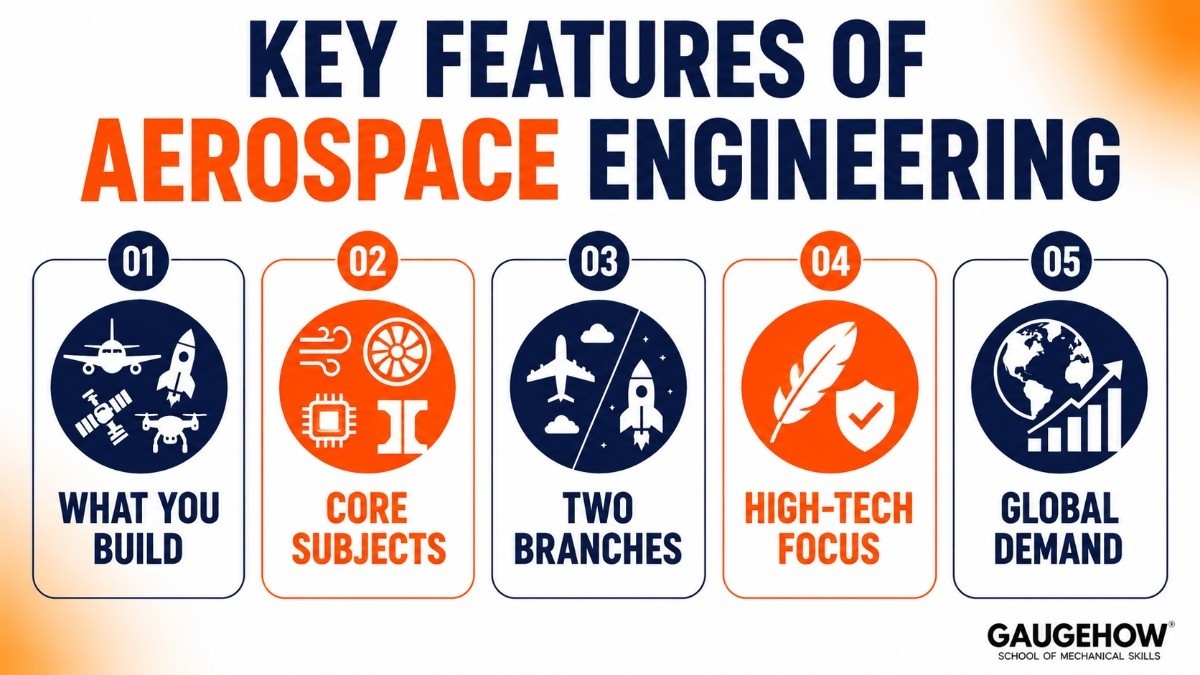
Here's what defines the field at a glance.
What you build — aircraft, rockets, satellites, drones, missiles.
Core subjects — aerodynamics, propulsion, avionics, structures, materials.
Two branches — aeronautical (air) and astronautical (space).
High-tech focus — strong, lightweight, super-efficient designs.
Global demand — one of the fastest-growing engineering sectors.
It's where physics, math, and imagination meet to defy gravity.
What Does an Aerospace Engineer Do?
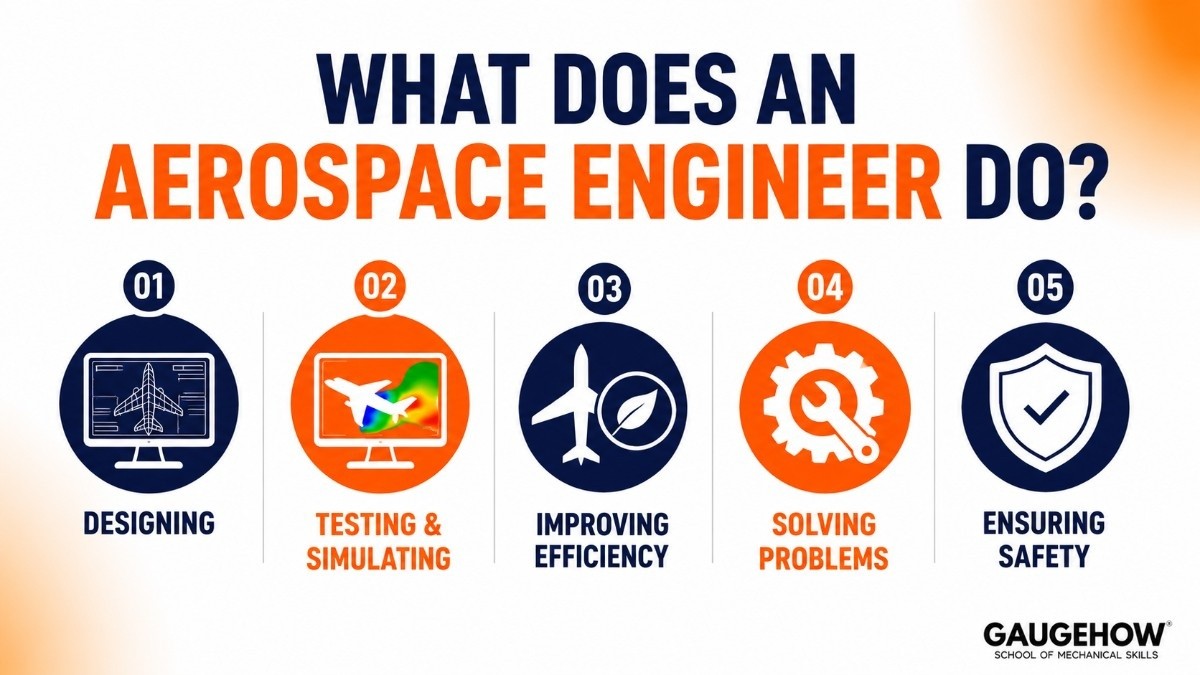
Good question and the answer is "a lot of cool things."
Aerospace engineers design, develop, test, and troubleshoot flight technologies. One might design a fighter jet's wing, while another fixes a satellite orbiting Earth.
Their typical tasks include:
Designing aircraft and spacecraft parts using CAD software
Running simulations and tests for safety and performance
Improving fuel efficiency and reducing weight
Solving problems with faulty parts or systems
Making sure everything meets strict safety standards
Most work in offices and labs, using computers and simulations. Some travel to test sites or manufacturing plants.
It's detail-heavy work because in aerospace, even a tiny error can be serious.
What Is Aerospace Engineering Salary?
Let's talk money. It's a fair thing to wonder about.
Experience | Average Salary (India) |
|---|---|
Freshers (0–2 yrs) | ₹4.5–7 LPA |
Mid-level (3–7 yrs) | ₹8–15 LPA |
Senior (8+ yrs) | ₹15–50+ LPA |
Figures are approximate for 2026 and vary by company, city, and skills.
The start is modest, but it grows fast with experience and specialization.
Want bigger numbers? Abroad, U.S. aerospace engineers earn an average of over $120,000 a year roughly ₹1 crore.
So the long-term earning potential is genuinely strong.
Is Aerospace Engineering Hard?
Honest answer: yes, it's challenging. But challenging in a good way.
It's consistently ranked among the toughest engineering majors. You'll dive deep into advanced math, physics, fluid dynamics, and propulsion.
Why so demanding? Because the stakes are high. A flawed design can put lives at risk, so precision matters at every step.
But here's the thing if you love physics and the idea of flight, it won't feel like a burden. It'll feel like a passion.
Hard? Yes. Worth it? For the right person, absolutely.
Aerospace vs Aeronautical Engineering
These two confuse almost every student. Let's clear it up fast.
Factor | Aerospace | Aeronautical |
|---|---|---|
Covers | Aircraft + spacecraft | Aircraft only |
Scope | Broader | More specialized |
Includes space? | Yes | No |
Best for | Space + flight lovers | Aircraft lovers |
Simple takeaway:
Aeronautical engineering is actually a part of aerospace engineering. Aerospace is the bigger umbrella it covers both planes and spacecraft.
Love rockets and satellites? Go aerospace. Only into aircraft? Aeronautical works too.
Pros & Cons of Aerospace Engineering
Every field has two sides. Here's the honest balance.
Pros
Exciting, future-focused work
Strong demand and salary growth
Prestige and global opportunities
Chance to work on space and defence missions
Skills that transfer to other industries
Cons
A tough, math-heavy curriculum
Niche field fewer jobs than mechanical
High competition for top roles
Modest starting salary
Defence jobs may need security clearances
If the pros excite you more than the cons worry you, you're on the right track.
Top Recruiters in Aerospace Engineering
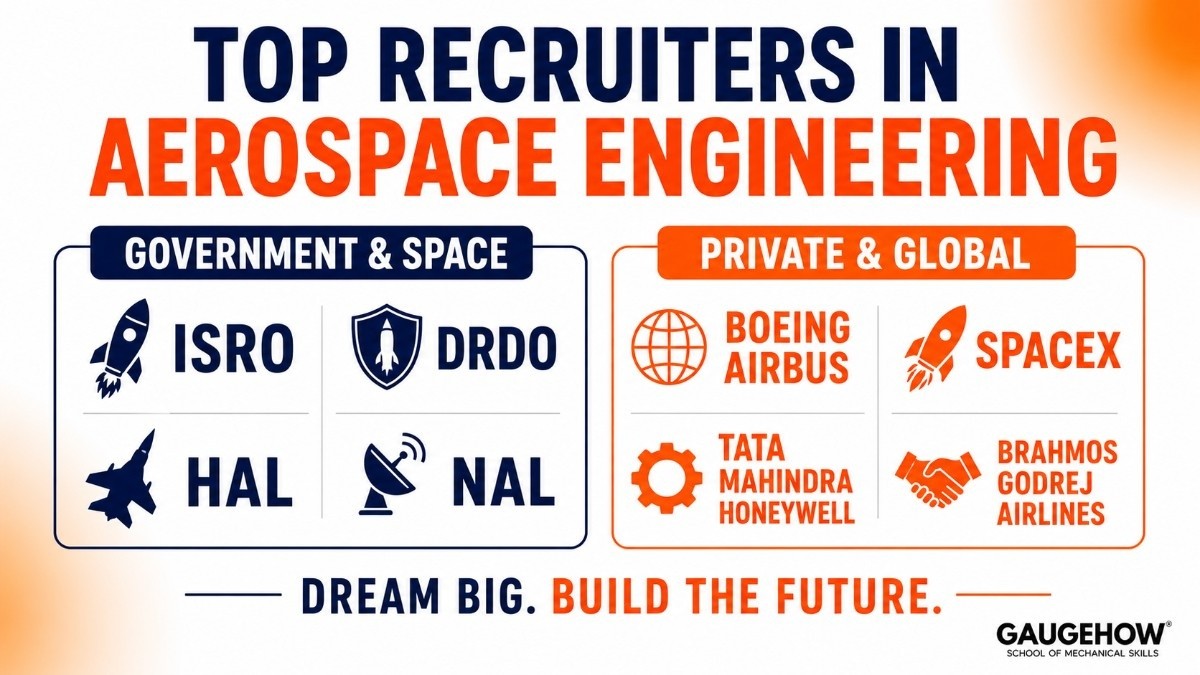
Wondering who'll hire you? Here are the big names to aim for.
Government & Space:
ISRO (satellites & space missions)
DRDO (defence & missiles)
HAL (military aircraft)
NAL (civil aviation research)
Private & Global:
Boeing, Airbus, Lockheed Martin, SpaceX
Tata Advanced Systems, Mahindra Aerospace
Honeywell, BrahMos, Godrej Aerospace
Airlines like IndiGo and Air India
From rockets to passenger jets, the doors are wide open in both government and private sectors.
FAQ
Q: What is aerospace engineering in simple words? It's the engineering field that designs and builds things that fly aircraft, spacecraft, satellites, and missiles.
Q: What does an aerospace engineer do? They design, test, and improve flight vehicles and their systems, from aircraft wings to satellites.
Q: What is the salary of an aerospace engineer? In India, freshers earn ₹4.5–7 LPA, rising to ₹15–50+ LPA with experience. Abroad, it's much higher.
Q: Is aerospace engineering hard? Yes, it's one of the tougher majors, with heavy math and physics. But it's very rewarding if you're passionate.
Q: What's the difference between aerospace and aeronautical engineering? Aerospace covers aircraft and spacecraft; aeronautical focuses only on aircraft within the atmosphere.
Q: Who hires aerospace engineers? ISRO, DRDO, HAL, Boeing, Airbus, Lockheed Martin, SpaceX, and Tata Advanced Systems, among others.
Conclusion
So, what is aerospace engineering? It's the thrilling science of building machines that fly from passenger jets to Mars-bound rockets.
It's challenging, yes. The math is hard and the competition is real. But the rewards exciting work, strong pay, and global impact make it worth it for the right student.
If you're fascinated by flight and space, and you don't mind hard work, this could be your perfect launchpad.
The first step is simple: keep learning, stay curious, and aim high.
Resources
For more information about aerospace engineering, salaries, and careers, explore these trusted sources:
NASA – Aircraft, spacecraft, and space exploration
ISRO – India's space missions and aerospace technology
U.S. Bureau of Labor Statistics (BLS) – Aerospace engineer salary and job outlook
American Institute of Aeronautics and Astronautics (AIAA) – Aerospace industry news and research
American Society of Mechanical Engineers (ASME) – Engineering standards and technical resources
Mechanical Engineering Courses That Industry Actually Uses
Learn Tools of Design & CAD, Analysis & Simulation, Automation & Robotics, and Industry 4.0 used in modern factories.
Join 40+ Mech Courses like GD&T, Siemens NX, SolidWorks, CATIA V5, AutoCAD, ANSYS (FEA & Fluent), ABAQUS, Creo, Fusion 360, CNC Programming, Digital Twins, Python for Mechanical, and Industry 4.0.
Our Courses
Complete Course Library
Access to 40+ courses covering various fields like Design, Simulation, Quality, Manufacturing, Robotics, and more.