What Does An Aerospace Engineer Do?
Learn More in This Video
Subscribe to GaugeHow for More
Ever wondered what an aerospace engineer does? Explore a day in the life, the skills you need, and where these engineers work from jets to rockets.
overview
You've watched a rocket pierce the sky or a jet thunder overhead and thought, someone designed that and I want to be that someone.
If that's you, you're standing at the start of one of the most exciting career paths in engineering. But before you commit, it's worth getting a clear, honest picture of the day-to-day reality.
So, what does an aerospace engineer do, beyond the obvious "build planes and rockets"?
This guide breaks it all down the actual tasks, the skills you'll need, where you'll work, and the two main branches of the field in plain language built for students figuring out their future.
What Does an Aerospace Engineer Do?
Let's start with the core answer. An aerospace engineer designs, develops, and tests aircraft, spacecraft, satellites, and missiles essentially everything that flies through the air or travels through space. It's a career that blends creativity with hard science, turning bold ideas into machines that actually leave the ground.
But the role is broader than just design. On any given project, an aerospace engineer might:
Design and develop aircraft, spacecraft, propulsion systems, and components
Run simulations and tests to see how a design performs under stress, heat, or extreme speed
Build and evaluate prototypes to make sure they work the way the math predicts
Analyze data from tests and real-world flights to refine and improve designs
Ensure safety and compliance with strict regulations (like FAA standards in the US)
Collaborate with multidisciplinary teams of engineers, scientists, and project managers
In short, aerospace engineers are involved at every stage from the first sketch on a whiteboard to the final test flight. Some focus narrowly on one system, like an aircraft's wings or control electronics, while others oversee an entire vehicle. It's precise, high-stakes work, because in aerospace a small error can have enormous consequences.
Aerospace Engineer Day in the Life
Job descriptions are useful, but what does the work actually feel like? Here's a realistic look at an aerospace engineer day in the life. No two days are identical, but a typical one often flows something like this:
Time of Day | What's Happening |
|---|---|
Morning | Catching up on industry news and project emails, reviewing design specs, and joining team stand-ups to align on the day's priorities |
Late morning | Brainstorming sessions — meeting colleagues to swap ideas and troubleshoot a problem that cropped up in testing |
Early afternoon | Heading into the lab to run CFD (computational fluid dynamics) simulations, crunch data, or test scale models |
Mid-afternoon | Field work — visiting a manufacturing site, overseeing a test rig, or inspecting a prototype in action |
Late afternoon | Documentation: writing up results, updating reports, and making data-driven design recommendations |
Notice the variety. You're not chained to a desk all day, but you're not always in a hangar either. Most aerospace engineers split their time between an office (often on a computer), a lab, and occasional field or test sites with some travel mixed in. Many work full-time, and crunch periods near deadlines or test launches can push past 40 hours.
The payoff? Surveys consistently show high job satisfaction in the field, with most engineers feeling their work genuinely matters.
What Skills Do Aerospace Engineers Need?
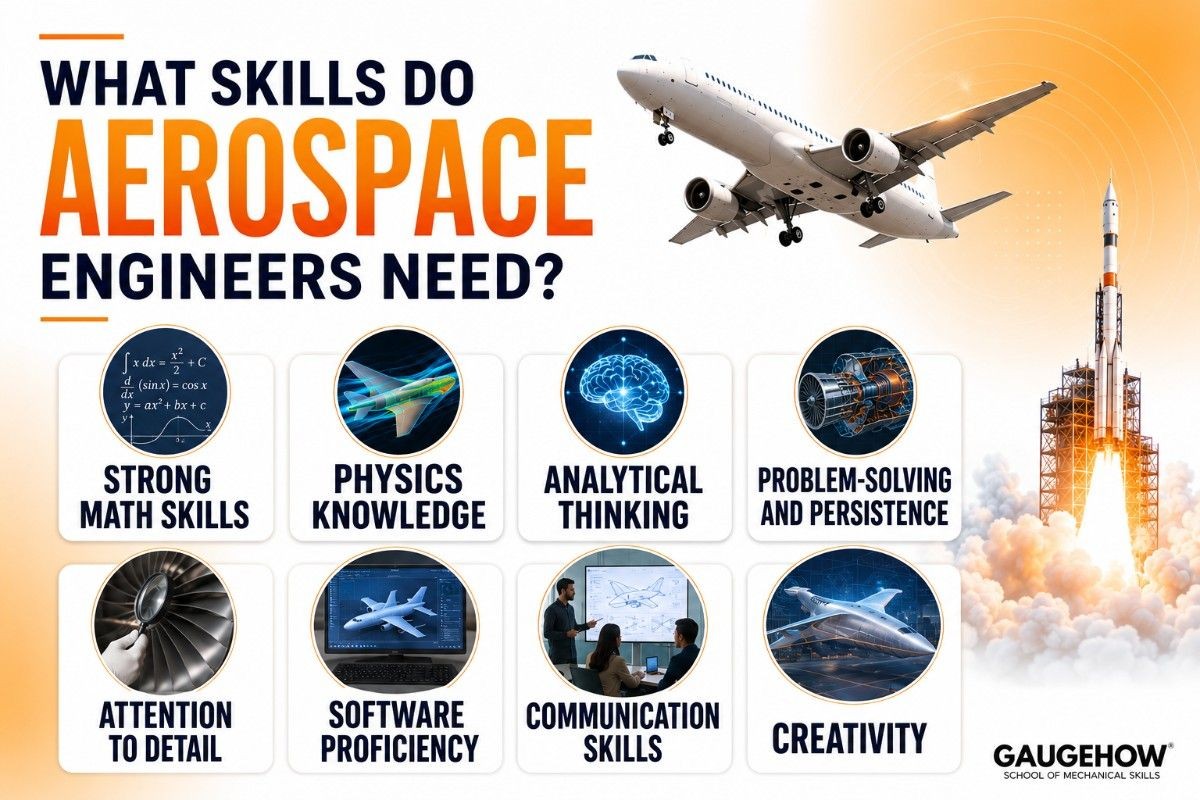
If you're wondering whether you've got what it takes, here's the honest list of what skills do aerospace engineers need to succeed. The encouraging part: most of these can be built, not just born with.
Strong math skills — calculus, trigonometry, and differential equations are everyday tools, not just exam topics.
Physics knowledge — especially aerodynamics, thermodynamics, and how materials behave under stress.
Analytical thinking — the ability to break a huge, messy problem into solvable pieces.
Problem-solving and persistence — designs fail, simulations break, and you debug your way forward.
Attention to detail — in a safety-critical field, precision isn't optional.
Software proficiency — CAD, CFD tools, MATLAB, and Python are part of the daily toolkit.
Communication skills — you'll write technical reports and explain complex ideas to teammates and clients.
Creativity — innovation is the heart of the job; the best engineers imagine what doesn't exist yet.
If that combination of logic and imagination excites you, you're already wired the right way for this field.
And if some of these feel weak right now, that's normal — they're exactly what your degree is designed to strengthen. (Curious how tough that degree is? That's a fair question worth exploring before you commit.)
Where Do Aerospace Engineers Work?
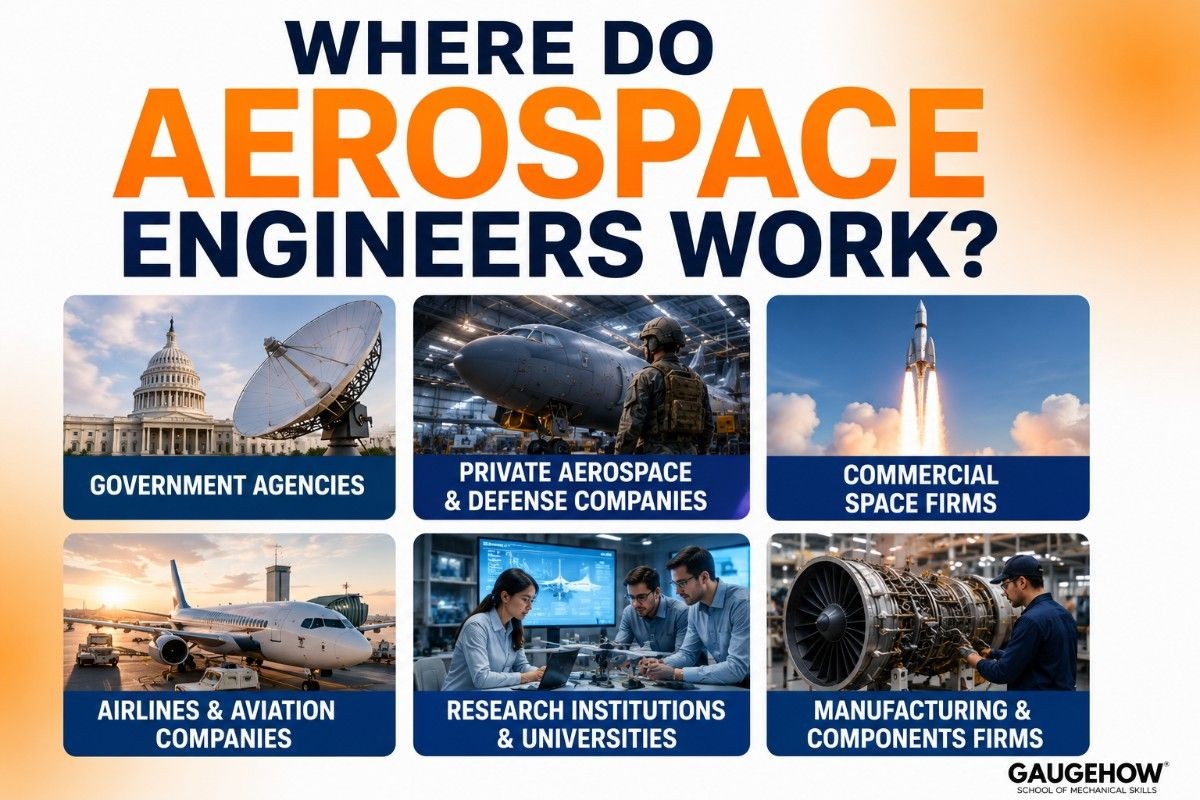
A common myth is that aerospace engineers all work at NASA. The reality is far more varied. So where do aerospace engineers work? Across a surprisingly wide range of industries and employers:
Government agencies — NASA, the Department of Defense, and national space organizations like ISRO (India) or ESA (Europe)
Private aerospace and defense companies — Boeing, Lockheed Martin, Airbus, Northrop Grumman
Commercial space firms — SpaceX, Blue Origin, and a growing wave of startups
Airlines and aviation companies — focused on aircraft performance, maintenance, and safety
Research institutions and universities — pushing the boundaries of new technology
Manufacturing and components firms — building the specialized parts that make flight possible
Most work happens in an office or lab setting, often on a computer, with travel to test sites and manufacturing facilities as needed. One thing worth knowing: because so much aerospace work touches national defense, many roles require a security clearance which, in countries like the US, usually means you'll need to be a citizen.
It's a field with strong, steady demand, so wherever you are, opportunities exist if you've got the skills.
Aeronautical vs Astronautical Engineer
Here's a distinction that trips up a lot of students. "Aerospace engineer" is actually an umbrella term covering two specializations: aeronautical and astronautical. Understanding the aeronautical vs astronautical engineer split helps you picture where you might fit.
Aspect | Aeronautical Engineer | Astronautical Engineer |
|---|---|---|
Focus | Aircraft within Earth's atmosphere | Spacecraft beyond Earth's atmosphere |
Works on | Airplanes, helicopters, drones, jets | Rockets, satellites, space probes, launch vehicles |
Key topics | Aerodynamics, propulsion, flight mechanics | Orbital mechanics, rocket propulsion, spacecraft design |
Typical employers | Airlines, defense aviation, aircraft makers | Space agencies, satellite firms, commercial space |
In simple terms: aeronautical engineers keep their work in the sky, while astronautical engineers send their work into space. The two share a big chunk of foundational knowledge the same maths and physics so you won't have to choose immediately.
Most degrees start broad and let you specialize later. If you're still weighing the bigger picture, it helps to understand how aerospace compares to related fields like aeronautical and mechanical engineering before you narrow down.
FAQ
What does an aerospace engineer do exactly? An aerospace engineer designs, develops, and tests aircraft, spacecraft, satellites, and missiles. Their work spans designing systems, running simulations, building prototypes, analyzing test data, and ensuring everything meets strict safety standards.
What does an aerospace engineer do on a daily basis? A typical day blends office work (reviewing designs, attending meetings), lab work (running simulations and tests), and sometimes field visits to manufacturing or test sites, plus writing up reports and recommendations.
What skills do aerospace engineers need? They need strong math and physics skills, analytical and problem-solving ability, attention to detail, proficiency with software like CAD and MATLAB, plus good communication and creativity.
Where do aerospace engineers work? They work at government agencies (like NASA), private aerospace and defense companies (Boeing, Lockheed Martin), commercial space firms (SpaceX), airlines, research institutions, and manufacturing companies.
What's the difference between an aeronautical and astronautical engineer? Aeronautical engineers focus on aircraft that fly within Earth's atmosphere, while astronautical engineers work on spacecraft designed to operate beyond it. Both fall under the broader aerospace engineering umbrella.
How much do aerospace engineers earn? In the US, aerospace engineers earn a median salary of around $134,830 per year (2024), one of the highest in engineering, with strong projected job growth of about 6% over the next decade.
Conclusion
So, what does an aerospace engineer do? They turn the dream of flight into reality designing, testing, and refining the aircraft and spacecraft that carry humanity higher and farther than ever before.
It's a career of variety: some days at a desk solving equations, others in a lab running simulations, and occasionally out in the field watching your work take shape.
If you're a student drawn to math, physics, and the thrill of building things that fly, aerospace engineering offers a path that's challenging, well-paid, and genuinely meaningful.
Whether your heart points toward aircraft soaring through the sky or rockets reaching for the stars, there's a place for you in this field. The only question left is which part of the sky or beyond you want to claim as your own.
Resources
To dig deeper before you decide, these are reliable places to explore:
U.S. Bureau of Labor Statistics (BLS) — official data on aerospace engineer duties, salary, and job outlook.
NASA Careers — real roles, internships, and insight into what space-agency engineers actually do.
AIAA (American Institute of Aeronautics and Astronautics) — student resources, scholarships, and industry news.
ABET — find accredited aerospace engineering degree programs.
University engineering department pages — for curriculum details and "day in the life" student stories.
Company career pages (Boeing, Lockheed Martin, SpaceX, ISRO) to see the kinds of roles and projects you could work on.
Mechanical Engineering Courses That Industry Actually Uses
Learn Tools of Design & CAD, Analysis & Simulation, Automation & Robotics, and Industry 4.0 used in modern factories.
Join 40+ Mech Courses like GD&T, Siemens NX, SolidWorks, CATIA V5, AutoCAD, ANSYS (FEA & Fluent), ABAQUS, Creo, Fusion 360, CNC Programming, Digital Twins, Python for Mechanical, and Industry 4.0.
Our Courses
Complete Course Library
Access to 40+ courses covering various fields like Design, Simulation, Quality, Manufacturing, Robotics, and more.