Is Aerospace Engineering Hard? What Every Student Should Know
Learn More in This Video
Subscribe to GaugeHow for More
Is aerospace engineering hard? Yes, but it's manageable. Discover why it's challenging, how it compares to other majors, and who thrives in it.
overview
Let's be real for a second. If you're reading this, you're probably a student staring at a course catalogue, heart set on rockets or aircraft, but with a nagging worry in the back of your mind: can I actually handle this?
It's a fair question, and you deserve a straight answer instead of empty cheerleading.
So here's the honest take on whether aerospace engineering is hard what makes it tough, how it stacks up against other majors, whether an average student can survive it, and what it takes to thrive. No sugar-coating, but no scare tactics either.
How Hard Is Aerospace Engineering?
Let's not dance around it: yes, aerospace engineering is hard. It's consistently ranked among the top three most challenging college majors, sitting right alongside chemical and electrical engineering.
But "hard" doesn't mean "impossible" it means demanding, and there's a real difference.
So how hard is aerospace engineering in practical terms? A few things make it intense:
It's deeply math and physics heavy. You'll live in calculus, differential equations, fluid dynamics, thermodynamics, and orbital mechanics. The maths isn't decorative it's the actual language of the field.
The workload is no joke. Aerospace programs often require around 127 credit hours, more than many majors, and the average student takes closer to 4.8 years to graduate rather than the usual four.
Precision matters enormously. When a tiny error can mean a failed launch or an unsafe aircraft, the standards are unforgiving. That pressure is part of the difficulty.
Here's a quick breakdown of where the challenge actually comes from:
Challenge Area | Why It's Demanding |
|---|---|
Mathematics | Advanced calculus, linear algebra, differential equations used constantly |
Physics | Fluid dynamics, thermodynamics, celestial mechanics — abstract and rigorous |
Workload | Heavy credit load, labs, projects, and long study hours |
Precision & safety | Zero tolerance for error in high-stakes designs |
Breadth | Combines mechanical, electrical, and software knowledge in one degree |
If that list looks intimidating, take a breath. Plenty of "ordinary" students get through all of it every single year. The difficulty is real, but it's also predictable and predictable challenges can be prepared for.
Is Aerospace Engineering Harder Than Mechanical?
This is the comparison students ask most, so let's tackle it head-on. Is aerospace engineering harder than mechanical engineering? The honest answer: they're very close, with aerospace edging slightly ahead in specialization.
Both majors share a huge chunk of early coursework the same maths, physics, and mechanics. Where aerospace pulls ahead in difficulty is the specialized layer: flight dynamics, propulsion, aerodynamics, and orbital mechanics add an extra level of abstraction that mechanical engineering doesn't always reach.
That said, mechanical has its own brutal moments, especially in thermodynamics and materials science.
Here's how aerospace generally compares across the engineering landscape:
Engineering Major | Relative Difficulty | What Makes It Tough |
|---|---|---|
Chemical | Very High | Integrates multiple sciences (chem, physics, biology) |
Aerospace | Very High | Heavy physics + flight dynamics + precision |
Electrical | High | Abstract concepts, signal theory, heavy math |
Mechanical | High | Broad, rigorous, thermodynamics-heavy |
Civil | Moderate–High | Practical focus, less advanced theory |
The takeaway? Aerospace is among the hardest, but it's in the same tier as mechanical and electrical, not in a league of its own.
In fact, because the early years overlap so much, many students start in mechanical and switch into aerospace (or vice versa) without losing much time a smart hedge if you're undecided.
Can an Average Student Do Aerospace Engineering?
Here's the question that probably matters most to you, and the answer is genuinely encouraging: yes, an average student absolutely can do aerospace engineering.
You don't need to be a genius or a math prodigy. What you need is consistency, curiosity, and a willingness to put in the work.
Some of the most successful aerospace students weren't the top of their high school class they were the ones who stayed persistent, asked questions, and didn't give up when a concept didn't click on the first try.
What matters far more than raw talent is genuine interest. If you're fascinated by how things fly, you'll find the motivation to push through the hard semesters.
The students who struggle most aren't usually the "average" ones they're the ones who chose the major for the prestige or the salary without actually caring about the subject.
A reassuring reality: even people without an aerospace degree (mechanical, electrical, or computer engineers) regularly build successful careers in the aerospace industry.
The field rewards skill and effort, not a perfect academic pedigree. So if you're an average student with above-average determination, you're in a stronger position than you might think.
Skills to Succeed in Aerospace Engineering
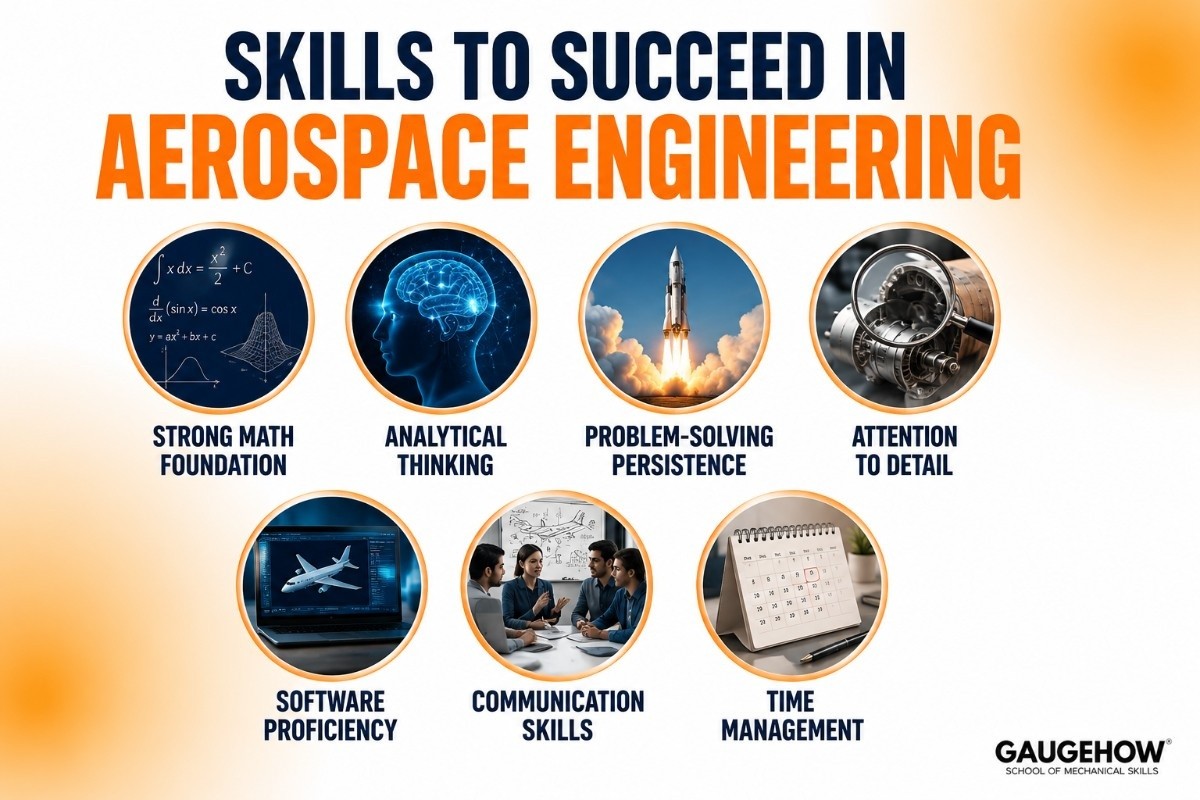
If you want to make the journey smoother, focus on building the right skills early.
The good news is most of these can be developed they're not fixed traits you're born with. Here are the skills to succeed in aerospace engineering that genuinely move the needle:
Strong math foundation — get comfortable with calculus and physics before and during the degree. This single thing makes everything else easier.
Analytical thinking — the ability to break a big, messy problem into smaller solvable parts.
Problem-solving persistence — projects fail, simulations break, and you debug your way forward. Resilience is a real skill here.
Attention to detail — in a field where small errors have big consequences, precision is non-negotiable.
Software proficiency — tools like MATLAB, Python, and CAD/simulation software are everyday companions.
Communication skills — you'll write reports and explain complex ideas to teammates. Engineering isn't a solo sport.
Time management — with a heavy workload, the students who plan their weeks survive; the ones who cram crumble.
Notice that only a couple of these are purely technical. The rest persistence, organization, communication are habits anyone can build. That's the quiet secret of aerospace engineering: discipline often beats raw brilliance.
Is Aerospace Engineering Worth It?
After all that talk of difficulty, the natural question is: is aerospace engineering worth it? For the right person, the answer is a resounding yes.
Start with the practical rewards. Aerospace engineers earn a median salary of around $134,830 in the US one of the highest across all engineering disciplines with top earners in defense and space crossing $160,000.
The field is growing steadily, with strong demand fueled by commercial space ventures, drones, defense, and green aviation. In short, the career prospects are excellent.
But the deeper payoff is the work itself. Few fields let you contribute to something as awe-inspiring as a spacecraft bound for another planet or an aircraft that moves thousands of people safely across the world. If that kind of impact lights you up, the difficulty stops feeling like a burden and starts feeling like a worthy challenge.
Is it worth it for everyone? No. If you don't enjoy maths, physics, or problem-solving, the grind will outweigh the reward.
But if you're genuinely passionate about flight and space, aerospace engineering offers a rare combination of intellectual challenge, strong pay, and meaningful work. That's a deal worth taking.
FAQ
Is aerospace engineering hard? Yes, it's one of the most challenging engineering majors due to its heavy math, physics, and precision requirements. However, it's very manageable for students with genuine interest, consistent effort, and good time management.
How hard is aerospace engineering compared to other majors? It ranks among the top three hardest majors, similar to chemical and electrical engineering, and slightly above mechanical and civil. The difficulty comes from advanced physics, flight dynamics, and demanding workloads.
Is aerospace engineering harder than mechanical engineering? They're closely matched. Aerospace is slightly harder because of specialized topics like aerodynamics and orbital mechanics, but the early coursework overlaps heavily, so the gap is smaller than people assume.
Can an average student do aerospace engineering? Absolutely. You don't need to be a genius — consistency, curiosity, and persistence matter far more than raw talent. Genuine interest in flight and space is the biggest predictor of success.
Do you need to be good at math for aerospace engineering? Yes, strong math skills help a lot, since calculus and physics are central. But math is a skill you can build with practice, not a fixed talent you either have or don't.
Is aerospace engineering worth it? For passionate students, yes. It offers a high median salary (~$134,830 in the US), strong job growth, and the chance to work on genuinely exciting aircraft and spacecraft projects.
Conclusion
So, is aerospace engineering hard? Yes but now you know it's a manageable kind of hard. It demands strong maths, real persistence, and a genuine love of the subject, but it doesn't demand genius. It rewards the curious, the consistent, and the determined far more than it rewards the naturally gifted.
If your heart races at the thought of designing something that flies, don't let the difficulty scare you off. Build your math foundation, develop the right habits, lean into your passion, and you'll find the challenge becomes part of the fun.
The students who thrive in aerospace aren't the ones who found it easy they're the ones who decided it was worth the effort. The only real question left is: are you one of them?
Resources
For more research before you commit, these are reliable places to dig deeper:
U.S. Bureau of Labor Statistics (BLS) — official salary, job outlook, and skills data for aerospace engineers.
ABET (Accreditation Board for Engineering and Technology) — find accredited aerospace engineering programs.
AIAA (American Institute of Aeronautics and Astronautics) — student resources, scholarships, and industry insight.
U.S. News Best Engineering Schools — rankings and program comparisons to help you choose a university.
University department pages — real curriculum, credit loads, and eligibility details so you know exactly what to expect.
Engineering student communities — forums and Q&A sites where current students share honest experiences about the workload.
Mechanical Engineering Courses That Industry Actually Uses
Learn Tools of Design & CAD, Analysis & Simulation, Automation & Robotics, and Industry 4.0 used in modern factories.
Join 40+ Mech Courses like GD&T, Siemens NX, SolidWorks, CATIA V5, AutoCAD, ANSYS (FEA & Fluent), ABAQUS, Creo, Fusion 360, CNC Programming, Digital Twins, Python for Mechanical, and Industry 4.0.
Our Courses
Complete Course Library
Access to 40+ courses covering various fields like Design, Simulation, Quality, Manufacturing, Robotics, and more.