aerospace-vs-mechanical-engineering
Learn More in This Video
Subscribe to GaugeHow for More
Aerospace vs mechanical engineering which pays more, which is harder, and which suits you? Compare salaries, scope, and careers to
Overview
At the simplest level, mechanical engineering is the broad parent and aerospace engineering is the specialized child.
Mechanical engineering deals with pretty much anything that moves, generates power, or involves mechanical systems engines, robots, HVAC, manufacturing lines, automotive, energy plants, you name it.
Aerospace engineering takes those same core principles and points them at the sky: aircraft, spacecraft, satellites, missiles, and propulsion systems.
In fact, a lot of universities consider aerospace a sub-field of mechanical engineering, and the two departments are sometimes housed together.
Both rely on the same foundation physics, advanced math, thermodynamics, fluid mechanics, and materials science. Where they split is in focus and application. Mechanical keeps its options wide open across industries. Aerospace goes deep on flight, aerodynamics, and the extreme conditions of air and space.
If you remember nothing else from this guide, remember this: mechanical engineering trades depth for breadth, and aerospace trades breadth for depth.
A comparison table will make this section much easier to scan and improve readability for SEO.
Difference Between Aerospace and Mechanical Engineering
At first glance, aerospace and mechanical engineering seem very similar because they share many core engineering principles. However, the biggest difference lies in their scope.
Mechanical engineering is a broad engineering discipline that focuses on designing, manufacturing, and improving machines, products, and mechanical systems across many industries.
Aerospace engineering is a specialized branch that applies these same principles to aircraft, spacecraft, satellites, missiles, and other flight systems.
Aerospace vs Mechanical Engineering: Key Differences
Feature | Mechanical Engineering | Aerospace Engineering |
|---|---|---|
Scope | Broad and versatile engineering discipline | Specialized branch focused on aircraft and spacecraft |
Primary Focus | Machines, manufacturing, energy, robotics, automotive, industrial systems | Aircraft, spacecraft, satellites, missiles, and defense systems |
Core Subjects | Mechanics, thermodynamics, manufacturing, materials, machine design | Aerodynamics, propulsion, flight mechanics, aerospace structures |
Industries | Automotive, manufacturing, healthcare, energy, robotics, HVAC, consumer products | Aviation, defense, space exploration, satellite technology |
Career Flexibility | High engineers can switch between many industries | Moderate careers are mostly within aerospace and defense sectors |
Work Environment | Design offices, factories, R&D labs, production facilities | Research labs, aerospace companies, testing facilities, simulation centers |
Typical Projects | Engines, robots, industrial machines, medical devices, manufacturing equipment | Aircraft, rockets, drones, satellites, propulsion systems |
Demand | High demand across multiple industries | Strong demand but limited to specialized sectors |
Bottom Line: Which One Should You Choose?
Choose Mechanical Engineering if you want more career flexibility, broader job opportunities, and the ability to work in industries like automotive, manufacturing, robotics, energy, and healthcare.
Choose Aerospace Engineering if you're passionate about aircraft, rockets, satellites, and space technology and want to build a career in aviation, defense, or space exploration.
In short: Mechanical engineering offers more versatility, while aerospace engineering offers greater specialization. The best choice depends on whether you prefer a broad career path or a focused career in the aerospace industry.
Aerospace vs Mechanical Engineering Salary
When choosing between aerospace and mechanical engineering, salary is often a deciding factor. The good news? Both careers offer strong earning potential.
Aerospace engineers earn a median annual salary of around $134,830, according to U.S. Bureau of Labor Statistics data. The top 10% make over $205,850. These higher salaries are largely driven by jobs in the aerospace, defense, and space industries, where projects are highly specialized and well-funded.
Mechanical engineers earn a median salary of about $99,500 per year. While the average is lower than aerospace, mechanical engineers have one major advantage they can work across a wide range of industries, including automotive, manufacturing, energy, robotics, healthcare, and consumer products. This creates more job opportunities in more locations.
What About Fresh Graduates?
The median salaries above reflect experienced professionals not new graduates.
Most entry-level engineers in both fields typically start between $65,000 and $80,000 per year. As you gain experience, develop specialized skills, earn certifications, or pursue a master's degree, your salary can grow significantly.
Which Engineering Field Pays More?
On average, aerospace engineering offers higher salaries because it is a specialized field with fewer, high-value roles. However, mechanical engineering provides greater job availability and steady earning potential across many industries.
In the long run, your salary depends less on your degree title and more on your experience, specialization, industry, and location.
Aerospace Engineering vs Mechanical Engineering: Which Is Better?
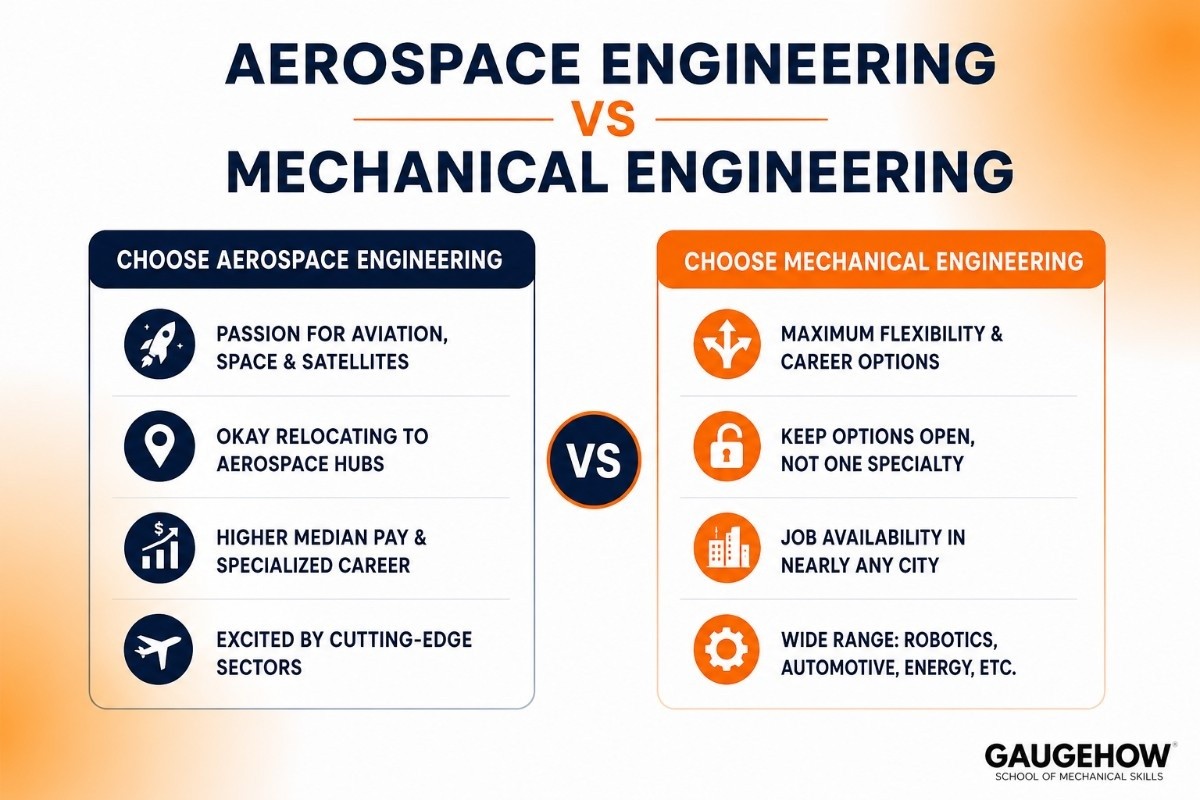
Now for the question everyone really wants answered aerospace engineering vs mechanical engineering, which is better? The honest answer is the one nobody likes to hear: it depends on you. There's no objectively superior choice, only the choice that fits your goals.
That said, here's a framework to actually make the decision instead of going in circles.
Choose aerospace engineering if:
You're genuinely passionate about aviation, rockets, satellites, or space exploration
You're okay relocating to aerospace hubs for the best opportunities
You want higher median pay and don't mind a more specialized career path
You're excited by cutting-edge sectors like reusable rockets and electric aircraft
Choose mechanical engineering if:
You want maximum flexibility and the freedom to switch industries later
You'd rather keep your options open than commit to one specialty at 18
You value job availability in nearly any city
You're drawn to a wide range of work robotics, automotive, energy, manufacturing
One more thing worth saying plainly: if you're undecided, mechanical engineering is the lower-risk pick. It keeps more doors open, and as we're about to see it doesn't actually close the aerospace door at all. Aerospace is the bolder, more focused bet that pays off beautifully if you're sure flight is your thing.
Can a Mechanical Engineer Work in Aerospace?
Short answer: absolutely yes. This is one of the most reassuring facts for anyone leaning mechanical but still daydreaming about airplanes.
Because the two fields share so much foundational coursework, mechanical engineers regularly land roles in the aerospace industry particularly in areas like structures, thermal systems, materials, and systems integration.
Major aerospace employers like Boeing, Airbus, and ISRO hire mechanical engineers all the time. So can a mechanical engineer work in aerospace? Not only can they, but plenty of aerospace teams are full of them.
There are limits worth being honest about. Highly specialized roles think aerodynamicists or propulsion specialists working on hypersonic flow typically favor candidates with dedicated aerospace training. A mechanical engineer can absolutely get there, but it may take extra effort to build that niche expertise.
If you want to set yourself up for an aerospace career from a mechanical degree, a few things help: take aerodynamics and propulsion electives if your program offers them, get comfortable with industry software like MATLAB, ANSYS, and CATIA, and chase internships at aerospace companies. Do that, and the transition becomes pretty smooth.
Can Mechanical Engineers Become Aerospace Engineers?
This is the natural follow-up can mechanical engineers become aerospace engineers in the full sense, not just work alongside them? Again, yes, and it's a well-trodden path.
The most common route is a master's degree in aerospace engineering after a mechanical bachelor's. That graduate specialization fills in the focused knowledge orbital mechanics, advanced aerodynamics, flight systems and signals to employers that you're serious about the field.
Many engineers do exactly this, using mechanical as a broad launchpad and then narrowing into aerospace when they're sure that's where they want to be.
You don't always need a second degree, though. Some mechanical engineers transition purely through work experience starting in an aerospace-adjacent mechanical role and gradually moving deeper into aerospace-specific projects.
Picking up the right tools and certifications along the way (and building a portfolio of relevant projects) goes a long way.
So if you're worried that choosing mechanical now locks you out of aerospace forever, let that worry go.
It genuinely doesn't. The reverse, interestingly, is a little harder a pure aerospace graduate can find it tougher to pivot into general mechanical roles without extra experience, simply because the degree is more specialized.
That asymmetry is one more quiet point in mechanical engineering's favor if you value keeping your options open.
FAQ
Is aerospace engineering harder than mechanical engineering? Neither is objectively "harder" both are demanding. Aerospace tends to go deeper into specialized, math-heavy topics like aerodynamics and orbital mechanics, while mechanical covers a broader range of subjects. Difficulty comes down to which type of challenge suits your brain better.
Is aerospace engineering a branch of mechanical engineering? Essentially, yes. Aerospace evolved from mechanical engineering applied to flight, and many universities treat it as a specialized sub-field. They share the same core principles but diverge in their final years of study.
Do aerospace engineers make more than mechanical engineers? On median, yes aerospace engineers earn roughly $134,830 versus around $99,500 for mechanical engineers in the US. But mechanical offers steadier earning potential across more industries and locations.
Which has more job opportunities, aerospace or mechanical engineering? Mechanical engineering, by a wide margin. Its jobs exist in nearly every city and sector, while aerospace roles concentrate around specific hubs tied to aviation, defense, and space.
Should I do mechanical or aerospace engineering if I'm undecided? If you're genuinely unsure, mechanical engineering is the safer bet it keeps more doors open and still lets you move into aerospace later through electives, internships, or a master's degree.
Can I do aerospace engineering with a mechanical engineering degree? Yes. Many engineers enter aerospace with a mechanical background, especially in structures, thermal, and systems roles. A master's in aerospace or targeted experience makes the transition even smoother.
Conclusion
When it comes to aerospace vs mechanical engineering, there's no wrong answer just the right answer for your goals.
Mechanical engineering hands you breadth, flexibility, and job security across countless industries. Aerospace engineering offers depth, higher median pay, and the thrill of building machines that fly and explore space.
If your heart is set on aviation and space and you're ready to specialize, aerospace is a fantastic, future-facing choice. If you'd rather keep your options wide open or you're simply not sure yet mechanical engineering gives you a versatile foundation that can still carry you into aerospace down the road.
Whichever path you choose, you're stepping into a field that designs the machines moving our world forward. Take an honest look at what excites you, weigh the salary and lifestyle trade-offs, talk to people working in both fields, and trust that decision. The sky quite literally isn't the limit.
Resources
For additional information and official data, visit these trusted sources:
U.S. Bureau of Labor Statistics (BLS) — Engineering salaries and job outlook
NASA — Aerospace engineering and space technology
ASME — Mechanical engineering resources and standards
AIAA — Aerospace engineering publications and careers
ISRO — India's space missions and aerospace developments
Mechanical Engineering Courses That Industry Actually Uses
Learn Tools of Design & CAD, Analysis & Simulation, Automation & Robotics, and Industry 4.0 used in modern factories.
Join 40+ Mech Courses like GD&T, Siemens NX, SolidWorks, CATIA V5, AutoCAD, ANSYS (FEA & Fluent), ABAQUS, Creo, Fusion 360, CNC Programming, Digital Twins, Python for Mechanical, and Industry 4.0.
Our Courses
Complete Course Library
Access to 40+ courses covering various fields like Design, Simulation, Quality, Manufacturing, Robotics, and more.