
How to Become an Industry 4.0 Engineer: A Step-by-Step Roadmap
Learn More in This Video
Subscribe to GaugeHow for More
Want to move into Industry 4.0 but not sure whether to start with IIoT, digital twins, or automation? You are not alone. Most engineers hear the term thrown around constantly but never get a clear order to learn the actual pieces in, so they end up with scattered knowledge instead of a job-ready skill set.
This roadmap breaks the field down into clear, ordered stages. No vague advice like "learn Industry 4.0." Just the tools, systems, and skills that actually show up in real job postings, in the order you should learn them.
What Does an Industry 4.0 Engineer Actually Do?
An Industry 4.0 engineer connects shop floor equipment, data, and decision-making into one smart, responsive manufacturing system. In practice, this means:
Connecting machines and sensors so production data flows into a central system
Building or interpreting dashboards that track equipment health and output in real time
Creating or using digital twins to simulate a process before it runs on the physical line
Working with automation and controls teams to close the gap between data and action
Identifying where predictive maintenance can reduce unplanned downtime
Coordinating across IT, operations, and engineering teams on connected systems
It's a role that sits between traditional manufacturing engineering and data-driven decision making. You do not need to be a software developer, but you need to be comfortable enough with data and connected systems to work alongside the people who are.
How to Become an Industry 4.0 Engineer: Step by Step
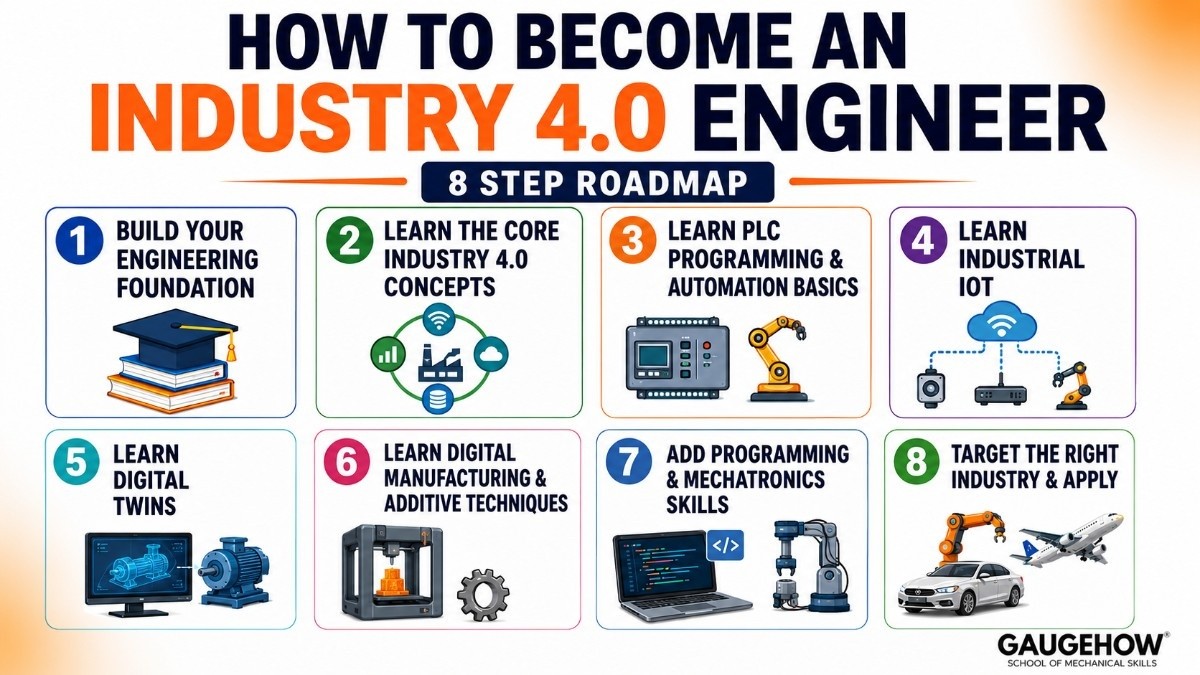
Step 1: Build Your Engineering Foundation
Most Industry 4.0 roles ask for a bachelor's degree in mechanical, industrial, electrical, or manufacturing engineering. If you are still studying, prioritize electives in manufacturing processes, control systems, and data fundamentals. If you already have the degree, this step is done. Move on.
Step 2: Learn the Core Industry 4.0 Concepts
Before diving into specific technologies, you need a clear picture of the overall framework: how smart sensors, connected systems, and data analytics come together to make manufacturing more responsive and efficient.
The Introduction to Industry 4.0 course covers this foundational picture, which every later step in this roadmap builds on.
Step 3: Learn PLC Programming and Automation Basics
Industry 4.0 does not replace traditional automation, it builds on top of it. Most connected systems still rely on PLCs controlling the physical equipment underneath the data layer, so understanding ladder logic and basic control systems is essential groundwork. The PLC Programming and Automation course covers this exact foundation.
Step 4: Learn Industrial IoT
This is where the connected part of Industry 4.0 actually happens. You need to understand how sensors and equipment feed data into a central system, what that data looks like, and how it gets used for monitoring and decision-making.
The Industrial Internet of Things (IIoT) course covers exactly this layer, building directly on your automation foundation.
Step 5: Learn Digital Twins
Digital twins let you simulate and validate a process or piece of equipment virtually before committing physical resources to it, which is becoming a core Industry 4.0 skill rather than a niche one.
Understanding how a digital twin mirrors real equipment behavior, and where it adds the most value, sets you apart from engineers who only understand the concept in theory. The Digital Twins course covers this exact skill set.
Step 6: Learn Digital Manufacturing and Additive Techniques
Industry 4.0 also changes how physical parts get made, not just how data flows. Understanding digital manufacturing workflows, along with where additive manufacturing fits into rapid prototyping and low-volume production, rounds out your picture of the modern smart factory.
The Digital Manufacturing course and 3D Printing / Additive Manufacturing course both build this piece of the roadmap.
Step 7: Add Programming and Mechatronics Skills
Connected systems generate data, and being able to script your own analysis or automation on top of that data is a real differentiator.
Python is the fastest entry point for most engineers, while understanding mechatronics helps you see how the physical sensors and actuators behind the data actually work. The Python for Mechanical Engineers & Robotics course and Mechatronics for Beginners course both build this combined skill set.
Step 8: Target the Right Industry and Apply
Industry 4.0 hiring looks different by sector. Automotive plants want connected robotics and predictive maintenance skills. Aerospace wants traceability and documentation discipline layered on top of connected systems.
If robotics-heavy environments interest you most, the Robotics industry page is worth checking, and the Automotive industry page is useful for high-volume connected production work.
Before interviews, review common technical questions so a connected systems or digital twin scenario does not catch you off guard. The Interview Q&A Hub has role-specific practice questions, and the Practice / MCQ Tests section is useful for a quick knowledge check before a technical round.
Industry 4.0 Engineer Skills Checklist
Skill Area | Beginner | Job Ready |
|---|---|---|
Industry 4.0 fundamentals | Knows the buzzwords | Can explain how data flows from machine to plant-wide decisions |
PLC and automation basics | Can read basic ladder logic | Can connect a PLC-controlled process into a data system |
IIoT | Aware connected sensors exist | Can interpret sensor data to catch a developing fault |
Digital twins | Knows what a digital twin is | Can build or use a digital twin to validate a process change |
Digital manufacturing and additive | Aware these technologies exist | Can decide when a part should be printed versus machined |
Programming and data handling | Knows basic Python syntax | Can build a script that processes real machine data |
Industry 4.0 Engineer vs Automation Engineer vs Digital Manufacturing Engineer
These three titles overlap constantly, and many job postings blend all three into one role.
Role | Main Focus | Typical Tools |
|---|---|---|
Industry 4.0 Engineer | Connecting shop floor data to plant-wide decisions | IIoT platforms, digital twins, dashboards |
Automation Engineer | Running a full process with minimal manual input | PLCs, SCADA, HMI, scripting |
Digital Manufacturing Engineer | Modernizing how physical parts get designed and produced | CAD, additive manufacturing, digital workflows |
A strong Industry 4.0 engineer usually understands enough automation and digital manufacturing to work across all three without needing a specialist for every small integration task.
For a course sequence built around this exact overlap, the Digital / Industry 4.0 Engineer career track is worth reviewing before you specialize further.
Frequently Asked Questions
Q: Do I need a specific degree to become an Industry 4.0 engineer?
A: Most employers prefer a bachelor's degree in mechanical, industrial, electrical, or manufacturing engineering, though candidates from automation or controls backgrounds are also hired regularly with the right hands-on experience.
Q: Is coding necessary for an Industry 4.0 engineer?
A: Yes, to a meaningful degree. PLC programming is a form of coding on its own, and most modern roles also expect basic scripting in Python for data handling and analysis beyond what off-the-shelf dashboards provide.
Q: What is the difference between Industry 4.0 and traditional automation?
A: Traditional automation focuses on running a process with minimal manual input. Industry 4.0 builds on top of that by connecting equipment data into plant-wide systems for monitoring, predictive maintenance, and smarter decision-making.
Q: How long does it take to become job ready as an Industry 4.0 engineer?
A: With an engineering degree already in hand, most people reach job ready in six months to a year by learning core Industry 4.0 concepts, PLC basics, IIoT, and completing one hands-on connected systems project they can walk through in an interview.
Q: Which industries hire the most Industry 4.0 engineers?
A: Automotive, electronics, pharmaceuticals, and general industrial manufacturing all hire heavily for this role, since each depends on reducing downtime and improving efficiency through connected systems.
Conclusion
Becoming an Industry 4.0 engineer is less about memorizing buzzwords and more about being able to connect physical equipment, real data, and practical decision-making into one working system.
Follow the roadmap in order: engineering foundation, core Industry 4.0 concepts, PLC and automation basics, IIoT, digital twins, digital manufacturing and additive techniques, then programming and mechatronics skills.
Ready to build the skill set? Start with the Digital / Industry 4.0 Engineer career track on GaugeHow to see the full course sequence mapped to this exact roadmap.
Mechanical Engineering Courses That Industry Actually Uses
Learn Tools of Design & CAD, Analysis & Simulation, Automation & Robotics, and Industry 4.0 used in modern factories.
Join 40+ Mech Courses like GD&T, Siemens NX, SolidWorks, CATIA V5, AutoCAD, ANSYS (FEA & Fluent), ABAQUS, Creo, Fusion 360, CNC Programming, Digital Twins, Python for Mechanical, and Industry 4.0.
Our Courses
Complete Course Library
Access to 40+ courses covering various fields like Design, Simulation, Quality, Manufacturing, Robotics, and more.