Become A CFD Specialist: 16-Week Roadmap + Portfolio


Deepak S Choudhary
If you are sitting at your desk right now and you keep seeing job posts asking for CFD, it can feel confusing. You want a clear plan, but most guides either push tools or drown you in theory. So this guide stays practical. It shows what teams expect, what you should build, and how you prove your results without sounding shaky.
You are going to treat this like a desk review. That means you will learn the skill stack in the right order, build proof early, and package three projects so a reviewer can trust you fast.
What Is CFD And Why Companies Pay For It
Most people ask what is CFD? It is because they want a simple answer. CFD is a way to predict flow, heat, and pressure using equations on a mesh. It helps teams compare designs before making hardware, which saves time and reduces risk.
But CFD is not magic. It is a model, so it carries assumptions and error sources. The value comes when you can explain what you trusted, what you tested for sensitivity, and what you did not validate. This guide:- How To Become A CFD Engineer: 16-Week Roadmap + Portfolio. Will solve every query that is going through your mind.
Companies pay for CFD when testing is slow, expensive, or risky. They also pay for it when they need trend guidance early, and then they confirm later with tests.
What You Actually Deliver At Work
When a reviewer approves your work, they do not approve “a run.” They approve a decision, and your simulation is the evidence.
In practice, you are delivering traceable engineering, not pictures.
The Outputs Teams Expect From You
A real project usually expects:
a clean problem statement and the KPI you will report
a mesh you can defend, with quality checks
boundary conditions with units, sources, and reasoning
solver settings that match the physics, and are stable
convergence evidence, plus a sensitivity check
a short limitations paragraph that sounds honest
That last item is not a soft skill. It is a credibility skill.
The Day-to-Day Workflow You Should Picture
Most days are input-checking days. You will clean geometry, rebuild meshes, sanity-check boundary conditions, and explain trends. You will also sit in reviews and answer sharp questions like “Why should I trust this result?”
This is where a CFD Engineer becomes valuable. You sound calm because your work is structured.
Skill Stack That Gets You Hired
A strong candidate is not “tool trained.” A strong candidate is layered. Fundamentals support numerics, numerics support meshing, and meshing supports believable KPIs.
Fundamentals You Must Be Fluent In
You do not need to be a professor. You do need working intuition: how continuity and momentum show up in real flows, why boundary layers drive drag and pressure loss, when heat transfer changes priorities, and how dimensional thinking keeps results sane.
Also, learn turbulence language early. You do not need perfect derivations, but you must know why turbulence models change answers.
Numerical Thinking That Separates Engineers From Operators
Discretization means you approximate gradients on a mesh. Schemes trade accuracy for stability. Residuals do not equal engineering convergence, so you must learn to ask “Is my KPI stable?” rather than Didd the residual flatten?”
Meshing Ability That Gets You Hired Faster
Meshing is often the real job. Near-wall layers change wall shear and heat transfer, skewness and orthogonality affect stability, and local refinement can move your KPI.
A good mesh explanation is simple. You state your near-wall intent, your refinement logic, and the one risk you watched for.
Post-Processing That Proves You Understand Physics
A plot is easy to make, but a plot is not proof. You should build the habit of checking mass balance, energy balance at least roughly, surface integrals for forces or pressure drop, and line probes where physics should behave smoothly.
Communication That Makes Reviewers Trust You
Practice three short explanations: assumptions, mesh strategy, and what could be wrong. Those are interview questions, but they are also review questions.
Tools And Workflow Choices
Tools matter, but your thinking matters more. Employers like familiarity, yet they hire for judgment.
Pick one solver first and go deep. Fluent is common in many companies, and OpenFOAM is common in research and cost-sensitive teams. Learn one deeply, then branch later.
Pre-processing matters because real work starts with geometry cleanup. Learn defeating, surface repair, watertight checks, and then a meshing path you can repeat.
CFD Workflow
This is the workflow you should follow on every case. It keeps you consistent, and it keeps your decisions reviewable.
Step 1: Define The Decision And One KPI
Start with a decision question, then choose one KPI that answers it. Examples are pressure drop, lift, max temperature, or mass flow split. Keep it boring and measurable.
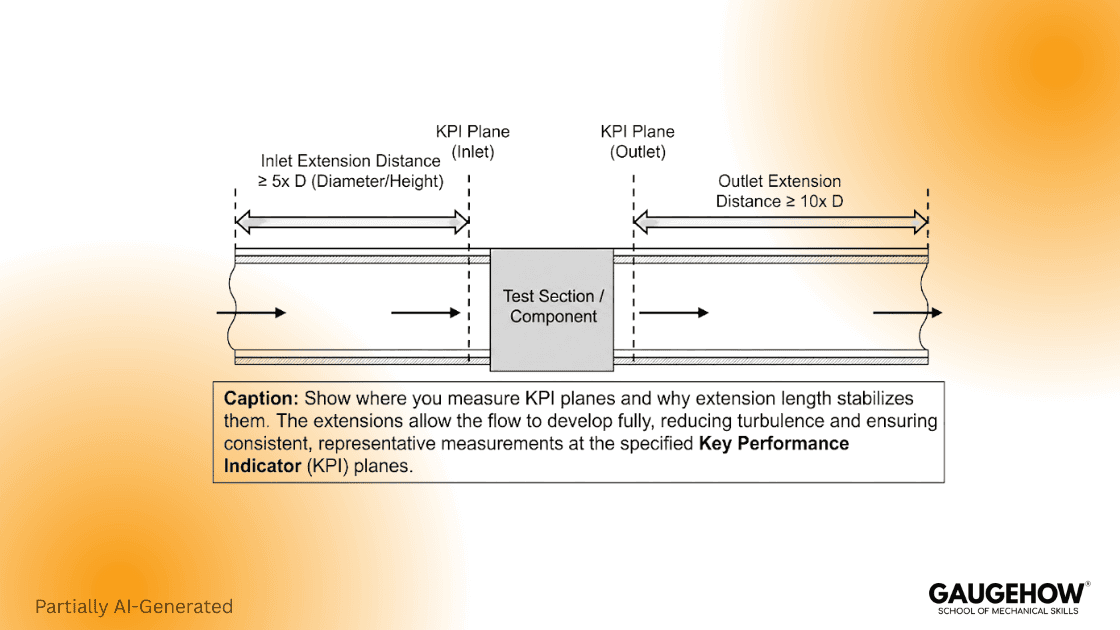
Step 2: Build A Domain That Does Not Fight You
Use inlet and outlet extensions so the boundary conditions do not contaminate the region you care about.
Step 3: Mesh With Near-Wall Intent
Your mesh is not “fine” or “coarse.” It is fit or not fit. State your near-wall plan, your refinement zones, and what mesh metrics you will monitor.
Step 4: Run Conservative Numerics First
Choose stable schemes and stable relaxation. Get a believable baseline, then improve. Reviewers trust controlled changes, not panic tuning.
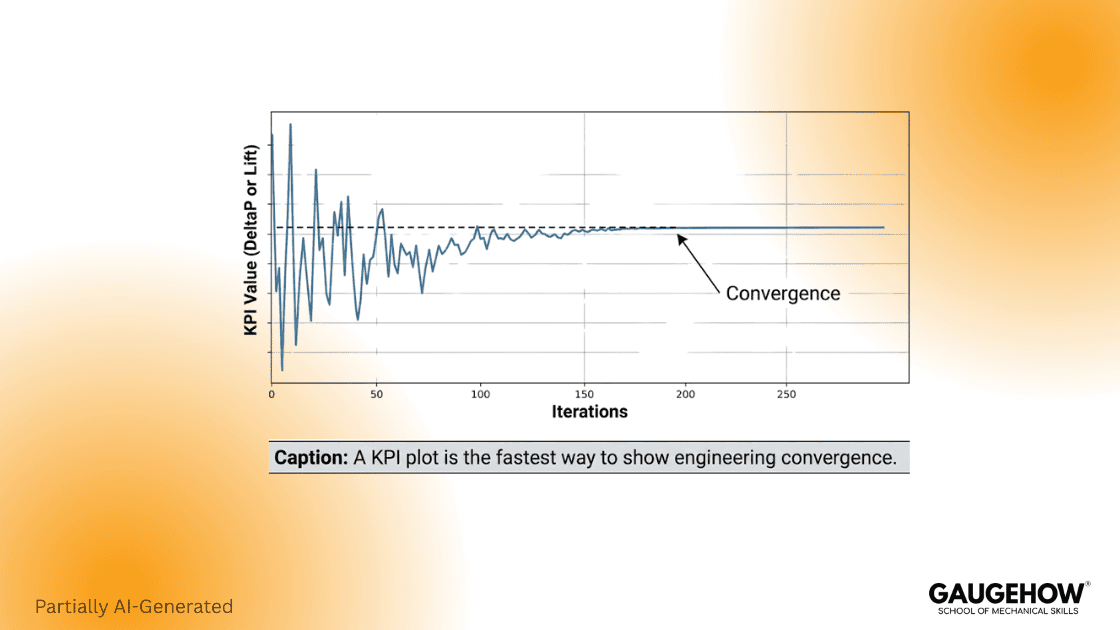
Step 5: Verify With KPI Convergence
Residuals are not enough. Track KPI versus iteration, and showthat it stabilizes.
Step 6: Report Limits Like A Professional
Write a short limits paragraph. State what you verified, what you validated, and what you could not validate.
Mesh Sensitivity
A simulation becomes believable when you control error sources. NIST highlights that credibility depends on model details, the quality of verification and validation, and the quality of uncertainty thinking. (NIST Publications)
ASME V&V 20 is a widely used standard that frames verification and validation for CFD and heat transfer, and it ties the process to uncertainty thinking. (ASME)
NASA Glenn’s V&V tutorial also walks through spatial grid convergence concepts and practical reporting, including a Grid Convergence Index style approach. (grc.nasa.gov)
Verification And Validation In Plain Terms
Verification asks: Did you solve the equations correctly? Validation asks: Do the equations represent your real case?
So your report should always include three short lines:
What you verified, like mesh and numerical stability. What you validated, like a comparison to a reference curve
What you could not validate, and why
That last line builds trust faster than hype.
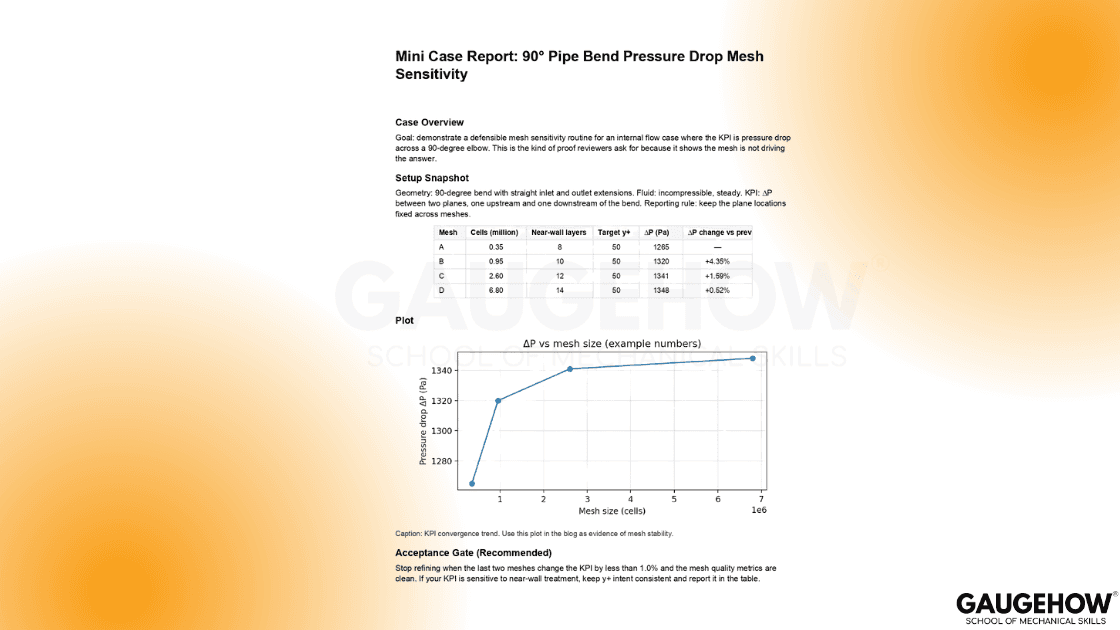
Mesh Independence Study Example
Keep it simple:
Pick one KP, I like pressure drop
Run at least three meshes if time allows
Report the KPI change and stop when changes shrink
That is your proof that the mesh is not driving the answer.
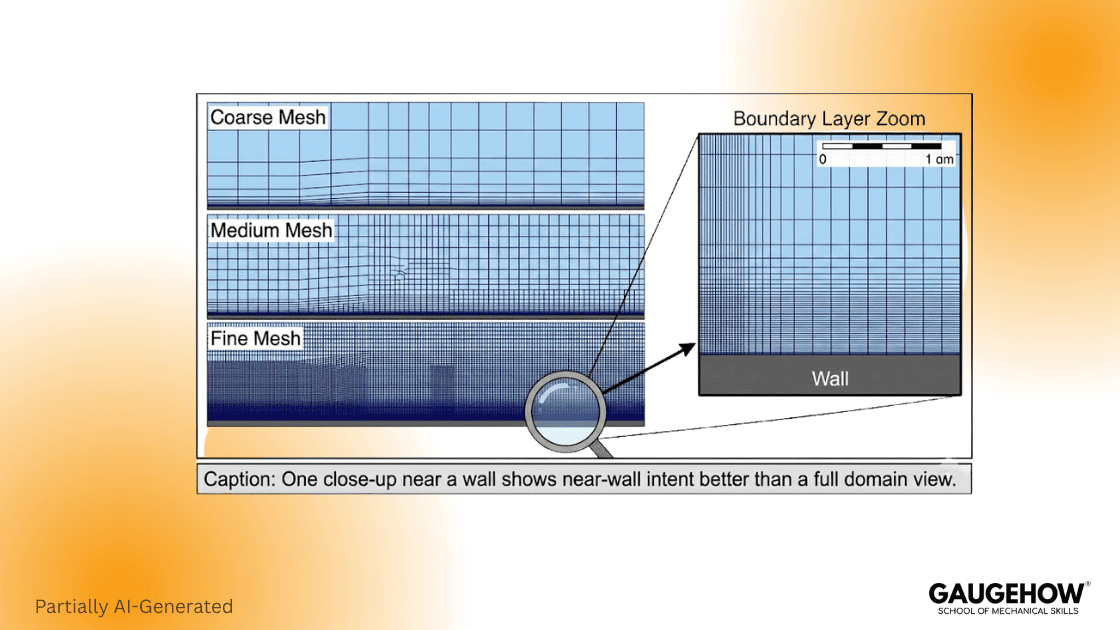
Original Proof: Mini Case Report + Checklist
Portfolio Projects That Get Interviews
You do not need ten random cases. You need three cases that show range and discipline.
Project 1: Internal Flow With Pressure Drop As KPI
Pick a duct or pipe with a bend so it is not trivial. Define pressure drop between two planes. Show near-wall mesh intent and show a sensitivity run.
Add one comparison anchor. It can be a known trend, an empirical curve, or a paper. The point is not perfection. The point is showing you know how to tie results to reality.
Project 2: External Flow With Clean Setup Logic
Pick a simple body and focus on domain sizing and boundary conditions. Show inlet intent, outlet stability, and wake behavior. Then run a controlled comparison between two turbulence models and explain why you trust one more for your KPI.
Project 3: Thermal Case That Looks Like Industry
Pick a heat sink, a casing, or a duct with a heated wall. Define a temperature limit KPI. Show material properties, heat source definition, and a clear results table.
This signals maturity because it forces physics choices, not just contours.
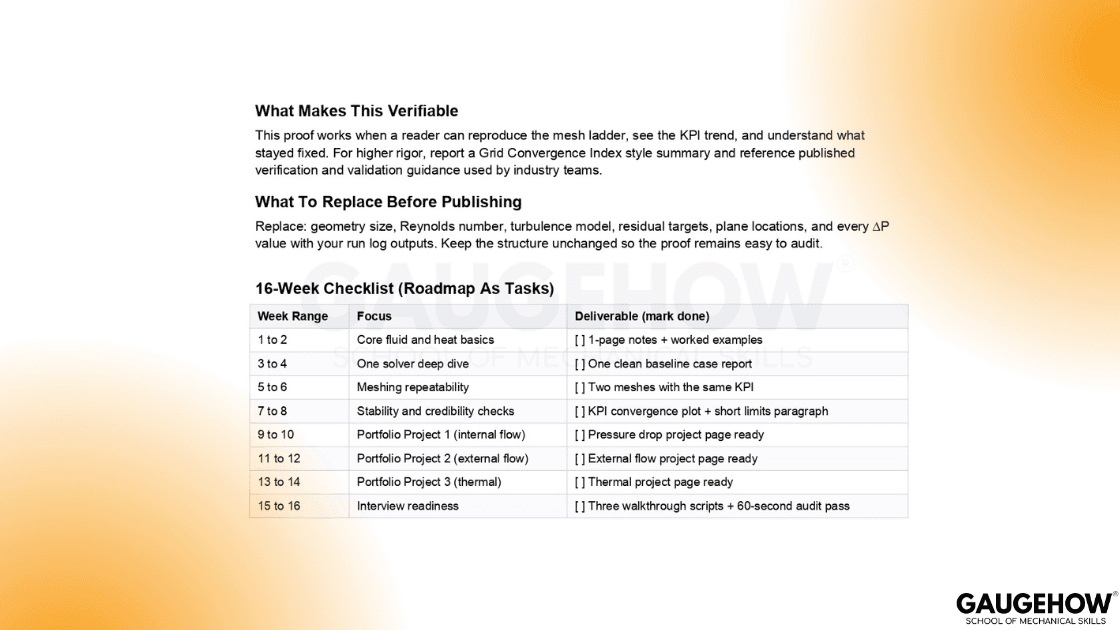
16-Week Roadmap You Can Follow
This structure works because it builds proof early and forces packaging before you overcomplicate physics.
Phase | Weeks | Focus | Output You Must Produce |
Phase 1 | 1 to 4 | Fundamentals + one solver | One clean case report |
Phase 2 | 5 to 8 | Meshing depth + stability | Two mesh variants + KPI plot |
Phase 3 | 9 to 12 | Portfolio build | Two project pages ready |
Phase 4 | 13 to 16 | Interview readiness | Three project walkthrough scripts |
Phase 1:- Pick a solver and stay with it. Document each choice and keep the setup traceable.
Phase 2:- Build repeatable mesh habits. Do your first mesh sensitivity check, even if it is rough. Keep the KPI and keep the conclusion honest.
Phase 3:- Focus on packaging. Your portfolio should read like engineering, not like a school lab.
Phase 4:- Rehearse your explanation. A calm explanation beats a complex case.
That is the core CFD roadmap, and it is the shortest path to proof.
Hiring Reality: Titles, Screens, And Salary
Hiring funnels screen for proof, not passion. So your portfolio structure matters more than certificates.
Job Titles To Search
Use titles like simulation engineer, flow simulation specialist, aerothermal analyst, aerodynamicist, thermal analyst, and CAE analyst. Then map the job responsibilities to your three projects.
What Recruiters Filter Fast
Recruiters filter for tool familiarity, proof that you can finish work, and clear write-ups that look reviewable. If your projects read like a technical report, you will pass more screens.
Salary Expectations With Realistic Context
In the United States, Indeed reports an average base salary of $105,255 per year for this role, updated December 10, 2025, based on job posting data. (Indeed)
In India, Glassdoor reports an average of ₹6,87,500 per year for this role, with percentile ranges based on salaries submitted as of December 2025. (Glassdoor)
Treat these as directional. Domain, location, and level will move the number.
Portfolio Scorecard
This section is designed to be linkable and reviewer-friendly. It also makes your standards obvious without sounding salesy.
Category | What “Good” Looks Like | Points |
Problem Framing | Clear goal and KPI, plus what success means | 2 |
Boundary Conditions Clarity | Units, sources, and a short justification | 2 |
Mesh Strategy + Quality Proof | Near-wall intent, mesh metrics, and a mesh ladder | 2 |
KPI Stability + Sensitivity | KPI convergence and at least a 3-mesh check | 2 |
Validation Anchor + Limits Honesty | One comparison anchor, plus a limits paragraph | 2 |
Total | 10-Point Review Standard | 10 |
If your project scores 8 or higher, it is usually interview-ready.
Common Mistakes And Fixes
This is where experience shows. If you avoid these, you move faster.
Treating residuals as the only convergence proof
Copying boundary conditions from random tutorials blindly
Using a mesh that looks fine, but is not fit
Changing five settings at once, and losing traceability
Skipping validation, then over-claiming accuracy
Reporting contours, but no KPI stability
The fix is consistent. Slow down, change one thing, measure the KPI change, and write what you changed.
Frequently Asked Questions
Do I Need A Master’s Degree To Start
No. Proof matters more than claims. A clean portfolio often beats vague credentials.
How Many Projects Are Enough To Apply
Three strong projects are enough if they are defensible and easy to review.
How Do I Choose Between Tools At The Start
Pick one solver and go deep first. Switching later is easier than starting shallow.
Is An Internship Required To Get Hired
It helps, but it is not required. A strong portfolio can compensate when it is review-ready.
If Someone Asks What Is CFD is, How Do I Answer
Say it is a method to predict flow and heat using equations on a mesh. Then add that assumptions and validation matter.
Conclusion
If you want this to feel simple, focus on proof. Build fundamentals, follow a repeatable workflow, and package three projects so a reviewer can trust you in sixty seconds.
Keep your CFD roadmap visible and follow it weekly. When someone asks what CFD is, answer clearly and mention limits, because that is what real teams trust.
That is how a CFD Engineer becomes employable, not by hype.
Also Read:- Best CFD Software 2026: Commercial Vs Open Source Guide
CAD-CAM-CAE Work Platform
Find or Post CAD, CAM and CAE freelance projects, full-time jobs and Internships.
GaugeHow is the platform built for core engineering work. Whether you need a freelancer for a CAD project, a full-time hire, or an engineering intern,post it here and get matched with the right person.
Our Courses
Complete Course Library
Access to 40+ courses covering various fields like Design, Simulation, Quality, Manufacturing, Robotics, and more.