
Why Do Fresh Graduates Lack Practical Industry Skills Despite Strong Academic Performance?
Learn More in This Video
Subscribe to GaugeHow for More
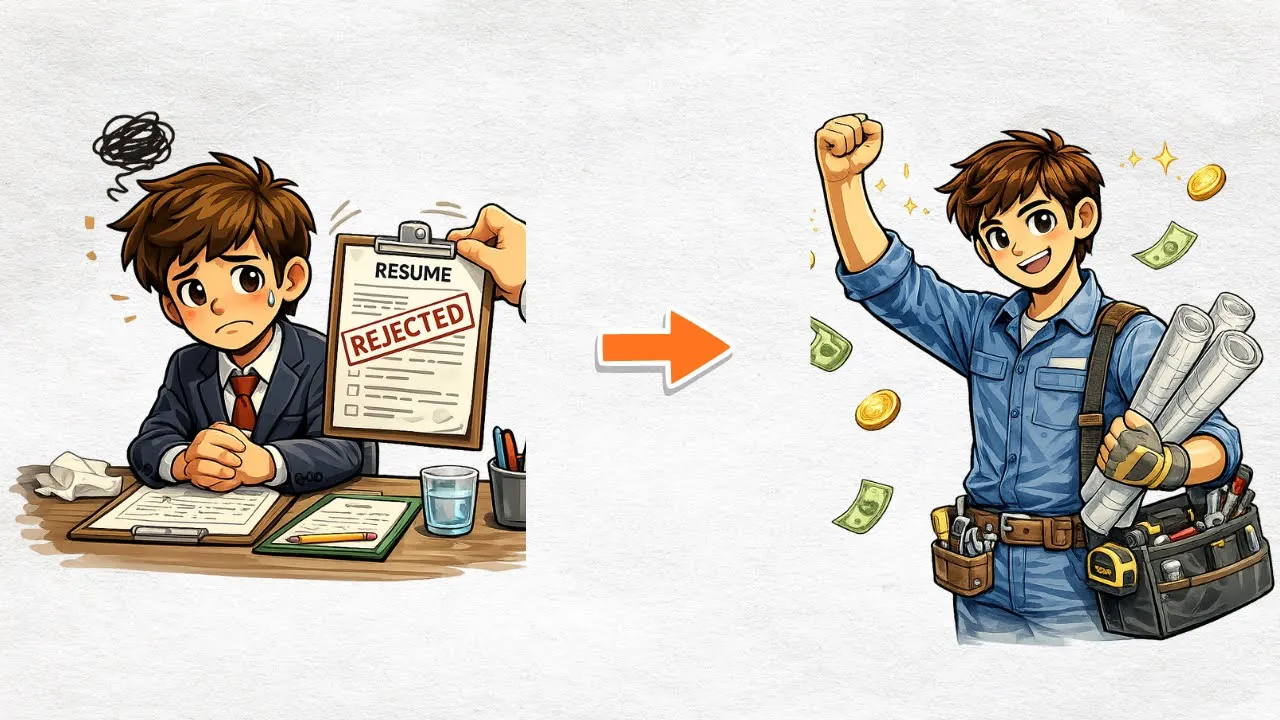
A graduate can score excellent marks, understand engineering theory, and still struggle during their first few months on the job.
This does not necessarily mean they lack knowledge or ability. The bigger issue is the gap between learning engineering concepts and applying them to real-world problems.
The Theory–Industry Gap
In college, students are often given clearly defined problems:
Calculate the stress.
Find the flow rate.
Solve the equation.
Design a component based on given parameters.
In industry, problems are rarely this straightforward.
An engineer may need to:
Design a component that is strong and cost-effective
Select the right material and manufacturing process
Modify a design for manufacturability
Decide appropriate tolerances
Work with CAD and engineering documentation
Troubleshoot real component failures
Balance quality, cost, time, and production requirements
The difference is significant.
Academic learning often asks, “Can you solve this problem?”
Industry asks, “Can you solve the right problem?”
Why Academic Performance Isn't Enough
1. Exams Reward Knowledge, Not Application
Students can become excellent at remembering formulas, solving standard problems, and preparing for examinations.
But practical engineering requires judgment.
Knowing an equation is only the beginning. Engineers need to understand when to use it, what assumptions apply, and what the result means in practice.
2. Limited Exposure to Real Engineering Workflows
Students may learn CAD, manufacturing, mechanics, thermodynamics, and materials as separate subjects.
In an actual engineering project, these concepts come together.
A single component might involve:
Design → Material Selection → Tolerances → Manufacturing → Inspection → Testing → Cost
Students need opportunities to understand how these pieces connect.
3. Academic Projects Don't Always Reflect Industry
Many college projects are designed to demonstrate that students understand a concept.
Industry projects have different questions:
Can it actually be manufactured?
Can it be assembled?
Will it survive real operating conditions?
How much will it cost?
Can it be produced consistently?
Can its quality be inspected?
These constraints fundamentally change how an engineer approaches a problem.
How GaugeHow Helps Bridge the Gap
GaugeHow focuses on the layer between engineering fundamentals and industry application.
Instead of learning concepts in isolation, students can learn through practical applications, engineering workflows, tools, and real-world use cases.
The learning approach is simple:
Learn the concept → Understand where it is used → Apply it to a practical problem → Build industry-relevant understanding
This helps students move beyond simply knowing engineering concepts toward understanding how those concepts are actually used by engineers.
The Goal Isn't More Theory
The solution isn't necessarily to add more subjects or make students study longer.
The bigger opportunity is to make existing engineering knowledge more practical and contextual.
A student who understands the theory and knows how to apply it is better prepared for the workplace than someone who can only reproduce that theory in an examination.
The Bottom Line
Academic performance shows that a student can learn engineering. Practical experience shows that they can use it.
Bridging this gap before graduation can make the transition from student → engineer much smoother.
That's the gap GaugeHow is built to address.
Mechanical Engineering Courses That Industry Actually Uses
Learn Tools of Design & CAD, Analysis & Simulation, Automation & Robotics, and Industry 4.0 used in modern factories.
Join 40+ Mech Courses like GD&T, Siemens NX, SolidWorks, CATIA V5, AutoCAD, ANSYS (FEA & Fluent), ABAQUS, Creo, Fusion 360, CNC Programming, Digital Twins, Python for Mechanical, and Industry 4.0.
Our Courses
Complete Course Library
Access to 40+ courses covering various fields like Design, Simulation, Quality, Manufacturing, Robotics, and more.