Engineering Mechanics
Branches Of Mechanics In Engineering Mechanics
Push a door and it swings. Park a car on a slope and it stays. Spin a fan and the blades pull outward. All three things happen because of forces, and all three are studied by different branches of mechanics in engineering mechanics.
Most students get confused here on day one. The textbook throws words like statics, dynamics, kinematics and kinetics in the first ten minutes, and everything sounds the same.
This lesson fixes that. By the end you will be able to look at any engineering problem, decide which branch it belongs to, and know which equations you are allowed to use.
That single skill saves you from half the mistakes people make in exams and in design work. Let us start from the top.
Classification of Engineering Mechanics

Mechanics is the study of what happens to a body when forces act on it. Does it stay still? Does it move? Does it bend or break? Mechanics answers all of this.
Before we look at engineering mechanics alone, it helps to see the full family tree. Mechanics as a science is divided into three big groups.
1. Mechanics of Rigid Bodies
A rigid body is a body we assume does not change shape when loaded. A steel beam in a building does bend a little, but the bend is so small that we ignore it while calculating reactions.
This is the part your college calls Engineering Mechanics. It is the foundation of the whole subject.
2. Mechanics of Deformable Bodies
Here we no longer ignore the bending, stretching or twisting. We calculate how much the body deforms and whether it will fail.
You will meet this later as Strength of Materials or Mechanics of Solids. Stress, strain and factor of safety live here.
3. Mechanics of Fluids
Liquids and gases cannot hold their shape, so they need their own rules. Water flowing in a pipe, air over an aircraft wing, coolant around an EV battery pack.
This becomes Fluid Mechanics, and later CFD software work.
Branches of Engineering Mechanics with Examples
Now zoom into rigid body mechanics, which is our subject. It has two main branches.
Statics
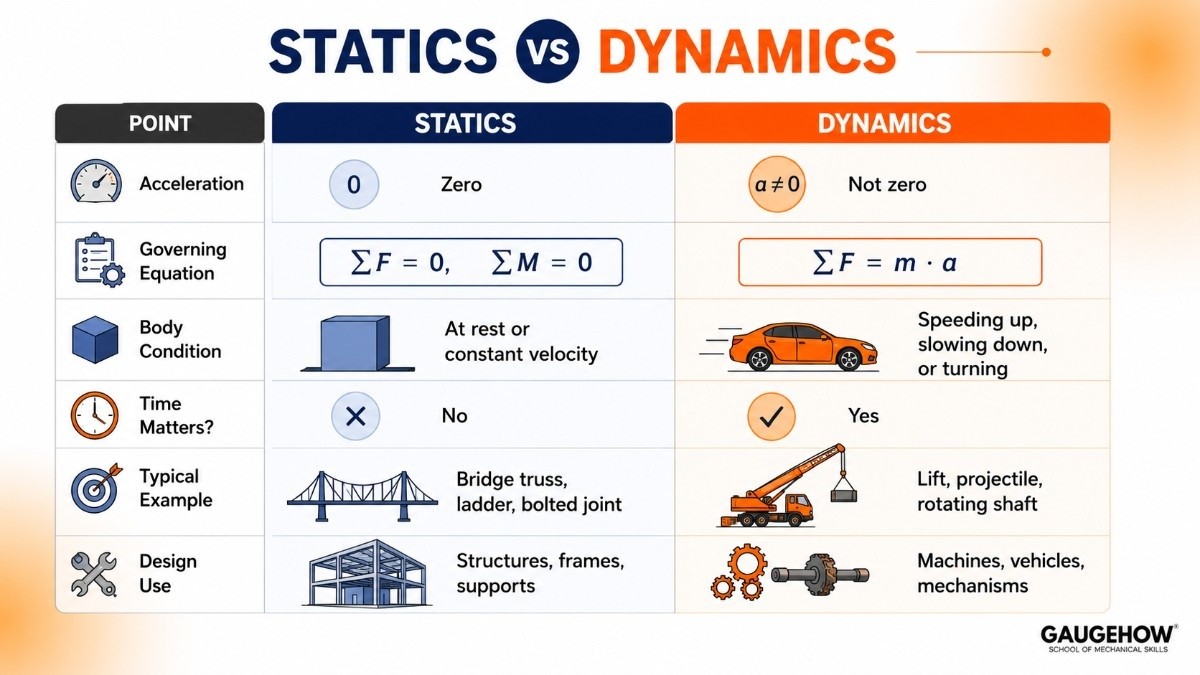
Statics is the study of bodies that are at rest, or moving at constant velocity, under the action of forces. In simple words, nothing is accelerating.
Everyday example: a book lying on your table. Gravity pulls it down, the table pushes it up, and the two cancel out. Nothing moves.
Governing condition:
ΣF = 0 and ΣM = 0
ΣF = sum of all forces acting on the body, in newtons (N)
ΣM = sum of all moments (turning effects) about any point, in newton metre (N·m)
The Greek letter Σ (sigma) simply means "add up everything"
If both sums come out zero, the body is in equilibrium.
Real examples of statics:
Reactions at the two supports of a bridge girder
Force in each member of a roof truss
Bolt loads in a machine frame that is bolted to the floor
A ladder leaning on a wall without slipping
Dynamics
Dynamics is the study of bodies that are accelerating. Something is speeding up, slowing down, or changing direction.
Everyday example: the same book, but now you slide it across the table and it slows down and stops. The forces no longer cancel. There is a net force, so there is acceleration.
Governing condition:
ΣF = m × a
m = mass of the body in kilograms (kg)
a = acceleration in metre per second squared (m/s²)
ΣF = net unbalanced force in newtons (N)
Real examples of dynamics:
A lift accelerating upward from the ground floor
A cricket ball flying through the air after a hit
A car braking on a wet road
A rotor speeding up inside an electric motor
The one-question test
Ask yourself: is the body accelerating?
No, a = 0, so it is a statics problem, use ΣF = 0
Yes, a is not zero, so it is a dynamics problem, use ΣF = ma
Notice that statics is just the special case of dynamics where a = 0. That is why ΣF = 0 falls straight out of ΣF = ma.
Statics and Dynamics in Engineering Mechanics
These two branches deserve a closer look, because almost every exam question and every real design job sits in one of them.
Statics in detail
Statics does not mean "the body never moves". It means the body has no acceleration.
A car cruising on a highway at a steady 60 km/h is a statics problem. Speed is constant, so acceleration is zero, so all the forces balance. Engine thrust equals drag plus rolling resistance.
Topics that live inside statics:
Force systems and resultants
Free body diagrams
Equilibrium of particles and rigid bodies
Support reactions in beams
Friction
Trusses and frames
Centroid and moment of inertia
Virtual work
Dynamics in detail
Dynamics is further divided into two sub-branches, and this is where most students slip.
Kinematics studies motion without asking what caused it. It only deals with geometry of motion: distance, displacement, velocity, acceleration and time. No mention of force or mass.
Analogy: watching a car on CCTV. You can see it went from 0 to 60 km/h in 5 seconds. You have no idea how heavy it was or how much force the engine gave. That is kinematics.
A standard kinematics equation:
v = u + a·t
u = initial velocity (m/s)
v = final velocity (m/s)
a = acceleration (m/s²)
t = time (s)
Kinetics studies motion along with the forces and masses that caused it. Here mass and force enter the picture.
Analogy: now you sit inside the car and measure the engine force and the car's mass. That is kinetics.
The core kinetics equation is Newton's second law, F = m·a.
Solved mini-example
A 1,200 kg car speeds up from rest to 20 m/s in 8 seconds on a straight road. Find the acceleration and the net driving force.
Step 1. Kinematics part. Use v = u + a·t. u = 0 m/s, v = 20 m/s, t = 8 s
Step 2. 20 = 0 + a × 8, so a = 20 / 8 = 2.5 m/s²
Step 3. Kinetics part. Use F = m·a. m = 1,200 kg, a = 2.5 m/s²
Step 4. F = 1,200 × 2.5 = 3,000 N = 3 kN
Notice how Step 1 and 2 used no force at all. That was kinematics. Step 3 and 4 brought in mass and force. That was kinetics. Same problem, two branches, used one after the other.
Types of Mechanics in Engineering

Beyond the classical statics and dynamics split, working engineers deal with a few more types of mechanics. You do not study all of these in first year, but knowing the map helps you see where your career can go.
Classical mechanics
The mechanics of Newton. Works perfectly for everything you can see and touch: cars, cranes, buildings, machines. This is what engineering mechanics is built on.
Solid mechanics (strength of materials)
Takes the forces you found in statics and checks whether the material will survive them. Stress, strain, bending, torsion, buckling.
If engineering mechanics tells you the beam carries 50 kN, solid mechanics tells you whether a 100 mm beam is enough or you need 150 mm.
Fluid mechanics
Forces in liquids and gases. Pumps, pipes, aerodynamics, cooling systems.
Thermodynamics and heat transfer
Not strictly mechanics, but it sits beside it in the mechanical engineering syllabus and often shares the same problems, such as an EV battery pack that must be both structurally safe and thermally cool.
Computational mechanics
The modern layer. Instead of solving equations by hand, we let software solve thousands of them. This is where FEA (Finite Element Analysis) and CFD live.
Important truth: software does not replace this subject. FEA software asks you for loads, supports and constraints. If your free body diagram is wrong, the colourful result on screen is confidently wrong. Every simulation engineer still thinks in ΣF = 0.
If you enjoy this side of engineering, the natural next step after mastering the basics is FEA with ANSYS, where you apply the same equilibrium ideas to real 3D parts. For quick force checks on your own CAD models, Fusion 360 has a built in static stress study.
Relativistic and quantum mechanics
Mentioned only so you are not surprised in a quiz. These apply at speeds close to light or at atomic scale. Not used in bridge or gearbox design. Classical mechanics is accurate enough for everything an engineer builds.
Engineering Mechanics is Divided Into
Here is the clean answer you can write in an exam.
Engineering mechanics is divided into two branches: Statics and Dynamics. Dynamics is further divided into Kinematics and Kinetics.
Text diagram to memorise:
Engineering Mechanics │ ├── Statics (bodies at rest, ΣF = 0) │ └── Dynamics (bodies accelerating) │ ├── Kinematics (motion only, no forces) │ └── Kinetics (motion + forces, F = ma)
Some textbooks add a third head called Mechanics of Materials or divide statics further into particle statics and rigid body statics. If your syllabus does this, follow your syllabus. But the two branch answer above is the standard, and it is what GATE and interview panels expect.
Where Engineers Actually Use These Branches
Theory means little until you see where the salary comes from. Here is who uses what.
Design engineers use statics every day to size brackets, frames and fasteners. Reaction forces decide bolt size. See the Design Engineer track.
CAE and simulation engineers feed statics results into FEA models. Wrong supports, wrong answer. See the CAE / Simulation Engineer track.
Automotive engineers use dynamics for suspension travel, braking distance and crash loads.
Robotics engineers use kinematics to plan where the arm's tip goes, then kinetics to size the motor torque. If you want to see how this is coded, Python for Mechanical Engineers and Robotics is a practical starting point.
Manufacturing engineers use statics for jig and fixture clamping forces, and dynamics for conveyor and press machinery.
Key Takeaways
Mechanics studies the effect of forces on bodies. Engineering mechanics is the rigid body part of it.
Engineering mechanics is divided into statics and dynamics.
Statics deals with bodies having zero acceleration. Condition: ΣF = 0 and ΣM = 0.
Dynamics deals with accelerating bodies. Condition: ΣF = m·a.
Dynamics splits into kinematics (motion without force) and kinetics (motion with force).
A body moving at constant velocity is still a statics problem, because acceleration is zero.
Statics finds the forces. Strength of materials then checks whether the material survives them.
FEA and CFD software are modern extensions of these branches, not replacements for them.
Practice Corner
A crate slides down a ramp at constant speed. Is this statics or dynamics? Explain in one line.
Name the two sub-branches of dynamics and state the difference in one sentence each.
Which branch would you use to find the reaction at the hinge of a gate that is not moving?
A 5 kg block is pushed with a net force of 20 N on a frictionless floor. Find its acceleration.
Fill in: Engineering mechanics is divided into ______ and ______.
Statics. Constant speed means zero acceleration, so all forces balance and ΣF = 0 applies. Do not be tricked by the word "slides".
Kinematics studies motion (distance, velocity, acceleration, time) without asking what caused it. Kinetics studies motion together with the forces and masses that cause it.
Statics. The gate is not accelerating, so use ΣF = 0 and ΣM = 0.
a = F / m = 20 / 5 = 4 m/s²
Statics and Dynamics.
FAQ
Q: What are the branches of mechanics in engineering mechanics?
A: Engineering mechanics has two branches, statics and dynamics. Statics studies bodies at rest or moving at constant velocity, where ΣF = 0. Dynamics studies accelerating bodies, where ΣF = m·a. Dynamics is further divided into kinematics and kinetics.
Q: Is engineering mechanics divided into two or three branches?
A: The standard and most widely accepted answer is two, statics and dynamics. Some syllabi add mechanics of deformable bodies as a third head, but that topic is usually taught separately as strength of materials.
Q: What is the difference between kinematics and kinetics?
A: Kinematics describes motion using only distance, velocity, acceleration and time. It never mentions force or mass. Kinetics links that motion to the forces and masses that produced it, using F = m·a.
Q: Is a car moving at constant speed a statics or dynamics problem?
A: Statics. Constant speed on a straight road means zero acceleration, so the driving force exactly balances drag and friction. The forces sum to zero.
Q: Which branch of engineering mechanics is used in FEA software?
A: Static structural analysis is built directly on statics, using equilibrium and support reactions. Dynamic and modal analysis extend into dynamics. Either way, the software needs correct loads and supports from you, which is why the hand method still matters.
Q: Do I need engineering mechanics for a mechanical engineering job?
A: Yes. Design, simulation, manufacturing and robotics roles all rely on it. It is also one of the highest weight topics in GATE and most PSU exams.
What's Next
In Lesson 2 we go deeper into the toolkit itself: scalars, vectors, SI units and unit conversion, the language you need before you can write a single equilibrium equation correctly.
Ready to apply this? Once you are comfortable with statics and dynamics, put it to work on real 3D parts with FEA with ANSYS, or browse the full library at GaugeHow Courses.
Internal links used:
FEA with ANSYS: https://gaugehow.com/course/fea-finite-element-analysis-with-ansys
Fusion 360: https://gaugehow.com/course/fusion-360
Python for Mechanical Engineers and Robotics: https://gaugehow.com/course/python-for-mechanical-engineers-robotics
Design Engineer track: https://gaugehow.com/design-engineer
CAE / Simulation Engineer track: https://gaugehow.com/cae-simulation-engineer
All Courses: https://gaugehow.com/course
Practice / MCQ Tests: https://gaugehow.com/practice
Interview Q&A Hub: https://gaugehow.com/interview