Engineering Mechanics
Dimensions in Engineering Mechanics
You are halfway through a numerical in an exam. You need the formula for kinetic energy. Your brain offers two options.
Is it ½mv² or ½mv?
You have thirty seconds and no textbook. Most students guess. But there is a way to know, without remembering anything about energy at all.
That method is dimensional analysis, and it is what dimensions in engineering mechanics are actually for. Not a definition to write in a two mark question. A working tool that catches wrong formulas before they cost you marks.
Here is how it works, why it works, and exactly where it stops working.
What Are Dimensions in Engineering Mechanics?
A dimension describes the physical nature of a quantity. It tells you what kind of thing you are measuring, without saying how much.
Length is a dimension. A metre, a foot, a mile and a light year are all units of that same dimension. They are different sizes of the same idea.
So when we say force has dimensions of mass times length divided by time squared, we are saying something deeper than "force is measured in newtons". We are saying that whatever unit system you use, force is always built from mass, length and time in that exact combination. Newtons, pound-force, dynes, kilogram-force. Every one of them.
Dimensions are the skeleton. Units are the clothes.
Dimensions vs Units: The Difference
Students mix these two constantly, and it is worth thirty seconds to nail down.
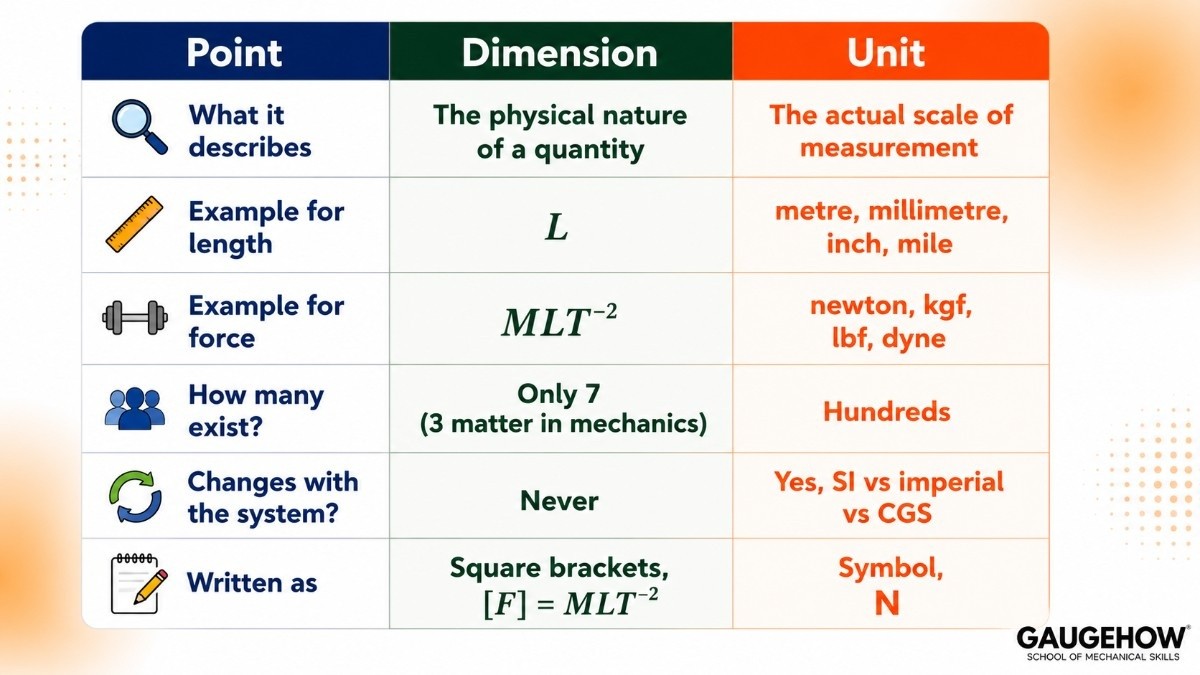
The one line version: a quantity has only one dimensional formula, but it can have many units.
Speed has dimensions LT⁻¹. Always. Whether you measure it in m/s, km/h, mph or knots, the dimension does not budge.
The Three Fundamental Dimensions (M, L, T)

Notice the pairs
Two rows in that table share dimensions but are completely different physically.
Work and torque are both ML²T⁻². Both are a force times a distance. But work is a scalar amount of energy and torque is a vector turning effect. Same dimensions, different physics. This is exactly why we call one joules and the other newton metre, so nobody adds them together by accident.
Impulse and momentum are both MLT⁻¹. That is not a coincidence. It is the impulse-momentum theorem hiding in plain sight. Impulse equals the change in momentum, so of course their dimensions match.
Dimensions do not just check formulas. Sometimes they reveal that two things you thought were unrelated are actually the same quantity wearing a different name.
What Is Dimensional Homogeneity?
Dimensional homogeneity is the rule that makes all of this work.
The principle: every term in a valid physical equation must have the same dimensions.
You cannot add a length to a mass, any more than you can add 5 apples to 3 hours and get a meaningful number. Both sides of the equals sign, and every single term being added or subtracted, must be the same dimensional type.
See it working
Take a familiar kinematic equation:
s = u·t + ½·a·t²
Check each term:
s → L
u·t → (LT⁻¹) × (T) = L
½·a·t² → (LT⁻²) × (T²) = L
All three terms are L. The equation is homogeneous. It survives.
The ½ is just a number. Pure numbers have no dimensions, so they can sit anywhere without disturbing the check. That is also the first hint of where this method has a weakness, and we will get to that.
How to Do Dimensional Analysis Step by Step
Back to the question from the intro. Is kinetic energy ½mv² or ½mv?
Step 1. Energy must have the dimensions of work, because they are the same thing. Work = force × distance = MLT⁻² × L = ML²T⁻²
Step 2. Test ½mv² M × (LT⁻¹)² = M × L²T⁻² = ML²T⁻² ✓
Step 3. Test ½mv M × LT⁻¹ = MLT⁻¹ ✗
Step 4. Only the first one matches. Kinetic energy is ½mv².
And note what ½mv actually turned out to be. MLT⁻¹ is momentum. The wrong answer was not nonsense. It was a real quantity, just the wrong one. Dimensional analysis told you that in about ten seconds, without you knowing a single thing about energy.
Catching a classic exam error
A student writes F = m·v for force.
Left side: MLT⁻²
Right side: M × LT⁻¹ = MLT⁻¹
Mismatch by one power of T. Wrong formula. Straight away, no second thought needed.
Deriving a formula you never learned
This is the impressive part. Dimensional analysis can sometimes build a formula for you.
Question: what does the time period of a simple pendulum depend on?
Guess that it depends on length (l), mass (m) and gravity (g). Write:
T = k · l^a · m^b · g^c
where k is some unknown dimensionless number.
Now match dimensions on both sides:
Left: T¹
Right: L^a × M^b × (LT⁻²)^c = M^b · L^(a+c) · T^(-2c)
Compare powers:
M: 0 = b, so b = 0
T: 1 = minus 2c, so c = minus ½
L: 0 = a + c, so a = ½
Substituting back:
T = k · l^(½) · g^(−½) = k · √(l/g)
Look at what just happened. The power of M came out zero, which means the time period does not depend on the mass of the bob at all. We never assumed that. The dimensions forced it.
The real formula is T = 2π√(l/g). We got everything except the 2π.
Uses of Dimensional Analysis
Checking formulas. The main one. Fast, reliable, and it works even when you have forgotten the physics entirely.
Deriving relationships. As with the pendulum, you can find how quantities relate to each other, up to an unknown constant.
Converting between unit systems. Because dimensions are unit independent, they give you a safe way to move between SI, imperial and CGS without guessing.
Model testing. Wind tunnels test small aircraft models, and towing tanks test small ship hulls. The results only transfer to the full sized object if certain dimensionless groups match between model and reality. That entire industry runs on dimensional reasoning.
Sanity checking simulation results. When an FEA solver hands back a stress figure, a quick dimensional check on your inputs tells you whether you have fed it a load in the wrong unit system. The software will never flag this itself, which is why unit and dimension discipline gets drilled early in FEA with ANSYS.
Consider s = u·t + a·t² (missing the ½). Every term is L. The check passes. The formula is still wrong.
So dimensional analysis is a filter, not a proof. It reliably tells you when something is definitely wrong. It never tells you that something is definitely right.
FAQ
Q: What are dimensions in engineering mechanics?
A: A dimension describes the physical nature of a quantity in terms of the fundamental quantities mass (M), length (L) and time (T). For example, force has the dimensional formula MLT⁻², meaning it is always mass times length divided by time squared, regardless of whether you measure it in newtons, kgf or pounds.
Q: What is the difference between dimensions and units?
A: A dimension is the type of physical quantity, and there is only one dimensional formula per quantity. A unit is the specific scale used to measure it, and there can be many. Length has one dimension, L, but many units: metre, millimetre, inch, mile.
Q: What is the dimensional formula of force?
A: MLT⁻². It comes from Newton's second law, force equals mass times acceleration, where acceleration has dimensions LT⁻². Multiplying M by LT⁻² gives MLT⁻².
Q: What is dimensional homogeneity?
A: The principle that every term in a valid physical equation must have the same dimensions. You cannot add a length to a time. If an equation fails this check, it is definitely wrong.
Q: Can dimensional analysis prove a formula is correct?
A: No. It can only prove a formula is wrong. A dimensionally correct equation may still be physically incorrect, because the method cannot detect missing dimensionless constants like ½ or 2π. It is a necessary check, not a sufficient one.
Q: Why are strain and coefficient of friction dimensionless?
A: Both are ratios of two quantities of the same kind. Strain divides a length by a length, and coefficient of friction divides a force by a force. The dimensions cancel completely, leaving a pure number.
The Bottom Line
Dimensions in engineering mechanics give you something no formula sheet can: a way to check your own memory.
Build every dimensional formula from M, L and T rather than memorising a list. Apply dimensional homogeneity to any equation you are unsure of. And remember the limit, it catches wrong formulas but never confirms right ones.
That ten second check has saved more marks in more exam halls than almost any other habit in this subject. Use it every time a formula feels shaky.
Want to see where dimensions and units bite in real engineering? Run a static stress study in Fusion 360, go deeper with FEA with ANSYS, or test yourself with the GaugeHow practice tests. Browse everything at GaugeHow Courses.
Internal links used (all from GaugeHow catalog):
FEA with ANSYS: https://gaugehow.com/course/fea-finite-element-analysis-with-ansys
Fusion 360: https://gaugehow.com/course/fusion-360
Practice / MCQ Tests: https://gaugehow.com/practice
All Courses: https://gaugehow.com/course