Engineering Mechanics
Lami's Theorem: Statement, Formula and Examples
Imagine a heavy lamp hanging from a hook, held by two strings pulling from different angles. You want to know how hard each string is being pulled. You could split every force into parts and write two equations, or you could use one neat rule that gives the answer in a single line. That neat rule is Lami's theorem.
For any problem with exactly three forces meeting at a point, Lami's theorem is often the fastest tool you have. It turns a balancing problem into a simple ratio of sines.
Students love it once they get it, because it skips a lot of the usual algebra. The only trick is knowing when it applies and how to read the angles correctly.
In this guide we will cover what Lami's theorem is, its statement and formula, the conditions to use it, a simple derivation, a solved example, and where engineers use it.
What Is Lami's Theorem?
Lami's theorem is a rule that connects three forces keeping a body in balance. It is named after the French mathematician Bernard Lami.
It only works in one specific situation: when exactly three forces act on a single point and hold it in equilibrium. In that case, the three forces are linked by a simple relationship between their sizes and the angles between them.
Think of three friends pulling ropes tied to one ring, with the ring not moving. Lami's theorem lets you work out how hard each friend is pulling if you know the angles.
It is a shortcut built for three concurrent forces, and it saves real time when those conditions are met.
Lami's Theorem Statement
The formal statement is short and worth learning word for word.
Lami's theorem states that if three coplanar, concurrent forces keep a body in equilibrium, then each force is proportional to the sine of the angle between the other two forces.
Let us unpack that plain phrase. "Coplanar" means all three forces lie in the same flat plane. "Concurrent" means their lines all pass through one common point. "In equilibrium" means the body is balanced and not accelerating.
The clever part is the phrase "angle between the other two forces". For each force, you look at the angle formed by the remaining two, not its own angle. That single idea is the whole theorem.
Lami's Theorem Formula
Say the three forces are P, Q, and R, acting at a point and holding it in balance.
The formula is written as: P / sin α = Q / sin β = R / sin γ
Here is what each symbol means. P, Q, and R are the three forces, measured in newtons (N). The angle α is the angle between the other two forces Q and R. The angle β is the angle between P and R. The angle γ is the angle between P and Q.
So each force sits on top, and below it goes the sine of the angle made by the other two. All three ratios are equal to the same number.
One useful check: the three angles always add up to 360 degrees, because they go all the way around the meeting point. If your angles do not sum to 360, you have measured one wrong.

Conditions for Applying Lami's Theorem
Lami's theorem is powerful, but it is fussy. All of these conditions must be true, or it does not apply.
Exactly three forces. Not two, not four. The theorem is built for three forces only.
Coplanar. All three forces must lie in the same plane.
Concurrent. Their lines of action must meet at one common point.
Non-collinear. The three forces must not all lie on one straight line.
In equilibrium. The body must be balanced and not accelerating.
If a problem has four forces, you cannot use Lami's theorem directly. You would first need to combine some forces into a single resultant, or switch to the component equations instead.
Derivation of Lami's Theorem
You do not need to memorise the proof, but seeing it once makes the formula feel obvious.
Start with the triangle law of forces. It says that if three forces keep a point in balance, you can draw them tip to tail and they will form a closed triangle. Each side of the triangle represents one force, in size and direction.
Now apply the sine rule to that triangle. The sine rule says each side divided by the sine of its opposite angle is the same for all sides.
The angles inside the force triangle turn out to be the supplements of the angles between the forces, meaning each is 180 degrees minus the angle at the meeting point. And there is a handy fact: the sine of 180 degrees minus an angle equals the sine of the angle itself.
So when you write the sine rule and swap in that fact, the 180 degree parts vanish and you are left with P over sin α equals Q over sin β equals R over sin γ. That is Lami's theorem, straight out of basic triangle geometry.
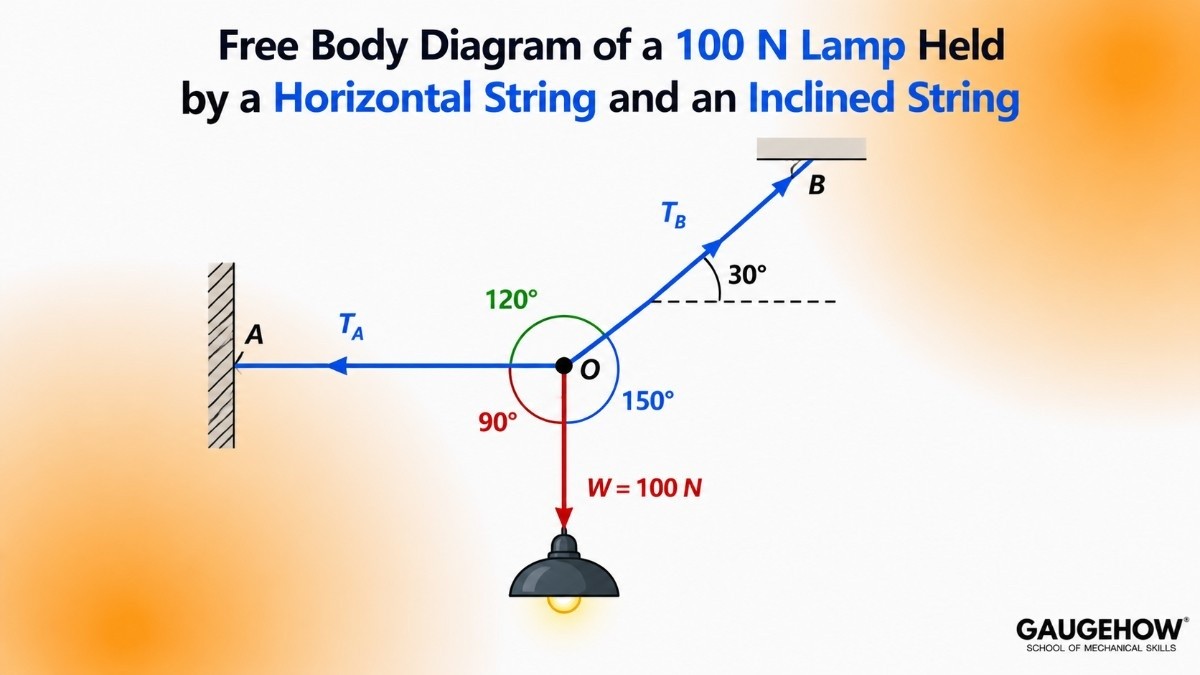
Solved Example: Lamp Held by Two Strings
Let us do a clean one so the method sticks.
A lamp weighing 100 N hangs from a point O. One string, OA, runs horizontally to a wall on the left. A second string, OB, runs up to the ceiling, making 30 degrees with the horizontal on the right. Find the tension in each string.
Step 1. Check the conditions. Three forces act at point O, they are coplanar and concurrent, and the lamp is in equilibrium. Lami's theorem applies.
Step 2. Find the angle between each pair of forces. The weight points straight down, string OA pulls horizontally left, and string OB pulls up and to the right at 30 degrees. Working around the point, the angle between the weight and OA is 90 degrees, the angle between the weight and OB is 120 degrees, and the angle between OA and OB is 150 degrees. These add up to 360 degrees, so the angles are correct.
Step 3. Write Lami's theorem. Each force goes over the sine of the angle between the other two. So weight over sin 150 equals tension OA over sin 120 equals tension OB over sin 90.
Step 4. Use the known force. The weight is 100 N and sin 150 is 0.5, so the common ratio is 100 divided by 0.5, which is 200.
Step 5. Solve for each tension. Tension OA equals 200 times sin 120, which is about 200 times 0.866, giving 173 N. Tension OB equals 200 times sin 90, which is 200 times 1, giving 200 N.
So the horizontal string carries about 173 N and the inclined string carries 200 N. You can double check with components, and both directions balance perfectly.
Lami's Theorem vs Equilibrium Equations
Students often ask which method to reach for. Both solve balanced forces, but they suit different cases.
The component equations, ΣFx = 0 and ΣFy = 0, work for any number of forces in any directions. They are the general purpose tool and never fail. Here ΣFx means the sum of horizontal forces and ΣFy the sum of vertical forces.
Lami's theorem works only for exactly three concurrent forces. When those conditions are met, it is usually faster, because you avoid resolving forces into components.
A simple rule of thumb: if you have precisely three forces meeting at a point and you know the angles between them, reach for Lami's theorem. For anything else, use the component equations.
Limitations of Lami's Theorem
Knowing where it fails is just as important as knowing where it works.
It cannot handle more than three forces. It cannot handle forces that are not in the same plane. It cannot be used if the forces do not meet at a common point. And it says nothing about moments or turning effects, since it deals only with forces at a single point.
It also assumes the body is in static equilibrium. If the body is accelerating, the forces do not balance and the theorem no longer holds.
Where Engineers Use Lami's Theorem
This is not just an exam trick. The three force case shows up often in real work.
Engineers use Lami's theorem to find cable tensions in hanging loads, sign boards, and light fittings. It appears in the analysis of tripod and derrick supports, in simple crane and pulley setups, and in checking forces at a joint where three members meet.
When a design grows past these simple cases, the same balancing idea is handled by software that solves large systems of equilibrium equations at once. To see how force and reaction analysis works on real structures, the FEA with ANSYS course walks through the full workflow. And to set up and test forces on parts you design yourself, the Fusion 360 course covers force analysis right inside the CAD model.
Key Points to Remember
Lami's theorem applies only when exactly three coplanar, concurrent forces keep a body in equilibrium. It states that each force is proportional to the sine of the angle between the other two, written P over sin α equals Q over sin β equals R over sin γ. The three angles always add up to 360 degrees, which is a quick way to check your work. It comes straight from the triangle law of forces and the sine rule. For three forces it is a fast shortcut, but for any other case, use the component equations instead.
Frequently Asked Questions
What is Lami's theorem in simple words?
It is a rule for three forces that hold a point in balance. It says each force is proportional to the sine of the angle between the other two forces. If you know the angles and one force, you can find the other two.
What are the conditions for Lami's theorem?
There must be exactly three forces, they must be coplanar, they must be concurrent, they must be non-collinear, and the body must be in equilibrium. If any condition fails, the theorem does not apply.
What is the formula for Lami's theorem?
For three forces P, Q, and R, the formula is P over sin α equals Q over sin β equals R over sin γ. Each angle is the one between the other two forces, and the three angles add up to 360 degrees.
How is Lami's theorem derived?
It comes from the triangle law of forces, which says three balanced forces form a closed triangle. Applying the sine rule to that triangle, and using the fact that the sine of 180 minus an angle equals the sine of the angle, gives Lami's theorem.
When should I use Lami's theorem instead of the component equations?
Use it only when exactly three concurrent forces are in balance and you know the angles between them. For more than three forces, or forces not meeting at a point, use the equilibrium equations ΣFx = 0 and ΣFy = 0.
Conclusion
Lami's theorem is one of the most satisfying tools in statics. When exactly three forces meet at a point, it hands you the answer in a single clean ratio, no component splitting needed.
Just confirm the three conditions, read the angle between each pair of forces carefully, and set up the sine ratios. With a little practice, three force problems become some of the quickest questions you will face.
Want to test your grip on this? Work through the statics question sets on the GaugeHow Practice and MCQ hub, and review commonly asked theory at the Engineering Interview Q&A hub before your next exam or placement.
Internal links used:
FEA with ANSYS (https://gaugehow.com/course/fea-finite-element-analysis-with-ansys),
Fusion 360 (https://gaugehow.com/course/fusion-360),
Practice / MCQ Tests (https://gaugehow.com/practice),
Interview Q&A Hub (https://gaugehow.com/interview)