Engineering Mechanics
SI Units In Engineering Mechanics : The Full Guide
In 1999, NASA lost a 125 million dollar spacecraft because one team worked in pound-force seconds and another assumed newton seconds. The Mars Climate Orbiter came in too low, hit the atmosphere, and burned up.
Nobody's maths was wrong. The units were.
That is the honest reason SI units in engineering mechanics deserve more than the fifteen minutes your syllabus gives them. Units are not the boring bit before the real work. They are the thing that decides whether the real work means anything.
This guide covers every unit you will actually use, the traps that catch students in exams, and a trick that lets you check any formula in about ten seconds.
What Are SI Units?
SI stands for Système International d'Unités, the international system of units. It is the standard measurement system used by engineers and scientists almost everywhere in the world.
The idea is simple. Everyone agrees on a small set of base quantities. Everything else gets built out of those.
Before SI, engineers worked in a mess of local units. Pounds, slugs, poundals, kilogram-force, dynes. Every conversion was an opportunity to make a mistake, and people did, expensively.
SI fixes that with one rule: pick your base units, stay consistent, and the answer comes out in the right unit automatically.
That last part matters more than it sounds. If you feed a formula mass in kilograms and acceleration in metres per second squared, force comes out in newtons without you doing anything. The system does the bookkeeping for you, as long as you do not mix systems halfway through.
The 7 SI Base Units
Everything in engineering is built from these seven. Only the first three appear constantly in mechanics.
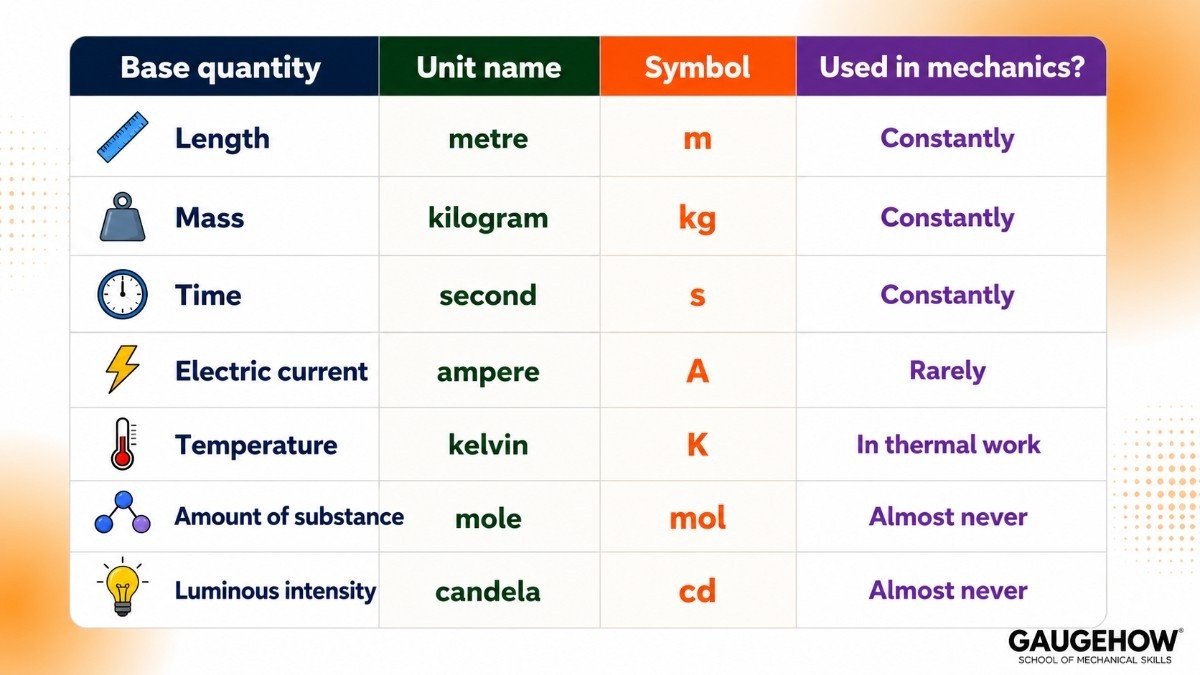
For engineering mechanics, your world is essentially metre, kilogram, second. Sometimes written as the MKS system.
One quirk worth noticing. The kilogram is the only base unit that already carries a prefix, the "kilo". That is a historical accident, and it is exactly why students get confused about grams later on.
Torque and energy share the same base units
Both torque and work come out as kg·m²/s². Dimensionally identical. But one is measured in newton metre and the other in joules, and engineers never swap the names.
Why? Because torque is a vector with a rotational direction, and energy is a scalar with no direction at all. They are physically different things that happen to share dimensions. Keeping the unit names separate stops people adding them together by accident.
If you write "the bolt was tightened to 40 joules" in an interview, you will get a look.
Why Force Is Measured in Newtons, Not Kilograms
Walk into any Indian market and ask for 2 kg of rice. Nobody says 19.62 newtons. So why does engineering insist?
Because mass and weight are different quantities.
Mass is how much matter something contains. It is a scalar. Measured in kilograms (kg). It never changes.
Weight is the force gravity pulls on that mass with. It is a vector, pointing down. Measured in newtons (N). It changes with location.
The link between them:
W = m × g
W = weight in newtons (N)
m = mass in kilograms (kg)
g = acceleration due to gravity, 9.81 m/s² on Earth
So a 70 kg person weighs 70 × 9.81 = 686.7 N, not 70 kg. Take the same person to the Moon and their mass is still 70 kg, but their weight drops to about 113 N because lunar gravity is roughly 1.62 m/s².
Your bathroom scale reads kilograms because it has been calibrated for Earth's gravity and quietly divides by 9.81 for you. It is measuring a force and reporting a mass. Convenient for shopping. Wrong for engineering.
The kilogram-force trap
You will still meet kgf (kilogram-force) in older Indian textbooks, on machine nameplates and in workshop drawings.
1 kgf = 9.81 N
If a hydraulic press is rated for 10 tonnes, that usually means 10 tonne-force, which is 10,000 kgf, which is 98,100 N or 98.1 kN. Not 10,000 N. Getting that wrong by a factor of 9.81 is not a rounding error. It is a failed component.
The N/mm² and MPa Trap

This one comes up in every stress calculation, and it is the source of endless doubt.
1 N/mm² = 1 MPa. Exactly. They are the same thing.
Here is the proof, and it is worth doing once so you never doubt it again:
1 mm = 10⁻³ m, so 1 mm² = 10⁻⁶ m²
Therefore 1 N/mm² = 1 N ÷ 10⁻⁶ m² = 10⁶ N/m² = 10⁶ Pa = 1 MPa
That is why mechanical drawings and material datasheets happily use both. A steel with 250 MPa yield strength has a yield strength of 250 N/mm². Same number, no conversion needed.
This is also why engineers love working in newtons and millimetres. Feed the formula force in N and area in mm², and stress pops out directly in MPa, which is exactly the unit every material datasheet is written in. No conversion step, no factor of a million to lose.
Dimensional Analysis: Check Any Formula in Ten Seconds
Here is a skill worth more than most of the formulas you memorise.
Dimensional analysis means checking that both sides of an equation have the same units. If they do not, the formula is wrong. Guaranteed. No exceptions.
The three mechanical dimensions are written as:
M for mass
L for length
T for time
So force, which is mass times acceleration, has dimensions:
[F] = M × L·T⁻² = MLT⁻²
Try it on a formula
Is v² = u² + 2·a·s dimensionally correct?
Left side: velocity squared = (LT⁻¹)² = L²T⁻²
Right side, term 1: same thing, L²T⁻²
Right side, term 2: acceleration × distance = (LT⁻²) × (L) = L²T⁻²
All three terms are L²T⁻². The formula survives. The number 2 has no dimensions, so it is free to sit there.
Now catch an error
A student writes F = m·v for force.
Left side: MLT⁻²
Right side: M × LT⁻¹ = MLT⁻¹
They do not match. One is missing a T⁻¹. So the formula is wrong, and you knew that in five seconds without remembering a single law of motion.
What the student actually wrote is momentum, not force. Dimensional analysis caught it instantly.
Use this in exams. When you are unsure whether you have remembered a formula correctly, check the dimensions. It cannot tell you if you have the wrong constant, but it will catch a wrong structure every single time.
Unit Conversion Guide
🔶 Force Conversions
Most common when solving statics and dynamics problems.
ConversionValue1 kgf → N× 9.811 tonne-force → kN× 9.811 lbf → N× 4.4481 kN → N× 1000
Remember: Engineering mechanics equations always use Newtons (N).
🔷 Pressure & Stress Conversions
Used in Strength of Materials and Machine Design.
ConversionValue1 MPa → N/mm²1 ✅1 MPa → Pa× 1,000,0001 GPa → MPa× 10001 bar → Pa× 100,0001 bar → MPa× 0.11 atm → Pa101,3251 psi → kPa× 6.8951 kgf/cm² → MPa× 0.0981
💡 Shortcut: 1 MPa = 1 N/mm²
📏 Length & Area Conversions
Frequently used in engineering drawings and CAD.
ConversionValue1 m → mm× 10001 m² → mm²× 1,000,0001 inch → mm25.41 m⁴ → mm⁴× 10¹²
⚠️ Remember: Area and moment of inertia require squared and fourth-power conversions.
⚡ Energy & Power Conversions
Common in thermodynamics and machine calculations.
ConversionValue1 kJ → J× 10001 kWh → J× 3,600,0001 hp (metric) → W735.51 hp (imperial) → W745.71 kW → W× 1000
💡 Easy memory:
1 kWh = 3.6 MJ
🚗 Speed Conversions
Used in Dynamics, Vibrations, and Machine Design.
ConversionValue1 km/h → m/s× 0.2778 (÷ 3.6)1 m/s → km/h× 3.61 rpm → rad/s× 0.1047 (π/30)
⭐ Exam Tip
Motor nameplates are almost always given in rpm, but engineering mechanics and dynamics equations require rad/s. Always convert before substituting values.
Where Unit Errors Actually Cost Money

The Mars Climate Orbiter is the famous one, but the everyday failures are smaller and far more common.
In CAD and simulation. Set your model in millimetres, then apply a load thinking in metres, and your stress result is out by a factor of a million. The software will not warn you. It will produce a beautiful, colourful, completely wrong contour plot. This is the single most common beginner error in FEA, and it is why FEA with ANSYS spends real time on unit systems before touching a solve. The same trap sits inside Fusion 360 static stress studies.
On the shop floor. A drawing dimensioned in inches, read by someone assuming millimetres. A torque spec of 40 N·m applied as 40 kgf·m, which is 392 N·m, and the bolt snaps.
In procurement. A press rated 100 tonnes is not 100 kN. It is 981 kN. Order the wrong frame and you have bought scrap.
The pattern is always the same. The formula was right. The arithmetic was right. Somebody just never checked what the numbers meant. Engineers who work in design and simulation roles develop the habit of writing the unit next to every single number, every time. It looks pedantic. It is the cheapest insurance in engineering.
FAQ
Q: What are the SI units used in engineering mechanics?
A: The three base units are metre for length, kilogram for mass and second for time. From these come the derived units used constantly in mechanics: newton (N) for force, newton metre (N·m) for moment, pascal (Pa) for stress and pressure, joule (J) for work and energy, and watt (W) for power.
Q: Is 1 N/mm² the same as 1 MPa?
A: Yes, exactly the same. Since 1 mm² equals 10⁻⁶ m², one newton per square millimetre works out to one million pascals, which is one megapascal. This is why engineers prefer working in newtons and millimetres, because stress comes out directly in MPa.
Q: Why is force measured in newtons and not kilograms?
A: Kilograms measure mass, which is the amount of matter in a body and never changes. Newtons measure force, including weight, which is mass multiplied by gravitational acceleration. A 70 kg person has a weight of about 687 N on Earth, and only about 113 N on the Moon, while their mass stays at 70 kg.
Q: What is 1 kgf in newtons?
A: One kilogram-force equals 9.81 newtons, because it is the weight of one kilogram under standard Earth gravity of 9.81 m/s². Machine ratings given in tonnes almost always mean tonne-force, so a 10 tonne press applies roughly 98.1 kN.
Q: What is dimensional analysis used for?
A: It checks whether both sides of an equation have the same units. If they do not, the formula is definitely wrong. It is the fastest way to catch a misremembered formula in an exam, though it cannot verify dimensionless constants.
Q: Should I use 9.81 or 10 for g?
A: Use 9.81 m/s² unless the question tells you otherwise. Using 10 is acceptable for a rough sanity check, but it introduces a 2 percent error, which is enough to lose marks in a numerical answer.
The Bottom Line
SI units in engineering mechanics come down to three habits.
Write the unit next to every number. Not at the end. Every line.
Convert everything to one consistent system before you start. Newtons and millimetres is the practical choice for anything involving stress, because MPa falls out for free.
Check your dimensions when a formula feels shaky. It takes ten seconds and it catches structural errors that no amount of careful arithmetic will.
The engineers who never have unit disasters are not the ones with better memories. They are the ones who never skip these three steps, even when the problem looks trivial.
Want to see units bite in real software? Watch what happens to a stress result when the model units are set wrong in FEA with ANSYS, or test your conversions with the GaugeHow practice tests. Browse everything at GaugeHow Courses.
Internal links used (all from GaugeHow catalog):
FEA with ANSYS: https://gaugehow.com/course/fea-finite-element-analysis-with-ansys
Fusion 360: https://gaugehow.com/course/fusion-360
Design Engineer track: https://gaugehow.com/design-engineer
CAE / Simulation Engineer track: https://gaugehow.com/cae-simulation-engineer
Practice / MCQ Tests: https://gaugehow.com/practice
All Courses: https://gaugehow.com/course