Engineering Mechanics
Three Force Member: Meaning, Conditions and Examples
Think about a street lamp arm that sticks out from a pole and holds a light at its end. It feels the weight of the lamp, a pull from a support cable, and a push from the pole joint. That is three forces on one part, and that part is a three force member.
If you have already met the two force member, this is the next step up. It has one more force, and that single extra force changes the rules in a neat, predictable way.
Students often find this topic tricky at first, but there is one simple idea that unlocks all of it. Once you learn where the three forces must point, the problems become quick.
In this guide we will cover what a three force member is, the two conditions it must satisfy, why the forces meet at a point, how it differs from a two force member, a solved example, and where engineers use it.
What Is a Three Force Member?
A three force member is a body that has forces acting on it at exactly three points, with no other loads and no applied moment.
Take that lamp arm again. The weight of the lamp acts at the tip, the support cable pulls at one point, and the joint at the pole pushes at another. Three separate forces, three separate points. That makes it a three force member.
Unlike a two force member, the three forces do not have to line up along one straight line. They can point in different directions. That extra freedom is exactly why these members can carry bending, not just simple pull or push.
You will meet three force members in beams, brackets, levers, and cranes, basically anywhere a part feels a load plus two supports.
Conditions for a Three Force Member
For a three force member to stay in equilibrium, the three forces must obey one of two conditions. There are no other options.
The first and most common case is that the three forces must be concurrent. This means their lines of action all pass through one single common point. Extend each force as a straight line, and all three lines cross at the same spot.
The second case covers a special situation: if the three forces happen to be parallel, they cannot meet at a point. Parallel lines never cross. In that case the member can still be in equilibrium as long as the forces balance out in the usual way.
So the rule is simple to state. Three forces on a body in equilibrium are either concurrent, meaning they meet at one point, or they are all parallel. Nothing in between works.

Why the Three Forces Must Be Concurrent
This is the part worth understanding, not just memorising. The reason comes straight from moment balance.
For any body in equilibrium, two things must be true. The forces must add to zero, and the turning effects, called moments, must also add to zero.
Now imagine two of the three forces. Extend their lines of action until they cross at a point. Call that point O. About point O, those two forces create no moment, because their lines pass right through it.
Here is the key step. For the total moment about O to be zero, the third force must also create no moment about O. The only way that happens is if the third force line also passes through O.
So all three lines are forced to pass through the same point. That is why a three force member in equilibrium must be concurrent. The parallel case is just the special version where that meeting point sits infinitely far away.
How to Solve a Three Force Member Problem
Here is why the concurrency rule is so useful. Once you know all three forces meet at one point, you can slide them to that common point and treat the whole thing like a particle.
That means the same simple equilibrium tools you already know apply directly:
The two component equations. Write ΣFx = 0 and ΣFy = 0, where ΣFx is the sum of all horizontal forces and ΣFy is the sum of all vertical forces. Both must equal zero.
The force triangle. Since three balanced forces form a closed triangle when drawn tip to tail, you can solve them using simple trigonometry or even by scale drawing.
Lami's theorem. For three concurrent forces, each force divided by the sine of the angle between the other two is the same. This is a fast shortcut you will use often.
The clever trick in many exam problems is to use concurrency to find an unknown direction first. If you know the lines of two forces, their crossing point tells you the direction of the third one, because it must also pass through that point.
Solved Example: Three Concurrent Forces on a Bracket
Let us do a small one so the idea sticks.
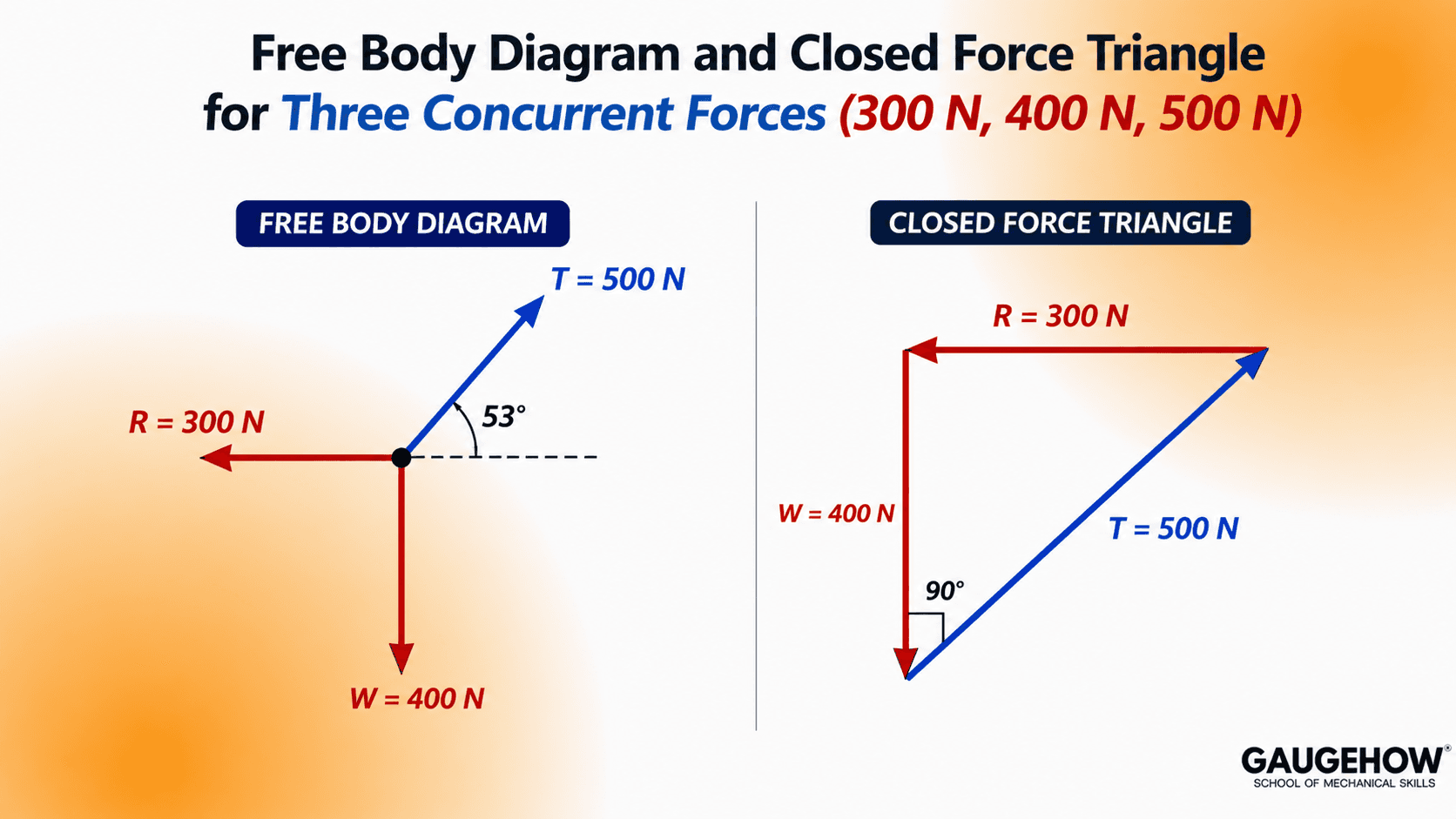
A bracket is held in equilibrium by three forces that meet at a common point. A load of 400 N pulls straight down. A cable pulls up and to the right at 53 degrees above the horizontal, with tension T. A hinge provides a horizontal reaction R. Find T and R.
Step 1. Confirm concurrency. All three forces pass through the same point, so we can treat that point like a particle and use the component equations.
Step 2. Balance the vertical direction, ΣFy = 0. Only the cable and the weight act up or down. So T times sin 53 must equal 400. Since sin 53 is about 0.8, we get 0.8 T = 400.
Step 3. Solve for the cable tension. That gives T = 500 N.
Step 4. Balance the horizontal direction, ΣFx = 0. The cable pulls right, the hinge pushes left, so R equals T times cos 53. Since cos 53 is about 0.6, R = 500 times 0.6.
Step 5. Solve for the reaction. That gives R = 300 N.
So the cable carries 500 N and the hinge reaction is 300 N. Notice the neat 3, 4, 5 pattern hiding inside, which is common in these problems.
Three Force Member vs Two Force Member
Students mix these two up constantly, so let us make the line clear.
A two force member has forces at only two points. Those forces must be equal, opposite, and collinear, meaning they sit on the same straight line. The member is in pure tension or pure compression, with no bending. A cable or a truss diagonal is the classic case.
A three force member has forces at three points. The forces do not sit on one line. Instead they must be concurrent, all meeting at a common point, or all parallel. Because the forces come from different directions, these members usually bend as well as carry axial load.
The easy way to remember it: two forces line up straight, three forces meet at a point. A simple beam with two supports and a central load is a good three force member to picture.
If you want the full picture of the simpler case, it is worth reviewing two force members alongside this, since real structures almost always mix both.
Common Examples of Three Force Members
These show up everywhere once you start looking.
A simple beam. Supported at two ends with a load in the middle, it feels three forces at three points.
A leaning ladder. Weight at the centre, a push from the ground, and a push from the wall. Three forces, and their lines meet at a point.
A crane jib or boom. The load at the tip, a support cable, and the pin at the base form a classic three force member.
A bracket or lever. An applied load plus two support reactions is a very common exam setup.
In each case, the moment you confirm there are three forces and they are not parallel, you know the lines of action must cross at one point. That fact alone often solves half the problem.
Where Engineers Use Three Force Members
This is not just a textbook idea. The concurrency rule is a real design and checking tool.
Structural engineers use it to find the direction of hidden support reactions in frames and brackets before any numbers are calculated. Mechanical engineers use it on levers, links, and clamps to size pins and joints safely. It is also the backbone of analysing frames and machines, which mix two force and three force members together.
When these hand methods move into software, the same loads and supports become the inputs to a stress model. To see how force systems on real parts are solved and checked, the FEA with ANSYS course walks through the full workflow. And to build and load test your own brackets and levers first, the Fusion 360 course covers force analysis right inside the CAD model.
Key Points to Remember
A three force member has forces at three points, with no applied moment. For equilibrium, the three forces must be concurrent, meaning their lines meet at one point, or they must all be parallel. This rule comes straight from moment balance about the point where two of the forces cross. Once concurrency is known, you can treat the meeting point like a particle and solve with ΣFx = 0, ΣFy = 0, a force triangle, or Lami's theorem. Unlike two force members, three force members usually carry bending, not just tension or compression.
Frequently Asked Questions
What is a three force member in simple words? It is a body that has forces acting on it at three different points, with no applied moment. For it to stay balanced, those three forces must either meet at one common point or all be parallel.
What are the conditions for a three force member? The three forces must be concurrent, meaning their lines of action pass through a single point, or they must all be parallel. If neither is true, the body cannot be in equilibrium.
Why must the three forces be concurrent? Take the point where two of the forces cross. Those two make no moment about that point. For the total moment to be zero, the third force must also pass through that point, so all three lines meet there.
What is the difference between a two force member and a three force member? A two force member has two forces that are equal, opposite, and on one straight line, giving pure tension or compression. A three force member has three forces that meet at a point or run parallel, and it usually bends.
Can a three force member be solved using Lami's theorem? Yes. Because the three forces are concurrent, they act like forces at a single point. Lami's theorem, the force triangle, and the component equations all work for finding the unknown forces.
Conclusion
The three force member looks harder than the two force member, but it rests on one clean idea: three balanced forces on a body must meet at a single point. Learn that, and you can find directions and magnitudes fast.
Confirm the three forces, find where two of their lines cross, and treat that point like a particle. From there it is just tidy trigonometry.
Want to test yourself on this and other statics topics? Work through the question sets on the GaugeHow Practice and MCQ hub, and review commonly asked theory at the Engineering Interview Q&A hub before your next exam or placement.
Internal links used: FEA with ANSYS (https://gaugehow.com/course/fea-finite-element-analysis-with-ansys), Fusion 360 (https://gaugehow.com/course/fusion-360), Practice / MCQ Tests (https://gaugehow.com/practice), Interview Q&A Hub (https://gaugehow.com/interview)