Engineering Mechanics
Two Force Member: Meaning, Conditions and Examples
Ever played tug of war? The rope has two teams pulling on it, one at each end, and nothing pushing on it in the middle. That rope is a perfect real-life two force member.
If you are studying equilibrium of particles and this term keeps popping up in your notes, do not worry. It sounds fancy, but the idea behind a two force member is one of the simplest and most useful shortcuts in all of statics.
Once you understand it, a whole class of problems that used to take pages of equations can be solved in a couple of lines. That is why examiners love it and why every mechanical and civil student needs it locked in.
In this guide we will cover what a two force member is, the three conditions it must satisfy, why it is always in tension or compression, a solved example, and how it differs from a three force member.
What Is a Two Force Member?
A two force member is a body that has forces acting on it at only two points, and nothing else. No other loads in between, no applied moments, and its own weight is treated as too small to matter.
Think of a straight metal link connected by a pin at each end. One pin pushes or pulls at one point, the other pin pushes or pulls at the second point. That is it. Two locations, two forces.
Because only two forces are involved, the body has to arrange itself in a very specific way to stay still. And that specific arrangement is what makes these members so easy to analyse.
You will see two force members everywhere once you know the pattern: cables, ropes, links, struts, connecting rods, and every single member inside a simple truss.
Conditions for a Two Force Member
For a body to qualify as a two force member and stay in equilibrium, three conditions must all be true at the same time. Miss any one of them, and it is no longer a two force member.
The three conditions are:
Equal in magnitude. The two forces must have exactly the same size. If one end feels 500 N, the other end also feels 500 N.
Opposite in direction. The two forces must point in exactly opposite directions. One pulls out, the other pulls out on the far side, or both push in.
Collinear. Both forces must act along the same straight line, which is the line joining the two points where the forces are applied.
There is also a fourth practical rule you should remember for problems: the member must be connected only at its two ends (usually by frictionless pins), with no load and no couple acting anywhere between those ends, and its self weight must be negligible.
If all of these hold, the force at both ends must run straight along the line connecting the two joints. Nothing else keeps the member balanced.
[IMAGE: Free body diagram of a straight two force member AB. Pin at point A on the left, pin at point B on the right. A force F acts at A pointing left along the line AB, and an equal force F acts at B pointing right along the same line AB. A dashed line runs through A and B labelled "line of action". Caption text near the member reads "equal, opposite, and collinear". Alt text: diagram of a two force member showing equal opposite and collinear forces along line AB.]

Why the Forces Must Be Equal, Opposite and Collinear
This is where most students just memorise the rule. But the reason is actually simple, and understanding it means you will never forget it.
For any body sitting still, two things must be true. The forces must add up to zero, and the moments must add up to zero.
Start with the forces. If only two forces act on the body and they must cancel out, then they have to be equal in size and point in opposite directions. That takes care of two conditions right away.
Now the moments. Imagine the two forces are equal and opposite but sit on two different parallel lines. That setup would create a turning effect, called a couple, and the body would spin. Since a body in equilibrium cannot spin, the two forces are forced onto the same line. That gives you collinear.
So the three conditions are not random rules. They fall straight out of the two basic equilibrium requirements you already know.
Two Force Member in Tension or Compression
Here is the payoff. Because the force always runs along the line joining the two ends, a two force member can only do one of two things: get pulled or get squeezed.
When the two forces pull the member outward from both ends, the member is in tension. Think of a rope in tug of war or a cable holding a signboard. It is being stretched.
When the two forces push the member inward from both ends, the member is in compression. Think of a wooden strut wedged between a wall and a shelf. It is being squeezed.
There is no bending and no shear in a pure two force member. The load is purely axial, meaning it runs along the length of the member. This is exactly why truss members are designed as two force members. Axial loading is efficient and easy to size.
How to Identify a Two Force Member
In an exam, spotting these members quickly saves huge amounts of time. Run this quick mental check on any member in a structure:
Is the member connected to the rest of the structure at only two points?
Are those connections pins, so they cannot carry a moment?
Is there any load or force applied anywhere between the two ends? There should be none.
Is the weight of the member small enough to ignore compared to the loads?
If the answer fits all of these, you have a two force member. You now know the direction of the force straight away. It acts along the line joining the two pins. You only need to find one number, the magnitude, because both ends carry the same value.
Solved Example: Force in a Diagonal Link
Let us try a small one so the idea sticks.
A straight diagonal link AB is pinned at both ends and carries no load in between. From the analysis of the joint at B, we find a pull of 5 kN acting on the member at B, directed along the member toward A.
Step 1. Confirm it is a two force member. Forces act at A and B only, both connections are pins, nothing acts in between, and weight is ignored. Yes, it qualifies.
Step 2. Apply the tension condition. The force at A must be equal, opposite, and collinear with the force at B. So the force at A is also 5 kN, acting along the member, pointing toward B.
Step 3. Check equilibrium. The sum of forces along the member is 5 kN minus 5 kN, which equals 0. Equilibrium is satisfied, written as ΣF = 0, where ΣF means the total of all forces on the body.
Step 4. State the result. The member carries 5 kN. Since both forces pull the ends outward, member AB is in tension.
Notice that you never had to break anything into x and y components. The two force member rule handed you the direction, so only the size was left to state. That is the shortcut in action.
Two Force Member vs Three Force Member
Students mix these two up all the time, so let us make the difference clear.
A two force member has forces at two points only. The forces are equal, opposite, and collinear, and the member is in pure tension or compression. A cable or a truss diagonal is the classic case.
A three force member has forces at three different points. Here the forces do not have to be collinear. Instead, for equilibrium, the three forces must either be parallel or meet at a single common point. That meeting point rule is called being concurrent.
A simple beam with two supports and one load in the middle is a good example of a three force member. It feels force at three places, and it bends, unlike a clean two force member.
The takeaway: two force members are the easy ones because the direction is already fixed by geometry. Three force members need a bit more work using the concurrency idea.
Where Engineers Use Two Force Members
This is not just an exam topic. Two force members are the backbone of real design.
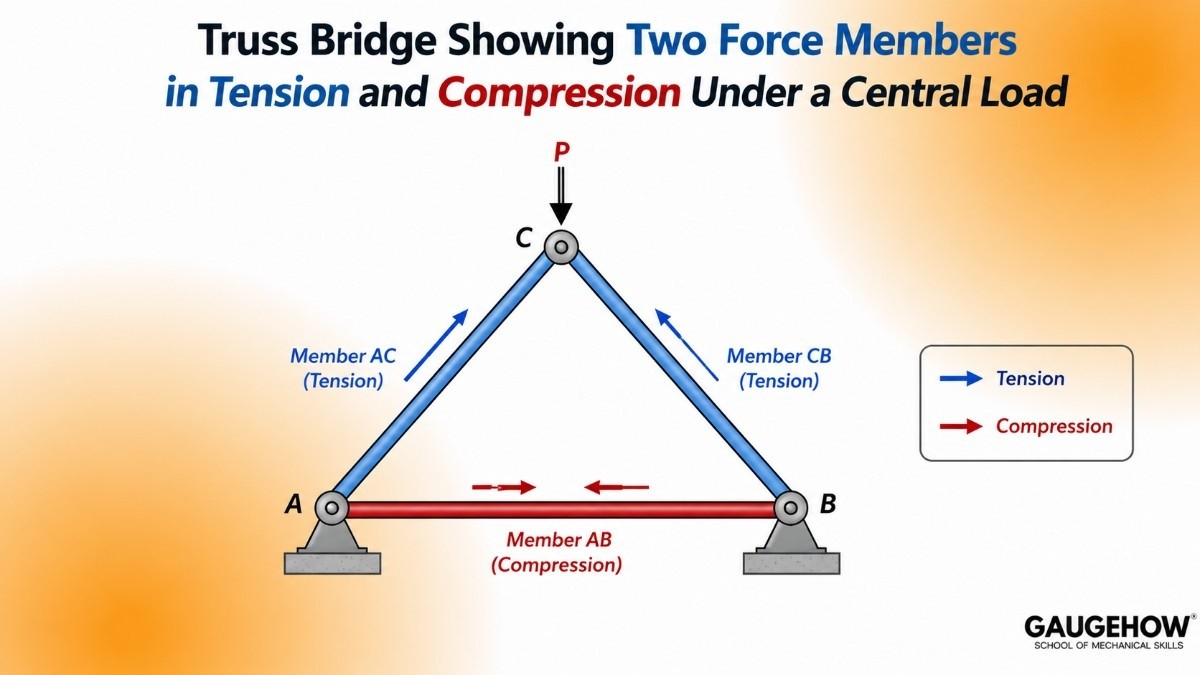
Every member in a truss, such as a roof truss, a bridge truss, or a transmission tower, is treated as a two force member. That single assumption is what makes truss analysis by the method of joints and method of sections possible.
You also see them as connecting links and struts in machines, hydraulic cylinders in cranes and excavators, cables in suspension systems, and tie rods in steel frames. In each case the part is loaded only at its two ends.
When engineers move from hand calculations to software, these same members are the first things checked in a stress model. If you want to see how axial forces in members are solved on real structures, the FEA with ANSYS course walks through it step by step. And if you would rather start by building and load testing simple parts, the Fusion 360 course covers force analysis right inside the CAD model.
[IMAGE: Simple triangular truss bridge with three joints and three members labelled. Arrows on two members show tension pulling outward and one member shows compression pushing inward, with a downward load applied at the top joint. Colour code: tension members in blue, compression member in red. Alt text: truss bridge showing two force members in tension and compression under a central load.]
Key Points to Remember
A two force member is loaded at only two points, with no moment and negligible weight. For equilibrium, the two forces must be equal, opposite, and collinear along the line joining the two points. This forces the member into either pure tension or pure compression, never bending. Spotting one instantly tells you the direction of the force, so only the magnitude is left to find. Trusses are built entirely from two force members, which is why they are so quick to analyse.
Frequently Asked Questions
What is a two force member in simple words?
It is a body that has forces acting on it at only two points and nothing else. To stay balanced, those two forces must be equal in size, opposite in direction, and act along the same straight line.
Is a two force member always straight?
Most are straight, but not all. Even a curved or bent link is a two force member if force is applied at only two points. The important thing is that the two forces still line up along the straight line joining those two points, not along the shape of the member.
Is a two force member in tension or compression?
Always one or the other. If the forces pull the two ends apart, it is in tension. If they push the ends together, it is in compression. There is no bending or shear in a pure two force member.
How is a two force member different from a three force member?
A two force member has forces at two points that are equal, opposite, and collinear. A three force member has forces at three points that must be concurrent or parallel. Two force members carry pure axial load, while three force members usually bend.
Why are two force members important in trusses?
Every member of an ideal truss is a two force member. This lets engineers assume each member carries only axial force, which makes the method of joints and method of sections work. Without this assumption, truss analysis would be far harder.
Conclusion
The two force member is one of those rare topics that is both easy to learn and hugely useful. Once you can spot one, you already know the direction of its force and only need a single number to finish the problem. That is a real advantage in exams and in design work.
Lock in the three conditions, remember that these members only pull or push along their axis, and practise identifying them inside trusses and frames.
Ready to test yourself on this and other statics concepts? Try the free question sets on the GaugeHow Practice and MCQ hub, and brush up on commonly asked theory at the Engineering Interview Q&A hub before your next test or placement.
Internal links used: FEA with ANSYS (https://gaugehow.com/course/fea-finite-element-analysis-with-ansys), Fusion 360 (https://gaugehow.com/course/fusion-360), Practice / MCQ Tests (https://gaugehow.com/practice), Interview Q&A Hub (https://gaugehow.com/interview)