Unit Conversion in Engineering Mechanics
Most students convert units by feel. Multiply by 1000, or was it divide? Move the decimal, hope for the best.
That works right up until you meet mm⁴, or kgf/cm², or a motor rated in rpm feeding a formula that wants rad/s. Then the guessing collapses.
There is a method that never fails, works for every unit you will ever meet, and takes about the same time as guessing. This guide covers it, plus the conversion tables you actually need and the specific traps that catch people in unit conversion in engineering mechanics.
What Is Unit Conversion in Engineering Mechanics?
Unit conversion means expressing the same physical quantity in a different unit without changing its actual value.
A force of 1 kN and a force of 1000 N are the same force. Nothing about the physical world changed. Only the label did.
The reason engineers do this constantly is that the world does not agree on units. Your textbook works in newtons and metres. The material datasheet quotes MPa. The hydraulic press nameplate says 10 tonnes. The imported drawing is in inches. The motor is rated in rpm and horsepower.
All of it has to end up in one consistent system before you can put it into a formula. Skip that step and the maths will still produce a number. It will just be the wrong number, delivered with total confidence.
The Unit Factor Method: Convert Anything, Every Time
Stop memorising which way to multiply. Use this instead.
The idea is simple. A conversion factor is a fraction that equals 1.
Since 1 m = 1000 mm, both of these fractions equal exactly 1:
(1000 mm ÷ 1 m) and (1 m ÷ 1000 mm)
Multiplying by 1 never changes a value. So you can multiply by either of these as often as you like. The trick is to choose the one that cancels the unit you want to get rid of.
Worked example: 5 m/s to km/h
Two things to fix. Metres must become kilometres. Seconds must become hours.
5 m/s × (1 km ÷ 1000 m) × (3600 s ÷ 1 h)
Now cancel. The m on top cancels the m on the bottom. The s on the bottom cancels the s on top.
Left with: 5 × 3600 ÷ 1000 = 18 km/h
You never had to decide whether to multiply or divide. The cancellation decided for you. Set the fractions so the unwanted units cancel, and the arithmetic is automatic.
Why this matters for squared and cubed units
Here is where guessing dies and the method saves you.
Convert 1 m² to mm².
Wrong instinct: multiply by 1000.
Do it properly. m² means m × m, so apply the factor twice:
1 m² × (1000 mm ÷ 1 m) × (1000 mm ÷ 1 m) = 1,000,000 mm²
One million, not one thousand. Off by a factor of 1000 if you guessed.
Now try 1 m⁴ to mm⁴ (this is the unit for area moment of inertia, and it appears in every bending calculation).
Apply the factor four times: 1000⁴ = 10¹² mm⁴
A trillion. Nobody guesses that correctly.
The rule: when a unit is raised to a power, the conversion factor is raised to that same power. Squared units get the factor squared. Fourth power units get the factor to the fourth.
Pressure and Stress Unit Conversion
Every material datasheet, every hydraulic gauge and every drawing uses a different one of these.
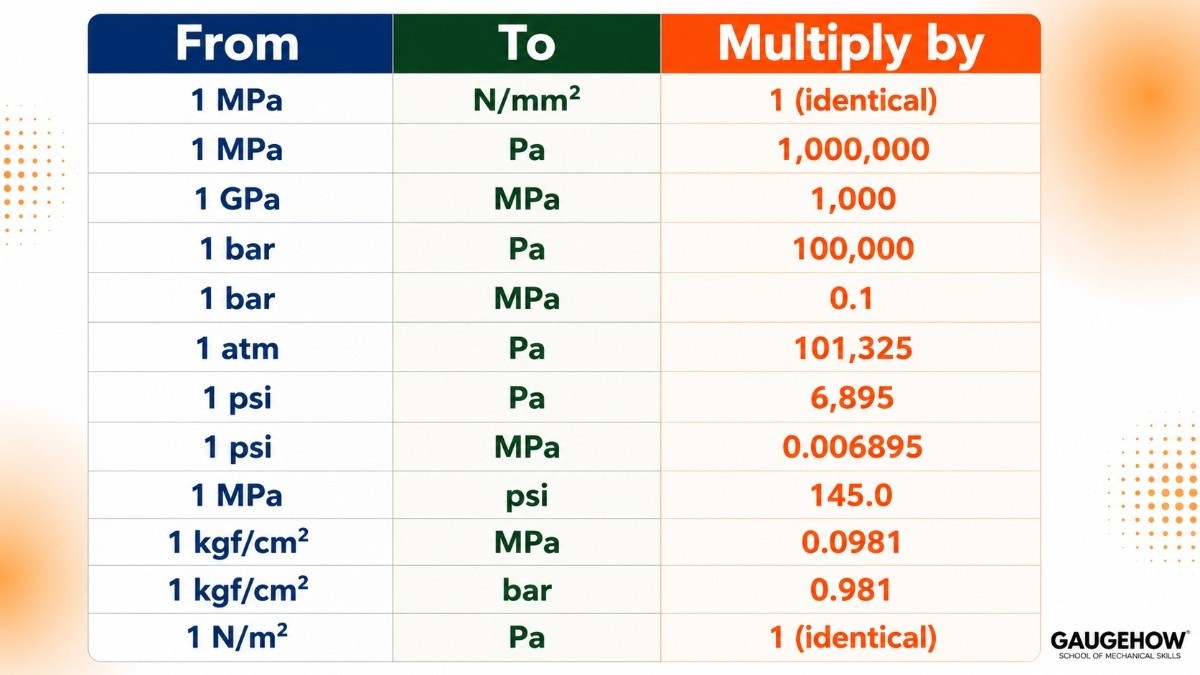
Why 1 N/mm² equals 1 MPa exactly
This one confuses students permanently, so prove it once and be done.
1 mm = 10⁻³ m, so 1 mm² = 10⁻⁶ m²
1 N/mm² = 1 N ÷ 10⁻⁶ m² = 10⁶ N/m² = 10⁶ Pa = 1 MPa
They are the same unit. A steel with 250 MPa yield strength has 250 N/mm² yield strength. No conversion needed, ever.
The near-miss that fools everyone
1 kgf/cm² ≈ 1 bar, and 1 bar ≈ 1 atm.
They are close. 0.981 versus 1.0. Only 2 percent apart, which is why workshop pressure gauges often print both and nobody argues.
But 2 percent is not zero. In a design calculation with a tight factor of safety, it is enough to matter. Convert properly.
Length, Area and Moment of Inertia Conversion
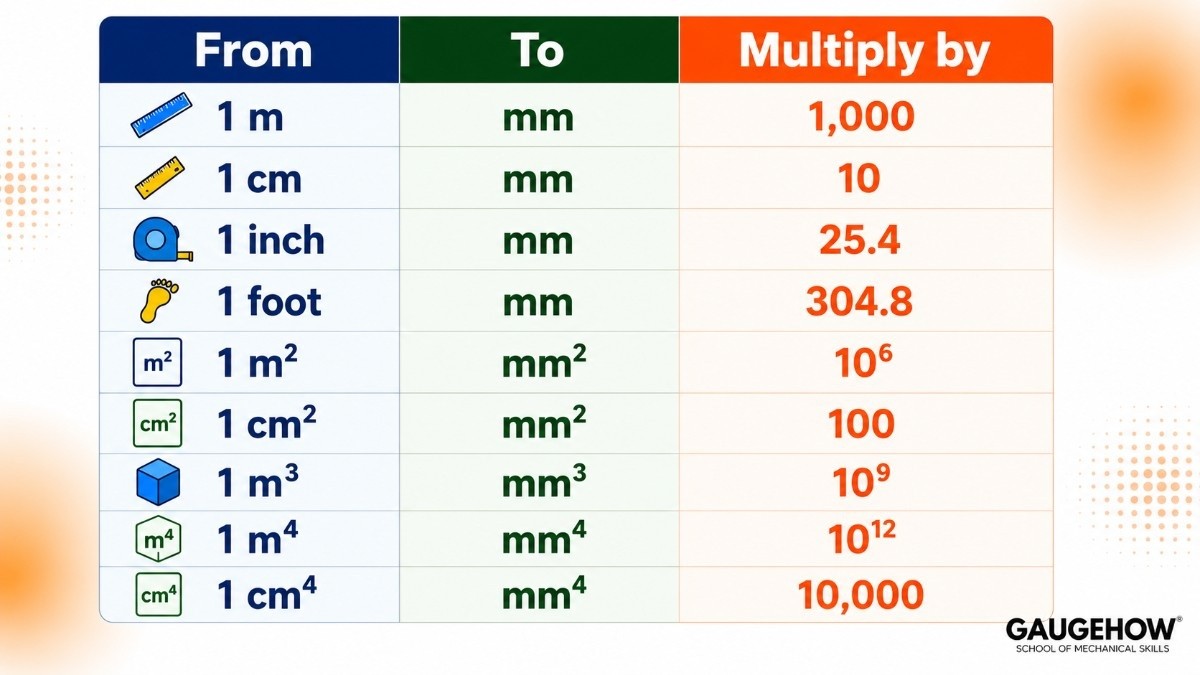
The inch is exactly 25.4 mm. Not approximately. That is a defined value, agreed internationally in 1959.
Watch the last two rows. Area moment of inertia (the I in bending formulas) is in m⁴ or mm⁴, and the conversion factors are enormous. Standard steel section tables from European sources often quote I in cm⁴, and a beam with I = 5,000 cm⁴ has I = 5 × 10⁷ mm⁴. Getting that wrong throws your deflection calculation out by four orders of magnitude.
Energy and Power Unit Conversion

Two horsepowers, genuinely
There are two definitions in common use. Metric horsepower (PS, used across Europe and India) is 735.5 W. Imperial or mechanical horsepower (used in the US and UK) is 745.7 W.
The gap is about 1.4 percent. Small, but it is why the same car engine gets quoted with slightly different bhp figures in different markets. When a datasheet says hp without specifying, check the origin of the document.
The rpm trap
This one catches almost everybody in dynamics.
Every motor nameplate gives rpm. Every rotational formula wants rad/s.
Where does 0.1047 come from? One revolution is 2π radians, and one minute is 60 seconds:
1 rpm = 2π rad ÷ 60 s = π/30 = 0.1047 rad/s
So a 1,440 rpm induction motor is spinning at 1,440 × 0.1047 = 150.8 rad/s.
Feed 1,440 straight into a centripetal acceleration or torque formula and your answer is out by a factor of about 9.5. It will look plausible. It will be nonsense.
Common Unit Conversion Mistakes
These are the ones that actually cost marks and money.
1. Forgetting to square or cube the factor. m² to mm² is ×10⁶, not ×10³. m⁴ to mm⁴ is ×10¹². This is the single most common area calculation error.
2. Treating kgf as N. They differ by 9.81. Press ratings, older textbooks and workshop torque specs are riddled with kgf.
3. Confusing capital M with lowercase m. Mega is 10⁶. Milli is 10⁻³. They are a billion apart. 5 MPa and 5 mPa are not the same by any stretch.
4. Converting halfway through a calculation. Convert everything at the start, then never touch units again until the answer. Mid-calculation conversion is where errors hide.
5. Using rpm where rad/s belongs. Factor of 9.5 out, and the number still looks reasonable.
6. Assuming tonne means 1000 N. It means 1000 kg, which is 9,810 N.
7. Dropping units entirely and adding them back at the end. Never do this. Carry the unit through every single line. It looks tedious. It is the cheapest error-checking available.
Consistent Unit Systems for CAD and FEA
This section is the one that separates people who can use simulation software from people who get lucky with it.
FEA solvers do not know what units you are using. They just do arithmetic on the numbers you feed them. If your inputs are consistent with each other, the outputs are correct. If not, you get a beautiful, colourful, completely wrong result, with no warning at all.
FAQ
Q: How do you convert units in engineering mechanics?
A: Use the unit factor method. Multiply your value by fractions that equal 1, arranged so the unwanted units cancel out. For example, to convert m/s to km/h, multiply by (1 km ÷ 1000 m) and (3600 s ÷ 1 h). The cancellation tells you whether to multiply or divide, so you never have to guess.
Q: How many newtons is 1 kgf?
A: 1 kgf equals 9.81 N, because it is the weight of one kilogram under standard Earth gravity of 9.81 m/s². Similarly, a 1 tonne-force is 9,810 N or 9.81 kN, not 1,000 N.
Q: Is 1 N/mm² equal to 1 MPa?
A: Yes, exactly. Since 1 mm² is 10⁻⁶ m², one newton per square millimetre equals 10⁶ pascals, which is 1 megapascal. Material datasheets use the two interchangeably.
Q: How do you convert rpm to rad/s?
A: Multiply rpm by π/30, which is approximately 0.1047. One revolution is 2π radians and one minute is 60 seconds, so 1 rpm equals 2π/60 rad/s. A 1,440 rpm motor runs at about 150.8 rad/s.
Q: Why do I have to square the conversion factor for area?
A: Because area is length multiplied by length, so the conversion factor gets applied twice. Converting m² to mm² means multiplying by 1000 twice, giving 10⁶. For m⁴, the factor is applied four times, giving 10¹².
Q: What units should I use in FEA software?
A: Use a consistent set. The most practical is mm for length, N for force, MPa for stress, tonne for mass and seconds for time. In this system, steel density is 7.85 × 10⁻⁹ t/mm³ and gravity is 9,810 mm/s². Entering density in kg/m³ in a mm-based model is a common and costly error.
The Bottom Line
Unit conversion in engineering mechanics stops being risky the moment you stop guessing.
Use the unit factor method. Let the cancellation decide the direction so you never wonder whether to multiply or divide.
Raise the factor to the same power as the unit. m² gets the factor squared. m⁴ gets it to the fourth.
Pick one consistent system and convert everything into it before you start. For anything involving stress, that system is mm, N and MPa, and the mass unit that comes with it is the tonne.
Do those three things and the entire category of unit disasters, the ones that lose spacecraft and snap bolts, simply stops happening to you.
Want to see units make or break a real result? Watch what happens to a stress plot when the unit system is wrong in FEA with ANSYS, or test yourself with the GaugeHow practice tests. Browse everything at GaugeHow Courses.
Internal links used (all from GaugeHow catalog):
FEA with ANSYS: https://gaugehow.com/course/fea-finite-element-analysis-with-ansys
Fusion 360: https://gaugehow.com/course/fusion-360
CAE / Simulation Engineer track: https://gaugehow.com/cae-simulation-engineer
Practice / MCQ Tests: https://gaugehow.com/practice
All Courses: https://gaugehow.com/course