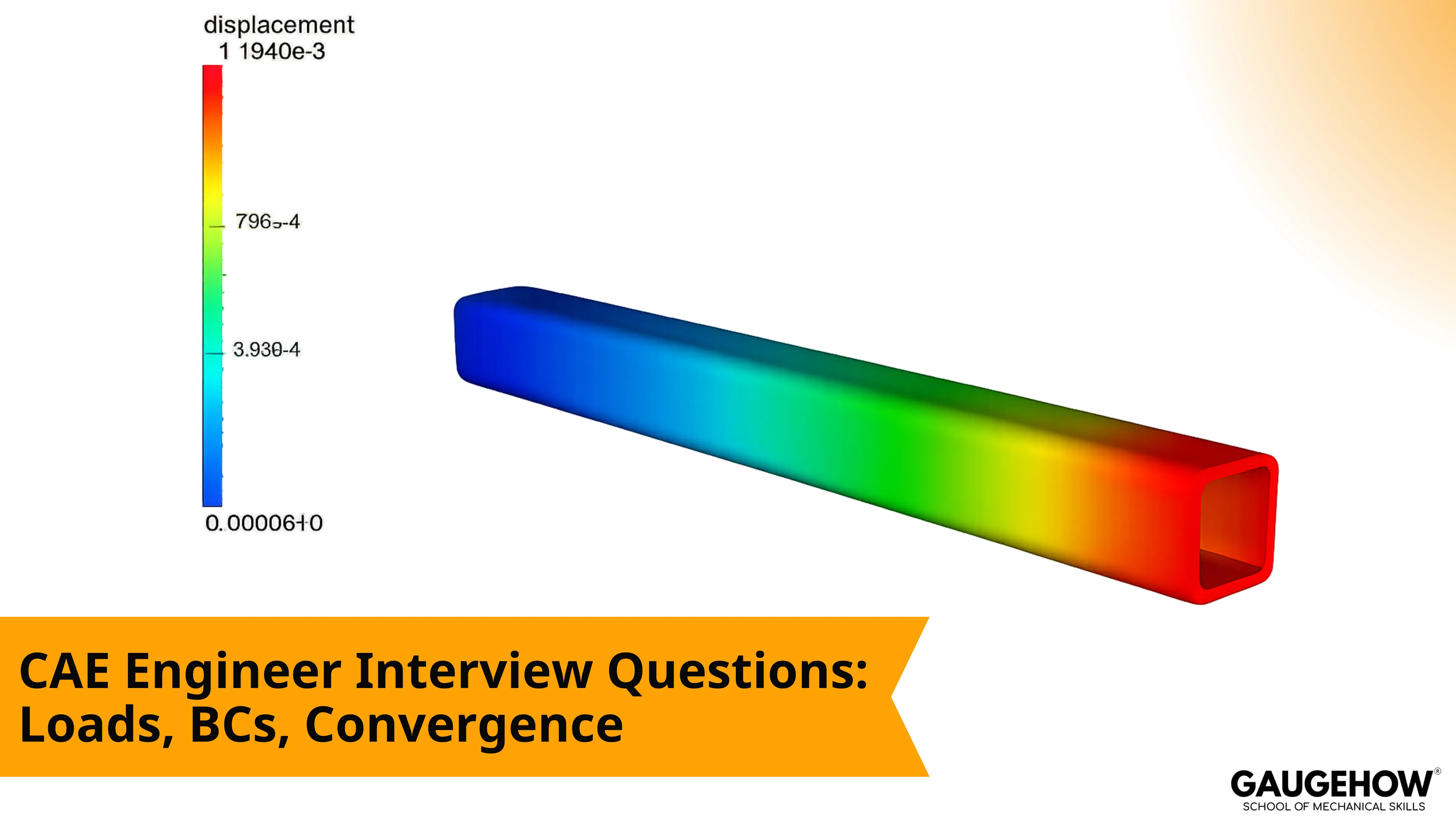
CAE Engineer Interview Questions: Loads, BCs, Convergence

Deepak S Choudhary
Learn More in This Video
Subscribe to GaugeHow for More
A CAE Engineer uses simulation, mainly FEA and CFD, to predict how a product will behave before it is built. This blog focuses on the interview side of that work: how you choose loads and constraints, build a mesh that you can defend, handle contact and nonlinearity, interpret stresses and safety margins, and correlate results with test data.
Feeling stuck because CAE interviews can jump from fundamentals to solver decisions in minutes?
Hiring teams use those jumps to see how you think: whether you can explain assumptions, spot modeling traps, and justify why a result is credible, not just “converged.”
You will walk away with a clear mental map of the topics they probe most and the exact kind of engineering reasoning that keeps your answers calm, sharp, and trusted.
Questions and Answers
1. What is CAE in mechanical engineering, and how is it different from FEA?
CAE is the broader simulation workflow used to guide design. FEA is one method inside CAE, mainly for structural and thermal problems. Interviews test whether you can turn requirements into a validated decision.
2. From start to finish, how do you run a finite element analysis?
Start with the decision metric. Idealize geometry, choose elements, apply materials, loads, and constraints, then run quality checks and mesh convergence. Verify reactions and energy balance, then report margins with assumptions.
3. Which CAE tools have you used (ANSYS, Abaqus, HyperMesh), and what did you do with them?
Name your toolchain by role: pre-processing, solver, and post. Example: HyperMesh for meshing, Abaqus for nonlinear contact, ANSYS for linear studies. Then tie it to outcomes: correlation, margin improvement, or weight reduction.
4. Do you trust hand calculations, or only solver results?
Hand checks bound the answer and catch setup mistakes. A quick free-body, stiffness estimate, or beam stress often exposes wrong constraints, missing loads, or unit errors before solver time is wasted.
5. How do you choose realistic loads and boundary conditions?
Work backward from the real load path. Model fixtures and contacts that match assembly and test. Sanity check with reactions and symmetry so the model cannot create or destroy load.
6. What is 1 N/mm² in MPa, and how do you prevent unit conversion mistakes in CAE?
1 N/mm² equals 1 MPa. I lock one unit system for the whole model, verify material units, and run a quick scale check using reactions and deflection magnitude before trusting stresses.
7. State Hooke’s law in one line, and name one case where it fails.
Stress equals Young’s modulus times strain in the linear elastic range. It fails after yield, under large strains, or with nonlinear materials like rubber, so linear stiffness predictions become wrong.
8. What is Young’s modulus, and what does it control in FEA results?
Young’s modulus sets elastic stiffness. It drives deflection strongly, and it changes load sharing in constrained assemblies. If E is wrong, “good-looking” stresses can still hide a wrong deformation and joint load path.
9. What is Poisson’s ratio, and when does it matter most?
It controls lateral strain under axial load. It matters in 3D stress states, near incompressible materials, and contact pressure problems. Values near 0.5 can cause locking unless the element formulation is appropriate.
10. When do you switch from linear to nonlinear analysis?
Use nonlinear when stiffness changes with deformation, contact opens or slides, plastic strain is expected, or load history matters. If results scale with load and assumptions hold, linear is usually sufficient.
11. How do you decide between bonded, frictionless, and frictional contact?
Bonded fits, welded or glued joints. Frictionless suits separation without shear transfer. Friction is needed for clamp and slip risk. Start simple, then add friction only if it changes the decision metric.
12. What does a singular matrix or rigid body motion warning mean?
It usually means the model has an unconstrained DOF or disconnected parts. Check constraints, contact status, MPCs, and connectivity. After fixing, confirm the reactions balance applied loads.
13. Shell vs solid elements: how do you choose?
Shells work when the thickness is small,l and bending dominates with a valid mid-surface and thickness. Solids fit thick parts, 3D stress states, and contact zones. Mix them only with clean transitions.
14. Tet vs hex elements: what is your default and why?
Hex often performs better in bending per DOF, but tets are faster for complex geometry. Choose based on gradients and turnaround time, then prove accuracy with convergence on the metric that drives the decision.
15. Linear vs quadratic elements: when do you use each?
Linear elements are faster but can be stiff in bending and contact. Quadratic captures curvature and gradients better. If hotspots, contact, or bending dominate, quadratic is safer, then convergence confirms it.
16. What is reduced integration, and when can it fail?
Reduced integration lowers cost but can introduce hourglass modes and artificial compliance. Watch hourglass energy, deformation shape, and stress noise. If hourglass dominates, change formulation or add proper stabilization.
17. What mesh quality checks do you run before solving?
Check distortion, skewness, aspect ratio, Jacobian, and warpage in high gradient zones. Confirm shell normals and thickness directions. Poor quality near contacts and fillets is usually the first thing to fix.
18. How do you perform a mesh convergence study in practice?
Refine only in the load path and hotspot region, then track one metric at a defined location. I stop when the metric change is below a set threshold, for example, less than 5% across refinements.
19. How do you handle stress singularities at sharp corners?
Do not size parts from a single node peak at a sharp reentrant corner. Add a realistic radius, use a defined stress extraction method, or switch to fracture or notch methods based on the requirement.
20. Why can nodal averaged stress be misleading?
Averaging can hide discontinuities and smear peaks, especially at interfaces and contacts. I review unaveraged integration point results and path plots, then report stresses at defined locations for repeatability.
21. How do you model a bolted joint quickly without losing physics?
Start with pretension plus contact on faying surfaces and a connector or beam bolt. If bearing, clamp loss, or local yield drives the decision, sub model with solids and a refined contact mesh.
22. RBE2 vs RBE3: When do you use each?
RBE2 enforces rigid motion and can add stiffness, so use it for genuinely stiff attachments. RBE3 distributes load without forcing rigid motion, so it is safer for load application and flexible couplings.
23. How do you pick an elastic plastic material model?
Match it to the stress-strain curve and load history. Isotropic hardening suits monotonic loading. Kinematic hardening matters for reversal and ratcheting. If the material model ignores the history, fatigue predictions drift.
24. Plasticity, creep, or viscoelastic: how do you choose?
Plasticity is permanent strain from overload. Creep is time dependent strain under sustained load at a temperature. Viscoelasticity is a rate-dependent, recoverable behavior. Service temperature and time scale usually decide the model.
25. S-N vs strain-life fatigue: what is the rule of thumb?
S-N fits high-cycle fatigue when the response is mostly elastic. Strain life fits low-cycle conditions with plastic strain. Mean stress correction and surface finish must be stated because they can shift life dramatically.
26. When do you use fracture mechanics instead of stress-based design?
Use it when cracks are plausible, and inspection is part of the plan. Then crack size and growth rate govern allowable life and interval, not a single peak stress. It makes damage tolerance explicit.
27. Linear buckling vs nonlinear buckling: what do you report?
Eigenvalue buckling gives a mode and idealized load factor, but ignores imperfections. For decisions, use nonlinear with a realistic imperfection shape or tolerance, then reportthe limit load and margin.
28. Implicit vs explicit dynamics: how do you pick?
Implicit fits slower events where equilibrium is meaningful. Explicit fits impact and severe contact where inertia dominates. I decide using event duration, contact severity, and whether quasi-static equilibrium is valid.
29. How do you estimate an explicit stable time step, and what drives it?
Smallest element size and wave speed drive it, roughly, dt about L over c. Micro example: L = 1 mm and c ≈ 5000 m/s gives dt around 2e-7 s. Silver elements destroy run time.
30. What convergence controls do you tune first in nonlinear solves?
I tune load stepping and contact controls first. Smaller increments and better contact stiffness solve most issues. I change tolerances last, and I only use stabilization when it does not distort energy balance.
31. Penalty vs Lagrange contact: what is the trade-off?
Penalty allows small penetration and is usually robust, but the stiffness choice matters. Lagrange enforces near-zero penetration but can be harder to converge. I pick based on whether penetration corrupts the metric.
32. How do you validate a modal analysis result quickly?
Check for expected rigid body modes, verify constraints, then review the first mode shape for physical realism. Compare trends with simple stiffness and mass intuition. Odd frequencies often mean wrong boundary conditions.
33. Von Mises vs principal stress: which do you use and why?
Von Mises fits ductile yield in metals. Principal stress fits brittle cracking and critical plane fatigue. I choose based on the failure mode and keep the stress measure consistent with the material data.
34. Where should you read stress in FEA: node or integration point?
Stress is computed at integration points, while nodal values are extrapolated or averaged. For decisions, I use integration point or centroid data with a defined extraction method so results stay repeatable.
35. How do you calculate the margin of safety from FEA?
Margin is allowable over demand minus one. Micro example: yield 250 MPa and von Mises 220 MPa gives a margin 250/220 minus 1, which is 0.136. I always state the load case and basis.
36. How do you correlate an FEA model to strain gauge test data?
Match load and boundary conditions first, then compare strain at the exact gauge location and direction. If the sign or phase is wrong, the setup is wrong. Only then adjust joint stiffness or material with change notes.
37. What is acceptable correlation, and what do you do if it is poor?
Agree on a metric upfront, like strain within 10% on key gauges. If it misses, revisit fixtures, contacts, and load path before tuning material. Most poor correlation comes from boundary conditions, not solver settings.
38. What are the biggest sources of uncertainty in CAE results?
Boundary conditions, contact friction, material scatter, thickness tolerance, and mesh discretization dominate. I run sensitivity on the top uncertain inputs and track how the margin moves, then document the risk to the decision.
39. How do you document CAE work so it is review-ready and reproducible?
I document load cases, constraint rationale, material source, element choices, mesh convergence proof, and extraction locations. I also state what the model cannot predict. If another engineer cannot rerun it, it is not done.
40. What do you highlight for a Tesla CAE engineer interview?
Highlight load path thinking, speed, and proof by correlation. A strong story is catching a wrong assumption early, then improving hardware with a validated model. Tie it to the domain, like crash, NVH, or durability.
Conclusion
A CAE interview is really about trust. The interviewer wants to know whether your model choices match the real load path, whether your mesh and contacts are under control, and whether you can explain results in a way that holds up when test data shows up.
When you answer, stay anchored to the same flow every time: what you assumed, why it is reasonable, and how you checked it. If you can speak clearly about constraints, convergence, units, and correlation, you sound like someone who can be relied on in a design review.
FAQs
1) What does a CAE engineer do?
A CAE engineer builds simulation models, chooses assumptions, runs studies, and converts results into design actions with margins. The job is predicting performance early and defending decisions with verification and correlation.
2) How should I prepare for a CAE engineer interview?
Prepare one strong project story: the goal, modeling choices, convergence proof, and correlation. Be ready to explain why each assumption was made and how you checked that the result was not an artifact.
3) Do you have CAE engineer interview questions PDF?
Yes. Use your browser's print option and save this page as a PDF. Keep it for quick revision before a technical screen or onsite.
4) What should I expect in engineering phone interview questions for CAE roles?
Expect quick checks on your last project, boundary conditions, mesh strategy, and how you validated the results. Crisp, technical answers beat long theory when the interviewer cannot see your model.
5) How is a CAE project engineer interview different from a CAE analyst interview?
Project roles probe planning, delivery, and review-ready reporting. Analyst roles go deeper into element choices, contact, convergence, and correlation detail. Both still demand decision-first thinking with defensible proof.