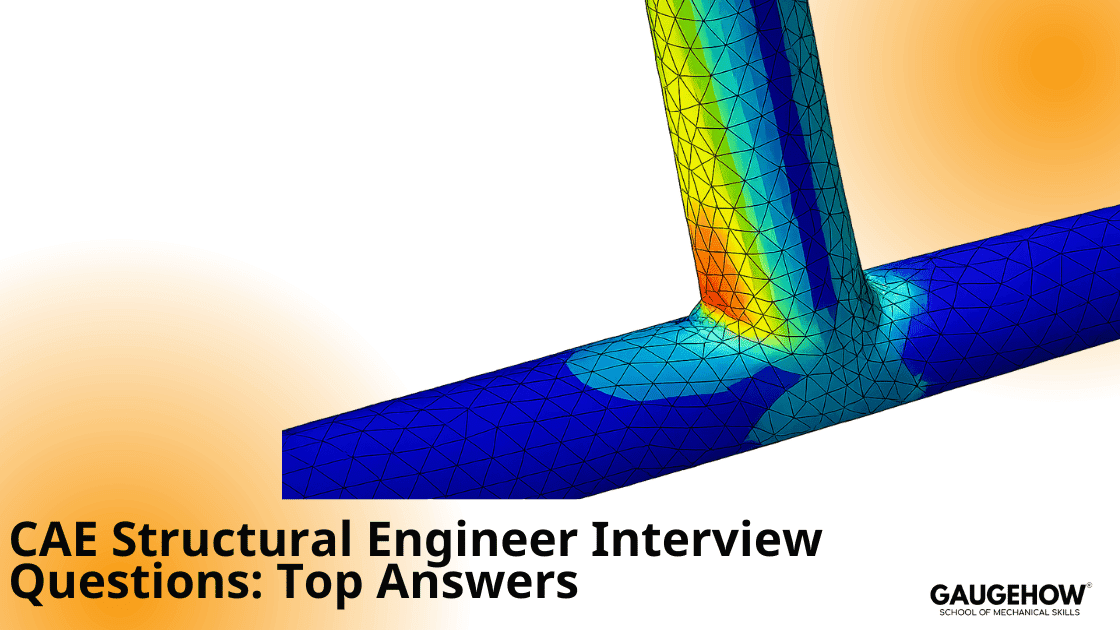
CAE Structural Engineer Interview Questions: Top Answers

Deepak S Choudhary
Learn More in This Video
Subscribe to GaugeHow for More
Structural CAE interviews are a physics and discipline check. The interviewer wants to see if your model matches how the part is loaded, located, and allowed to move, not whether you know which buttons to click.
In a structural role, you translate a messy load case into a controlled simulation. You lock down boundary realism, choose the right elements and mesh density, treat contacts and bolts like real interfaces, and control the solver so it converges for the right reasons.
Contours can look perfect and still be wrong. If reactions do not balance, contact pressure is nonphysical, or correlation breaks at the first stiffness change, the setup is not credible.
This Q&A set focuses on what gets probed: load path and constraints, contact and nonlinearity, bolt behavior, solver stability, verification checks, correlation logic, and how you report risk with clear assumptions and margins.
Q1. What is cae?
Answer: CAE is using simulation to predict product behavior before testing. In structural work, it means stiffness, stress, fatigue risk, and failure modes, tied back to real loads and constraints.
Q2. What does CAE stand for?
Answer: It stands for Computer-Aided Engineering. In interviews, translate that as “I use physics-based models to make decisions, not just to generate plots.”
Q3. What is computer-aided engineering?
Answer: It is an engineering analysis done with software, usually FEA for structures. The value is controlled by assumptions, traceable inputs, and checks that prove the model is not lying.
Q4. What is a CAE engineer?
Answer: A CAE engineer builds simulation models that replicate real behavior closely enough to guide design. Strong ones validate loads, joints, and boundary stiffness, then correlate to tests.
Q5. How do you rewrite a vague problem into a defendable CAE statement?
Answer: Lock three things: objective, load path, acceptance metric. Example: “Bracket must survive 10 kN with a margin of 1.3, no yielding, bolt slip below 0.1 mm.”
Q6. What does “load path thinking” mean in structural CAE?
Answer: It means tracing the force from where it enters to where it exits. If that path crosses a joint, weld, or thin section, your modeling detail must increase there.
Q7. What is the fastest way to catch unrealistic boundary conditions?
Answer: Ask what hardware provides the restraint in real life. If you cannot point to a surface, bolt group, bushing, or contact patch, your constraint is probably fiction.
Q8. When should you replace a fixed support with stiffness or connectors?
Answer: When the surrounding structure flexes. A “fixed” clamp often over-stiffens and shifts stress. Use connector stiffness or a remote constraint that matches test fixturing compliance.
Q9. How do you apply a load when you only know a force at a bolt?
Answer: Convert it into a realistic distribution through the joint. Use preload plus shear transfer by friction, or bearing on the hole, instead of dumping a point force on one node.
Q10. How do you decide symmetry is valid?
Answer: Symmetry needs symmetric geometry, loads, and constraints. If contact, friction, or bolt patterns break symmetry, forcing symmetry can erase the real load path.
Q11. Solid vs shell vs beam, what is your quick rule?
Answer: Use shells for thin walls, solids for thickness-driven stress gradients, and beams for slender members where section properties govern. For CAD-driven prep, Siemens NX workflows help build clean midsurfaces.
Q12. When is a shell model the wrong choice?
Answer: When through-thickness stress, bearing at holes, or contact pressure matters. If the decision depends on local 3D effects, shells alone will under-resolve the failure mode.
Q13. Linear tetra vs quadratic tetra, what is the interview safe answer?
Answer: Linear tests can be overly stiff in bending and need careful refinement. Quadratic tets usually behave better for curvature and bending, but still need mesh quality control.
Q14. What mesh quality checks do you trust first?
Answer: Jacobian, warpage, aspect ratio, and abrupt size transitions. If those are bad, convergence will be fake even if the solver finishes without errors.
Q15. What is mesh convergence in practical terms?
Answer: Results stop moving when you refine. Track a decision metric, not peak stress at a sharp corner. Example: displacement changes under 2 percent between 6 mm and 3 mm meshes.
Q16. How do you treat stress singularities in interviews?
Answer: Call them out, then switch to a meaningful metric: averaged stress away from the corner, hotspot method, or a notch model. Never claim failure from an infinite corner stress.
Q17. When do you use submodeling?
Answer: When global stiffness is right, but local detail is missing. Drive the submodel with boundary displacements from the global model, then verify energy and reaction consistency locally.
Q18. RBE2 vs RBE: What is the real difference in behavior?
Answer: RBE2 enforces rigid kinematics and can over-stiffen. RBE3 distributes loads without rigidizing motion. Pick based on whether you need kinematic coupling or force distribution.
Q19. How do you set connector stiffness for bushings or mounts?
Answer: Start from test curves or supplier data. If unavailable, back calculate from measured deflection. Example: 1 mm under 1 kN implies 1000 N/mm stiffness in that direction.
Q20. Bonded vs frictional contact, how do you decide?
Answer: Bonded is for welded, glued, or interference-locked interfaces. Frictional is for clamped joints or sliding interfaces. If slip changes the load path, friction must be modeled.
Q21. What causes contact “chattering” and what do you change first?
Answer: Poor contact stiffness settings, coarse mesh on contact patches, or abrupt load steps. Smooth the step, refine the contact zone, and tune penalty or augmented Lagrange controls.
Q22. How do you model bolt pretension when torque is given?
Answer: Convert torque to preload with a nut factor assumption, then run sensitivity. Micro example: 50 N·m on M10 with K 0.2 gives about 25 kN preload.
Q23. When does bolt preload change conclusions?
Answer: Whenever friction carries shear, sealing matters, or joint separation is the failure mode. Without preload, you predict a slip or opening that a real clamped joint never shows.
Q24. How do you model a welded joint in CAE without overbuilding?
Answer: Use tied contact or connector elements for global stiffness, then a local weld detail model only if fatigue or toe stress drives the decision.
Q25. What is the fastest way to decide linear vs nonlinear?
Answer: Check three triggers: contact state changes, plasticity risk, or large deformation. If any are real, linear is a first pass only, not the final answer.
Q26. Bilinear vs multilinear plasticity: what governs the choice?
Answer: How sensitive is the decision to the post yield slope? If you only need “yield or not,” bilinear works. If strain localization or permanent set matters, use a curve.
Q27. How do you spot large deformation early?
Answer: Compare deflection to characteristic thickness or clearance. If deflection changes contact, load direction, or geometry significantly, you need geometric nonlinearity.
Q28. Why do nonlinear models diverge even with a fine mesh?
Answer: Because the physics setup is unstable, not because the mesh is poor. Common culprits are unrealistic constraints, aggressive load steps, ill-conditioned contact, or missing damping.
Q29. Implicit vs explicit, what is the clean decision trigger?
Answer: Implicit for quasi-static and smooth nonlinear problems. Explicit for impact, fast transients, or severe contact events. If inertia dominates, explicit is usually safer.
Q30. What explicit step control prevents nonsense results?
Answer: Control time step with stable element size awareness, avoid excessive mass scaling, and monitor energy balance. If kinetic energy dominates a “static” event, the setup is wrong.
Q31. What is hourglassing, and how do you catch it?
Answer: It is zero energy deformation in reduced integration elements. Catch it by checking the hourglass energy versus the internal energy. If hourglass energy grows, your stiffness is contaminated.
Q32. What is shear locking, and how do you avoid it?
Answer: Locking makes bending artificially stiff in certain elements. Avoid it with appropriate element formulations, higher-order elements, or mesh refinement that reduces distortion in bending zones.
Q33. What verification check do you run before trusting any contour?
Answer: Free body equilibrium. Reactions must balance applied loads and moments within a tight tolerance. If they do not, stop and fix constraints, contacts, or the load application.
Q34. What is your quickest unit and scaling check?
Answer: Sanity check stiffness. If a steel bracket deflects meters under kilonewtons, the units are wrong. If it deflects microns under huge loads, constraints are too stiff.
Q35. How do you use energy balance as a quality gate?
Answer: In dynamics, check that external work roughly matches internal plus kinetic plus damping. If energy is created without input, contact, or stabilization is injecting nonphysical work.
Q36. What is a sensitivity run that interviewers respect?
Answer: One that targets uncertainty. Vary friction, preload, boundary stiffness, and mesh size around the decision point. If the conclusion flips easily, you must report it as a risk.
Q37. Why do FEA results fail the test correlation most often?
Answer: Boundary conditions and joints are wrong. Material curves are second. Mesh is third. If you match fixture stiffness and joint compliance, correlation usually improves dramatically.
Q38. What do you do when the peak stress keeps moving with mesh?
Answer: Shift to a stable metric. Use averaged stress over a defined path, a structural stress method, or displacement-based acceptance. Peak corner stress is rarely a pass fail metric.
Q39. How do you convert FEA stress into fatigue inputs?
Answer: Extract stress range at the hotspot location, apply mean stress correction if required, and ensure load scaling matches duty cycle. For durability workflows, Abaqus CAE practice helps build repeatable extraction.
Q40. How do you present results without hiding behind plots?
Answer: State assumptions first, then show one decision metric, then show evidence checks. If reviewers want deeper proof, point to equilibrium, mesh sensitivity, and correlation deltas, not prettier contours.
Conclusion
A Structural CAE interview is where your thinking gets tested more than your solver settings. You do well when you can talk through the story of the model like it is a real part of a real fixture, where the forces go, what you chose to simplify, and what you did to make sure those simplifications did not betray you.
A couple of sharp sanity checks, plus verification and correlation habits, make your work feel trustworthy fast. If you can explain that calmly, the contour plot becomes the least interesting part.