CFD Engineer Interview Questions: y+, Mesh, Turbulence

Deepak S Choudhary
Learn More in This Video
Subscribe to GaugeHow for More
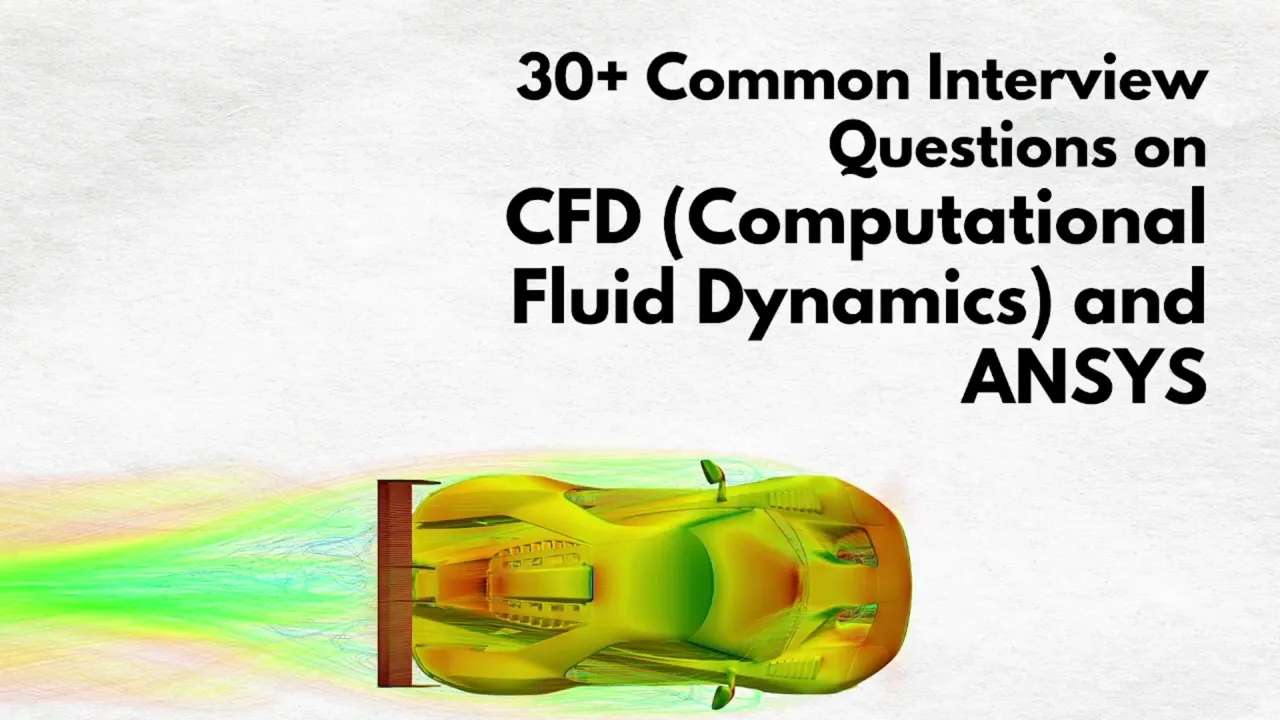
A CFD Engineer builds trusted flow and heat-transfer predictions by solving continuity, Navier–Stokes, and energy equations on a mesh. This interview sheet targets turbulence choice (RANS vs LES, k–ε, k–ω SST), y+ and wall treatment, meshing, boundary conditions, numerics (SIMPLE/PISO, CFL), convergence, V&V, and reporting.
CFD Engineering focuses on predicting how fluids move, mix, and transfer heat inside and around products.
CFD engineers typically work in automotive, aerospace, energy, HVAC, electronics cooling, and process industries, where a wrong pressure drop or heat-transfer estimate can break performance targets.
Why do many “converged” cases still fail a design review or mismatch test data? Most failures come from turbulence choice, near-wall treatment, mesh strategy, and boundary condition realism, not from the solver button you clicked.
In this blog, you will practice high-intent interview questions and practical answers that map directly to real engineering checks.
Governing Equations
1. What is the continuity equation in CFD, and what does it enforce?
It enforces mass conservation. For incompressible flow, it becomes ∇·u = 0, so the velocity field cannot create or destroy mass. Pressure–velocity coupling exists mainly to satisfy this.
2. What physical terms appear in the Navier–Stokes momentum equation?
Momentum balance includes unsteady, convection, pressure gradient, viscous diffusion, and body forces. Interviews test whether you can link each term to a real effect like separation, acceleration, or buoyancy.
3. What are Reynolds, Mach, and Prandtl numbers used for in CFD?
Reynolds sets turbulence and boundary-layer behavior. Mach flags compressibility importance. Prandtl links momentum and thermal diffusion, so it steers heat-transfer scaling and turbulence thermal closure choices.
4. When can you treat a flow as incompressible in CFD?
Treat it as incompressible when density changes do not meaningfully affect the outputs you care about. Confirm by checking expected pressure and temperature variations against the physics and operating conditions.
5. What is the energy equation used for in CFD?
It covers thermal physics. Solve it when temperature affects density, viscosity, or heat transfer, or when you need heat flux, h, or conjugate heat transfer to be defensible.
Turbulence Choices
6. Why do we use RANS instead of DNS in most engineering CFD?
DNS resolves all turbulence scales, so the cost explodes as the Reynolds number rises. RANS models the averaged turbulence effect, giving usable mean predictions within practical time and hardware limits.
7. RANS vs LES: which to use and when?
Pick RANS for mean loads and fast design loops. Use LES when large unsteady structures drive the answer, like mixing, shedding, or acoustics, and you can afford fine grids and small time steps.
8. What is the k–ε model used for in CFD?
It is a workhorse RANS model for many internal flows. It tends to be stable and fast with wall functions, but it can struggle with strong adverse pressure gradients and separation sensitivity.
9. What is the k–ω SST model used for in CFD?
SST is often chosen for external aerodynamics and separated flows because it behaves well near walls and handles adverse pressure gradients more reliably, especially when near-wall resolution and shear prediction matter.
10. What does “turbulence model sensitivity” mean in an interview answer?
It means your key results shift when you change the turbulence model or wall treatment. If Cd, Δp, or h moves materially, you must report the sensitivity and justify the chosen model for the physics.
Near-Wall And y+
11. What is y+ in CFD?
y+ is the non-dimensional wall distance of the first cell. It tells whether your near-wall approach is valid. Wrong y+ breaks skin friction and heat transfer, even when residuals look clean.
12. What y+ range should you target for wall functions vs near-wall resolving?
Wall functions typically need y+ in the rough 30–300 band. Near-wall resolving for SST targets about y+≈1. Micro-example: plot y+ and confirm most wall area stays inside your intended band.
13. What is wall treatment in CFD?
Wall treatment is how the solver handles the near-wall region, including whether it resolves the viscous sublayer or uses wall functions. It must match your y+ and your turbulence model, or drag and heat transfer drift.
14. How do you choose boundary-layer prism layers fast?
Pick first-layer height from y+ target, then add enough layers so the total prism thickness covers the boundary-layer region you care about. Ensure smooth growth, or gradients get smeared and separation shifts.
Meshing
15. What is a mesh independence study in CFD?
It is proving that your key outputs do not change meaningfully with further mesh refinement. Micro-example: refine by about 1.5× and confirm Cd or Δp changes under a chosen tolerance, with stable flow features.
16. What mesh quality metrics matter most for stability?
Skewness, orthogonality, and smooth size transitions. Bad quality creates non-physical gradients and slow convergence. Fix poor regions locally first, because global refinement often wastes cells without curing the root issue.
17. Structured vs unstructured mesh: what trade-off do you defend?
Structured meshes give accuracy per cell and lower numerical diffusion. Unstructured meshes fit complex geometry faster. Defend the choice by where gradients live, how controlled the near-wall region is, and how predictable the solver behavior is.
Boundary Conditions
18. Inlet boundary conditions: What do you need besides velocity?
You also need turbulence inputs and often temperature or total conditions. Provide turbulence intensity and length scale, or k and ω, consistent with upstream hardware, because wrong turbulence can shift separation and pressure loss.
19. When is a pressure outlet risky?
It becomes risky when recirculation reaches the outlet and causes backflow. Then the outlet condition influences the domain in non-physical ways. Extend the domain or add a buffer region to keep the reversal away from the boundary.
20. Symmetry vs wall: When should you use symmetry?
Use symmetry when physics and geometry are truly symmetric, and there is no cross-flow through the plane. It enforces zero normal velocity and zero normal gradients, cutting cells without adding wall shear.
21. Slip wall vs no-slip wall: What is the difference?
No-slip enforces zero velocity at the wall and captures shear stress and boundary layers. Slip removes tangential shear and behaves like an inviscid reflection. Use a slip only when viscosity effects are intentionally ignored.
22. MRF vs sliding mesh: when do you choose each?
MRF is steady and efficient for the mean performance. Sliding mesh is transient and captures rotor–stator interaction and blade passing. Choose sliding mesh when unsteady loads, pulsation, or mixing dominate the decision.
Numerics And Solvers
23. What is the SIMPLE algorithm in CFD?
SIMPLE is a pressure–velocity coupling method for incompressible flow. It iteratively corrects pressure and velocity so that momentum and continuity are satisfied together, trading speed for robustness in many steady problems.
24. SIMPLE vs PISO in CFD: what changes?
PISO uses additional pressure corrections per time step, so it suits transient cases and can converge faster per step. SIMPLE is often used for steady problems with under-relaxation and outer iterations.
25. What is the CFL number used for in CFD?
CFL links time step, velocity, and cell size. It guides stability and accuracy in transient runs. Micro-example: if CFL spikes in a jet or tip region, reduce Δt or refine that high-speed zone.
26. First-order vs second-order discretization: when do you switch?
Use first-order to stabilize and debug the setup. Switch to second-order for final results to reduce numerical diffusion. The switch should not flip trends like which design has higher Δp or higher Cd.
27. What are under-relaxation factors, practically?
They limit how much variables change per iteration. Too aggressive causes oscillation and divergence. Too conservative slows progress. Adjust them only after mesh quality and boundary condition realism are already under control.
28. What is the most common reason a solver diverges early?
Set up errors beat solver choice. Typical causes include poor near-wall resolution for the chosen wall treatment, bad outlet placement with backflow, unrealistic turbulence inputs, or extreme skewness in high-gradient regions.
Fluent And OpenFOAM Traps
29. In ANSYS Fluent, why do residuals drop but forces keep drifting?
Residuals measure equation imbalance, not output stability. Forces drift when flow is still evolving, monitors are under-resolved, or turbulence and near-wall treatment are inconsistent. Trust stabilized monitors and mass balance over residual shape.
30. In Fluent, what does “reversed flow at outlet” usually mean?
It usually means the outlet is inside a recirculation zone or too close to separation. The boundary condition then contaminates the domain. Extend the outlet, add a diffuser region, or change the outlet strategy.
31. In OpenFOAM, what do continuity errors tell you?
They indicate how well mass conservation is being satisfied during iterations. Large, persistent errors often point to mesh issues, boundary conditions, or solver settings. A good sign is errors dropping and the integrated mass balance closing.
32. In OpenFOAM, why do non-orthogonal meshes need corrections?
Non-orthogonality creates flux errors and pressure–velocity inconsistency. Corrections help stabilize and improve accuracy, but they increase cost. If corrections must be very high, the mesh quality is often the real problem.
Convergence And V&V
33. Residuals vs monitors: which proves convergence?
Monitors prove it. Residuals can drop while forces, Δp, or heat flux drift. A converged case shows stable integral outputs and good mass balance, not only low residuals.
34. What is verification vs validation in CFD?
Verification checks you solved the equations correctly for your chosen setup, including mesh and time-step independence. Validation checks whether the physics matches reality by comparing to experiments or trusted correlations.
35. How do you prove your CFD result is defensible in a design review?
Show stable monitors, acceptable mass and energy balance, mesh independence evidence, and model sensitivity awareness. Then anchor at least one validation point, even a benchmark or correlation, tied to your operating regime.
36. Where does CFD fail most often in real projects?
CFD fails most often through boundary conditions, near-wall mismatch, turbulence model misuse, and weak mesh strategy. Those errors can still produce smooth contours and low residuals, so you must defend setup logic, not visuals.
Post-Processing And Reporting
37. How do you compute pressure drop correctly in post-processing?
Use area-weighted static pressure on planes away from local disturbances and subtract the inlet and outlet means. Avoid single points near bends or wakes because they capture local extremes, not system-level Δp.
38. How do you report Cd and Cl in a defensible way?
State reference area and velocity, confirm force monitors are steady, and report sensitivity to mesh and turbulence choice. Micro-example: give Cd with a small sensitivity band based on refinement and model swap, not a single number.
39. How do you detect flow separation in results?
Look for wall shear stress reversal, skin-friction sign change, and streamlines detaching from the surface. Confirm with pressure behavior and velocity profiles, because contours alone can hide numerical diffusion or smoothing.
40. What is conjugate heat transfer (CHT) in CFD?
CHT solves conduction in solids and convection in fluids together with a coupled interface, so wall temperature and heat flux are predicted consistently. It matters when solid thermal resistance and contact paths affect temperatures.
FAQ
What is y+ in CFD?
y+ is a non-dimensional wall distance for the first cell near the wall. It tells whether your wall treatment is valid. Wrong y+ can corrupt wall shear, drag, and heat transfer.
How do you check convergence in CFD?
Check that key monitors like forces, Δp, and heat flux stabilize, mass balance closes, and residuals drop without oscillation. Convergence is output stability plus conservation, not residuals alone.
What is the SIMPLE algorithm?
SIMPLE is a pressure–velocity coupling method that iteratively corrects pressure and velocity to satisfy continuity and momentum together. It is common for steady incompressible CFD because it is stable and predictable.
What is a mesh independence study?
It is proving that your key outputs do not change meaningfully with further mesh refinement. You demonstrate stability of Cd, Δp, or h across at least one refinement step and consistent flow features.
RANS vs LES: which to use and when?
Use RANS for mean performance and fast iteration. Use LES when large unsteady structures drive the answer, such as mixing and vortex shedding, and when you can afford fine grids and small time steps.
Conclusion
By the time you finish this CFD blog, the big picture becomes clearer. Good CFD is not about sounding smart; it is about showing a clean way of thinking. Start with what matters in the problem, set things up to match that reality, and keep checking that the results are actually settling to something stable.
When the basics are handled with care, the conversation in an interview becomes calm and logical. That calm is the real signal that the work can be trusted.