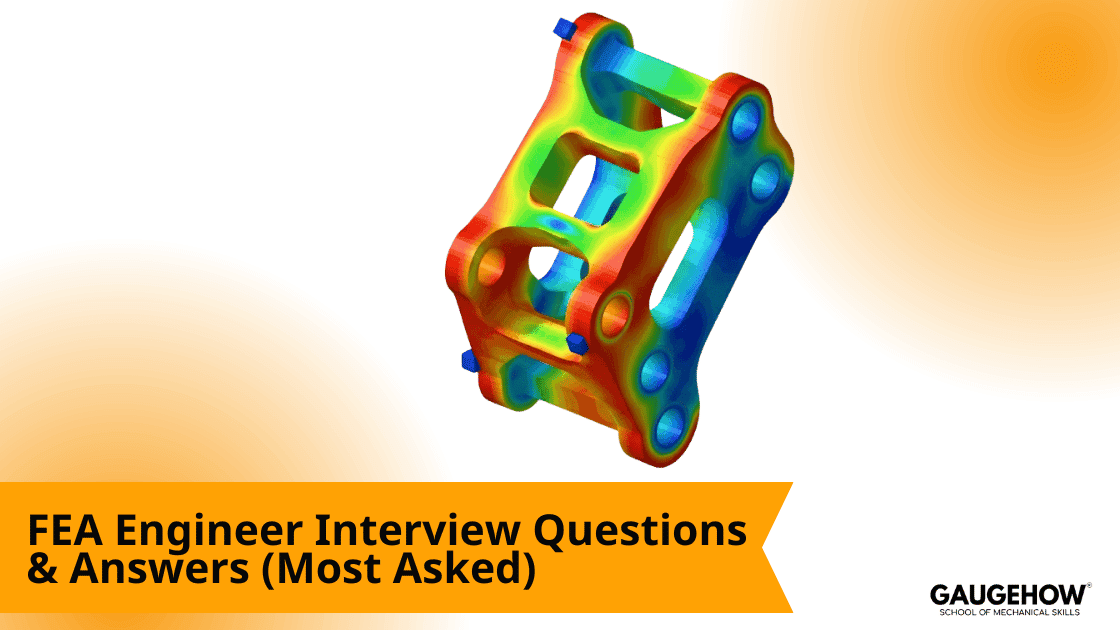
FEA Engineer Interview Questions & Answers (Most Asked)

Deepak S Choudhary
Learn More in This Video
Subscribe to GaugeHow for More
FEA Engineer interview questions target what breaks real simulations: wrong constraints, contact chatter, mesh-dependent peaks, nonlinear surprises, solver nonconvergence, and test mismatch. You will cover setup intent, element, and mesh strategy, material nonlinearity, implicit vs explicit choices, verification checks, and defensible reporting.
Finite Element Analysis work is about converting real loads into a defensible model. A good FEA Engineer builds results that survive review, not screenshots.
Have you ever run a model that looked perfect, but failed a simple reaction check or test correlation?
This guide is built to stop that. You will get 40 interview-grade questions on setup, meshing, contact, nonlinear behavior, solver choices, verification, and communication, written in a crisp engineering voice.
Model Credibility Quick Check Card
Check | What “Good” Looks Like | What Failure Looks Like | What You Change First |
Reaction balance | Sum the reactions ≈ applied load | Large mismatch | Fix constraints and load the application |
Deformation shape | Matches expected load path | Weird bending or rigid drift | Remove over-constraints, add missing supports |
Contact status | Correct open, close, and slip zones | Chatter, deep penetration | Refine contact mesh, adjust contact settings |
Energy trends | Internal dominates for static | Hourglass or KE dominates | Fix elements, reduce dt, limit scaling |
Mesh independence | Key metric stops moving | Peak stress keeps climbing | Converge a physical metric, handle singularities |
Material realism | Strain level matches model | Plasticity too early or never | Recheck units, curve, and hardening law |
Boundary realism | Constraints mimic hardware | “Infinite stiffness” supports | Replace with connectors, stiffness, or fixtures |
Report traceability | Assumptions and checks shown | Only screenshots | Add checks, margins, and limitations |
Simulation Setup and Intent
Q1. How do you turn a vague request into a solvable FEA problem?
Answer: Lock the objective first, then define the load path, constraints, contact pairs, and acceptance metric. If you cannot state “pass or fail” in one line, the model scope is still unclear.
Q2. From a screenshot, where do you refine the mesh first?
Answer: Refine where gradients live, like fillets, load entry, contact edges, and thickness transitions. Ignore big flat zones first. Converongetse a chosen metric, not the prettiest contour.
Q3. How do you choose loads when real loads are uncertain?
Answer: Use bounding cases tied to physics: minimum credible, nominal, and worst credible. Then run sensitivity on the few variables that move stress or deflection the most.
Q4. What is the fastest way to check that your constraints are not fake?
Answer: Look at the deformation shape and reactions. If a load exists through a “fixed” face that is not a real interface, you built infinite stiffness into the model.
Q5. How do you avoid over-constraining a model?
Answer: Constrain only the required DOFs to stop rigid motion, then validate reactions and shape. If datum logic is unclear, align to inspection datums using GD&T.
Q6. How do you represent missing stiffness, such as bushings or mounts?
Answer: Add connector elements, springs, or distributed stiffness using test or supplier rates. Then sweep stiffness to see if conclusions flip, because supports often dominate deflection.
Q7. Bonded vs contact vs connector: how do you decide?
Answer: Bonded is for welded or glued intent, contact is for separation or slip, and connectors are for joint behavior. Choose the simplest model that still matches interface physics.
Q8. What makes a good success criterion for an FEA study?
Answer: A numeric requirement tied to function, like max deflection, plastic strain cap, fatigue damage limit, or slip margin. “Stress is low” is not a success criterion.
Element and Mesh Strategy
Q9. Solid vs shell vs beam: what is your decision rule?
Answer: Use beams for slender members, shells for thin walls with bending, and solids where through-thickness stress matters.
Q10. What mesh quality metrics actually matter in interviews?
Answer: Aspect ratio, skewness, Jacobian quality, and warped faces matter because they create stiffness errors. I also watch distortion near contacts, fillets, and small radii where gradients spike.
Q11. Tet vs hex: what is your practical rule of thumb?
Answer: Use hex where mapping is clean in critical zones. Use tet for complex geometry, but avoid coarse linear tets in bending-dominated regions because stiffness error becomes the story.
Q12. How do you run mesh convergence without wasting time?
Answer: Track one or two response metrics, like a displacement at a functional point and a hot-spot stress tied to a physical distance. Refine locally until the metric change becomes small and stable.
Q13. How do you handle stress singularities at corners or point loads?
Answer: I do not report singular peak stress. I distribute the load realistically, add fillets if physical, and report stress over a meaningful path or averaged region tied to thickness.
Q14. What is shear locking, and how do you detect it?
Answer: Locking shows as an unrealistically stiff bending response. A quick tell is deflection that refuses to converge, while stress looks strangely high. I switch formulation or element type and recheck.
Q15. Hourglassing: What does “hourglass energy” mean?
Answer: It is non-physical deformation energy from reduced integration behavior. If it grows and starts competing with internal energy, the results are polluted. I change formulation, improve mesh, or add control.
Material and Nonlinearity Modeling
Q16. Poisson’s ratio near 0.5 in rubber, what breaks explicitly?
Answer: Near-incompressible behavior can cause volumetric locking and tiny stable time steps. You often need hybrid or incompressible-capable formulations, plus careful hourglass control and mesh sizing.
Q17. How do you choose a plasticity model in practice?
Answer: Start with elastic-plastic and appropriate hardening, then calibrate to true stress–strain in the strain range you expect.
Q18. Engineering stress–strain vs true stress–strain: what is the rule?
Answer: Use true curves when plastic strain is significant. Engineering data can understate flow stress at higher strain, shifting predicted yield spread and safety margin.
Q19. Hyperelastic modeling: what minimum data do you need?
Answer: At least one deformation mode curve, but better is multiple modes, so the fit is not a coincidence. I validate with a simple component test response, not just a curve fit plot.
Q20. Creep vs viscoelastic: how do you choose?
Answer: Creep targets time-dependent strain under sustained stress. Viscoelastic targets rate-dependent stiffness and relaxation. I choose based on failure mode, then validate against the time-history trend.
Q21. What changes when you enable large deformation?
Answer: Stiffness updates with geometry, so load path and contact pressure can move. That matters in thin parts, snap fits, seals, and anything where geometry change creates new physics.
Contact and Boundary Condition Realism
Q22. How do you set friction without guessing?
Answer: Use a bounded range from material pairing knowledge, then run sensitivity. If conclusions depend on friction, push for test data, because friction can flip slip, stress, and clamp behavior.
Q23. What is the correct bolt pretension workflow?
Answer: Pretension in its own step, lock it, then apply external loads in the next step while allowing separation or slip if intended. I always check clamp force retention after loading.
Q24. Detailed bolted joint vs simplified joint: when do you choose which?
Answer: Use simplified connectors for global stiffness and load path. Build detailed contact and friction only when slip, separation, or local joint stress is the design risk.
Q25. Contact chatter or penetration, what is your triage order?
Answer: Fix surface normals, initial gaps, and mesh density at contact first. Then tune the contact stiffness or formulation. If it still chatters, reduce the step size and remove sharp geometry that drives instability.
Q26. Remote load or coupling: when is it valid and when is it risky?
Answer: Valid when the load is truly distributed through a rigid feature. Risky when it injects artificial stiffness or bending moments that the real structure cannot carry.
Q27. Why are constraints the #1 source of “pretty but wrong” plots?
Answer: Constraints silently replace real stiffness with infinite stiffness. I validate every support by checking the deformation shape, reaction spread, and whether it matches the actual fixture or interface.
Solver Choices and Numerical Stability
Q28. Implicit vs explicit: how do you choose?
Answer: Implicit fits quasi-static and slow dynamics with equilibrium iterations. Explicit fits impact and severe contact events, but demand stable time steps and strict energy monitoring.
Q29. What is your time step rule in explicit analysis?
Answer: A stable time step is set by the smallest element size and wave speed, so tiny elements dominate the runtime. If dt collapses, fix mesh sizing, not just solver controls.
Q30. When is mass scaling acceptable?
Answer: Only when kinetic energy stays small compared to internal energy for a quasi-static event. If scaling changes the deformation mode or peak load, it invalidates the conclusion.
Q31. Nonconvergence at the first increment, what do you check first?
Answer: Constraints and contact definitions first, then material laws and units. After that, reduce the step size and simplify contact pairs. I only add stabilization after I know what is unstable.
Q32. Stabilization and damping: how do you avoid hiding physics?
Answer: Use the minimum needed, then quantify its influence by tracking stabilization work or energy. If stabilization becomes “significant,” your model is being pushed into convergence, not solving physics.
Q33. What does a singular matrix usually mean in FEA?
Answer: It usually means missing constraints, disconnected parts, or unstable mechanisms. I treat it as a model definition error and fix connectivity, contact, or boundary conditions before touching solver knobs.
Verification, Validation, and Interpretation
Q34. What quick checks do you run after solving?
Answer: Reactions must balance applied loads, energy terms must be sensible, and deformation shape must match intuition. If anyone fails, I do not trust the stress plot.
Q35. Rigid body modes, what do they imply, and what do you verify?
Answer: They imply missing constraints, loose contacts, or disconnected bodies. I check contact status, connectivity, and constraint DOFs, then rerun a small load case to confirm stability.
Q36. Nodal vs elemental stress: which do you report?
Answer: I report what matches the failure criterion and mesh resolution. Nodal averaging can hide gradients, and elemental averaging can look noisy. I explain the choice and show sensitivity where needed.
Q37. Von Mises vs principal stress: when do you use each?
Answer: Von Mises is for ductile yield checks. Principal stress is for brittle cracking and tension-driven failure. I also check directions so a scalar plot does not hide the real risk.
Q38. Stress linearization: when is it worth doing?
Answer: Use it when you need membrane and bending separation, like pressure vessels or structural walls. It prevents overreacting to local peaks and helps tie stress to code style allowables.
Q39. Give a micro hand-check example you actually use.
Answer: For a cantilever, I compare tip deflection and root bending stress to beam theory within a rough tolerance. If FEA is far off, the boundary conditions, thickness, or stiffness intent is wrong.
Q40. How do you defend your FEA result in a design review?
Answer: I show assumptions, load path, mesh independence evidence, and a small set of checks that back the conclusion. For repeatable reporting, I automate plots and tables using Python.
FAQ
Q1. What does an FEA engineer do?
Answer: An FEA engineer uses Finite Element Analysis to predict stress, deflection, stability, and life, then defends decisions with assumptions, checks, and correlation. The job is credibility management, not just running software.
Q2. What is mesh convergence in FEA?
Answer: It is proving that your key result stops changing as the mesh is refined. You converge a response metric, not a color plot, and you refine where gradients and contacts actually live.
Q3. What is the difference between implicit and explicit?
Answer: Implicit solves equilibrium with iterations, good for quasi-static. Explicit integrates forward in time, good for impact and harsh contact, but needs stable time steps and energy checks.
Q4. Why do FEA results fail correlation?
Answer: Wrong constraints, missing stiffness, poor contact intent, incorrect material data, or unverified loads. If reactions and deformation shape fail basic physics, correlation will fail even with a fine mesh.
Q5. What is hourglassing in FEA?
Answer: It is a non-physical deformation mode common in reduced integration elements that can corrupt stiffness and stress. Monitor hourglass energy and fix formulation, mesh, or control when it becomes significant.
Conclusion
These interviews are a filter for modeling discipline. You are being judged on whether your loads follow a real load path, whether your constraints mimic hardware, and whether your contacts and mesh choices survive a convergence check. Keep every answer practical: state the assumption, name the verification check, then give the margin you would sign off.
If your weak link is turning “CAE theory” into a clean, repeatable workflow, close it with our CAE course so your results read like engineering evidence, not solver output.