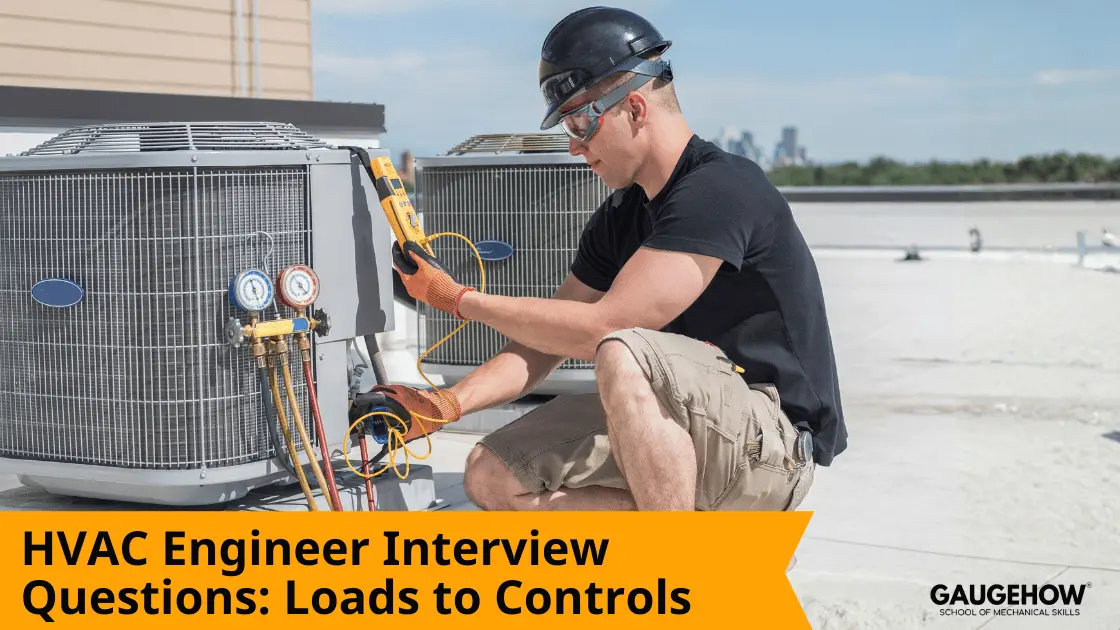
HVAC Engineer Interview Questions: Loads to Controls

Deepak S Choudhary
Learn More in This Video
Subscribe to GaugeHow for More
HVAC engineering turns building loads into equipment, airflow, water flow, and control logic that work on day one and keep working at part load. This guide covers 40 interview questions on sizing, psychrometrics, refrigeration, ducts, central plants, BMS, commissioning, and compliance.
HVAC engineering deals with the design and performance of heating, ventilation, and air-conditioning systems used in homes, commercial buildings, hospitals, and industrial spaces.
HVAC engineers convert comfort and IAQ targets into measurable numbers, like tons, CFM, static pressure, chilled-water ΔT, and ventilation rates. Most interview panels test one thing first: can you explain the “why” behind your sizing and control decisions?
What happens when the load sheet looks correct, but the site reports high humidity, noise, or low airflow? In this blog, you will practice the exact technical questions that hiring teams use to judge design readiness.
Load And Equipment Sizing
1. How do you calculate cooling load for equipment sizing?
Start with envelope gains, solar, people, lights, and ventilation, then separate sensible and latent. Size the design day and verify part load behavior, not just the peak number.
2. What is sensible heat vs latent heat in HVAC?
Sensible changes in dry bulb temperature. Latent changes the moisture content. Both drive coil selection because a coil can meet a sensible load and still fail humidity if the latent capacity is short.
3. What is SHR, and why does it matter for coil selection?
SHR is sensibly divided by the total load. Example: 8 kW sensible and 2 kW latent gives SHR 0.8. Match SHR to coil performance so dehumidification is not accidental.
4. What is the diversity factor in HVAC load calculations?
Diversity accounts for loads that do not peak together. It reduces unrealistic summations, especially across zones, but you still protect critical rooms that truly peak concurrently.
5. When do you use a safety factor in HVAC sizing?
Use it only when the uncertainty is real, like unknown envelope data or future occupancy. Avoid blanket oversizing because it often creates short cycling and poor moisture control.
6. Why is oversizing an HVAC unit a problem?
Oversizing can satisfy the thermostat quickly, then shut off before removing moisture. That drives high RH, comfort complaints, and inefficient cycling, especially in humid climates or with low sensible loads.
Psychrometrics And Comfort Control
7. Dry bulb vs wet bulb vs dew point: what’s the difference?
Dry bulb is air temperature. Wet bulb reflects evaporative cooling potential. Dew point is the condensation threshold. Dew point tracks moisture risk better than RH when temperatures change.
8. Relative humidity vs dew point: Which one do you control?
Control the dew point when moisture risk matters, like mold and condensation. RH is secondary because RH swings with temperature, even if the moisture content stays similar.
9. How do you read a psychrometric chart quickly in an interview?
Pick any two known properties, locate the state point, then read the rest. Use it to show what a coil does: temperature drop, moisture removal, and enthalpy change.
10. How do you calculate outdoor air ventilation for a zone?
Base it on code-required outdoor air per person and per area, then convert to system intake using ventilation effectiveness and distribution logic. Always check worst-case occupancy and system mode.
11. How do you control humidity without overcooling spaces?
Use a DOAS approach or reheat strategy so latent removal stays stable. Keep supply air dew point targeted, then use sensible trim with reheat or terminal control.
12. Is CO₂-based demand control ventilation always safe?
Not always. CO₂ tracks people, not all pollutants. It can under-ventilate during low-CO₂ contamination events, so you still need minimum ventilation logic and filtration aligned to the space risk.
Refrigeration And Heat Pump Fundamentals
13. Explain the vapor compression cycle in one minute.
The compressor raises pressure and temperature, the condenser rejects heat, the expansion drops pressure, and the evaporator absorbs heat. Capacity depends on mass flow and enthalpy lift, not just “cold air output.”
14. What is superheat, and why do you measure it?
Superheat confirms vapor enters the compressor, not liquid. Low superheat risks floodback and damage, while excessive superheat wastes coil area and reduces capacity.
15. What is subcooling, and what does it tell you?
Subcooling indicates liquid refrigerant stability leaving the condenser. Too low suggests flashing or undercharging. Too high can indicate overcharge or condenser flooding, depending on the system design.
16. COP vs EER vs SEER: how do you explain them fast?
COP is efficiency as heat moved per work, dimensionless. EER is steady-state cooling per power. SEER is a seasonal performance that reflects cycling and part-load behavior.
17. How do systems control refrigeration capacity at part load?
Common methods include variable speed drives, staging, digital scroll modulation, or valve control. Avoid hot gas bypass unless necessary because it reduces efficiency while keeping the compressor loaded.
18. What makes heat pump performance drop in cold weather?
Lower outdoor temperature reduces evaporating pressure, which cuts capacity and COP. Defrost adds penalties, so low ambient design needs correct sizing, defrost logic, and sometimes auxiliary heat strategy.
Air Distribution And Duct Design
19. How do you determine the required CFM for a room?
Convert sensible load to airflow using supply and room temperature difference, then verify ventilation minimums and diffuser performance. Airflow is a comfort tool, not a substitute for correct coil selection.
20. How do you select diffusers for a given CFM?
Match diffuser type to throw, drop, and noise at the expected airflow. Example: splitting 1200 CFM across six diffusers targets 200 CFM each, then adjust for room geometry and drafts.
21. What is static pressure, and why does it matter for fan selection?
Static pressure is the resistance the fan must overcome through filters, coils, ducts, and terminals. Underestimating it causes low flow, bad ventilation, and poor coil performance.
22. How do you size ducts using the equal friction method?
Pick an allowable friction rate, size the main duct to meet it, then step down sizes as the flow reduces. Validate velocity and noise so the friction target does not create an acoustic problem.
23. What is duct balancing, and what does TAB actually verify?
Balancing adjusts dampers to meet design flows. TAB verifies air and water flows, pressures, and temperatures against design intent, then documents results so you can troubleshoot with evidence later.
24. How do you reduce HVAC noise from ducts and diffusers?
Control velocity, avoid sharp fittings near terminals, and manage fan operating point. Noise is usually a pressure and turbulence problem, so fix geometry and operating conditions, not just add lining.
Hydronics And Central Plants
25. Explain the chilled water ΔT problem in simple terms.
If ΔT collapses, you need more flow to move the same load. Example: halving ΔT doubles the required flow, which overloads pumps and reduces plant efficiency even when the chiller is healthy.
26. Primary-secondary vs variable primary flow: how do you decide?
Primary-secondary isolates chiller flow for stability. Variable primary simplifies piping and saves pumping energy, but demands good controls and minimum flow protection so chillers stay within safe limits.
27. How do you estimate pump head for a hydronic loop?
Sum friction losses through the worst path, including pipe, fittings, coils, and valves. Add control valve authority considerations so the valve can regulate without starving the coil or creating hunting.
28. What is NPSH, and why do pumps cavitate?
NPSH is the pressure margin preventing boiling at the impeller eye. Cavitation happens when the suction pressure drops too low, causing vapor bubbles that collapse and damage the pump while killing the flow.
29. Cooling tower range vs approach?
The range is from hot to cold water drops. The approach is cold water temperature above the ambient wet bulb. A smaller approach improves chiller efficiency but costs more tower capacity and fan power.
30. How do you balance chilled water systems in the field?
Set design flows with balancing valves or flow meters, verify differential pressure at critical points, and confirm coil ΔT matches expectations. A balanced system proves itself through stable control valve positions.
Controls And BMS Sequences
31. Walk me through a typical AHU sequence of operation.
Start with safeties, then prove airflow, modulate outside air to a minimum, control supply air temperature, and reset static pressure or supply temp based on zone demand. Alarms should point to the root cause, not symptoms.
32. What does a PID loop do in HVAC controls?
PID adjusts an output to hold a setpoint using present error, accumulated error, and rate of change. Poor tuning shows up as hunting, slow recovery, or steady offset under stable loads.
33. How does a VAV box control zone temperature?
It first varies the airflow by modulating the damper position. If minimum airflow is reached and the zone still cools, reheat trims the temperature. If the zone warms, airflow increases before reheat disables.
34. What is economizer control, and what can go wrong?
Economizers use cool outdoor air to reduce mechanical cooling. Failures come from bad sensors, wrong high-limit logic, or poor mixed-air control, which can cause humidity problems or coil freeze risk.
35. Where should temperature and humidity sensors be placed?
Place sensors where they represent the controlled condition, not where they are convenient. Avoid stratification zones, direct drafts, or radiant influence, then calibrate and trend them to catch drift early.
36. How do you use trend logs to troubleshoot a comfort complaint?
Trend space temp, RH, supply temp, damper positions, airflow, and valve commands together. The pattern reveals whether the issue is load, control sequence, sensor bias, or equipment capacity shortfall.
Energy, Commissioning, And Codes
37. What is kW per ton, and what does it really measure?
It is a plant efficiency metric: electrical power divided by cooling delivered. Use it to compare operating states, then tie changes to lift, condenser conditions, flow rates, and control strategy.
38. What are your first start-up checks on a chiller plant?
Verify water flow, correct valve positions, pump rotation, clean strainers, stable condenser water conditions, and safeties. Trend key temperatures and pressures during loading so the plant proves stability before handover.
39. What should a TAB report include for an HVAC handover?
Include design vs measured air and water flows, static pressures, coil ΔT, damper and valve positions, and instrument details. A good TAB report lets you replicate performance and diagnose deviations later.
40. How do you defend code compliance in HVAC design reviews?
Show ventilation basis, energy intent, control sequences, and measurable acceptance checks. Reference the standard requirement to a drawing note, schedule, and commissioning test so compliance is auditable, not assumed.
Conclusion
Finishing this HVAC set, one theme stays consistent: strong answers tie the textbook to what occupants actually feel. Sizing is not presented as a number; it is explained as a choice that protects comfort, air quality, and operating cost.
Controls are described like real sequences, with what can go wrong and how it shows up on site. When the thinking stays measurable and practical, the discussion sounds like someone who has seen buildings misbehave. That is what interviewers trust.
FAQs
1. What questions are asked in an HVAC engineer interview?
Expect load and sizing logic, psychrometrics, refrigeration basics, duct and hydronic design, AHU and VAV sequences, plus commissioning and code thinking. Interviewers look for defensible decisions, not memorized definitions.
2. How do I prepare for an HVAC design engineer interview quickly?
Practice explaining one full design path: load to equipment, airflow to duct sizing, chilled water to pumping, then controls and commissioning checks. Short explanations with one micro example beat long theory dumps.
3. Which HVAC software is most asked about in interviews?
Load tools like Carrier HAP or Trane TRACE are commonly mentioned, along with BIM and drafting workflows. What matters most is explaining your inputs, assumptions, and how you sanity-check the output.
4. What is the most common HVAC sizing mistake engineers make?
Oversizing without validating latent control and part load behavior. The system may “meet tons,” yet fail in humidity, noise, or ventilation once installed.
5. Which ASHRAE topics come up most in HVAC interviews?
Ventilation and IAQ intent, plus how you prove compliance through measurable outdoor air rates and commissioning tests. Hiring teams often probe how you prevent under-ventilation during real operating modes.