NVH Engineer Interview Questions: 40 Top Q&A (2026)

Deepak S Choudhary
Learn More in This Video
Subscribe to GaugeHow for More
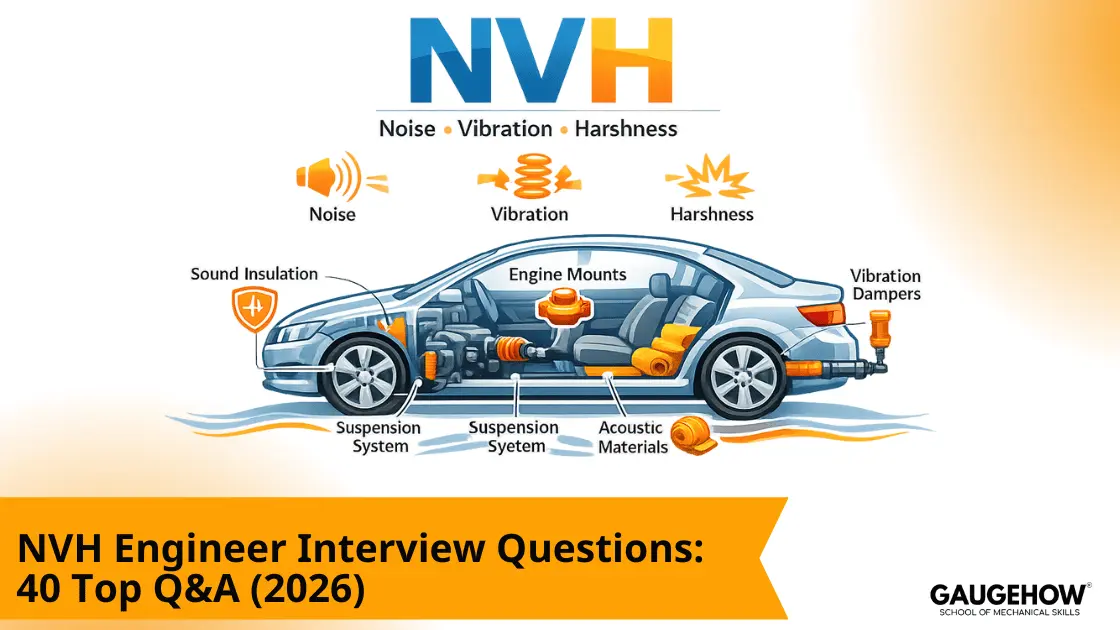
An NVH engineer reduces noise, vibration, and harshness by turning customer complaints into measurable targets. This blog delivers 40 high-intent NVH interview questions & answers on source-path-receiver logic, dB(A), and sound quality, FFT, order tracking, TPA, testing, and countermeasures.
NVH engineering is the discipline that controls how a vehicle sounds and feels in real driving. NVH engineers work at the intersection of design, testing, and validation, so issues like boom, whine, squeal, and rattle become data, not opinions.
Automotive programs move fast, and one uncontrolled NVH issue can travel from prototype to production if targets, test setups, and contribution ranking are weak. That is why NVH roles demand structured thinking, not just plots or software clicks.
NVH Interview Questions
1. What is the source path receiver in nvh?
It separates what generates energy, how it travels, and where it is heard or felt. That split prevents random part swapping and makes targets measurable.
2. What does dba mean in NVH?
dB(A) is a frequency-weighted level that approximates human hearing sensitivity. It is useful for overall loudness, but it can hide narrow tonal issues.
3. When is a weighting wrong for nvh?
Be careful for strong tones, low-frequency boom, and EV whine. A single A-weighted number can look fine while sound quality is still poor.
4. How to set an nvh target for cabin noise?
Fix the operating condition, choose a metric, then set a limit relative to baseline or benchmark. Example: cap 100–160 Hz cabin SPL at cruise by a defined margin.
5. Airborne vs. structure-borne noise difference?
Airborne travels through the air and leaks through gaps. Structure-borne travels through mounts and structures, then radiates as noise or becomes felt vibration.
6. What is resonance in nvh?
Resonance is the peak response when excitation aligns with a natural frequency. It shows as a narrow, repeatable peak that grows sharply at a specific speed or load.
7. What is damping and q factor in nvh?
Damping limits resonance amplification. High Q means sharp peaks and long ring-down. More damping lowers Q, reduces sensitivity, and improves robustness.
8. What is frf in nvh testing?
FRF links the input force to the output response over frequency. It helps identify resonances, compare design changes, and confirm whether a countermeasure moved the right mode.
9. What does low coherence mean in frf?
Low coherence often indicates poor excitation, sensor issues, nonlinear behavior, or multiple uncorrelated sources. Fix the setup before trusting FRFs.
10. Where to place the cabin microphone for nvh?
Place the ear positions to represent what occupants hear. Add near-field mics near suspected sources to isolate contributors, and keep placement repeatable.
11. Where to place the accelerometer for nvh?
Mount on stiff, representative points near interfaces and receivers. Avoid thin panels unless panel radiation is the goal, because local panel modes can mislead.
12. How to check accelerometer mounting for nvh tests?
Check mounting torque or adhesive, cable strain relief, and a quick tap test. Loose mounting creates false peaks and phase errors.
13. Sampling rate for fft in nvh testing?
Sample well above the highest frequency of interest and confirm anti-alias filters are active. Bad sampling creates false content that looks like real NVH.
14. What is fft in NVH?
FFT converts time data into frequency content. Use it to find tones, broadband levels, and resonances, then link peaks back to operating conditions.
15. Which window to use for fft in nvh?
Use a window that reduces leakage for tones and suits your signal type. Wrong windowing smears peaks and hides the true order or resonance.
16. Narrowband vs 1 3 octave for nvh?
Use narrowband for diagnosis and order tracking. Use a 1/3-octave for reporting and trend summaries when the exact tone frequency is less critical.
17. What is order tracking in nvh?
Order tracking maps noise or vibration to multiples of rotational speed. It turns a drifting peak into a stable order line, which makes rotating sources obvious.
18. How to convert rpm to hz for order tracking?
Frequency equals order × rpm ÷ 60.
Example: 2nd order at 3000 rpm is 2×3000/60 = 100 Hz.
19. Tach signal requirements for order tracking?
You need a clean, stable speed reference tied to the correct shaft. Noisy tach, wrong shaft, or dropouts will corrupt orders and cause false conclusions.
20. What is a Campbell diagram in nvh?
It plots frequency content versus speed. Sloped lines indicate orders, while horizontal bands suggest structural modes. Crossings often point to resonance events.
21. What is modal analysis in biw?
It identifies body-in-white natural frequencies, mode shapes, and damping. The value is linking a complaint band to a body mode you can shift or damp.
22. What is ods operating deflection shape?
ODS shows how structures move under real running loads. It is useful when the operating excitation is complex, and you need motion patterns at the complaint frequency.
23. What is transfer path analysis (TPA)?
TPA quantifies how each path contributes to a receiver response. It prevents guesswork by ranking which mounts, attachments, or panels dominate the cabin metric.
24. What is operational TPA OTPA?
OTPA estimates contributions using operating data and correlated references without direct force measurement. It is useful early when instrumenting input forces is difficult.
25. How to rank TPA contributions?
Hold operating points constant, repeat runs, and confirm ranking stability. Validate by a controlled change on the top path and checking receiver reduction.
26. source vs path vs receiver countermeasure selection?
Fix the source if generation is high, isolate or block the dominant path if transfer dominates, or treat the receiver if radiation is the main mechanism.
27. How to diagnose idle shake steering wheel vibration?
Confirm engine order content, mount directions, and receiver responses at the steering wheel and seat rail. Then separate powertrain excitation from body resonance using a speed sweep.
28. How to diagnose the cabin boom at a specific rpm?
Identify boom frequency, link it to an order or body mode, then test a temporary path change.
Micro example: 1200 rpm 2nd order is 2×1200/60 = 40 Hz.
29. How to diagnose gear whine?
Treat it as tonal and speed-related. Link the tone to gear mesh frequency and load sensitivity.
Micro example: 30 teeth at 2000 rpm gives 30×2000/60 = 1000 Hz.
30. Motor whine vs inverter switching noise: How to separate?
Motor electromagnetic orders track rotor speed. Inverter switching often appears at fixed or PWM-related bands. A speed sweep at constant torque separates the signatures.
31. Noise moved after the fix. What to do?
Assume boundary conditions changed and a mode shifted. Re-test the same condition, compare Campbell or FRF changes, then retune the fix toward the dominant contributor.
32. How to troubleshoot brake squeal?
Squeal is a stability problem, not only loudness. Confirm temperature and pressure conditions, identify dominant squeal frequency, then add damping or change friction interface stability.
33. How to fix squeak and rattle bsr?
Reproduce the event, isolate the interface with controlled excitation, then fix with retention, lubrication, felt, or tolerance control. A repeatable trigger is mandatory.
34. When to change mounts for nvh?
Change mounts when a dominant structure-borne path is proven, and isolation is achievable without creating stability issues. Softer mounts can add shake or new resonances if poorly tuned.
35. What is transmissibility in mount isolation?
Transmissibility is output divided by input across a mount. Below 1 means isolation, above 1 means amplification near resonance.
Micro example: if the dominant excitation is 30 Hz, the target mount's natural frequency is near 12 Hz.
36. Where do damping pads work in nvh?
They work best on panel resonance and radiation peaks. They are weak for low-frequency rigid-body issues, where stiffness, mass distribution, or isolation dominates.
37. What is insertion loss in nvh?
Insertion loss is the change after a modification. It quickly proves countermeasure effectiveness without arguing about absolute levels or test day variability.
38. How to validate an nvh fix for production variation?
Check across temperature, load, and build tolerance corners. A robust fix keeps margin across the spread, not just on one best-case vehicle.
39. How to presentNVHh results in a design review?
State the symptom, condition, and target first. Show one plot proving the dominant contributor, then propose the smallest-change countermeasure that buys repeatable margin.
40. Common mistakes in nvh testing and data acquisition?
Non-repeatable setups, missing speed reference, sensor overload, poor mounting, and uncontrolled operating points. If the test is not repeatable, conclusions will not survive scrutiny.
FAQ
1. What is NVH in cars?
NVH in cars means noise, vibration, and harshness perceived by occupants. It includes what you hear, what you feel, and the unpleasant character that shapes comfort and perceived quality.
2. What is NVH?
NVH is an engineering discipline that measures and controls sound and vibration, then links them to design actions through targets, tests, contribution ranking, and validated fixes.
3. What is NVH in automobiles?
In automobiles, NVH focuses on cabin sound and vibration across idle, cruise, acceleration, braking, and rough roads so the vehicle feels refined in real use.
4. What does NVH mean?
NVH means Noise, Vibration, Harshness. It describes both the level and the character of what customers hear and feel.
5. What is noise, vibration, and harshness?
Noise is airborne sound, vibration is structural motion you feel, and harshness is the sharp, unpleasant quality that can feel bad even when overall levels look acceptable.
6. What does NVH stand for?
NVH stands for Noise, Vibration, and Harshness.
7. What is an NVH engineer?
An NVH engineer diagnoses noise and vibration issues, sets measurable targets, ranks sources and transfer paths, and delivers fixes that remain stable across temperature, build variation, and aging.
Conclusion
Work through these NVH questions, and your answers get structured. You learn to pinpoint the symptom to one condition. Then you pick a metric that matches the complaint. Source path receiver thinking helps you rank the suspects. Once one path is proven, the fix is deliberate.
Quick order math keeps you honest in the room. At 1200 rpm, the second order sits near 40 Hz. That control is what makes your response land.