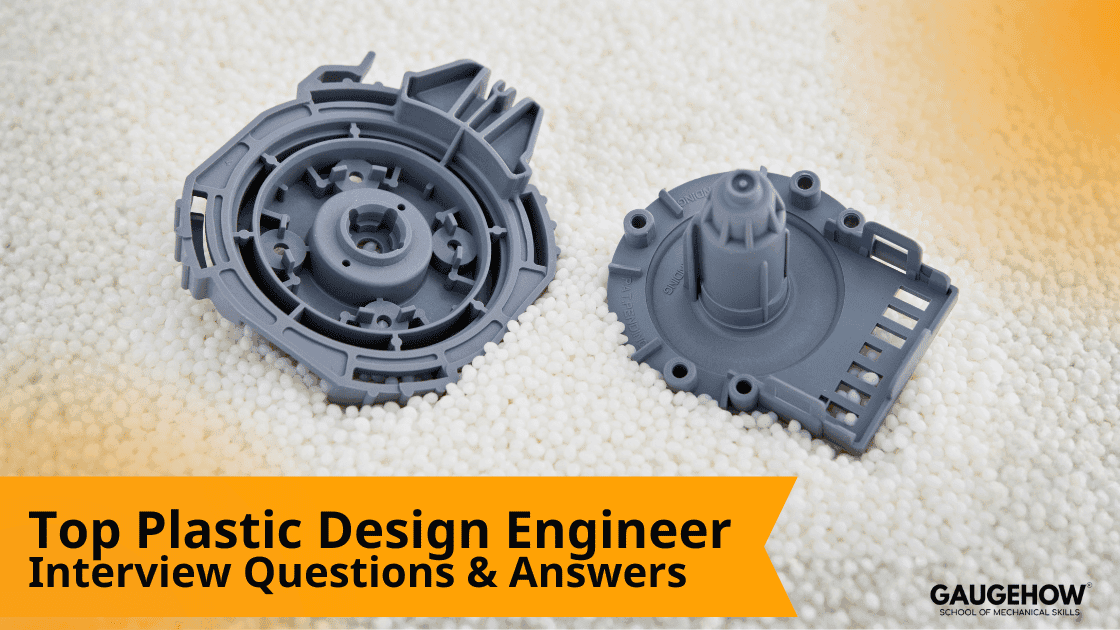
Top Plastic Design Engineer Interview Questions & Answers

Deepak S Choudhary
Learn More in This Video
Subscribe to GaugeHow for More
Plastic Design Engineer interview questions and answers focused on injection molding failure modes: sink marks, warpage, weak bosses, cracked snaps, weld-line breaks, and poor parting lines. Covers polymer behavior, ribs and bosses, gate/vent design, shrinkage control, trim attachments, and CAD/DFM checks for tooling readiness.
A plastic design engineer turns polymer behavior into moldable geometry that holds function after heat, time, chemicals, and assembly loads. The role is part design discipline, tooling awareness, and validation thinking, not just clean CAD.
Why does a part look correct in CAD, yet come back with sink, warp, weak snaps, or ugly parting lines? Because plastics amplify thickness, flow path, cooling balance, and surface decisions, and the tool exposes every shortcut.
This guide is built to answer fast and accurately in interviews, including CAD test questions, trim attachment features, and the defect terms recruiters keep searching for.
Defects → Design Lever Table
Defect | Design Lever That Actually Moves It |
Sink | Remove mass, core thick zones, keep wall uniform, rib, and boss discipline |
Weld Line | Shift gate, change flow path, avoid loaded weld at sna, ps, and thin roots |
Air Trap | Open the end of the fill for venting, avoid closed pockets, and redesign rib mazes. |
Short Shot | Reduce pressure drop with a thicker flow path, shorten flow length, and smooth turns.s |
Flash | Strengthen shutoffs, add draft, reduce thin knife edges, and weak parting areas. |
Splay | Avoid long thin jets, reduce shear hot spots, and keep gates and flow paths stable. ble |
Below are 40 plastic design engineer interview questions written in the same scan pattern interviewers and searchers prefer.
Q1. What is Tg in plastics, and why does it matter in part design?
Answer: Tg is where stiffness drops sharply. If service temperature sits near Tg, expect more creep, weaker snap retention, and dimensional drift. Designing only at room temperature is a common interview trap.
Q2. What is HDT in plastics, and how is it different from Tg?
Answer: Tg is a material transition, while HDT is a deflection under load at temperature. Use HDT when the part must hold shape under stress, like housings, brackets, and clips near heat.
Q3. How does plastic modulus change with temperature, in simple interview terms?
Answer: Modulus falls as temperature rises, and it can drop fast near Tg. Always check stiffness and strength at worst-case service temperature, because 23°C data can mislead functional decisions.
Q4. What is creep in plastics, and when do you design around it?
Answer: Creep is time-based strain under constant load. Treat it as critical for snaps, press fits, screwed joints, and seals, because the part can relax and fail after weeks, not minutes.
Q5. Why do plastics need conditioning before final measurement?
Answer: Some plastics shift with moisture and time after molding. Conditioning aligns inspection to real use, so tolerances reflect the stabilized state, not the fresh-off-the-tool dimension.
Q6. What is ESCR, and why is it a common field failure topic?
Answer: ESCR is resistance to stress cracking with chemicals present. A part can pass strength tests yet crack in service when stress meets cleaners, oils, or sweat, especially at sharp roots.
Q7. How do you choose a plastic for UV resistance and outdoor use?
Answer: UV degrades the surface and toughness over time. Pick UV-stabilized grades, avoid sharp stressed features, and assume aging reduces margin. Interviews reward this “life over lab” thinking.
Q8. What changes when you add glass fiber to a polymer?
Answer: Stiffness rises, but shrinkage becomes directional, and warpage risk increases. Fiber orientation also affects weld line strength, so gate choice and cooling balance matter more than the nominal CAD.
Q9. How do you create a tooling axis for an automotive plastic CAD test?
Answer: Choose the pull direction that minimizes side actions, then align features to draft cleanly. For fast, correct setup practice, build this skill with our CATIA V5 Essentials Course.
Q10. How do you interpret a draft analysis report in a CAD test?
Answer: Look for zero draft, negative draft, and thin shutoff regions first. Then check textured faces for extra draft needs. A good answer states what you would change, not only what you see.
Q11. How do you extract the parting line in automotive trim CAD tests?
Answer: Parting line follows where surfaces transition between core and cavity along the tooling direction. Keep it stable on non-show areas, and avoid routing it through sharp corners or cosmetic highlights.
Q12. What is shutoff design in injection molding, and how do you model it?
Answer: Shutoffs are mating surfaces that block plastic without a steel overlap. Add draft, avoid knife edges, and keep shutoff length robust. Weak shutoffs create flash, wear, and inconsistent sealing.
Q13. What do G0, G1, and G2 continuity mean in plastic surface quality?
Answer: G0 is a position match, G1 is a tangent match, and G2 is a curvature match. Higher continuity improves reflections and reduces read-through. Surface continuity is a frequent automotive Class A interview check.
Q14. How do you detect and fix undercuts in a plastic CAD test?
Answer: Run undercut checks along the tooling axis, then remove the undercut by redesigning the feature, adding draft, or accepting a side action only when function demands it.
Q15. How do you present your CAD test result in an interview?
Answer: Show the tooling axis, draft analysis, parting line, and key risk callouts with screenshots. If your workflow is slow, practice a clean review pipeline in the Fusion 360 Course.
Q16. Why is uniform wall thickness important in injection-molded parts?
Answer: Wall thickness drives cooling and shrinkage. Variations cause sinks, voids, and warpage because thick zones pack and cool differently. Good designs use coring and ribs instead of thickening walls.
Q17. How do you fix thick-to-thin transitions in molded plastic parts?
Answer: Avoid abrupt mass changes. Core thick areas, taper transitions, and keep flow paths smooth. This reduces local shrink imbalance and helps packing pressure stay effective across the part.
Q18. What draft angle do interviewers expect you to mention for plastics?
Answer: Draft is ejection insurance. Add more draft on textured faces, and never leave vertical shutoffs at zero draft. A small draft increase often saves scuffing, sticking, and tool wear.
Q19. Why are fillets and radii mandatory in plastic part design?
Answer: Sharp corners spike stress and restrict flow. Radii reduce crack initiation, improve filling, and help packing, which improves cosmetics and strength without requiring process heroics.
Q20. How do you choose parting line placement for cosmetic plastic parts?
Answer: Put parting where witness and flash are acceptable, and shutoffs are strong. Hiding it on a show face usually increases polishing time, risk of mismatch, and quality escapes.
Q21. When do you accept sliders or lifters for undercuts in plastic parts?
Answer: Accept side actions only for function-critical undercuts. Otherwise, we redesign the feature. Every slider adds cost, variation, maintenance, and a higher chance of flash or mismatch over tool life.
Q22. How do you choose the gate location in injection molding design?
Answer: Gate where packing and strength matter most, and push weld lines away from loaded snaps and thin roots. A strong answer links gate choice to warpage, weld risk, and cosmetics.
Q23. Edge gate vs fan gate vs tunnel gate, which is best and why?
Answer: Fan gates help wide fills, tunnel gates hide vestige, and edge gates are simple and robust. The best choice depends on weld line sensitivity, packing needs, and where you can accept vestige.
Q24. What causes weld lines or knit lines, and how do you reduce weakness?
Answer: They form where flow fronts meet. Reduce risk by shifting the gate, changing the flow path, or thickening a loaded region. Never let a loaded snap root sit on a weak weld line.
Q25. What causes air traps in injection molding, and what is the design fix?
Answer: Air traps occur at the end of fill or in closed pockets. Redesign to create vent-friendly end zones, avoid boxed-in rib networks, and keep flow from sealing air with no escape route.
Q26. Short shot vs flash, how do you explain the design-side difference?
Answer: Short shot is flow not reaching due to pressure drop and freezing. Flash is plastic escaping at the weak parting or shutoff. Design levers differ: improve flow for short shots, strengthen shutoffs for flash.
Q27. What is runner balance, and why does it matter for part consistency?
Answer: Balanced runners equalize fill timing and pressure across cavities. If one cavity fills early, it over-packs while others starve, creating variation that no drawing tolerance can reliably cover.
Q28. What causes sink marks in molded parts, and what is the fastest design fix?
Answer: Sink is a local shrink from a thick mass. Fix geometry first by coring thick zones and keeping ribs and bosses disciplined. Relying on packing pressure alone is a weak long-term solution.
Q29. What rib thickness should you use to avoid sink marks?
Answer: Keep ribs thinner than the nominal wall. Micro example: with a 2.5 mm wall, target roughly 1.25–1.5 mm ribs, then tune height for stiffness without adding heat-trapping mass.
Q30. What is the most common rib design mistake in injection molding?
Answer: A sharp rib root. It concentrates stress and becomes a crack starter, especially near weld lines. A good root radius and draft make the rib both moldable and durable.
Q31. How do you design a screw boss that will not crack?
Answer: Core the boss, keep the boss wall controlled, and support with gussets instead of thickening the base. Cracks often start from hoop stress plus a sink-weakened boss region.
Q32. Thread-forming screw vs metal insert, which do you choose?
Answer: Use thread-forming screws for light-duty and low reassembly cycles. Choose inserts when torque, serviceability, or repeated assembly matters. Model the boss cleanly in the SolidWorks Online Course.
Q33. What is a doghouse in automotive plastic design, and why is it used?
Answer: A doghouse is a raised feature used to support screws, clips, or locators without thickening the show surface. It helps keep wall thickness stable while placing attachment points where packaging demands.
Q34. What is the locator strategy in automotive trim plastics?
Answer: Locators control fit and flush by defining where the part seats and where it floats. A strong strategy separates locating from clamping, so the tolerance stack does not force stress and squeaks into the part.
Q35. What is heat staking in plastics, and when do you use it?
Answer: Heat staking forms a plastic stud head to retain another part. Use it for low-cost, permanent joins when access is simple and cosmetic limits allow. Design the stake with controlled melt volume and support.
Q36. Ultrasonic welding vs heat staking, how do you choose for joining?
Answer: Ultrasonic welding suits sealed or strong joints with fast cycles, but needs joint design and energy control. Heat staking is simpler for retention features, but is slower and less structural.
Q37. What is the biggest snap-fit design failure mode you mention first?
Answer: Root cracking and stress whitening from over-strain. Reduce strain by lengthening the arm, controlling root radius, and picking a resin that tolerates cyclic flex without brittle cracking.
Q38. How do you design a living hinge so it survives cycles?
Answer: Choose a hinge-friendly resin, keep hinge geometry thin and uniform, and avoid sharp transitions into thick sections. Many hinge failures are geometry-driven fatigue, not a molding defect.
Q39. What tolerances are realistic for injection-molded plastic parts?
Answer: Plastics vary with shrinkage, moisture, and temperature, so tolerances must match function. Use tighter tolerances only where needed, and avoid over-constraining cosmetic geometry that naturally drifts.
Q40. How do you set datums and inspection rules for plastic parts?
Answer: Datums must represent how the part locates in assembly, not arbitrary flat faces. Inspect after agreed conditioning, and define critical-to-function checks. Strengthen this skill with our Hands-on GD&T Online Course.
FAQs
What does a plastic design engineer do?
They convert requirements into moldable geometry, pick materials, manage tooling constraints, and validate performance against creep, cracking, and warpage risks.
What are the most asked plastic design engineer interview questions?
Tooling axis and draft analysis, ribs and bosses, gate and weld line logic, sink and warpage control, and trim attachment features like doghouses and heat staking.
What is a doghouse feature in automotive plastics?
A doghouse is a raised support feature that enables fastening or locating without thickening the show surface, which helps avoid sink and read-through.
What is the difference between heat staking and ultrasonic welding?
Heat staking reshapes plastic studs for retention. Ultrasonic welding fuses parts at a joint for faster, stronger, often sealed connections, but it needs proper joint design.
How do I prepare for an automotive plastic CAD test?
Practice tooling axis setup, draft analysis interpretation, parting line extraction, shutoff robustness, and surface continuity checks.
Conclusion
Plastic design interviews go best when you talk in failure modes, not just features. If you connect resin behavior to creep, geometry to sink and warp, and gating and venting to weld lines and burns, you come across as production-ready. If your modeling speed or draft discipline slows you down in CAD tests, build that muscle with our Fusion 360 course so you can show intent fast, not just talk about it.