Engineering Mechanics
Analytical Method of Finding the Resultant Force
There are two ways to combine forces. You can draw them carefully to scale and measure the answer with a ruler, or you can resolve them into numbers and calculate the answer exactly.
The second way is the analytical method, and it is the one engineers actually use. Rulers slip, protractors are read wrong, and a drawing is only as accurate as the pencil. Numbers are not.
This guide explains what the analytical method is, the formulas behind it, the four steps, the sign convention that decides whether you get full marks or none, and how the same method handles equilibrium problems and inclined planes. Everything is worked through with real numbers in simple language.
What Is the Analytical Method?
The analytical method, also called the method of resolution, is a way of finding the resultant of several forces by breaking each force into perpendicular components, adding the components, and then recombining them using trigonometry.
No drawing to scale. No measuring. Just arithmetic you can check line by line.
The name comes from analysis, meaning to break something down into parts. That is literally what happens. One awkward slanted force becomes two convenient straight ones, and awkward geometry becomes ordinary addition.
Here is the everyday version. Suppose four people are pushing a stalled car from different angles. Instead of trying to picture the combined shove, you ask each person how hard they push forward and how hard they push sideways. Add up all the forward numbers. Add up all the sideways numbers. Now you have one forward total and one sideways total, and the combined push falls out in one step.
Why the Analytical Method Works
There is one principle underneath the whole method, and understanding it beats memorising the steps.
Perpendicular directions are independent. A force acting purely along the x axis has zero effect along the y axis. They never interfere.
That independence is what allows you to split a two-dimensional problem into two one-dimensional problems. Forces along x can be added like plain numbers. Forces along y can be added like plain numbers. Neither sum needs to know anything about the other.
If you picked two directions that were not at right angles, each component would contribute partly to the other, the sums would tangle, and you would gain nothing over the original problem. The 90 degrees is not a convention. It is the reason the method works at all.
Analytical Method Formulas
Two formulas do all the splitting, and two do all the recombining.
Splitting a force into components:
Fx = F cos θ Fy = F sin θ
Recombining the totals into a resultant:
R = √((ΣFx)² + (ΣFy)²) tan α = ΣFy / ΣFx
Where:
F is the magnitude of an individual force, in newtons (N)
θ (theta) is the angle that force makes with the x axis, in degrees
Fx and Fy are that force's horizontal and vertical components, in newtons (N)
ΣFx is the algebraic sum of all horizontal components, in newtons (N)
ΣFy is the algebraic sum of all vertical components, in newtons (N)
R is the resultant force, in newtons (N)
α (alpha) is the angle of the resultant from the x axis, in degrees
The symbol Σ is the Greek letter sigma and means add them all together, signs included.
One rule prevents most formula errors: the component lying along the same line as the angle takes cosine, the component across from it takes sine. If the angle is drawn from the vertical rather than the horizontal, sine and cosine swap. Look at the diagram every single time.
Steps of the Analytical Method

Four steps, and they never change whether you have two forces or twenty.
Draw a clear diagram. Mark the x and y axes, and mark every angle from the x axis.
Resolve each force into Fx and Fy, writing the sign of each component as you go.
Add separately. All horizontal components into ΣFx, all vertical components into ΣFy.
Combine. Find R from the square root formula and α from the inverse tangent, then state the direction in words.
Two habits worth building. Write your components in a neat column so nothing gets lost halfway down the page. And always finish by stating the direction in plain words, such as up and to the right, because a magnitude on its own is only half an answer.
Sign Convention in the Analytical Method
This is where the marks are actually lost, so it deserves its own section.
Components carry direction through their sign:
Pointing right is positive x, pointing left is negative x
Pointing up is positive y, pointing down is negative y
Work by quadrant and it becomes automatic:
0 to 90 degrees: Fx positive, Fy positive
90 to 180 degrees: Fx negative, Fy positive
180 to 270 degrees: Fx negative, Fy negative
270 to 360 degrees: Fx positive, Fy negative
If you enter the angle correctly into a calculator, the cosine and sine functions produce the right signs on their own. The errors creep in when students convert every angle to something under 90 degrees first and then try to reattach the signs from memory. Measure everything from the positive x axis and let the trigonometry handle it.
Weight is the dependable one. It always acts straight down, so on horizontal and vertical axes it is always negative y.
Solved Example: Two Forces
A bracket carries two forces: 250 N at 30 degrees and 180 N at 105 degrees. Find the resultant.
Force 1: Fx = 250 cos 30° = 216.5, Fy = 250 sin 30° = 125.0
Force 2: Fx = 180 cos 105° = −46.6, Fy = 180 sin 105° = 173.9
ΣFx = 216.5 − 46.6 = 169.9 N
ΣFy = 125.0 + 173.9 = 298.9 N
R = √(169.9² + 298.9²) = √(28866 + 89341) = √118207 = 343.8 N
tan α = 298.9 / 169.9 = 1.759, so α = 60.4 degrees from the x axis
Both sums are positive, so the resultant points up and to the right.
Now check it for plausibility. The two forces sum to 430 N and differ by 70 N, so any correct resultant must sit between those values. 343.8 N does. That thirty second check catches most calculator slips.
Solved Example: Four Forces
Four forces act at a point: 120 N at 0 degrees, 90 N at 65 degrees, 70 N at 155 degrees and 50 N at 250 degrees.
Force 1: Fx = 120.0, Fy = 0
Force 2: Fx = 90 cos 65° = 38.0, Fy = 90 sin 65° = 81.6
Force 3: Fx = 70 cos 155° = −63.4, Fy = 70 sin 155° = 29.6
Force 4: Fx = 50 cos 250° = −17.1, Fy = 50 sin 250° = −47.0
ΣFx = 120.0 + 38.0 − 63.4 − 17.1 = 77.5 N
ΣFy = 0 + 81.6 + 29.6 − 47.0 = 64.2 N
R = √(77.5² + 64.2²) = √(6006 + 4122) = √10128 = 100.6 N
tan α = 64.2 / 77.5 = 0.828, so α = 39.6 degrees from the x axis
Notice that adding two more forces changed nothing about the method. It only added two more rows. That scalability is exactly why the analytical method beats drawing once you have more than three forces.
Analytical Method vs Graphical Method
Both methods give the same answer when done properly, but they are good at different things.
The analytical method:
Gives exact values, limited only by your calculator
Handles any number of forces without getting harder
Works just as well in three dimensions
Is what exams, interviews and real design calculations expect
Needs care with signs and quadrants
The graphical method:
Draws the forces to scale head to tail and measures the closing arrow
Builds real physical intuition about how forces combine
Shows equilibrium instantly, because a closed polygon means zero resultant
Is limited by the accuracy of your ruler and protractor
Becomes messy with many forces or in three dimensions
The sensible approach is to use both. Sketch the forces roughly to see what direction the answer should point, then calculate analytically for the number you would actually put your name to. The sketch catches quadrant errors that the arithmetic cannot.
Using the Analytical Method for Equilibrium Problems
The method is not only for finding a resultant. It is the standard tool for proving there is not one.
If a body is not accelerating, the resultant of all forces on it must be zero, which means both sums must be zero:
ΣFx = 0 ΣFy = 0
Two equations means you can solve for two unknowns, which is usually two unknown forces such as cable tensions or support reactions.
Solved example
A lamp of weight 200 N hangs from two cables. One pulls up and to the left at 120 degrees, the other up and to the right at 50 degrees. Find both tensions.
Horizontal: T1 cos 120° + T2 cos 50° = 0, so −0.5 T1 + 0.643 T2 = 0
From that, T1 = 1.286 T2
Vertical: T1 sin 120° + T2 sin 50° − 200 = 0, so 0.866 T1 + 0.766 T2 = 200
Substitute: 0.866 × 1.286 T2 + 0.766 T2 = 200, giving 1.880 T2 = 200
T2 = 106.4 N and T1 = 136.8 N
Check the result by putting both back into the vertical equation. 0.866 × 136.8 + 0.766 × 106.4 = 118.5 + 81.5 = 200. It balances, so the answer is right.
The Analytical Method on Inclined Planes
The method also lets you choose smarter axes, and on a slope that saves a great deal of work.
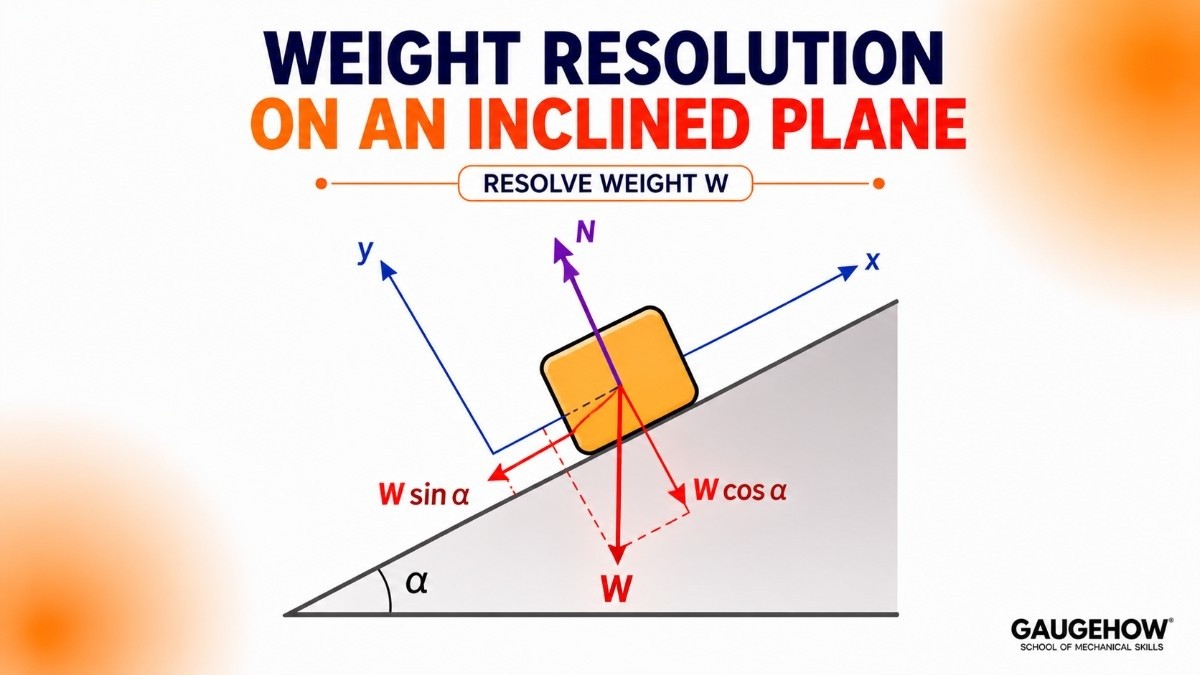
Nothing requires x to be horizontal. On an inclined plane, take x along the slope and y perpendicular to the slope. They are still 90 degrees apart, so every formula still applies.
With rotated axes, the normal reaction lies purely along y and any motion lies purely along x. Only the weight needs resolving:
Component along the plane = W sin α Component perpendicular to the plane = W cos α
Where W is the weight in newtons, equal to mass × 9.81, and α is the slope angle in degrees.
Keep the axes horizontal instead and you must resolve the normal reaction and friction as well, turning a two-line problem into six lines for exactly the same answer. Choosing good axes is part of the method, not a shortcut around it.
Advantages and Limitations
What the analytical method does well:
Produces exact answers rather than measured approximations
Scales to any number of forces with no extra difficulty
Extends naturally to three dimensions using direction cosines
Is repeatable, so anyone can check your working line by line
Underpins every software solver you will ever use
Where it needs care:
Sign and quadrant errors are easy to make and hard to spot
The arithmetic gets long with many forces, so neat layout matters
It hides the physical picture, which is why a rough sketch alongside is always worth the thirty seconds
Common Mistakes to Avoid
Reattaching signs by hand. Enter the full angle from the positive x axis and let the calculator produce the signs.
Using cosine when the angle is measured from the vertical. Read the diagram, not the habit.
Adding magnitudes instead of components. A 60 N and an 80 N force give 140 N only if they point the same way.
Leaving the calculator in radian mode. Check that sin 30° gives exactly 0.5 before you start.
Quoting a magnitude with no direction. The resultant is a vector, so both parts are needed.
Trusting the inverse tangent blindly. It cannot tell the first quadrant from the third. Your sketch can.
Working in kilograms. Convert mass to weight by multiplying by 9.81 before resolving.
Key Takeaways
The analytical method finds the resultant by resolving forces into components and adding them.
It works because perpendicular directions are completely independent of each other.
Split with Fx = F cos θ and Fy = F sin θ, then recombine with R = √((ΣFx)² + (ΣFy)²).
Measure every angle from the positive x axis and let the trigonometry supply the signs.
The same method proves equilibrium by setting ΣFx = 0 and ΣFy = 0.
On a slope, rotate the axes along and perpendicular to the surface to cut the work.
It is exact and scalable, while the graphical method is intuitive but limited by drawing accuracy.
Always check the resultant lies between the sum and the difference of the forces.
Quick Revision Box
Horizontal component: Fx = F cos θ
Vertical component: Fy = F sin θ
Sum of horizontal components: ΣFx
Sum of vertical components: ΣFy
Resultant magnitude: R = √((ΣFx)² + (ΣFy)²)
Resultant direction: tan α = ΣFy / ΣFx
Equilibrium conditions: ΣFx = 0 and ΣFy = 0
On an incline: along plane = W sin α, perpendicular = W cos α
Weight from mass: W = m × 9.81
Plausibility check: (F1 − F2) ≤ R ≤ (F1 + F2)
Frequently Asked Questions
What is the analytical method of resolution of forces?
It is a calculation-based way of finding the resultant. Each force is split into perpendicular components, all the horizontal components are added, all the vertical components are added, and the two totals are combined with Pythagoras and an inverse tangent.
Why is the analytical method preferred over the graphical method?
Because it is exact and repeatable. A drawn answer is only as accurate as the ruler and protractor, while a calculated one can be checked line by line and stays just as easy with twenty forces as with two.
How do I know whether to use sine or cosine?
Look at where the angle is drawn from. The component lying along the same line as the angle takes cosine, and the component at right angles to it takes sine. An angle measured from the vertical swaps the two.
Can the analytical method be used in three dimensions?
Yes. You add a third component along the z axis and use direction cosines, then combine with R = √(ΣFx² + ΣFy² + ΣFz²). The logic is identical, just with one more column.
Does the analytical method work for equilibrium problems?
It is the standard tool for them. Setting ΣFx = 0 and ΣFy = 0 gives two equations, which is enough to solve for two unknown forces such as cable tensions or support reactions.
Practice Corner
Why must the two chosen directions be perpendicular for this method to work?
A 400 N force acts at 125 degrees. Find its components with correct signs.
Two forces act at a point: 100 N at 0 degrees and 150 N at 90 degrees. Find the resultant and its direction.
Three forces give ΣFx = −30 N and ΣFy = −40 N. Find the resultant and describe its direction.
State the two equilibrium equations used in the analytical method.
Answers
Because perpendicular components are independent, so a force along one axis has no effect along the other. That lets the two sums be done separately as plain arithmetic. At any other angle the components overlap and the simplification disappears.
Fx = 400 cos 125° = −229.4 N and Fy = 400 sin 125° = 327.7 N. The force points up and to the left.
R = √(100² + 150²) = √32500 = 180.3 N, at tan α = 150/100, so 56.3 degrees above the x axis.
R = √(900 + 1600) = √2500 = 50 N. Both sums are negative, so it points down and to the left, at 53.1 degrees below the negative x axis.
ΣFx = 0 and ΣFy = 0.
Where to Practise This Further
The analytical method only becomes fast once the sign convention is automatic, and that takes repetition. Drill component and resultant questions under time pressure with the free MCQ practice tests, and see how they get asked in placement rounds in the engineering interview question bank.
To watch the same arithmetic running inside real software, the Fusion 360 course shows how load directions are applied to a model, and the FEA with ANSYS course takes component thinking into full static structural analysis. If you would rather automate the sums, Python for Mechanical Engineers covers scripting these calculations in a few lines.
Students planning a design career can also browse the Mechanical Engineer hub and the Design Engineer track to see where statics fits into the wider skill set.
Internal links:
Resultant force formula and examples
Rectangular components of a force explained simply
Inclined forces and inclined plane problems explained
Practice tests: https://gaugehow.com/practice
Interview Q&A hub: https://gaugehow.com/interview