Engineering Mechanics
Beam Equilibrium Explained Simply (Conditions With Example)
A beam holding up a floor does not move, does not sink, and does not tip. It just sits there carrying load, year after year. The reason it stays perfectly still has a name in engineering. It is called beam equilibrium, and it is the rule every safe beam must obey.
This lesson continues the Equilibrium of Rigid Bodies module in the GaugeHow Engineering Mechanics series. In the last lesson we learned how to calculate support reactions. Now we apply those ideas to whole beams and check that they are truly balanced.
By the end, you will know the conditions for beam equilibrium, the main beam types, and how to solve a beam that overhangs its support. Let us keep it clear.
What Is Beam Equilibrium?
Beam equilibrium means a beam is fully balanced under its loads and supports, so it does not move or rotate.
A beam carries loads and passes them down to its supports. The supports push back with reactions. When every push and every turn cancels out, the beam is in equilibrium and stays still.
This balance is not optional. A real beam must be in equilibrium, or it would slide, sag, or topple. Checking equilibrium is how engineers prove a beam will hold.
Conditions for Beam Equilibrium
For a flat beam loaded in one plane, three conditions must all be true at once.
Horizontal forces balance. All left and right forces add up to zero. Written as ΣFx = 0.
Vertical forces balance. All up and down forces add up to zero. Written as ΣFy = 0.
Moments balance. All turning effects about any point add up to zero. Written as ΣM = 0.
If all three hold, the beam cannot move sideways, cannot move up or down, and cannot rotate. That is complete equilibrium. If even one fails, the beam is not balanced.
Types of Beams

Beams are named by how they are supported. Knowing the type tells you what reactions to expect.
Simply supported beam. Rests on a pin at one end and a roller at the other. The most common type.
Cantilever beam. Fixed at one end and free at the other, like a balcony.
Overhanging beam. A simply supported beam whose end extends past a support.
Fixed beam. Fixed at both ends, so it resists rotation at both.
Continuous beam. Rests on more than two supports along its length.
The first three are usually statically determinate, meaning you can solve them with the three equilibrium conditions alone. We will focus on those in this module.
How to Check if a Beam Is in Equilibrium
To confirm a beam is balanced, you test the three conditions in order.
Draw the free body diagram. Show the beam alone with all loads and support reactions.
Check horizontal balance. Add all horizontal forces. They must sum to zero.
Check vertical balance. Add all vertical forces, including reactions. They must sum to zero.
Check moment balance. Pick any point and add all moments. They must sum to zero.
If all three sums come out zero, the beam is in equilibrium. In practice, you usually use these same equations in reverse to find the unknown reactions first, then the balance is guaranteed.
Beam Equilibrium Solved Example
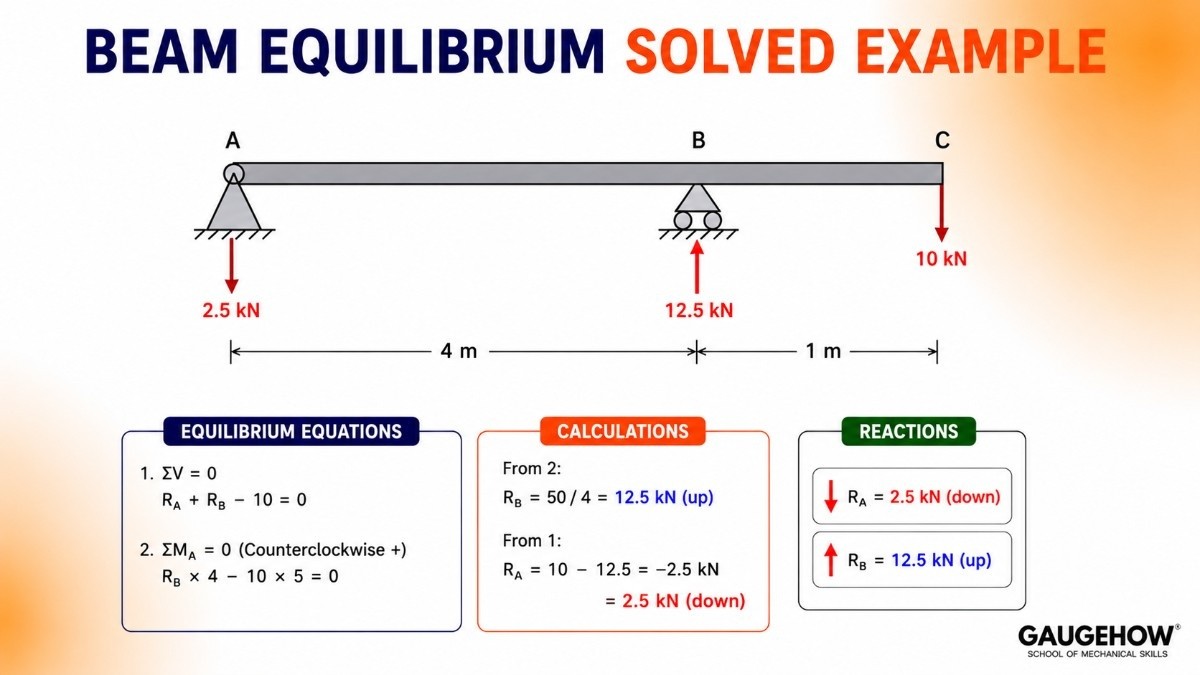
Let us solve an overhanging beam, since it shows something surprising. We use the balance conditions.
Problem: A beam has a pin support at A and a roller support at B, 4 m apart. The beam overhangs 1 m past B to a free end at C, which is 5 m from A. A downward load of 10 kN acts at C. Find the reactions at A and B.
Step 1. Take moments about A to find By. Taking counterclockwise as positive: By × 4 = 10 × 5 By × 4 = 50 By = 12.5 kN upward.
Step 2. Balance the vertical forces to find Ay. Ay + By = 10 Ay + 12.5 = 10 Ay = -2.5 kN
Step 3. Read the negative sign. Ay came out negative, which means the reaction at A actually acts downward, not upward. The support at A must pull the beam down to stop the overhanging load from lifting that end.
Step 4. State the result. By = 12.5 kN upward, and Ay = 2.5 kN downward.
This is a key lesson. When a load hangs past a support, the far support can be pulled down. A negative reaction is not a mistake. It simply tells you the true direction is opposite to what you assumed.
Statically Determinate vs Indeterminate Beams
Not every beam can be solved with the three equations alone.
A beam is statically determinate when its number of unknown reactions equals three, matching the three equations. Simply supported, cantilever, and overhanging beams are all determinate.
A beam is statically indeterminate when it has more than three unknown reactions. A fixed beam has six reactions and a continuous beam has more than three, so both need advanced methods beyond basic statics.
For this module, every beam is determinate, so the three equilibrium conditions are all you need.
Where Engineers Use Beam Equilibrium
Beam equilibrium is the foundation of almost all structural design.
Floor and roof beams, checked for balance before sizing them.
Bridge girders, where reactions decide the load on each pier.
Crane arms and booms, balanced so they carry load without tipping.
Machine supports and frames, kept steady under working loads.
Every safe structure starts with a balanced beam. If you plan to work on real structures, this is a daily skill. You can explore role based learning on the Mechanical Engineer hub, and later see full beam analysis in the Fusion 360 and FEA with ANSYS courses.
Frequently Asked Questions
What is beam equilibrium in simple words?
It means a beam is fully balanced under its loads and supports, so it does not move sideways, move up or down, or rotate.
What are the conditions for beam equilibrium?
Three conditions. The sum of horizontal forces is zero, the sum of vertical forces is zero, and the sum of moments about any point is zero.
What are the main types of beams?
Simply supported, cantilever, overhanging, fixed, and continuous beams. They are named by how and where they are supported.
Can a support reaction be negative?
Yes. A negative reaction means the true direction is opposite to what you assumed. It often happens at the far support of an overhanging beam, where the support must hold that end down.
Which beams are statically determinate?
Simply supported, cantilever, and overhanging beams are determinate, since they have three unknown reactions that match the three equilibrium equations.
Why must a beam be in equilibrium?
Because if it were not, the loads and reactions would not cancel, and the beam would slide, sink, or rotate instead of standing still and carrying load.
Key Takeaways
Beam equilibrium means the beam is fully balanced and does not move or rotate.
Three conditions must hold: ΣFx = 0, ΣFy = 0, and ΣM = 0.
Beams are named by their supports: simply supported, cantilever, overhanging, fixed, and continuous.
Check equilibrium with a free body diagram and the three balance sums.
A negative reaction means the real direction is opposite to your assumption.
Simply supported, cantilever, and overhanging beams are statically determinate.
Fixed and continuous beams are indeterminate and need advanced methods.
Quick Revision Box
Beam equilibrium conditions: ΣFx = 0, ΣFy = 0, ΣM = 0
Beam types: simply supported, cantilever, overhanging, fixed, continuous
Determinate: 3 unknown reactions match 3 equations
Indeterminate: more than 3 unknown reactions
Negative reaction = direction is opposite to assumed
Units: forces in N or kN, moments in N·m or kN·m
Practice Corner
Try these before moving on. Answers are at the bottom.
What does it mean for a beam to be in equilibrium?
Write the three conditions for beam equilibrium.
Name three statically determinate beam types.
A beam has a pin at A and a roller at B, 3 m apart, and overhangs 1 m past B to C. A 6 kN load acts at C. Find the reaction at B.
What does a negative reaction tell you?
<details> <summary>Answers</summary>
It means the beam is fully balanced under its loads and supports, so it does not move sideways, move up or down, or rotate.
Sum of horizontal forces = 0, sum of vertical forces = 0, and sum of moments = 0.
Simply supported, cantilever, and overhanging beams.
Taking moments about A: By × 3 = 6 × 4, so By × 3 = 24, giving By = 8 kN upward.
It tells you the true direction of that reaction is opposite to the direction you assumed.
</details>
Want more practice? Try the GaugeHow practice tests and browse common interview questions once you feel ready.
What's Next
Next we will study Distributed Loads, how to replace a spread out load with a single equal force so beam problems stay simple.
Internal links: Mechanical Engineer hub (https://gaugehow.com/mech), Fusion 360 course (https://gaugehow.com/course/fusion-360), FEA with ANSYS course (https://gaugehow.com/course/fea-finite-element-analysis-with-ansys), Practice tests (https://gaugehow.com/practice), Interview Q&A (https://gaugehow.com/interview)