Engineering Mechanics
Characteristics of Force Explained for Students
Try a quick test. Push a door open near the handle. Easy. Now push the same door with the same effort, but close to the hinge. It barely moves.
The push was the same size, yet the result changed completely. Why? Because a force is not just about how hard you push. Where you push, and in which direction, matters just as much.
In this lesson you will learn the characteristics of force, which are the four things that fully describe any force. Master these and you will understand why forces behave the way they do, and why engineers care so much about every detail of a force.
We defined force in the previous lesson as a push or a pull. Quick recall: force can start motion, stop it, change direction, or change shape. Now we look closer at what makes each force unique.
What Are the Characteristics of Force?
A characteristic of force is a piece of information you need to describe that force completely.
A single number is never enough. Saying "a force of 50 newtons" does not tell the full story. You also need to know which way it points and where it acts.
There are four characteristics of force:
Magnitude
Direction
Point of application
Line of action
Miss any one of these and the force is only half described. Let us take them one at a time.
What Is the Magnitude of Force?
The magnitude is how strong the force is. It answers the simple question, "how hard?"
Magnitude is a number with a unit. In SI units, force is measured in newtons (N). So a force might be 10 N, 250 N, or 5000 N.
Think of two people pushing a car. One pushes gently, the other pushes hard. Both apply a force in the same direction, but the stronger push has a larger magnitude. That is the part most people already understand about force.
What Is the Direction of Force?
The direction tells you which way the force points. Up, down, left, right, or at any angle.
Direction changes everything. Lift a bag straight up and it rises. Push it sideways and it slides. Same object, same effort, totally different result, all because of direction.
This is why we always state the direction of a force. For example, "a force of 100 N acting vertically downward" or "a force of 30 N at 45 degrees above the horizontal."
What Is the Sense of a Force?
The sense is closely linked to direction. It tells you which way along a line the force acts, either one way or the exact opposite.
Picture a rope lying flat. A force can pull it to the left or pull it to the right. Both act along the same line, but their sense is opposite. We usually show sense with the arrowhead. The tip of the arrow points in the direction the force is pushing or pulling.
So direction gives the line and angle, and sense gives which end of that line the force pushes toward.
What Is the Point of Application of Force?
The point of application is the exact spot where the force acts on the body.
Go back to the door example. Pushing near the handle and pushing near the hinge use the same magnitude and direction, but the point of application is different. That single change made the door easy or hard to open.
Engineers care deeply about this. Where a load lands on a beam decides how much it bends. Where a bolt is tightened decides how the joint holds. The point of application is not a small detail. It often decides success or failure.
What Is the Line of Action of Force?
The line of action is the straight line along which the force acts. Imagine extending the force arrow forward and backward into a full straight line. That line is the line of action.
Why does this matter? Because for a rigid body, a force can be slid along its line of action without changing its effect. This idea is called the principle of transmissibility, and it makes many problems easier to solve.
[IMAGE: a block with a force arrow F, showing the point of application as a dot, the arrowhead showing direction and sense, and a dashed straight line extended through the arrow labelled line of action]

Why Is Force a Vector Quantity?
Because a force has both magnitude and direction, it is a vector quantity.
A plain number like mass or temperature is a scalar. It has size but no direction. Force is different. You cannot describe it with a number alone, so it must be a vector.
This is exactly why we draw forces as arrows. The length of the arrow shows the magnitude. The direction of the arrow shows the direction. The tail shows the point of application. One small arrow carries almost every characteristic at once.
How Do You Represent a Force?
There are two common ways engineers show a force.
First, the graphical way. Draw an arrow. Make its length match the magnitude using a scale, point it in the correct direction, and start it at the point of application. This is the method used in free body diagrams.
Second, the vector way. Write the force in terms of its parts along the x and y axes, such as F = (30, 40) N. This is handy for calculations and is the method used once problems get more complex.
Both describe the same force. One is easy to picture, the other is easy to compute.
Characteristics of Force with a Simple Example
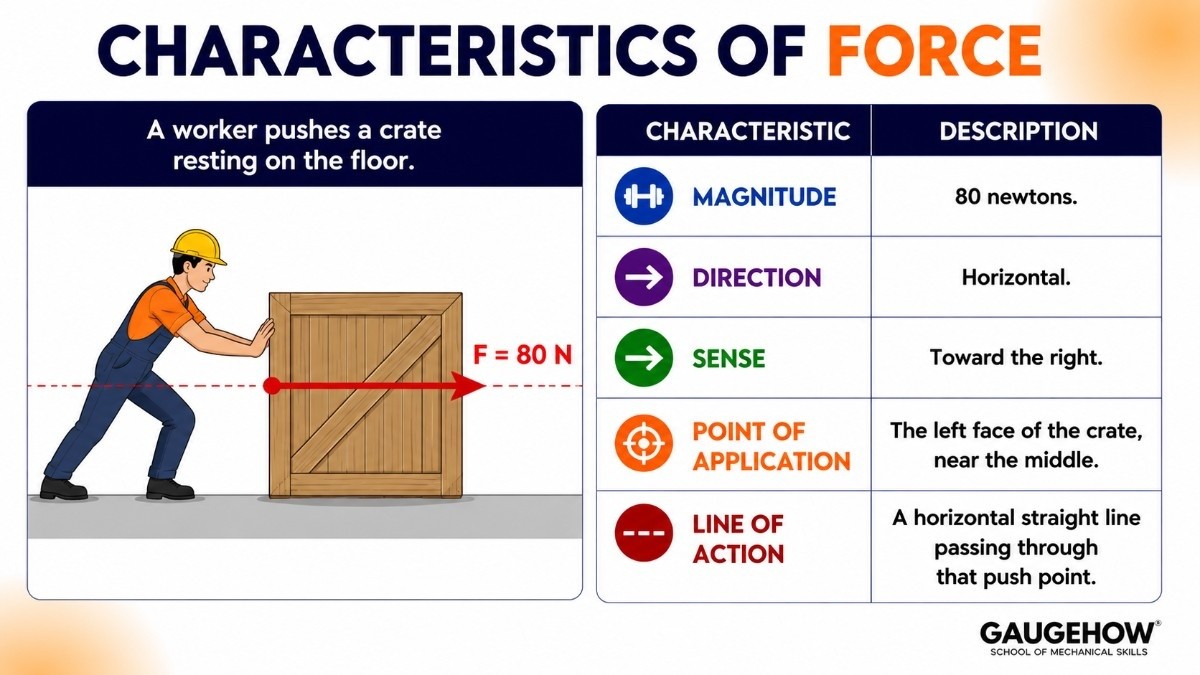
Let us describe one force fully using all four characteristics.
A worker pushes a crate resting on the floor.
Magnitude: 80 newtons.
Direction: horizontal.
Sense: toward the right.
Point of application: the left face of the crate, near the middle.
Line of action: a horizontal straight line passing through that push point.
Notice how the description is now complete. Anyone reading it can picture the exact force and predict how the crate will slide. That is the whole reason we learn these characteristics.
Where Do Engineers Use the Characteristics of Force?
These four ideas are the base of almost every mechanics calculation.
Structural engineers use point of application and line of action to work out how a load bends a beam or twists a column. Mechanical engineers use magnitude and direction to size shafts, gears, and bolts so they do not break under load. Design engineers rely on these details when they run force analysis in software.
When forces get complicated, engineers use tools like finite element analysis to track magnitude and direction at thousands of points inside a part. That skill is covered in the FEA with ANSYS course.
Frequently Asked Questions
Q: What are the characteristics of force?
A: The four characteristics are magnitude, direction, point of application, and line of action. Together they describe a force completely.
Q: Why is force a vector quantity?
A: Because it has both magnitude and direction. A number alone cannot describe it, so it must be shown as a vector, usually drawn as an arrow.
Q: What is the point of application of a force?
A: It is the exact spot on a body where the force acts. Changing this spot can change the effect of the force, as seen when pushing a door near the hinge versus the handle.
Q: What is the line of action of a force?
A: It is the straight line along which the force acts. For a rigid body, a force can slide along this line without changing its effect.
Q: What is the difference between direction and sense of a force?
A: Direction is the line and angle along which the force acts. Sense tells you which way along that line the force pushes, shown by the arrowhead.
Key Takeaways
A force needs four characteristics to be fully described.
Magnitude is how strong the force is, measured in newtons.
Direction is which way it points, and sense is which way along that line.
Point of application is where the force acts on the body.
Line of action is the straight line along which the force acts.
Because force has magnitude and direction, it is a vector and is drawn as an arrow.
Quick Revision Box
Characteristics of force: magnitude, direction, point of application, line of action
Sense: the arrowhead shows which way along the line the force acts
SI unit of magnitude: newton (N)
Nature of force: vector quantity
Graphical form: an arrow (length for magnitude, tip for direction, tail for point of application)
Practice Corner
List the four characteristics of force.
Why does pushing a door near the hinge feel harder than pushing near the handle?
Explain the difference between the direction and the sense of a force.
What does the length of a force arrow represent in a diagram?
Why can a force be moved along its line of action on a rigid body without changing its effect?
Answers
Magnitude, direction, point of application, and line of action.
Because the point of application changed. Near the hinge the force has far less turning effect.
Direction is the line and angle of the force. Sense is which way along that line it pushes, shown by the arrowhead.
It represents the magnitude of the force, drawn to a chosen scale.
This is the principle of transmissibility, which holds for rigid bodies as long as magnitude, direction, and line of action stay the same.
What's Next
Next we cover the Principle of Transmissibility in full, which builds directly on the line of action you just learned, followed by Force Representation and the different Types of Forces.
Conclusion
A force is far more than a number. To describe it properly you need its magnitude, direction, point of application, and line of action. Keep these four in mind and every force diagram you draw will make sense. This foundation carries straight into moments, equilibrium, and structural analysis later in the course.
Want to lock in these basics? Explore the free tools on the GaugeHow Learn Hub and test your understanding with the Practice and MCQ tests.
Internal links:
FEA with ANSYS (force analysis in real parts) → https://gaugehow.com/course/fea-finite-element-analysis-with-ansys
Mechanical Engineer Hub → https://gaugehow.com/mech
Learn Hub → https://gaugehow.com/learn
Practice and MCQ Tests → https://gaugehow.com/practice
Interview Q&A Hub → https://gaugehow.com/interview