Engineering Mechanics
Clockwise and Counterclockwise Moment Explained Simply
Push a door on the right side and it swings one way. Push it on the left and it swings the other way. Same door, same push, but a different turning direction. That difference is the whole idea behind clockwise and counterclockwise moments.
This lesson continues the GaugeHow Engineering Mechanics series. We have already learned the moment of force, the principle of moments, and Varignon's theorem. Now we slow down on one detail that trips up many students: how to tell which way a moment turns and what sign to give it.
By the end, you will name the direction of any moment, apply the correct sign, and stop losing marks on sign mistakes. Let us keep it simple.
What Is a Clockwise Moment?
A clockwise moment turns an object in the same direction that the hands of a clock move. That is, from the top going to the right, then down, then left, and back up.
Picture a clock on the wall. The hands sweep from 12 to 3 to 6 to 9. Any force that tries to spin a body in that same sweep is creating a clockwise moment.
A simple example is pushing down on the right end of a seesaw. That side drops and the whole seesaw rotates clockwise about the pivot.
What Is a Counterclockwise Moment?
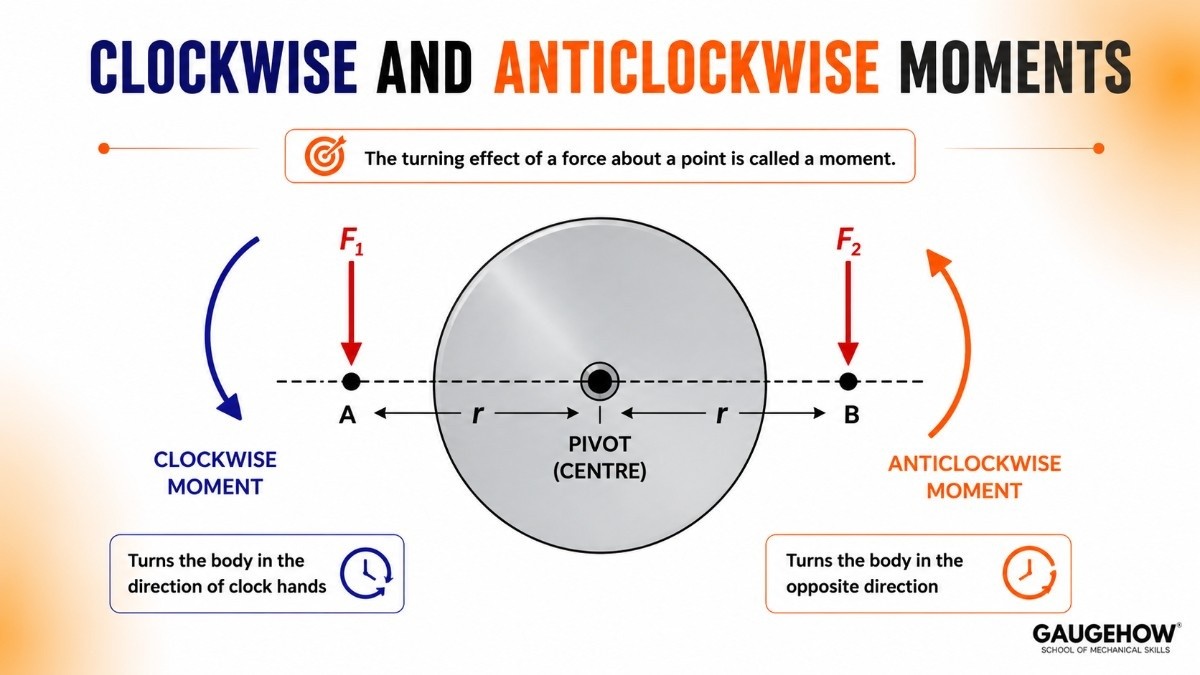
A counterclockwise moment, also called an anticlockwise moment, turns an object the opposite way to a clock's hands. It sweeps from 12 to 9 to 6 to 3.
Push down on the left end of the same seesaw and it rotates the other way. That is a counterclockwise moment.
Both words mean the same thing. British and Indian textbooks usually say anticlockwise, while American books say counterclockwise. Do not let the two words confuse you. They point to the exact same direction.
Clockwise vs Counterclockwise Moment
The only real difference between the two is the direction of turning. Everything else, the formula and the unit, stays the same.
Here are the key points to hold in your head.
A clockwise moment turns the body the way clock hands move.
A counterclockwise moment turns it the opposite way.
Both are still found using moment equals force times perpendicular distance.
Both are measured in newton metre (N·m).
On the same pivot, the two directions oppose each other and can cancel out.
That last point is important. When clockwise and counterclockwise moments on a body are equal, they balance and the body does not rotate. That is the principle of moments we saw earlier.
Sign Convention for Moments
To add up moments in a problem, you need to give each one a plus or minus sign. This is called the sign convention.
In this series we follow the common physics choice.
A counterclockwise (anticlockwise) moment is taken as positive.
A clockwise moment is taken as negative.
So when several forces act on a body, you write each moment with its sign and then add them. The final sign tells you the direction of the net turning effect. A positive answer means the body tends to turn counterclockwise, and a negative answer means clockwise.
One honest note. This sign choice is not a law of nature. It is just an agreement to keep calculations consistent. In some fields, especially beam and structural analysis, engineers flip it and call clockwise positive. Either choice works. The only rule that truly matters is that you pick one convention at the start of a problem and stick with it the whole way through.
How to Tell if a Moment Is Clockwise or Counterclockwise
Here is a quick trick that always works.
Imagine holding the body fixed at the pivot, then apply only the one force you are checking. Watch which way the body would start to spin. That is the direction of that moment.
Another way is to stand the force at the pivot in your mind and trace its curl. If your hand curls the way a clock turns, it is clockwise. If it curls the other way, it is counterclockwise.
Do this for each force one at a time. Do not try to judge all forces together, because that is where mistakes creep in. Handle them separately, give each a sign, then combine.
Solved Example on Moment Direction
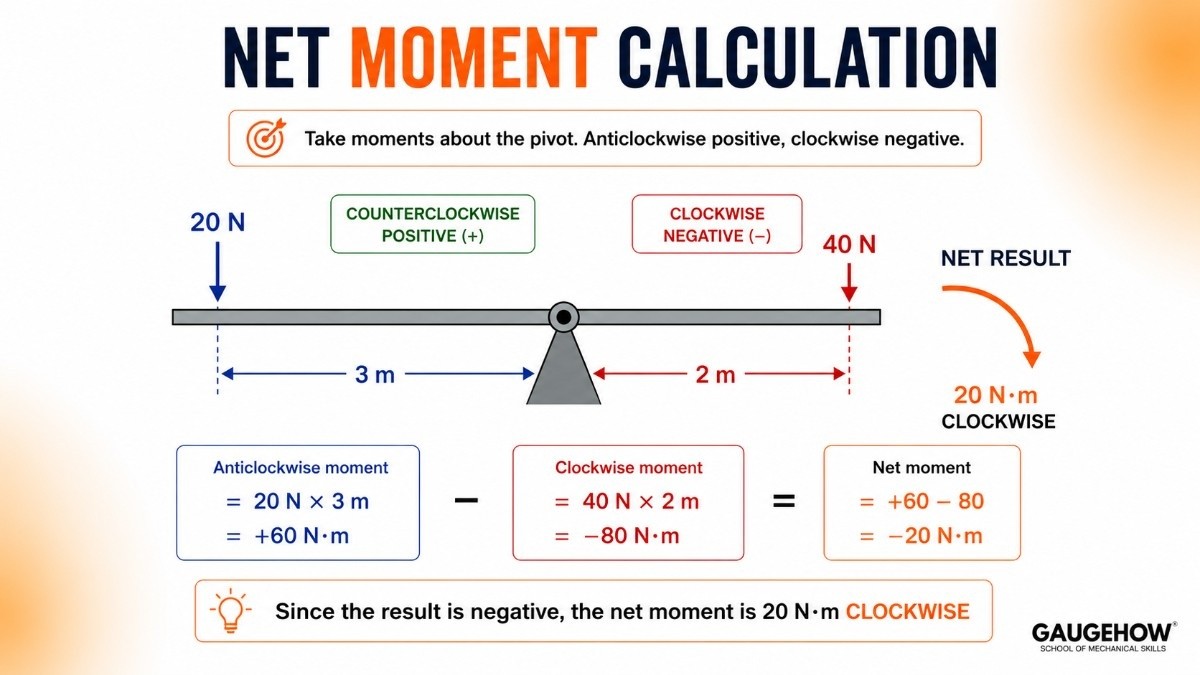
Let us solve a short problem that uses both directions.
Problem: A beam is pivoted at its centre. A 20 N force acts downward 3 m to the left of the pivot. A 40 N force acts downward 2 m to the right of the pivot. Find the net moment and its direction.
Step 1. Check the left force direction. A downward push on the left makes the beam turn counterclockwise. Moment = 20 × 3 = 60 N·m, and it is positive.
Step 2. Check the right force direction. A downward push on the right makes the beam turn clockwise. Moment = 40 × 2 = 80 N·m, and it is negative.
Step 3. Add the moments with signs. Net moment = (+60) + (-80) = -20 N·m
Step 4. Read the answer. The result is negative, so the net moment is 20 N·m clockwise.
The beam will tend to rotate clockwise, because the right side wins. If both moments had been equal, the answer would be zero and the beam would stay balanced.
Where Moment Direction Matters in Engineering
Getting the direction right is not just about exam marks. It decides whether a design works or fails.
In beam and bridge analysis, wrong moment signs give the wrong bending result and an unsafe design.
In machine shafts and gears, the direction of the moment sets the direction of rotation and load.
In cranes and levers, engineers make sure the useful moment beats the tipping moment.
In robotics and joints, each motor must apply a moment in the correct direction to move an arm.
If you plan to work on real structures and machines, this small habit of tracking direction carefully pays off constantly. You can explore role based learning on the Mechanical Engineer hub, and later see it applied in the Fusion 360 and FEA with ANSYS courses.
Key Takeaways
A clockwise moment turns a body the way clock hands move.
A counterclockwise moment, also called anticlockwise, turns it the opposite way.
Counterclockwise and anticlockwise are two words for the same direction.
The formula and unit are the same for both, moment equals force times distance in N·m.
Common sign convention: counterclockwise positive, clockwise negative.
The sign choice is an agreement, so pick one and use it for the whole problem.
To find direction, apply one force at a time and watch which way the body would spin.
Quick Revision Box
Moment: M = F × d
Clockwise moment: turns like clock hands, taken as negative here
Counterclockwise (anticlockwise) moment: opposite to clock hands, taken as positive here
Net moment = sum of all moments with their signs
Positive net = counterclockwise, negative net = clockwise
Unit: newton metre (N·m)
Practice Corner
Try these before moving on. Answers are at the bottom.
What is the difference between a clockwise and a counterclockwise moment?
Are counterclockwise and anticlockwise the same thing?
Using counterclockwise as positive, what sign does a clockwise moment get?
A 15 N force acts downward 2 m left of a pivot, and a 10 N force acts downward 4 m right of the pivot. Find the net moment and its direction.
Why must you keep the same sign convention throughout a problem?
<details> <summary>Answers</summary>
A clockwise moment turns the body the way clock hands move, while a counterclockwise moment turns it the opposite way.
Yes, counterclockwise and anticlockwise mean the same direction.
It gets a negative sign.
Left force: 15 × 2 = 30 N·m counterclockwise (positive). Right force: 10 × 4 = 40 N·m clockwise (negative). Net = 30 - 40 = -10 N·m, so 10 N·m clockwise.
Because mixing conventions midway would add moments with the wrong signs and give a wrong net result.
</details>
Want more practice? Try the GaugeHow practice tests and browse common interview questions once you feel ready.
What's Next
Next we will study the Couple, a special pair of forces that creates pure rotation without pushing the body in any direction.
Internal links: Mechanical Engineer hub (https://gaugehow.com/mech), Fusion 360 course (https://gaugehow.com/course/fusion-360), FEA with ANSYS course (https://gaugehow.com/course/fea-finite-element-analysis-with-ansys), Practice tests (https://gaugehow.com/practice), Interview Q&A (https://gaugehow.com/interview)