Engineering Mechanics
Couple in Mechanics: Why Two Equal Forces Make Things Spin
Grab a steering wheel with both hands. Your top hand pushes one way and your bottom hand pushes the other way. The wheel does not move sideways. It simply turns.
That is a couple in action. Two equal forces, pushing in opposite directions, working together to create pure rotation. Couples are the reason steering wheels turn, taps open, and screwdrivers work.
In this lesson you will learn what a couple is, its special features, and how to find its turning effect using a simple formula. By the end you will understand why a couple only spins things and never slides them.
This follows the last lesson on distributed loads. Quick recall: a distributed load spreads over a length and can be replaced by one equivalent point force. Now we meet a special force pair.
What Is a Couple in Mechanics?
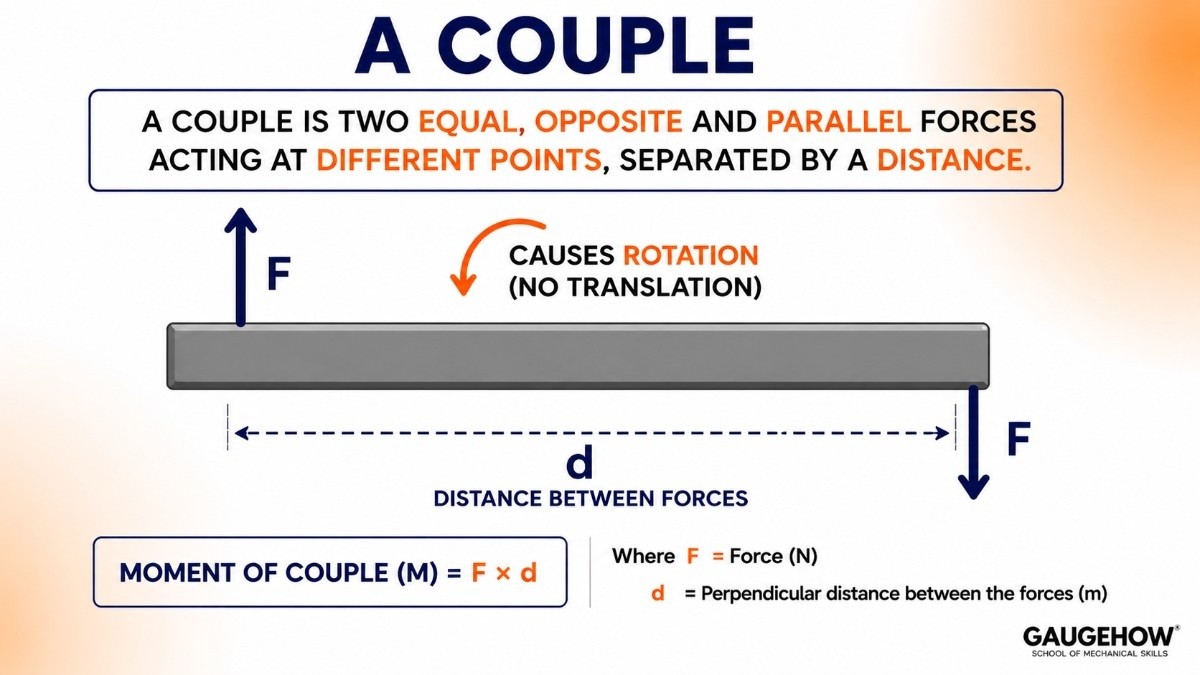
A couple is a pair of two forces that are equal in size, opposite in direction, and separated by a distance.
The two forces are parallel, but they do not act along the same line. There is a gap between them. This gap is what gives the couple its turning power.
Because the two forces are equal and opposite, they do not push the body in any one direction. Instead, they twist it. A couple is a pure turning action.
What Are the Characteristics of a Couple?
A couple has a few clear features. Knowing them helps you spot a couple instantly.
The two forces are equal in magnitude.
The two forces are opposite in direction.
The two forces are parallel but act along different lines.
There is a perpendicular distance between them, called the arm.
The net force is zero, so the body does not move sideways.
If a force pair has all of these, it is a couple. The zero net force is the giveaway. It means the only thing left is rotation.
Why Does a Couple Cause Only Rotation?
This is the heart of the idea, so let us make it clear.
When you add the two forces of a couple, they cancel, because they are equal and opposite. So the total force pushing the body in any direction is zero. That means no sliding, no straight line motion.
But the forces act at different places, with a gap between them. So even though they cancel for pushing, they both help turn the body the same way. The result is pure rotation with no movement of the centre.
What Is the Moment of a Couple?
The moment of a couple is the measure of its turning effect. It tells you how strongly the couple rotates the body.
The bigger the forces, or the wider the gap between them, the stronger the turning effect. That is why a longer spanner turns a bolt more easily than a short one. The extra distance boosts the moment.
The moment of a couple is also special in one way. It stays the same about any point on the body. You do not need to pick a centre of rotation, which makes couples easy to work with.
What Is the Formula for the Moment of a Couple?
The moment of a couple is found with a simple formula:
M = F × d
Where:
M is the moment of the couple, in newton metres (N·m)
F is the size of one of the two forces, in newtons (N)
d is the perpendicular distance between the two forces, in metres (m)
Notice that you use only one of the forces, not both, because they are equal. You simply multiply that force by the gap between the two lines of action.
The SI unit of the moment of a couple is the newton metre (N·m).
What Is the Difference Between a Couple and a Moment?

These two are closely linked, so students often mix them up. Moment gets its own full lesson next, so here is the short version.
A moment is the turning effect of a single force about a point. A couple is the turning effect of two equal and opposite forces, and it does not need a point to turn about.
The key difference is this. A single force can both push and turn a body. A couple only turns it, because its forces cancel for pushing. We will cover moments fully in the next lesson.
What Are Real Life Examples of a Couple?
Couples show up in many everyday actions:
Turning a steering wheel with both hands.
Opening a tap or a bottle cap with two fingers.
Turning a screwdriver or winding a clock key.
Turning the handle of a hand drill.
Using both hands to twist off a jar lid.
In each case, two equal and opposite forces work across a gap to create rotation, and nothing slides.
Couple Example
Let us find the moment of a simple couple.
Two equal and opposite forces of 20 newtons each act on a bar. The perpendicular distance between them is 0.5 metres. Find the moment of the couple.
Step 1. Note the force of one side: F = 20 N. Step 2. Note the perpendicular distance: d = 0.5 m. Step 3. Apply the formula: M = F × d. Step 4. M = 20 × 0.5 = 10 newton metres.
So the couple produces a turning effect of 10 N·m. That single number tells an engineer exactly how strongly the bar is being twisted.
Where Do Engineers Use Couples?
Couples appear in many machines and tools.
Mechanical engineers design steering systems, valve handles, and taps around the idea of a couple, so a small effort gives a strong turn. The torque that a motor delivers to a shaft is a couple, since it produces pure rotation. Understanding couples helps engineers size shafts, keys, and handles correctly.
When these turning effects act on complex parts, engineers use simulation to check how the part handles the twist. That skill is developed in the FEA with ANSYS course.
Frequently Asked Questions
Q: What is a couple in mechanics?
A: A couple is a pair of two forces that are equal in size, opposite in direction, and separated by a distance. Together they cause pure rotation.
Q: Why does a couple cause only rotation?
A: Because the two forces are equal and opposite, they cancel for pushing, so the net force is zero. The gap between them still creates a turning effect, so the body only rotates.
Q: What is the moment of a couple?
A: It is the turning effect of the couple, found using M = F × d, where F is one of the forces and d is the perpendicular distance between them. Its unit is the newton metre.
Q: What is the difference between a couple and a moment?
A: A moment is the turning effect of a single force about a point. A couple is the turning effect of two equal and opposite forces, and it is the same about any point.
Q: Can a couple be balanced by a single force?
A: No. A couple can only be balanced by another couple of equal and opposite moment, since a single force cannot cancel a pure rotation.
Key Takeaways
A couple is two equal, opposite, parallel forces separated by a distance.
The net force of a couple is zero, so it causes only rotation.
The moment of a couple measures its turning effect.
The formula is M = F × d, with the unit newton metre (N·m).
The moment of a couple is the same about any point on the body.
A couple can only be balanced by another couple.
Quick Revision Box
Couple: two equal, opposite, parallel forces separated by a distance
Net force: zero, so pure rotation only
Moment of a couple: M = F × d
Unit: newton metre (N·m)
Special property: same moment about any point
Balanced only by: another couple
Practice Corner
In your own words, what is a couple?
Why does a couple not cause any straight line motion?
Write the formula for the moment of a couple and name its unit.
Two forces of 15 N act as a couple with a perpendicular distance of 0.4 m. Find the moment.
Give two real life examples of a couple.
Answers
It is a pair of equal and opposite parallel forces separated by a distance that together cause rotation.
Because the two forces are equal and opposite, they cancel out, so the net pushing force is zero.
M = F × d, and the unit is the newton metre (N·m).
M = 15 × 0.4 = 6 newton metres.
Turning a steering wheel and opening a tap with two fingers. Other correct answers are fine.
What's Next
Next we study the Moment of a Force, the turning effect of a single force about a point, which completes the Force System module.
Conclusion
A couple is a simple but powerful idea. Two equal and opposite forces, working across a gap, create pure rotation and nothing else. Remember the formula M = F × d and the fact that the net force is always zero, and you will handle couples in any tool, shaft, or steering system. This sets you up perfectly for the next lesson on moments.
Want to strengthen these fundamentals? Explore the free tools on the GaugeHow Learn Hub and test yourself with the Practice and MCQ tests.
Internal links:
FEA with ANSYS (analysing twist and torque on real parts) → https://gaugehow.com/course/fea-finite-element-analysis-with-ansys
Mechanical Engineer Hub → https://gaugehow.com/mech
Learn Hub → https://gaugehow.com/learn
Practice and MCQ Tests → https://gaugehow.com/practice
Interview Q&A Hub → https://gaugehow.com/interview