Engineering Mechanics
Cross Product Explained Simply for Engineering Mechanics
Push a door near the handle and it swings open easily. Push the same door near the hinges and almost nothing happens. Same force, very different turning effect. The difference is the distance from the hinge, and the way that distance and force combine.
That turning effect is what the cross product measures. It is the maths behind why a spanner with a longer handle loosens a stubborn bolt more easily.
In our last lesson the dot product multiplied two vectors to give a plain number. The cross product is the second way to multiply vectors, and this time the answer is a brand new vector, not a number.
By the end of this lesson you will know what the cross product means, both ways to calculate it, how to find the direction using the right-hand rule, and why it is the key to understanding moment and torque.
What Is the Cross Product?
The cross product is a way of multiplying two vectors that produces a new vector as the result.
Because the answer is a vector, the cross product is also called the vector product. This is the big difference from the dot product, which gave a scalar. Here the result has both a size and a direction.
The new vector points in a very specific way: it is perpendicular to both of the original vectors. In other words, it sticks straight out of the flat surface that the two vectors lie in.
Think of two pencils lying flat on a table at an angle to each other. Their cross product points straight up out of the table, at right angles to both. That "out of the plane" direction is exactly what a turning axis looks like, which is why the cross product describes rotation.
What the Size of the Cross Product Means
The magnitude (size) of the cross product tells you how much turning effect the two vectors produce together.
The formula for the size is:
|A × B| = |A| |B| sin θ
|A × B| is the magnitude of the cross product.
|A| and |B| are the sizes of the two vectors.
θ (theta) is the angle between them.
Notice it uses sin θ, while the dot product used cos θ. This is the mirror image of the dot product, and it changes everything.
When the vectors are perpendicular (90 degrees), sin 90 is 1, so the cross product is largest. Maximum turning effect.
When the vectors point the same way (0 degrees), sin 0 is 0, so the cross product is zero. No turning effect at all.
This matches the door. Push at right angles to the door and it swings best. Push along the door, straight into the hinge line, and it does not turn.
The Right-Hand Rule: Finding the Direction
The cross product gives a vector, so we need its direction, not just its size. Engineers find it with the right-hand rule.
Here is how to do it. Point the fingers of your right hand along the first vector (A). Curl them toward the second vector (B). Your thumb now points in the direction of the cross product A × B.
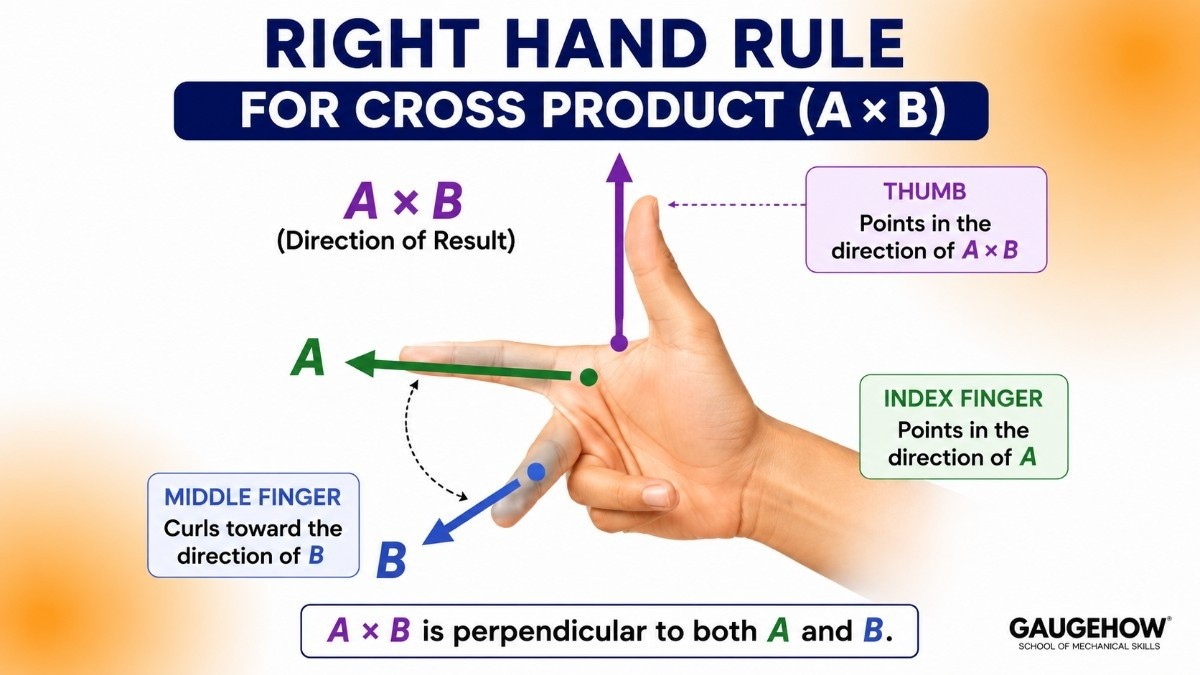
That thumb direction is the axis the turning happens around. For a bolt, it tells you whether the cross product points out of the wall or into it, which is the same as saying whether the bolt tightens or loosens.
One important result of this rule: order matters. A × B and B × A point in exact opposite directions. Swapping the vectors flips the thumb. So unlike the dot product, you must keep the order correct.
Calculating the Cross Product from Components
When the vectors are given in component form, we calculate the cross product using a set pattern. For A = Ax i + Ay j + Az k and B = Bx i + By j + Bz k:
A × B = (Ay Bz − Az By) i + (Az Bx − Ax Bz) j + (Ax By − Ay Bx) k
That looks heavy, so here is the easy way to remember each part:
The i component uses the y and z parts: (Ay Bz − Az By).
The j component uses the z and x parts: (Az Bx − Ax Bz).
The k component uses the x and y parts: (Ax By − Ay Bx).
Each line skips its own letter and crosses the other two. Once you see the pattern, it becomes routine.
Solved Mini-Example
Find A × B for A = 2i + 3j + 0k and B = 1i + 4j + 0k. (Both lie flat in the xy-plane.)
i component: (3 × 0) − (0 × 4) = 0
j component: (0 × 1) − (2 × 0) = 0
k component: (2 × 4) − (3 × 1) = 8 − 3 = 5
So A × B = 5k. The answer points purely along the z-axis (out of the page), which makes sense because both vectors lay flat in the xy-plane. The turning axis is straight out of that plane.
The Special Case: Parallel Vectors
Just as a zero dot product meant perpendicular vectors, a zero cross product has its own meaning.
If two vectors are parallel (they point the same way or exact opposite ways), their cross product is zero.
Why? Because the angle between them is 0 or 180 degrees, and sin 0 and sin 180 are both 0. No angle between them means no turning effect.
This gives engineers a quick test. If a cross product comes out zero, the two vectors lie along the same line. It also explains the door again: pushing straight along the door line produces zero turning, because your push is parallel to the arm from the hinge.
The Big Application: Moment of a Force
The cross product is the exact tool behind the moment of a force, also called torque, which is the turning effect of a force about a point.
M = r × F
M is the moment (turning effect), in newton-metres (N·m) in SI units.
r is the position vector from the pivot to where the force acts, from our position vector lesson.
F is the force vector, in newtons (N).
The size of the moment is |M| = |r| |F| sin θ, where θ is the angle between the arm and the force. This is why a longer spanner (bigger r) or a force at right angles (sin 90 = 1) gives more turning power.
Solved Mini-Example
You apply a 20 N force at the end of a spanner 0.3 m long, pushing at right angles to the handle. Find the moment about the bolt.
The force is at 90 degrees to the arm, so sin θ = sin 90 = 1.
Use |M| = |r| |F| sin θ = 0.3 × 20 × 1
|M| = 6 N·m
So the turning effect is 6 newton-metres. If you used a 0.6 m spanner instead, the moment would double to 12 N·m for the same push. That is exactly why longer handles loosen tight bolts more easily.
Dot Product vs Cross Product: The Quick Difference
Both multiply two vectors, but they answer different questions:
The dot product gives a plain number and measures how much two vectors point the same way. It uses cos θ and peaks when the vectors are aligned.
The cross product gives a new vector and measures how much they point in different directions. It uses sin θ and peaks when the vectors are perpendicular.
An easy way to keep them straight: dot product is about alignment (work done), cross product is about rotation (turning effect). One is for energy, the other is for moments.
Where Engineers Use the Cross Product
The cross product runs through a huge amount of mechanics:
Moments and torque: Every turning-effect calculation on a beam, shaft, or spanner uses the cross product. This becomes central in the moments module later.
Rotational motion: Angular velocity and the speed of a spinning point are found with cross products.
Structural analysis: Finding how off-centre loads twist a member uses moments, which tools like FEA with ANSYS compute across a model.
CAD and 3D geometry: Surface normals, the perpendicular directions of faces, are cross products, and they sit inside tools like Fusion 360.
Robotics: Joint rotations and the direction of turning are handled with cross products, often coded in Python.
Common Mistakes to Avoid
Expecting a number. The cross product gives a vector, with a direction. The dot product gave a number; do not mix them up.
Ignoring order. A × B and B × A point opposite ways. Keep the order as the problem states it.
Using cos instead of sin. The cross product size uses sin θ, not cos θ.
Forgetting the direction. Always apply the right-hand rule to state which way the result points.
Frequently Asked Questions
What is the cross product in simple words?
It is a way of multiplying two vectors that gives a new vector, pointing perpendicular to both. Its size measures the turning effect between them.
Why is the cross product called the vector product?
Because the answer is a vector, with both size and direction, unlike the dot product, which gives a plain number.
What is the right-hand rule?
Point your right-hand fingers along the first vector, curl them toward the second, and your thumb points in the direction of the cross product.
What does a cross product of zero mean?
The two vectors are parallel, pointing the same way or exact opposite ways, so there is no turning effect.
Where is the cross product used in engineering?
Most often to find the moment or torque of a force, and to find perpendicular directions like surface normals.
Key Takeaways
The cross product multiplies two vectors to give a new vector, perpendicular to both.
Its size is |A × B| = |A| |B| sin θ, largest when the vectors are perpendicular.
The right-hand rule gives the direction of the result.
Order matters: A × B and B × A point in opposite directions.
A cross product of zero means the vectors are parallel.
Moment of a force is a cross product: M = r × F.
Quick Revision Box
Cross product size: |A × B| = |A| |B| sin θ
Component form: A × B = (Ay Bz − Az By) i + (Az Bx − Ax Bz) j + (Ax By − Ay Bx) k
Direction: right-hand rule
Parallel test: A × B = 0
Moment of a force: M = r × F, size |M| = |r| |F| sin θ
Practice Corner
What kind of quantity is the result of a cross product, a number or a vector?
Find A × B for A = 1i + 2j + 0k and B = 3i + 1j + 0k.
What does a cross product of zero tell you about two vectors?
A 25 N force acts at right angles on a 0.4 m arm. Find the moment.
Is A × B the same as B × A? Explain in one line.
<details> <summary>Answers</summary>
A vector, with both size and direction.
k component: (1 × 1) − (2 × 3) = 1 − 6 = −5. The i and j parts are zero, so A × B = −5k.
They are parallel, pointing the same way or exact opposite ways.
|M| = 0.4 × 25 × sin 90 = 0.4 × 25 × 1 = 10 N·m.
No. They are exact opposites: same size, opposite direction.
Conclusion
The cross product turns two vectors into a new vector that captures their turning effect, with the right-hand rule giving its direction. It is the exact tool behind the moment of a force, so mastering it now sets you up perfectly for the moments and torque work ahead.
Want to lock it in? Visit the Mechanical Engineer learning hub at GaugeHow and try the practice questions before moving on.
What's Next
Next up: Vector Resolution, where we split a single vector into its parts along the axes, the everyday skill that makes force problems solvable.
Internal links: FEA with ANSYS → https://gaugehow.com/course/fea-finite-element-analysis-with-ansys
3D modelling in Fusion 360 → https://gaugehow.com/course/fusion-360
Python for Mechanical Engineers → https://gaugehow.com/course/python-for-mechanical-engineers-robotics
Mechanical Engineer Hub → https://gaugehow.com/mech
Practice tests → https://gaugehow.com/practice