Engineering Mechanics
Distributed Load Explained: Turn a Spread-Out Force Into One Simple Point
Here is a question that trips up many students. If a load is spread all along a beam, where exactly does it act? At the start? The end? Everywhere at once?
The answer is a neat trick engineers use every day. They turn the whole spread-out load into one single force acting at one point. Once you learn this move, distributed loads stop being scary and become easy.
In this lesson you will learn what a distributed load is, its two common types, its unit, and the simple method to convert it into a point load. By the end you will solve distributed load problems with ease.
This follows the last lesson on concentrated loads. Quick recall: a concentrated load acts at a single point and is shown as one arrow.
What Is a Distributed Load?
A distributed load is a force that spreads over a length or an area, instead of acting at a single point.
Think of a row of books resting along a shelf. The weight does not press at one spot. It is shared all along the shelf. That spread of force is a distributed load.
So while a concentrated load pushes at one place, a distributed load is shared over many places. This small difference changes how we handle it in calculations.
What Is the Difference Between Distributed and Concentrated Loads?
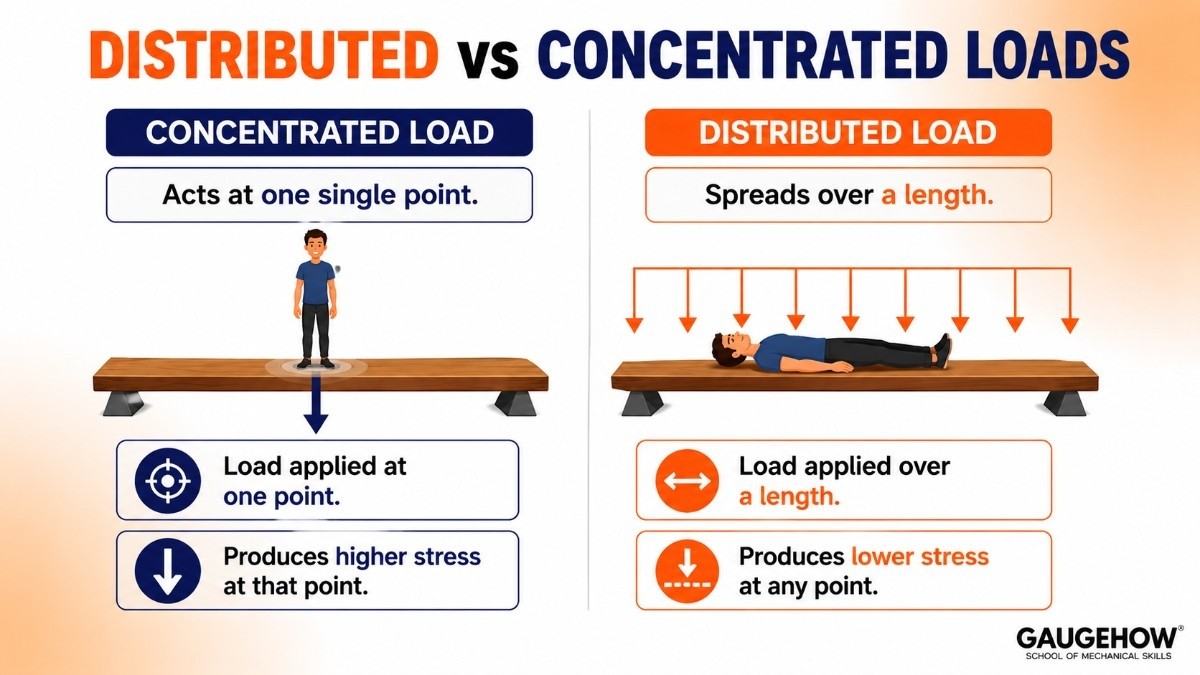
Let us make the contrast clear, since you just learned about concentrated loads.
A concentrated load acts at one single point, like a person standing on one spot of a plank. A distributed load spreads over a length, like the same person lying flat along the plank so their weight is shared.
Same weight, different spread. The concentrated load is focused, and the distributed load is shared. Recognising which one you have is the first step to solving the problem.
What Is the Unit of a Distributed Load?
Because a distributed load is spread out, its unit is not just a plain force.
For a load spread along a length, the unit is newtons per metre (N/m). This tells you how much force acts on each metre of length. So a load of 10 N/m means every metre carries 10 newtons.
For a load spread over an area, such as pressure, the unit is newtons per square metre (N/m²). For now we will focus on loads spread along a length, since these are the most common in beam problems.
What Are the Types of Distributed Load?
There are two main types you will meet in mechanics.
Uniformly Distributed Load, or UDL, where the load is the same all along the length.
Uniformly Varying Load, or UVL, where the load changes steadily from one end to the other.
Let us look at each with a simple picture.
What Is a Uniformly Distributed Load (UDL)?
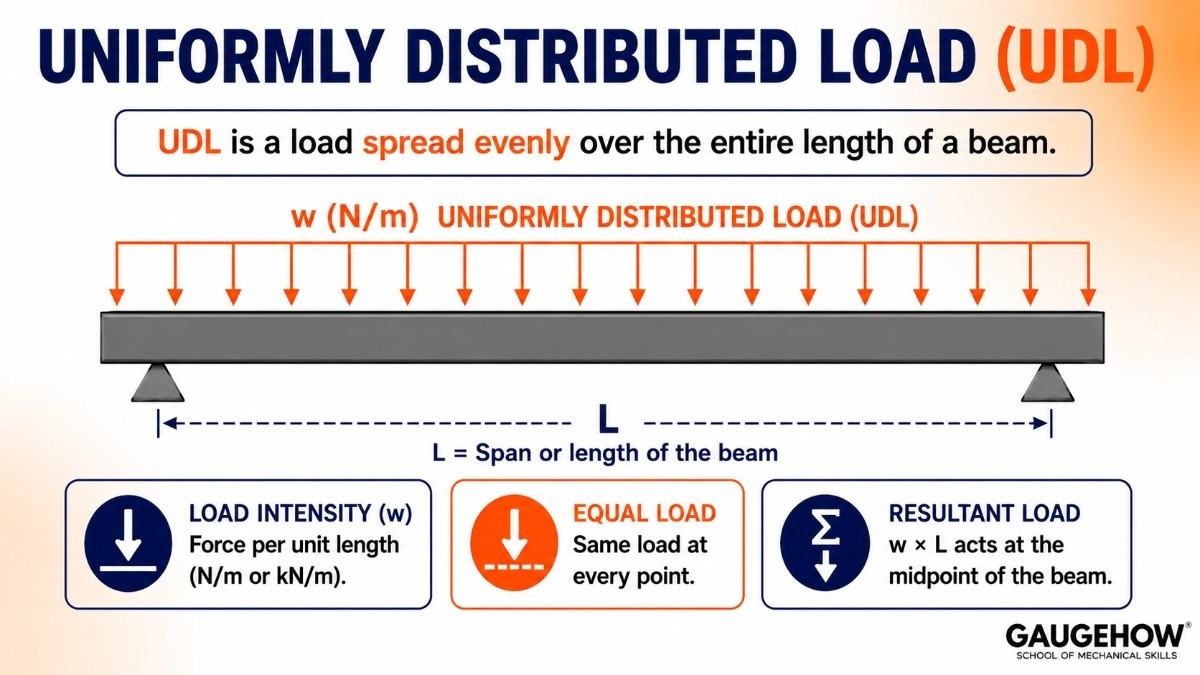
A uniformly distributed load, or UDL, has the same intensity at every point along its length.
Picture snow lying evenly on a flat roof. Every part of the roof carries the same amount of snow. That even spread is a UDL. On a diagram, a UDL is drawn as a rectangle of small arrows, all the same height.
The value of a UDL is given as a rate, such as 10 N/m. To find the total force, you multiply the rate by the length it covers.
What Is a Uniformly Varying Load (UVL)?
A uniformly varying load, or UVL, changes steadily along its length. It is zero at one end and grows to a maximum at the other.
The classic example is water pressure on a dam wall. Near the top, the water is shallow and pushes gently. Near the bottom, the water is deep and pushes hard. The load grows steadily with depth, forming a triangle shape.
On a diagram, a UVL is drawn as a triangle of arrows, short at one end and tall at the other. Its highest value is also given in N/m.
How Do You Convert a Distributed Load Into a Point Load?
This is the key skill of the whole lesson. To solve a distributed load, you replace it with one equivalent point load. You need two things: how big it is, and where it acts.
For a uniformly distributed load (UDL):
Total force = load rate multiplied by length, or W = w × L
It acts at the middle of the length.
For a uniformly varying load (UVL), which is a triangle:
Total force = half of the maximum rate multiplied by length, or W = (1/2) × w × L
It acts at one third of the length, measured from the tall end.
Where:
W is the total equivalent force, in newtons (N)
w is the load rate, in newtons per metre (N/m)
L is the length over which the load acts, in metres (m)
The rule is simple. The total force equals the area of the load shape, and it acts through the centre of that shape.
Distributed Load Example
Let us solve a beam carrying a UDL.
A beam of length 4 metres rests on two supports, one at each end. It carries a uniformly distributed load of 10 N/m along its full length. Find the reaction at each support.
Step 1. Total load = load rate multiplied by length = 10 × 4 = 40 N. Step 2. This UDL acts at the middle of the beam, which is 2 metres from each end. Step 3. Because the load is central, it splits equally between the two supports. Step 4. Reaction at each support = 40 divided by 2 = 20 newtons.
So each support pushes up with 20 N. The trick worked. We turned a spread-out load into a single 40 N force and solved it like a point load.
What Are Real Life Examples of Distributed Load?
Distributed loads are all around you:
Snow lying evenly across a roof, which is a UDL.
Water pressure pushing on a dam wall, which is a UVL.
A row of books spread along a shelf.
The self weight of a beam spread along its own length.
Wind pressure acting across the face of a wall.
Each of these spreads its force over a length or an area rather than one point.
Where Do Engineers Use Distributed Loads?
Distributed loads are everywhere in real design, because most real loads are spread out.
Structural engineers treat the self weight of a beam and the load of a floor as distributed loads when checking a building. Civil engineers use uniformly varying loads to design dam walls and water tanks. Turning these loads into equivalent point forces is one of the most common steps in structural analysis.
When the load pattern gets complex, engineers use simulation to apply it accurately across a part. That skill is developed in the FEA with ANSYS course.
Frequently Asked Questions
Q: What is a distributed load? A: A distributed load is a force that spreads over a length or an area, instead of acting at a single point. A row of books on a shelf is a good example.
Q: What is the unit of a distributed load? A: For loads spread along a length, the unit is newtons per metre (N/m). For loads spread over an area, it is newtons per square metre (N/m²).
Q: What is the difference between UDL and UVL? A: A uniformly distributed load (UDL) has the same value all along its length. A uniformly varying load (UVL) changes steadily from zero at one end to a maximum at the other.
Q: How do you convert a distributed load into a point load? A: Find the total force, which equals the area of the load shape, and place it at the centre of that shape. For a UDL, the total is w times L acting at the middle.
Q: Where does a UDL act on a beam? A: A uniformly distributed load acts at the middle of the length it covers.
Key Takeaways
A distributed load spreads over a length or area, not a single point.
Its unit is newtons per metre (N/m) for a load spread along a length.
A UDL has the same value everywhere and acts at the middle.
A UVL varies steadily and acts at one third of the length from the tall end.
To solve it, replace the distributed load with one equivalent point load.
The total force equals the area of the load shape.
Quick Revision Box
Distributed load: a force spread over a length or area
Unit: newtons per metre (N/m); pressure uses N/m²
UDL total: W = w × L, acting at the middle
UVL total: W = (1/2) × w × L, acting at one third from the tall end
Rule: total force equals the area of the load shape, acting at its centre
Practice Corner
In your own words, what is a distributed load?
What is the difference between a UDL and a UVL?
What is the unit of a distributed load spread along a length?
A beam of length 6 m carries a UDL of 5 N/m. Find the total load and where it acts.
Give one real life example each of a UDL and a UVL.
Answers
It is a force that spreads over a length or an area rather than acting at one single point.
A UDL stays the same all along its length, while a UVL changes steadily from zero at one end to a maximum at the other.
Newtons per metre (N/m).
Total load = 5 × 6 = 30 N, acting at the middle of the beam, which is 3 metres from each end.
UDL: snow lying evenly on a roof. UVL: water pressure on a dam wall. Other correct answers are fine.
What's Next
Next we study the Couple, a special pair of forces that produce pure rotation, followed by the Moment, which measures the turning effect of a force.
Conclusion
A distributed load looks harder than a point load, but the trick is simple. Turn the spread-out force into one equivalent point load using the area of the load shape, then solve as usual. Master this for UDL and UVL, and you will handle beams, floors, and dam walls with confidence throughout the course.
Want to practise these skills? Explore the free tools on the GaugeHow Learn Hub and test yourself with the Practice and MCQ tests.
Internal links:
FEA with ANSYS (applying distributed loads to real parts) → https://gaugehow.com/course/fea-finite-element-analysis-with-ansys
Mechanical Engineer Hub → https://gaugehow.com/mech
Learn Hub → https://gaugehow.com/learn
Practice and MCQ Tests → https://gaugehow.com/practice
Interview Q&A Hub → https://gaugehow.com/interview