Engineering Mechanics
Distributed Loads Explained Simply (UDL, UVL + Example)
Not every load sits at a single spot. The weight of a water tank spreads across a whole slab. Snow lies evenly along a roof beam. A pile of sand tapers from thick to thin. These spread out loads are called distributed loads, and there is a neat trick to handle them without messy maths.
This lesson continues the Equilibrium of Rigid Bodies module in the GaugeHow Engineering Mechanics series. In the last lesson we solved beams using point loads. Now we learn how to deal with loads that are spread along the beam.
By the end, you will know the types of distributed loads, how to turn them into a single point load, and how to solve a beam that carries one. Let us keep it clear.
What Is a Distributed Load?
A distributed load is a load that is spread over a length or an area instead of acting at one single point.
A point load, by contrast, presses at one exact spot, like a person standing on one plank. A distributed load pushes along a stretch, like a row of books lying across a whole shelf.
Because it is spread out, a distributed load is measured by its intensity, which is force per unit length. Its unit is newton per metre (N/m) or kilonewton per metre (kN/m). This tells you how heavy each metre of the load is.
Types of Distributed Loads
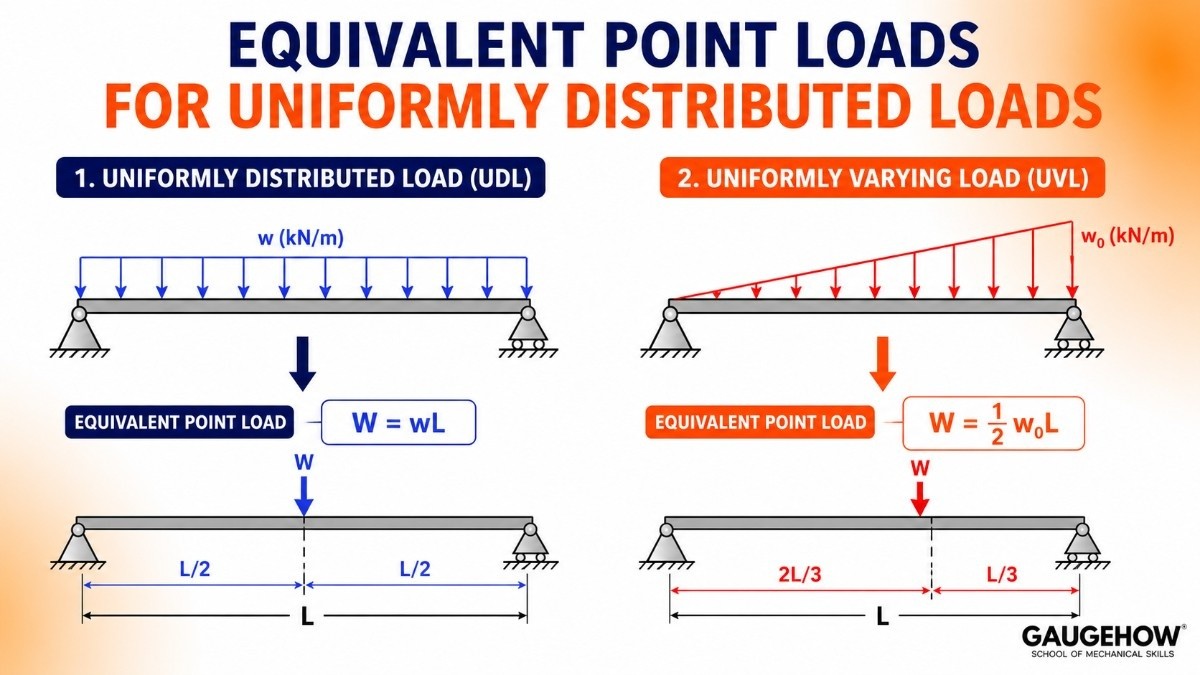
There are two common types you will meet in beam problems.
Uniformly distributed load (UDL). The intensity is the same everywhere along the length. Its shape on a diagram is a rectangle. Snow lying evenly on a roof is a good example.
Uniformly varying load (UVL). The intensity changes at a steady rate, often from zero at one end to a maximum at the other. Its shape is a triangle. Water pressure on a wall, deeper at the bottom, is a UVL.
A UDL is drawn as arrows of equal length in a row. A UVL is drawn as arrows that grow from short to long, forming a triangle. The shape of the load is the key to solving it.
Distributed Load vs Point Load
Students often ask how these differ, so here is the clean comparison.
A point load acts at a single spot and is measured in newtons (N) or kilonewtons (kN). A distributed load acts along a length and is measured in newtons per metre (N/m).
The good news is that any distributed load can be replaced by a single equal point load for the purpose of finding reactions. This replacement keeps the same total force and the same turning effect on the supports, which makes the beam much easier to solve.
How to Convert a Distributed Load to a Point Load
There are just two things to find when you replace a distributed load.
The total force. This equals the area of the load shape on the diagram.
The location. The single point load acts at the centre of that shape, called the centroid.
So the whole spread out load becomes one arrow. Its size is the area under the load, and its position is the balance point of that area. Once you have this single load, you solve the beam exactly like before.
UDL Equivalent Point Load
For a uniformly distributed load, the shape is a rectangle, so the maths is simple.
Equivalent point load = w × L
Here w is the load intensity in kN/m and L is the length the load covers in metres. This single force acts at the middle of the loaded length, because the centre of a rectangle is at its midpoint.
For example, a UDL of 5 kN/m spread over 4 m gives a total of 5 × 4 = 20 kN, acting 2 m from the start of the load. If the UDL covers only part of the beam, the point load still acts at the middle of that loaded part.
UVL Equivalent Point Load
For a uniformly varying load, the shape is a triangle, so we use the area of a triangle.
Equivalent point load = half × w × L
Here w is the maximum intensity in kN/m and L is the length of the triangle in metres. This single force acts at the centroid of the triangle, which is one third of the length from the larger end, where the load is biggest.
For example, a UVL rising from zero to 6 kN/m over 3 m gives a total of half × 6 × 3 = 9 kN. It acts 1 m from the maximum end, which is one third of 3 m.
Distributed Load Solved Example

Let us solve a beam carrying a UDL from start to finish.
Problem: A beam AB is 6 m long, with a pin support at A and a roller support at B. A uniformly distributed load of 4 kN/m covers the whole beam. Find the support reactions.
Step 1. Replace the UDL with a point load. Total load = w × L = 4 × 6 = 24 kN. It acts at the middle of the beam, which is 3 m from A.
Step 2. Take moments about A to find By. By × 6 = 24 × 3 By × 6 = 72 By = 12 kN upward.
Step 3. Balance the vertical forces to find Ay. Ay + By = 24 Ay + 12 = 24 Ay = 12 kN upward.
Step 4. State the result. Both reactions are 12 kN upward. This makes sense, because the load is spread evenly, so each support carries an equal half.
That is the power of the equivalent point load. A spread out load became one simple 24 kN force, and the rest was ordinary beam work.
Where Engineers Use Distributed Loads
Distributed loads appear in almost every real structure.
Floor and roof loads, where the weight spreads across the whole slab or beam.
Snow and wind loads, which act along a surface rather than at a point.
Water and soil pressure, which vary with depth as a triangular UVL.
Self weight of beams, since a beam's own weight is spread along its length.
Turning these into equivalent point loads is a daily shortcut in design. If you plan to work on real structures, this skill saves time on every problem. You can explore role based learning on the Mechanical Engineer hub, and later see distributed loads modelled in the Fusion 360 and FEA with ANSYS courses.
Frequently Asked Questions
What is a distributed load in simple words?
It is a load spread over a length or area instead of acting at one point, like snow lying along a roof beam. It is measured in force per unit length, such as kN/m.
What is the difference between UDL and UVL?
A UDL has the same intensity everywhere and is shaped like a rectangle. A UVL changes at a steady rate, often zero to maximum, and is shaped like a triangle.
How do you convert a distributed load to a point load?
Find the total force, which is the area of the load shape, and place it at the centroid of that shape. For a UDL that is w times L at the middle.
Where does the equivalent point load of a UDL act?
At the middle of the loaded length, because the centre of a rectangle is at its midpoint.
Where does the equivalent point load of a UVL act?
At one third of the length from the larger end, which is the centroid of the triangular load shape.
Why do we replace distributed loads with point loads?
Because a single point load keeps the same total force and turning effect, which makes finding support reactions much simpler.
Key Takeaways
A distributed load is spread over a length and measured in force per unit length, like kN/m.
A UDL has constant intensity, shaped like a rectangle.
A UVL varies at a steady rate, shaped like a triangle.
Replace a distributed load with a point load equal to the area of its shape.
The point load acts at the centroid of the load shape.
UDL: equivalent load = w × L, acting at the middle.
UVL: equivalent load = half × w × L, acting one third from the larger end.
Quick Revision Box
Distributed load unit: force per length, N/m or kN/m
UDL equivalent load: w × L, at the middle of the load
UVL equivalent load: half × w × L, at one third from the larger end
Equivalent load size = area of the load shape
Equivalent load position = centroid of the load shape
After converting, solve the beam like a normal point load problem
Practice Corner
Try these before moving on. Answers are at the bottom.
What is the difference between a point load and a distributed load?
What shape does a UDL make, and where does its equivalent load act?
A UDL of 3 kN/m covers 5 m of a beam. Find its equivalent point load and where it acts.
A UVL rises from zero to 8 kN/m over 6 m. Find its equivalent point load and where it acts.
Why is a distributed load replaced by a single point load?
<details> <summary>Answers</summary>
A point load acts at one single spot and is measured in newtons, while a distributed load is spread over a length and measured in newtons per metre.
A UDL makes a rectangle, and its equivalent load acts at the middle of the loaded length.
Equivalent load = 3 × 5 = 15 kN, acting 2.5 m from the start of the load.
Equivalent load = half × 8 × 6 = 24 kN, acting 2 m from the maximum end, which is one third of 6 m.
Because a single point load keeps the same total force and turning effect, which makes finding the support reactions much simpler.
</details>
Want more practice? Try the GaugeHow practice tests and browse common interview questions once you feel ready.
What's Next
Next we will study Multiple Loads, how to handle several point and distributed loads on the same beam at once.
Internal links:
Mechanical Engineer hub (https://gaugehow.com/mech),
Fusion 360 course (https://gaugehow.com/course/fusion-360),
FEA with ANSYS course (https://gaugehow.com/course/fea-finite-element-analysis-with-ansys),
Practice tests (https://gaugehow.com/practice),
Interview Q&A (https://gaugehow.com/interview)