Engineering Mechanics
Dry Friction Explained Simply: Laws, Formula and Examples
Push a heavy cupboard across the floor. For the first second nothing moves, even though you are pushing hard. Then suddenly it slides, and now it feels easier to keep it moving.
That whole experience is dry friction, and this guide explains exactly what is happening.
Most mechanics problems start by assuming smooth contact everywhere. Real surfaces are never smooth. Dry friction is the force that decides whether a ladder slips, whether a brake stops a car, and whether a bolted joint holds.
By the end of this guide you will be able to define dry friction in plain words, apply the laws of dry friction, use the coefficient of friction correctly with SI units, tell static friction and kinetic friction apart, and solve block and incline problems the way GATE asks them.
What Is Dry Friction in Engineering Mechanics
Dry friction is the resisting force that acts between two solid surfaces that touch each other directly, with no oil, grease or water film in between.
It always acts along the contact surface, and it always opposes motion or the tendency of motion. It never helps motion along.
The word "dry" simply means unlubricated. Engineers also call it Coulomb friction, after Charles Coulomb, who tested it experimentally in 1781.
Why dry friction exists
Look at a polished steel plate. It feels perfectly flat to your finger. Under a microscope it looks like a mountain range.
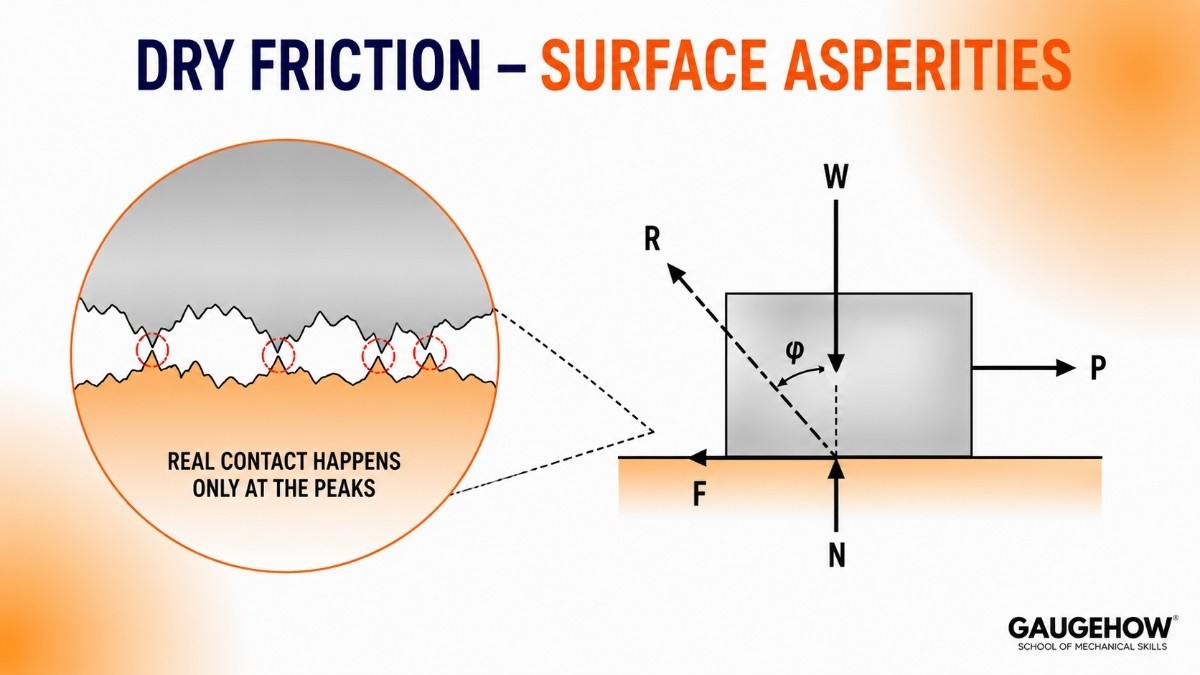
Every surface has tiny peaks called asperities. When two surfaces press together, only these peaks actually touch, so the real contact area is a small fraction of what you see.
At those tiny contact points the pressure is enormous. The peaks lock into each other and even weld together slightly at the atomic level. To slide the surfaces, you must shear these micro joints. That resistance is dry friction.
Everyday example
Rub your palms together slowly. You feel resistance, and after a few seconds you feel heat.
That heat is the work you did against dry friction turning into thermal energy. A car brake does exactly the same thing, just with a steel disc and a much bigger force.
Types of Dry Friction: Static, Limiting and Kinetic
Dry friction is not one fixed number. It changes depending on whether the body is still standing still or already sliding.
Static friction
Static friction acts when the body is at rest but a force is trying to move it.
Here is the part most students get wrong. Static friction is not a fixed value. It adjusts itself to exactly match the applied force, up to a maximum.
Push the cupboard with 100 N and it does not move, so friction is exactly 100 N. Push with 150 N and it still does not move, so friction is now exactly 150 N. Friction is only doing as much work as needed.
Limiting friction
Keep increasing the push and you reach a point where the body is just about to slide. It has not moved yet, but any extra force will move it.
The friction at that instant is the maximum static friction, called limiting friction. This is the peak value dry friction can reach.
Kinetic friction

Once the body is actually sliding, the resistance drops slightly and then stays roughly constant. This is kinetic friction, also called dynamic or sliding friction.
Kinetic friction is always a little smaller than limiting friction. That is why the cupboard suddenly lurches forward once it breaks free.
Laws of Dry Friction
These are the classical laws that all dry friction problems are built on. Learn them in this order, because exams ask them directly.
Friction always acts opposite to the direction of motion, or opposite to the direction in which motion is about to happen.
Limiting friction is directly proportional to the normal reaction between the surfaces.
Limiting friction does not depend on the apparent area of contact, as long as the normal reaction stays the same.
Limiting friction depends on the nature and roughness of the two surfaces in contact.
Kinetic friction is slightly less than limiting friction.
Kinetic friction is nearly independent of sliding speed at ordinary engineering speeds.
Law 3 surprises everyone. A brick lying flat and the same brick standing on its narrow edge need the same force to start sliding.
The reason is that a smaller area carries a higher pressure, so the total number of contacting asperities stays about the same. Area cancels out.
Coefficient of Friction Formula and SI Units
The coefficient of friction is the number that links friction force to normal reaction. It is written as the Greek letter mu.
Impending motion (limiting condition):
F_max = μs × N
Sliding motion:
F_k = μk × N
General static condition (body not yet moving):
F ≤ μs × N
Where:
F is the friction force, in newtons (N)
F_max is limiting friction, in newtons (N)
N is the normal reaction perpendicular to the contact surface, in newtons (N)
μs is the coefficient of static friction, dimensionless (no unit)
μk is the coefficient of kinetic friction, dimensionless (no unit)
Mu has no unit because it is a force divided by a force. If a value in a question carries units, something is wrong.
Typical values worth remembering: rubber on dry concrete is around 0.7 to 0.9, steel on steel is around 0.6 dry and 0.15 lubricated, wood on wood is around 0.3 to 0.5, and PTFE on steel is around 0.04.
Solved mini example 1: will the block move
A 50 kg crate rests on a horizontal floor. The coefficient of static friction is 0.30. A worker pushes horizontally with 120 N. Does the crate move?
Step 1. Find the weight. W = m × g = 50 × 9.81 = 490.5 N
Step 2. On a horizontal surface with no vertical applied force, N = W = 490.5 N
Step 3. Find limiting friction. F_max = 0.30 × 490.5 = 147.2 N
Step 4. Compare. Applied force 120 N is less than 147.2 N, so the crate stays at rest.
Step 5. The actual friction acting right now is 120 N, not 147.2 N. Friction only matches what is applied.
Answer: The crate does not move. It needs at least 147.2 N to start sliding.
Where engineers use this
Brake and clutch design starts from F = μN, because stopping torque depends entirely on the friction coefficient of the lining material.
Bolted joints rely on friction too. The clamping force from bolt tension creates the normal reaction that stops two plates sliding across each other.
Angle of Friction and Angle of Repose
The floor pushes back on a block with two things at once: the normal reaction N and the friction force F. Combine them into a single resultant reaction R.
The angle of friction is the angle between this resultant R and the normal N, measured when motion is impending.
tan φ = F_max / N = μs
Where φ (phi) is the angle of friction in degrees, and μs is the coefficient of static friction.
So the angle of friction is just another way of writing the coefficient of friction. If μs = 0.30, then φ = tan⁻¹(0.30) = 16.7°.
The angle of repose is the steepest angle of an inclined plane on which a body can rest without sliding down on its own. For dry friction, the angle of repose is numerically equal to the angle of friction.
You have seen this with sand. Pour dry sand into a heap and the slope always settles at the same angle, because that is where gravity and friction exactly balance.
Solved mini example 2: block on an incline
A 20 kg block rests on a plane inclined at 20° to the horizontal. The coefficient of static friction is 0.35. Will it slide down?
Step 1. Weight. W = 20 × 9.81 = 196.2 N
Step 2. Resolve perpendicular to the plane. N = W cos 20° = 196.2 × 0.9397 = 184.4 N
Step 3. Resolve along the plane. Driving force = W sin 20° = 196.2 × 0.3420 = 67.1 N
Step 4. Limiting friction available. F_max = 0.35 × 184.4 = 64.5 N
Step 5. Compare. Driving force 67.1 N is greater than available friction 64.5 N.
Answer: The block slides down. You can also check this with the angle of repose: φ = tan⁻¹(0.35) = 19.3°, which is less than the 20° slope, so sliding is expected.
Dry Friction Examples in Real Engineering
Vehicle braking and tyre grip. Everything a car does when accelerating, braking or cornering happens through dry friction at four small rubber contact patches.
Belt conveyors. Material is carried because friction between the belt and the drive pulley transmits torque without slip.
Machine tool clamping. A workpiece held in a vice stays put because of friction generated by the clamping force, not because the jaws grip it mechanically.
Wedges, screw jacks and fasteners. A bolt stays tight only because thread friction resists it turning loose under vibration.
Simulation work. Contact friction coefficients are direct inputs in FEA. If you want to see how this is defined in real solver settings, the FEA with ANSYS course covers contact modelling in detail.
Common Mistakes Students Make
Using F = μN when the body is not yet on the verge of moving. That equation is only valid at impending motion or during sliding.
Assuming N always equals mg. If the push is at an angle, or the surface is inclined, N changes and so does friction.
Forgetting that a larger contact area does not give more friction.
Mixing up μs and μk in the same problem.
Key Takeaways
Dry friction is the resistance between two unlubricated solid surfaces in contact, also called Coulomb friction.
Friction acts along the contact surface and always opposes motion or the tendency of motion.
Static friction is variable and self-adjusting up to a maximum value called limiting friction.
Kinetic friction acts during sliding and is slightly smaller than limiting friction.
The coefficient of friction is dimensionless and depends on the material pair, not on contact area.
F = μN applies only at impending motion or during sliding, not in every static situation.
The angle of friction φ satisfies tan φ = μs, and it equals the angle of repose.
On an incline, sliding begins when the slope angle exceeds the angle of repose.
Practice Corner
A body needs 39.24 N to just start sliding on a horizontal floor. Its mass is 10 kg. Find the coefficient of static friction.
Explain in one line why a wide tyre and a narrow tyre made of the same rubber give the same limiting friction on the same road.
A block rests on an incline of 25°. The coefficient of static friction is 0.60. Will it slide down? Justify with the angle of repose.
State any three laws of dry friction.
A 30 kg box is already sliding on a floor with μk = 0.20. Find the horizontal force needed to keep it moving at constant velocity.
<details> <summary><strong>Answers</strong></summary>
N = 10 × 9.81 = 98.1 N. μs = 39.24 / 98.1 = 0.40
Friction depends on the normal reaction and the material pair, not on apparent contact area. A wider tyre spreads the same load over more area, so contact pressure drops in proportion and the total friction stays the same.
Angle of repose φ = tan⁻¹(0.60) = 31.0°. The slope is 25°, which is less than 31.0°, so the block stays at rest.
Any three from the list in the Laws of Dry Friction section.
At constant velocity the applied force equals kinetic friction. N = 30 × 9.81 = 294.3 N. F_k = 0.20 × 294.3 = 58.9 N
</details>
Frequently Asked Questions
What is dry friction in simple words?
Dry friction is the resisting force between two solid surfaces that touch directly without any lubricant between them. It acts along the surface and opposes motion or the tendency of motion. It exists because microscopic surface peaks interlock and must be sheared before sliding can begin.
What is the difference between static and kinetic friction?
Static friction acts when the body is still at rest and varies to match the applied force, up to a maximum called limiting friction. Kinetic friction acts once the body is sliding and stays roughly constant. Kinetic friction is always slightly smaller, which is why an object lurches forward the moment it breaks free.
Does friction depend on the area of contact?
No. Classical dry friction depends only on the normal reaction and the coefficient of friction for that material pair. Increasing the apparent area reduces the contact pressure by the same proportion, so the friction force stays the same.
Is the coefficient of friction ever greater than 1?
Yes. Values above 1 are common for soft, high-grip pairs such as silicone rubber on clean glass or racing tyre compounds on hot tarmac. It simply means the friction force can exceed the normal reaction. There is no physical rule limiting mu to 1.
Why is dry friction called Coulomb friction?
Charles Coulomb published systematic experiments on unlubricated sliding in 1781 and established the proportional relationship between friction and normal load. The simple model F = μN is named after him and is still the standard model in engineering mechanics.
What is the difference between angle of friction and angle of repose?
The angle of friction is the angle between the resultant reaction and the normal reaction at impending motion. The angle of repose is the maximum incline angle on which a body rests without sliding. For dry friction the two are numerically equal, since both satisfy tan of the angle equals mu.
Is dry friction always harmful?
No. Brakes, clutches, belt drives, tyres, bolted joints and clamping systems all depend on dry friction to work. It is only unwanted in bearings, guideways and gears, where lubrication is used to reduce it.
Conclusion
Dry friction comes down to one relationship, F = μN, and one condition, that it only applies at impending motion or during sliding. Get that right and block problems, incline problems and angle of repose questions all fall into place.
The same idea scales up into wedges, screw threads and belt drives, where friction acts on curved and inclined contacts instead of a flat floor.
Want to see how these contact forces behave in real components? Start with the FEA with ANSYS course, or browse the free course to build your mechanics base first.
Internal links:
Engineering Mechanics for Mechanical Engineers: anchor in the introduction, topic hub for mechanical engineering
FEA with ANSYS: anchor in the real engineering applications section, contact friction inputs
Fusion 360: anchor near motion study or applications, motion analysis with friction
Interview Q&A Hub: anchor near the FAQ section, friction is a standard interview question
Practice / MCQ Tests: anchor in the Practice Corner intro
Free Course: anchor in the closing CTA