Engineering Mechanics
Engineering Structures Explained Simply (Trusses, Frames, Machines)
A bridge, a ladder, and a pair of pliers all carry loads, yet they work in very different ways. Engineers sort every load carrying object into just three families. Knowing which family a thing belongs to tells you exactly how to analyse it. These families are the heart of engineering structures.
This lesson closes the Equilibrium of Rigid Bodies module in the GaugeHow Engineering Mechanics series. We have learned supports, reactions, and how to balance beams. Now we see how those ideas come together in real structures.
By the end, you will know the three types of structures, what a two-force member is, and how to tell them apart. Let us keep it clear.
What Is an Engineering Structure?
An engineering structure is any connected system of parts built to support or transfer loads safely.
The word connected is important. A structure is not one solid block. It is several members joined together, each carrying part of the load and passing forces to the others.
Bridges, roof frames, cranes, ladders, and even scissors are all engineering structures. To analyse one, engineers often take it apart in their minds and study each member separately, then use the balance rules we already know.
Types of Engineering Structures

Every load carrying structure falls into one of three groups.
Truss. Made entirely of straight members joined at their ends, arranged in triangles.
Frame. A rigid, stationary structure with at least one member that carries more than two forces.
Machine. Like a frame, but with moving parts, usually built to multiply force.
Sorting a structure into the right group is the first step in solving it, because each group is analysed a little differently. Let us look at each one.
What Is a Truss?
A truss is a structure made of straight, slender members connected only at their ends, arranged in triangles.
Because the members join only at the ends and carry load only along their length, each truss member is a two-force member. This means it is either pulled (tension) or pushed (compression), with no bending.
Triangles are the secret. A triangle cannot change shape without changing the length of its sides, so it is naturally rigid. That is why trusses are strong yet light. You see them in bridges, roof frames, cranes, and transmission towers.
What Is a Frame?
A frame is a rigid, stationary structure that has at least one member carrying more than two forces.
That special member is called a multi-force member. Because it takes forces at several points, it must resist bending as well as push and pull. This is the key difference from a truss.
Frames are all around you. Building skeletons, ladders, scaffolding, and chairs are all frames. They stay still and support loads, but unlike trusses, some of their members bend under load.
What Is a Machine?
A machine is much like a frame, but it contains moving parts and is usually built to multiply or redirect force.
The moving parts are what set a machine apart. When you squeeze the handles of pliers, the jaws close with far more force than your hand applied. That force multiplication is the whole purpose.
Common machines include pliers, scissors, a car jack, a hydraulic press, and construction equipment. They still obey the balance rules, but their moving joints must be handled with care.
Difference Between Truss, Frame, and Machine
Students often mix these up, so here is the clean way to tell them apart.
A truss has only two-force members and never moves. A frame has at least one multi-force member and never moves. A machine has at least one multi-force member and does have moving parts.
So ask two quick questions. First, does it have a member with more than two forces? If no, it is a truss. If yes, it is a frame or a machine. Second, does it have moving parts? If no, it is a frame. If yes, it is a machine.
Two-Force Members Explained
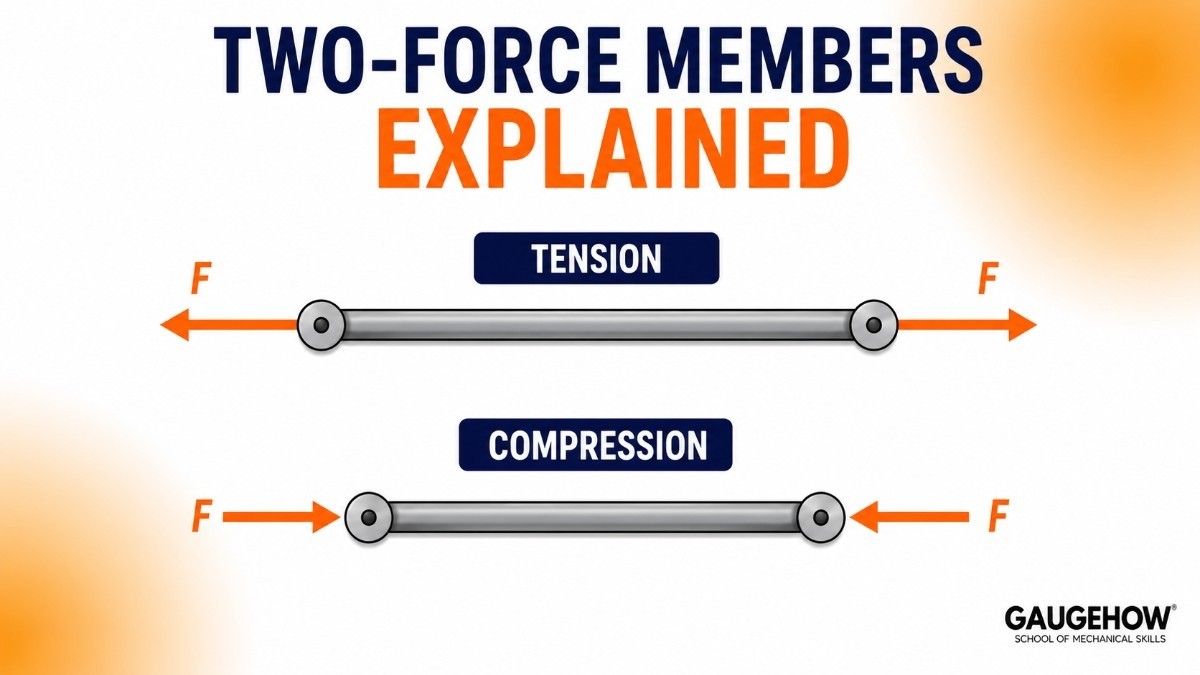
A two-force member is a member with forces applied at only two points, one at each end.
When only two forces act on a member and it is balanced, those forces must be equal, opposite, and along the straight line joining the two points. This makes the member carry pure tension or pure compression, with no bending at all.
This idea is what makes trusses easy to analyse. Every member is simply being stretched or squeezed. If a member has forces at three or more points, it is no longer a two-force member, and the structure becomes a frame or a machine.
How Engineers Analyse Structures
The method is the same balance work you already know, applied member by member.
First, treat the whole structure as one rigid body and find the support reactions using the three equilibrium equations. Then take the structure apart and draw a free body diagram for each member. At every joint, remember Newton's third law, so the force one member puts on another has an equal and opposite partner.
Finally, apply the balance rules to each member to find the internal forces. Getting these action and reaction pairs right is the most common place students slip, so draw them carefully.
Where Engineers Use This
Classifying and solving structures is core to real design.
Bridges and roof systems are trusses, sized so every member is safe in tension or compression.
Buildings and towers are frames, designed for both load and bending.
Tools and lifting gear are machines, built to multiply force safely.
Cranes and booms mix truss and frame ideas in one structure.
Knowing the type tells an engineer how to analyse and design it. If you plan to work on real structures, this classification is where every project begins. You can explore role based learning on the Mechanical Engineer hub, and later model full structures in the Fusion 360 and FEA with ANSYS courses.
Frequently Asked Questions
What is an engineering structure in simple words?
It is any connected system of parts built to support or transfer loads safely, such as a bridge, a ladder, or a pair of scissors.
What are the three types of engineering structures?
Trusses, frames, and machines. A truss has only two-force members, a frame has a multi-force member, and a machine has a multi-force member plus moving parts.
What is a two-force member?
A member with forces applied at only two points. The forces are equal, opposite, and along the line joining the points, so the member carries pure tension or compression.
What is the difference between a truss and a frame?
A truss is made only of two-force members and carries axial forces. A frame has at least one multi-force member, so some members also bend.
What is the difference between a frame and a machine?
A frame is rigid and stationary, while a machine has moving parts and is usually built to multiply force. Both contain multi-force members.
Why are triangles used in trusses?
Because a triangle cannot change shape without changing its side lengths, so it is naturally rigid. This makes trusses strong and lightweight.
Key Takeaways
An engineering structure is a connected system of parts that carries or transfers loads.
The three types are trusses, frames, and machines.
A truss has only two-force members and is built from rigid triangles.
A frame has at least one multi-force member and stays stationary.
A machine is like a frame but has moving parts to multiply force.
A two-force member carries pure tension or compression along its length.
Structures are solved by finding reactions, then analysing each member with Newton's third law.
Quick Revision Box
Engineering structure: connected system that carries loads
Truss: only two-force members, triangular, axial forces
Frame: at least one multi-force member, stationary, some bending
Machine: multi-force member plus moving parts, multiplies force
Two-force member: forces at two ends only, tension or compression
Analysis: reactions first, then each member with action-reaction pairs
Practice Corner
Try these before moving on. Answers are at the bottom.
What is an engineering structure in your own words?
Name the three types of engineering structures.
What makes a member a two-force member?
How do you tell a frame apart from a machine?
Why are triangles used in trusses?
<details> <summary>Answers</summary>
It is a connected system of parts built to support or transfer loads safely, like a bridge or a pair of pliers.
Trusses, frames, and machines.
It has forces applied at only two points, so those forces are equal, opposite, and along the line joining the points, giving pure tension or compression.
A frame is rigid and stationary, while a machine has moving parts and usually multiplies force. Both have at least one multi-force member.
Because a triangle cannot change shape without changing its side lengths, so it is naturally rigid, making the truss strong and light.
</details>
Want more practice? Try the GaugeHow practice tests and browse common interview questions once you feel ready.
What's Next
That completes the Equilibrium of Rigid Bodies module. Next we begin Friction, the force that resists sliding and quietly shapes almost every machine and structure.
Internal links: Mechanical Engineer hub (https://gaugehow.com/mech), Fusion 360 course (https://gaugehow.com/course/fusion-360), FEA with ANSYS course (https://gaugehow.com/course/fea-finite-element-analysis-with-ansys), Practice tests (https://gaugehow.com/practice), Interview Q&A (https://gaugehow.com/interview)