Engineering Mechanics
Equivalent Force-Couple System Explained Simply (With Steps)
Can you move a force from one point on a body to another and still keep the same effect? The surprising answer is yes, but only if you add a small couple to make up for the shift. This clever idea is called the equivalent force-couple system, and it turns messy problems into simple ones.
This lesson wraps up the Moments and Couples module in the GaugeHow Engineering Mechanics series. We have learned moments, the principle of moments, Varignon's theorem, and couples. Now we combine forces and couples into one neat tool.
By the end, you will know what an equivalent force-couple system is, why moving a force needs a couple, and how to find it step by step. Let us keep it clear.
What Is an Equivalent Force-Couple System?
An equivalent force-couple system replaces a force, or a whole set of forces, with a single force plus a single couple acting at a chosen point.
The word equivalent is the key. The new system creates the exact same push and the exact same turn on the body as the original. Nothing about the overall effect changes. You have just rearranged it into a tidier form.
So instead of dealing with many scattered forces, you end up with one clear force and one clear couple at a point you pick. That is much easier to work with.
Why Moving a Force Needs a Couple
Here is the heart of the idea. A force does two things at once. It pushes the body, and because it acts at a distance from other points, it also turns the body about those points.
If you simply slide the force to a new point, you keep the push. But you lose the turning effect that the force used to create about that new point. The body would behave differently, so the systems would not be equal.
To fix this, you add a couple at the new point. This couple restores the exact turning effect that was lost. The push stays the same, the turn is put back, and now the two systems truly match.
In short, move the force and add a couple. That couple is often called a compensatory couple, because it compensates for the shift.
[IMAGE: a force F acting at point A on a body, then the same force F drawn at point O with a curved couple arrow added, showing that the relocated force plus the couple gives the same effect as the original force at A]
How to Move a Force to Another Point
There is a simple visual trick behind this rule.
Suppose a force F acts at point A, and you want it at point O instead. At point O, imagine adding two equal and opposite forces, both equal to F. Since they cancel, you have changed nothing.
Now look at the picture. One of your new forces at O points the same way as the original. The other new force at O, together with the original force at A, forms a couple. So you are left with a single force at O plus a couple. That couple has the value F times the perpendicular distance between A and O.
This is why relocating a force always brings a couple along with it.
Steps to Find the Equivalent Force-Couple System

Follow these four steps for any set of forces.
Choose a point. Pick the point where you want the equivalent system. It is often a joint or the centre of the body.
Add up the forces. Sum all the forces to get the single resultant force. This force acts at your chosen point.
Add up the moments. Find the moment of every force about your chosen point, and include any couples already present. Add them with their signs.
State the result. Your equivalent system is the resultant force from step 2, plus the total couple from step 3, both at the chosen point.
That is it. One force, one couple, one point.
Solved Example on Equivalent Force-Couple System
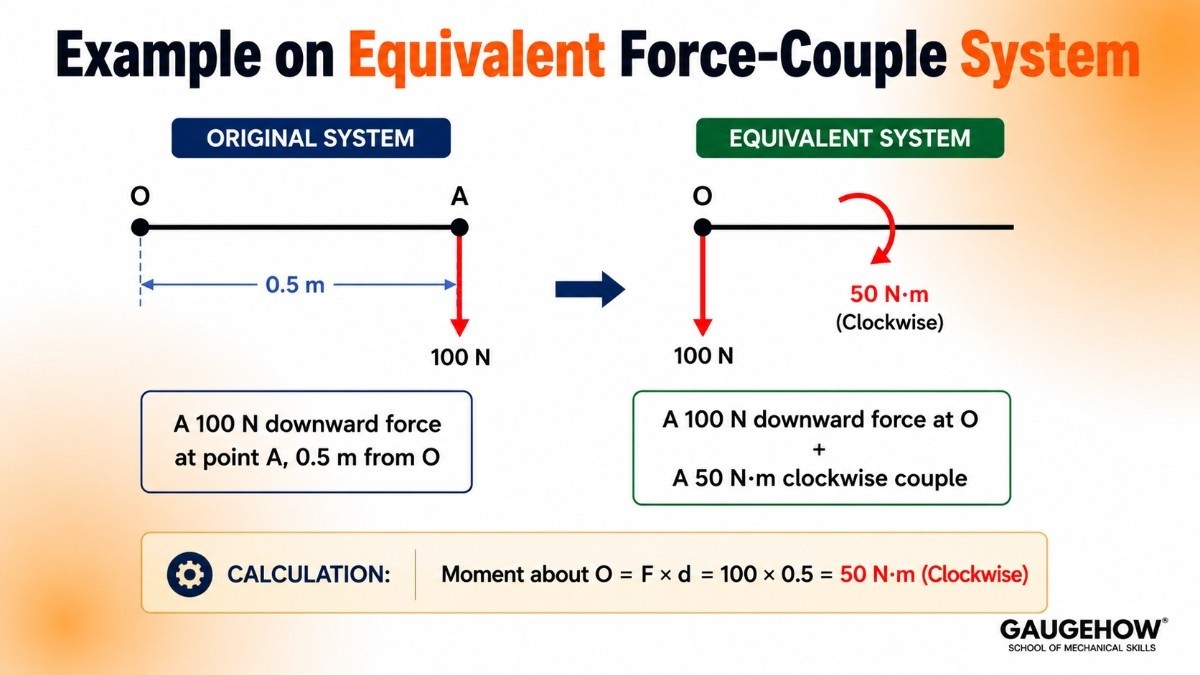
Let us move a single force and see the couple appear.
Problem: A force of 100 N acts straight down at point A. Point A is 0.5 m to the right of point O. Replace this force with an equivalent force-couple system at point O.
Step 1. Choose the point. We want the system at point O.
Step 2. Find the resultant force. There is only one force, so the resultant is 100 N acting straight down at O.
Step 3. Find the couple. The original downward force at 0.5 m to the right of O created a moment about O. Couple = F × d = 100 × 0.5 = 50 N·m A downward force to the right of O turns the body clockwise, so this couple is clockwise.
Step 4. State the result. The equivalent system at O is a 100 N downward force plus a 50 N·m clockwise couple.
Both systems now have the same push, 100 N down, and the same turn about O. They are fully equivalent.
Applications of the Equivalent Force-Couple System
This tool shows up all over real engineering.
Simplifying loads on beams and frames into one force and one couple at a support.
Analysing brackets and machine parts where forces act at odd points.
Modelling a body's total weight as one force at the centre of mass instead of many small weights.
Preparing equilibrium equations faster by reducing scattered forces to a single force and couple.
Wind and pressure loads on structures, which are combined into one resultant force and couple.
If you plan to work on structures and machines, this reduction skill saves huge amounts of time. You can explore role based learning on the Mechanical Engineer hub, and later see it applied to full parts in the Fusion 360 and FEA with ANSYS courses.
Frequently Asked Questions
What is an equivalent force-couple system in simple words?
It is a way to replace a force, or many forces, with one single force and one couple at a chosen point, while keeping the same overall push and turn on the body.
Why does moving a force create a couple?
Moving a force keeps its push but changes the turning effect about the new point. Adding a couple restores that lost turning effect, so the two systems stay equivalent.
How do you calculate the couple when moving a force?
The couple equals the force times the perpendicular distance between the old line of action and the new point. In symbols, M = F × d.
Does the equivalent system depend on the chosen point?
The resultant force stays the same for any point, but the couple changes depending on which point you pick. So the couple value depends on your chosen point.
Is the equivalent force-couple system the same as the original inside the body?
No. It keeps the same external effect, meaning the same overall push and turn. Internal stresses can differ, so this tool is used for rigid body statics, not internal stress analysis.
What is the unit of the couple in this system?
The couple is a moment, so its unit is the newton metre (N·m). The force is in newtons (N).
Key Takeaways
An equivalent force-couple system replaces forces with one force plus one couple at a point.
The new system keeps the same overall push and turn as the original.
Moving a force off its line of action always adds a couple.
The added couple equals the force times the perpendicular distance moved, M = F × d.
Steps: choose a point, sum the forces, sum the moments, then state the force and couple.
The resultant force is the same for any point, but the couple depends on the point.
It is used to simplify loads for rigid body analysis, not for internal stresses.
Quick Revision Box
Equivalent system = one resultant force + one couple at a chosen point
Resultant force = sum of all forces
Couple at the point = sum of all moments and couples about that point
Couple from moving a force: M = F × d
Force unit: newton (N). Couple unit: newton metre (N·m)
Practice Corner
Try these before moving on. Answers are at the bottom.
What is an equivalent force-couple system in your own words?
Why must you add a couple when you move a force to a new point?
A 60 N downward force acts 0.4 m to the right of point O. Find the equivalent force-couple system at O.
Does the resultant force change when you pick a different point? Does the couple?
Why can this tool not be used to find internal stresses?
<details> <summary>Answers</summary>
It is a single force plus a single couple at a chosen point that has the same overall push and turn as the original set of forces.
Because moving the force keeps its push but loses the turning effect about the new point, and the couple puts that turning effect back.
Resultant force = 60 N downward at O. Couple = 60 × 0.4 = 24 N·m clockwise. So the system is a 60 N downward force plus a 24 N·m clockwise couple at O.
The resultant force stays the same for any point, but the couple changes when you pick a different point.
Because it only keeps the same external effect on a rigid body. Internal stresses depend on where the forces actually act, so the original loads must be used for that.
</details>
Want more practice? Try the GaugeHow practice tests and browse common interview questions once you feel ready.
What's Next
That completes the Moments and Couples module. Next we begin Equilibrium of Rigid Bodies, starting with the types of supports and how each one holds a structure in place.
Internal links: Mechanical Engineer hub (https://gaugehow.com/mech), Fusion 360 course (https://gaugehow.com/course/fusion-360), FEA with ANSYS course (https://gaugehow.com/course/fea-finite-element-analysis-with-ansys), Practice tests (https://gaugehow.com/practice), Interview Q&A (https://gaugehow.com/interview)