Engineering Mechanics
Internal Forces in Mechanics
Stretch a rubber band between your fingers. From the outside, you are pulling on it. But something is also happening inside the band. Every part of it is pulling back, trying to hold itself together.
That hidden pull inside the material is an internal force. You cannot see it, yet it is the reason objects do not fall apart under load. Understanding internal forces is the key to knowing whether a part will hold or break.
In this lesson you will learn what internal forces are, why they develop, and the main types like tension, compression, and shear. By the end you will understand the forces that live inside every loaded object.
This follows the last lesson on external forces. Quick recall: external forces act on a body from outside, such as an applied push, weight, and reactions.
What Are Internal Forces?
An internal force is a force that develops inside a material to resist the external loads acting on it.
When you push, pull, or bend an object, its particles react. They hold on to each other and push back against the load. These forces between the particles, deep inside the body, are the internal forces.
In short, external forces act on the body, and internal forces act within the body. Both are always present when a load is applied.
Why Do Internal Forces Develop?
Internal forces appear because a body wants to keep its shape and stay in one piece.
When an external load tries to stretch, squeeze, or twist a material, the particles inside resist that change. This resistance is the internal force. The stronger the external load, the stronger the internal force needed to fight it.
If the external load ever grows larger than the internal force the material can provide, the object breaks. So internal forces are what keep a part safe, right up to its limit.
What Is the Difference Between Internal and External Forces?
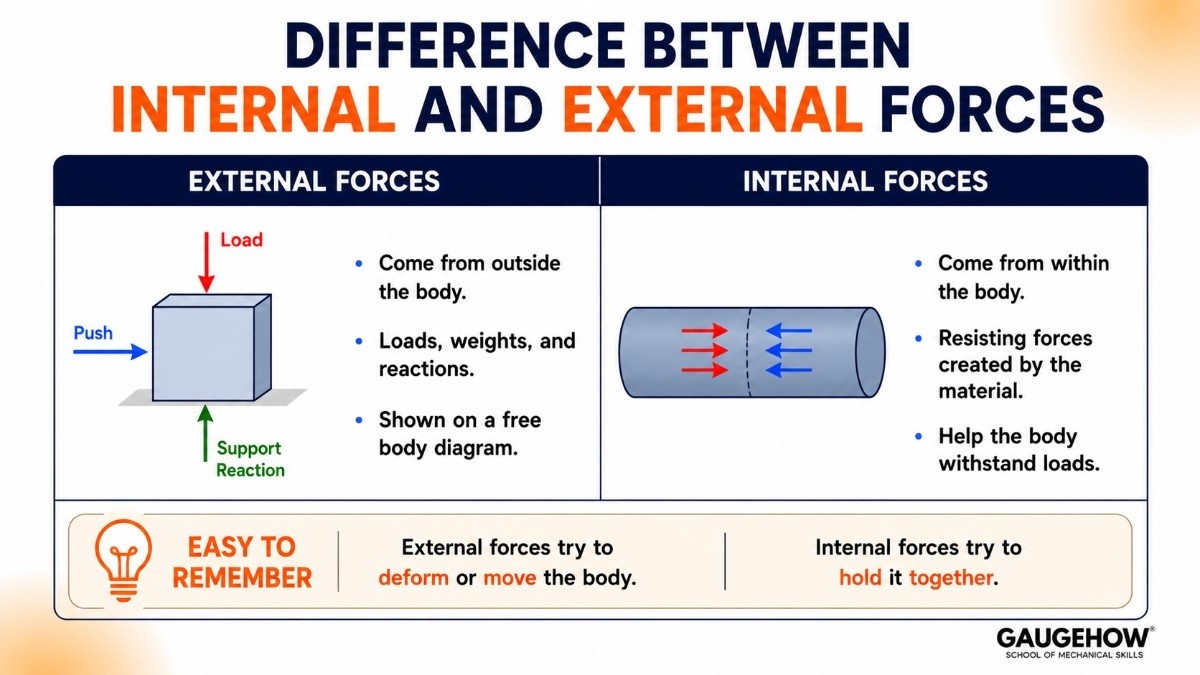
Let us make this simple and clear.
External forces come from outside the body. They are the loads, weights, and reactions you draw on a free body diagram. Internal forces come from within the body. They are the resisting forces the material creates to survive those loads.
Here is an easy way to remember it. External forces try to deform or move the body. Internal forces try to hold it together. One acts from outside, the other from inside.
What Is Tension as an Internal Force?
Tension is the internal force that develops when a material is being pulled or stretched.
Go back to the rubber band. As you pull its ends apart, the inside of the band pulls back to resist. That inward pull is tension. Ropes, cables, and chains all carry tension when they lift or hold a load.
A material in tension is being stretched, so its particles are trying to pull back together. Tension is one of the most common internal forces in engineering structures.
What Is Compression as an Internal Force?
Compression is the internal force that develops when a material is being pushed or squeezed.
Picture a pillar holding up a roof. The weight of the roof presses down on the pillar. Inside the pillar, the particles push back up to resist being crushed. That resisting push is compression.
So compression is the opposite of tension. Tension stretches a body, while compression squeezes it. Columns, table legs, and short posts usually work in compression.

What Is Shear Force?
Shear force is the internal force that acts when two parts of a body are pushed to slide past each other in opposite directions.
The clearest example is a pair of scissors cutting paper. The two blades push the paper in opposite directions, very close together. This sliding action is shear. A bolt holding two plates that are being pulled apart also feels shear.
Shear tries to cut or slice a material along a plane, rather than stretch or squeeze it. It is a key internal force in bolts, pins, rivets, and beams.
What About Bending and Twisting?
Two more internal actions appear in more advanced problems, so it helps to know their names.
Bending happens when a load makes a beam curve. The material on one side stretches while the other side squeezes, so bending mixes tension and compression across the same section.
Torsion, or twisting, happens when a load turns a shaft about its axis, like wringing a wet towel. You will study bending and torsion in depth later in the course, but for now just know they are internal actions too.
Why Do Internal Forces Occur in Pairs?
Internal forces always come in equal and opposite pairs. This follows from Newton's Third Law of Motion, which says every action has an equal and opposite reaction.
Inside a body, if one part pulls on the neighbouring part, that part pulls back just as hard. Because these pairs are equal and opposite, they cancel out when you look at the whole body from outside.
This is exactly why we do not draw internal forces on a free body diagram of the whole object. They balance internally. We only reveal them when we cut the body open to study one section, which is a method you will use often in beams and trusses.
Internal Forces Example
Imagine a steel cable lifting a load of 500 newtons.
The external force on the cable is the 500 N pull of the load, acting downward. To hold this load without snapping, the cable develops an internal force. Inside the cable, a tension of 500 N acts to resist the pull.
So the internal tension in the cable equals 500 newtons. If the cable can safely carry more than this, the lift is safe. If not, the cable fails. That single comparison is the heart of engineering design.
Where Do Engineers Use Internal Forces?
Internal forces decide whether a design is strong enough, so engineers calculate them constantly.
Structural engineers work out the tension and compression in each member of a truss to pick the right size. Mechanical engineers find the shear force in bolts and pins to stop joints from failing. The whole idea of strength of materials is built on finding internal forces and comparing them to what the material can take.
When these internal forces are hard to calculate by hand, engineers use simulation to map them across a part. That skill is developed in the FEA with ANSYS course.
Frequently Asked Questions
Q: What are internal forces? A: Internal forces are forces that develop inside a material to resist external loads. They keep the body together and stop it from breaking.
Q: What is the difference between internal and external forces? A: External forces act on a body from outside, such as loads and reactions. Internal forces act within the body to resist those loads.
Q: What are the main types of internal forces? A: The main types are tension, which stretches a material, compression, which squeezes it, and shear, which makes parts slide past each other. Bending and torsion are internal actions too.
Q: Why do internal forces occur in pairs? A: Because of Newton's Third Law, every internal action has an equal and opposite reaction, so internal forces cancel when the whole body is viewed from outside.
Q: Why are internal forces not shown in a free body diagram of the whole body? A: Because they act in equal and opposite pairs and cancel internally. They are revealed only when you cut the body to study a single section.
Key Takeaways
An internal force develops inside a material to resist external loads.
Internal forces keep a body together and stop it from breaking.
Tension stretches a material, compression squeezes it.
Shear force makes two parts of a body slide past each other.
Bending and torsion are internal actions seen in beams and shafts.
Internal forces occur in equal and opposite pairs and cancel over the whole body.
Quick Revision Box
Internal force: a resisting force developed inside a material
Tension: internal force when a body is pulled or stretched
Compression: internal force when a body is pushed or squeezed
Shear: internal force when parts slide past each other
Bending and torsion: internal actions from curving and twisting
Reason for pairs: Newton's Third Law, so they cancel over the whole body
Practice Corner
In your own words, why do internal forces develop in a loaded body?
What is the difference between tension and compression?
Give one real example each of tension, compression, and shear.
A rope lifts a load of 300 N. What is the internal force in the rope, and what type is it?
Why do internal forces not appear on the free body diagram of a whole object?
Answers
Because the material resists the external load and tries to keep its shape and hold together.
Tension stretches a material, while compression squeezes it. They are opposite internal forces.
Tension: a cable lifting a load. Compression: a pillar holding a roof. Shear: a bolt joining two plates that are pulled apart. Other correct answers are fine.
The internal force is a tension of 300 N, since the rope resists the downward pull.
Because internal forces act in equal and opposite pairs and cancel out over the whole body.
What's Next
Next we look at the Concentrated Load, a force that acts at a single point, and then the Distributed Load, which spreads over a length or area.
Conclusion
Internal forces are the hidden heroes of mechanics. They live inside every loaded object, resisting tension, compression, and shear to keep it from failing. External forces try to break a part, and internal forces fight to hold it together. Master this idea now, because the entire subject of strength of materials is built upon it.
Want to go deeper into these fundamentals? Explore the free tools on the GaugeHow Learn Hub and test yourself with the Practice and MCQ tests.
Internal links:
FEA with ANSYS (mapping internal forces and stress) → https://gaugehow.com/course/fea-finite-element-analysis-with-ansys
Mechanical Engineer Hub → https://gaugehow.com/mech
Learn Hub → https://gaugehow.com/learn
Practice and MCQ Tests → https://gaugehow.com/practice
Interview Q&A Hub → https://gaugehow.com/interview