Engineering Mechanics
Kinetic Friction Explained Simply: Formula and Examples
Slide a book across a table and let go. It travels a short distance, slows down, and stops.
Nobody pulled it backwards. No wall got in the way. Something along the table surface quietly took its energy away.
That something is kinetic friction, and it is the force that acts whenever two surfaces are actually sliding against each other.
Most students meet this topic right after static friction and assume it is just the same thing with a different letter. It is not. Static friction is about whether something moves at all. Kinetic friction is about what happens once it already is moving, which means acceleration, distance and heat all come into the picture.
This guide covers the definition, the formula, how to use it with Newton's second law, why it is smaller than static friction, and the mistakes that cost marks in exams.
What Is Kinetic Friction
Kinetic friction is the resisting force between two surfaces that are sliding over each other. You will also see it called sliding friction or dynamic friction. All three names mean the same thing.
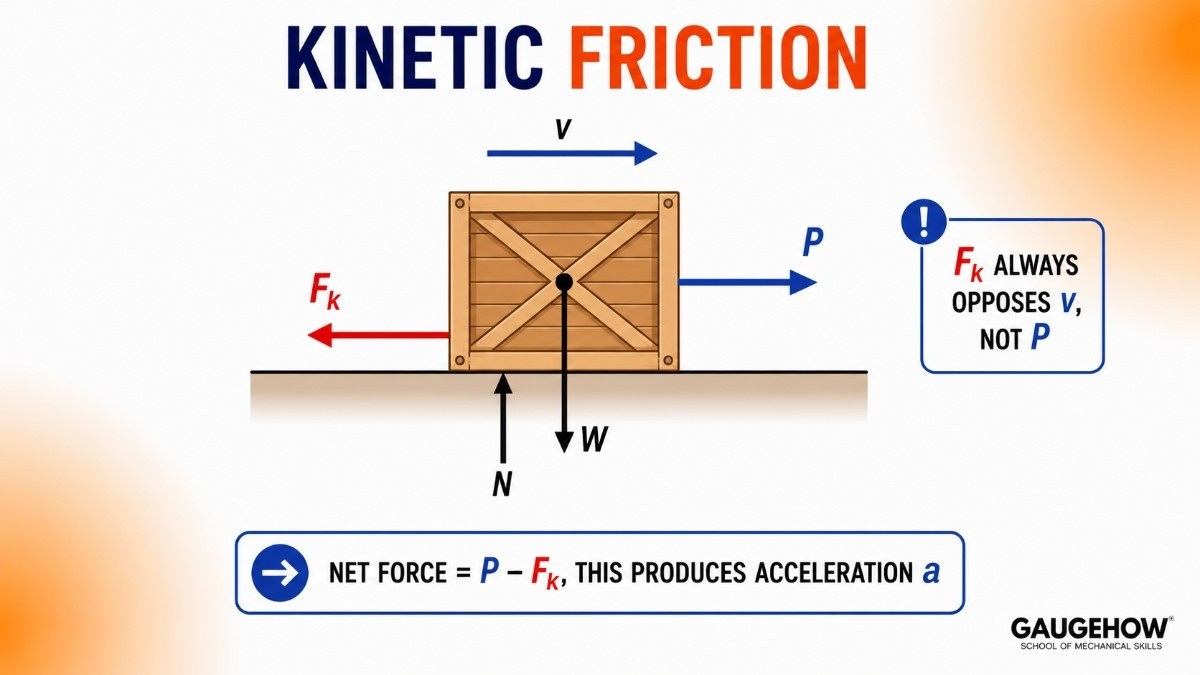
It acts along the contact surface, and it always points opposite to the direction the body is actually moving.
Read that last line again, because it is the single most useful fact in the topic. Kinetic friction does not care where you are pushing. It only cares which way the surface is sliding.
If a crate slides to the right, kinetic friction acts to the left. If the same crate is pushed to the right but is sliding to the left, kinetic friction still acts to the right, opposing the motion, not the push.
When does it start acting
Static friction holds a body until the applied force exceeds limiting friction. The moment sliding begins, static friction disappears and kinetic friction takes over.
There is a small drop at that instant. That drop is why heavy furniture suddenly lurches forward once it breaks free, and why you almost stumble the first time it moves.
Once sliding is underway, kinetic friction settles at a nearly constant value and stays there.
Kinetic Friction Formula
Unlike static friction, this one is a straight equation. No inequality, no special condition.
F_k = μk × N
Where:
F_k is the kinetic friction force, in newtons (N)
μk is the coefficient of kinetic friction, dimensionless with no unit
N is the normal reaction perpendicular to the contact surface, in newtons (N)
That is the whole formula. The difficulty in exam questions is almost never the formula itself. It is finding N correctly, and then deciding what to do with the friction force once you have it.
For a body on a flat floor with only a horizontal push, N equals the weight, so N = mg. Change anything about that setup, tilt the surface, pull at an angle, add a second body on top, and N changes with it.
Solved example 1: the basic case
A 20 kg crate slides across a level warehouse floor. The coefficient of kinetic friction is 0.25. Find the friction force acting on it.
Step 1. Weight, W = 20 × 9.81 = 196.2 N
Step 2. The floor is level and nothing pulls upward, so N = W = 196.2 N
Step 3. F_k = 0.25 × 196.2 = 49.1 N
This 49.1 N acts backwards along the floor for as long as the crate keeps sliding, no matter how fast it is going.
Coefficient of Kinetic Friction Values
The coefficient of kinetic friction depends on the two materials in contact and their surface condition. It is a property of the pair, not of either material alone. Steel on steel and steel on ice are completely different numbers.
Values worth keeping in your head:
Rubber on dry concrete: 0.60 to 0.85
Rubber on wet concrete: 0.30 to 0.50
Steel on steel, dry: 0.40 to 0.60
Steel on steel, oiled: 0.05 to 0.10
Wood on wood: 0.20 to 0.40
Brake lining on cast iron: 0.30 to 0.40
PTFE on steel: 0.04
Steel on ice: 0.02 to 0.03
Notice how brake linings sit in a narrow, deliberately chosen band. Too low and the car does not stop. Too high and the braking becomes grabby and the lining wears out fast.
For any given pair, μk is smaller than μs. As a rough working rule, kinetic is about 70 to 80 percent of static. If a question gives you only one value and does not say which, check the wording for the word sliding or moving.
How to Calculate Kinetic Friction with Acceleration
This is where kinetic friction gets genuinely different from static friction, and where most exam numericals live.
Once a body slides, it is no longer in equilibrium. There is usually a net force, so Newton's second law applies.
ΣF = m × a
Where ΣF is the net force along the direction of motion in newtons, m is mass in kilograms, and a is acceleration in metres per second squared.
The method is always the same four steps. Find N. Find F_k. Add up forces along the direction of motion, remembering friction is negative. Divide by mass.
Solved example 2: crate being pushed while sliding
The same 20 kg crate from before, with μk = 0.25, is now pushed with a steady horizontal force of 80 N while it slides. Find its acceleration.
Step 1. N = 196.2 N, as before
Step 2. F_k = 0.25 × 196.2 = 49.1 N
Step 3. Net force along the floor = 80 − 49.1 = 30.9 N
Step 4. a = 30.9 / 20 = 1.55 m/s²
The crate speeds up, but only at about a sixth of the rate it would on a frictionless floor.
Solved example 3: how far does it slide before stopping
A block is sliding at 6 m/s on a level floor with μk = 0.30. Nothing is pushing it. How far does it travel before coming to rest?
Step 1. The only horizontal force is friction, so F_k = μk m g, and the mass cancels when you divide by m
Step 2. Deceleration, a = μk × g = 0.30 × 9.81 = 2.94 m/s²
Step 3. Use v² = u² + 2as with v = 0 and u = 6 m/s, so 0 = 36 − 2 × 2.94 × s
Step 4. s = 36 / 5.89 = 6.1 m
Look at step 1 again. The mass disappeared. A 5 kg block and a 500 kg block sliding at 6 m/s on the same floor stop in exactly the same distance. That result surprises almost everyone the first time they see it, and examiners love asking it.
Why Kinetic Friction Is Less Than Static Friction
Zoom in far enough on any surface, even a polished one, and it looks rough. The tiny peaks are called asperities, and only these peaks actually touch when two bodies rest together.
When the surfaces are stationary, those peaks have time to settle into each other. Under high local pressure they deform and form tiny cold welds. Starting motion means shearing all of them, which takes extra force.
Once sliding begins, the peaks skip across each other. They collide, deform and separate too quickly to bond properly. Fewer junctions form, so less force is needed to keep things moving.
That is the whole reason μk is smaller than μs. It is not an arbitrary rule from a textbook, it comes from what is happening at the microscopic level.
Does Kinetic Friction Depend on Speed
For ordinary engineering conditions, the honest answer is no, not much. Classical theory treats kinetic friction as independent of sliding speed, and for most problems at moderate speeds that assumption holds well.
The reason is the same as before. Friction depends on the real contact area at the asperities, and that area is set by the normal load, not by how fast the surfaces move.
In reality there is some speed dependence, mostly because sliding generates heat. Hot brake pads fade, hot rubber behaves differently, and at very high sliding speeds a thin softened layer can form and reduce friction.
For exam problems, treat μk as constant. Just know that in real design work, brake engineers absolutely do account for fade.
Kinetic friction also does not depend on the apparent contact area. Two blocks of the same material and weight, one wide and flat, one narrow and tall, experience the same friction. A smaller area carries proportionally higher pressure, so the number of real contact points balances out.
Kinetic Friction on an Inclined Plane
Sliding down a slope brings in two changes. The normal reaction shrinks, and gravity now has a component pulling the body along the surface.
For a body of mass m on a plane inclined at angle θ, sliding down:
N = m g cos θ F_k = μk m g cos θ Driving component along slope = m g sin θ Net force = m g sin θ − μk m g cos θ a = g (sin θ − μk cos θ)
Mass cancels again, which means the acceleration down a slope depends only on the angle, the surface pair and gravity.
If the body is sliding up the slope instead, gravity and friction both act downhill, so the deceleration is g(sin θ + μk cos θ). Getting this sign right is worth practising, since it flips depending on direction of motion.
Solved example 4: block sliding down a ramp
A 10 kg block slides down a ramp inclined at 30°. The coefficient of kinetic friction is 0.20. Find its acceleration.
Step 1. a = g (sin 30° − μk cos 30°)
Step 2. a = 9.81 × (0.500 − 0.20 × 0.866)
Step 3. a = 9.81 × (0.500 − 0.173) = 9.81 × 0.327
Answer: a = 3.21 m/s² down the slope
Without friction it would have been 4.91 m/s², so friction has removed about a third of the acceleration.
Work Done Against Kinetic Friction and Heat
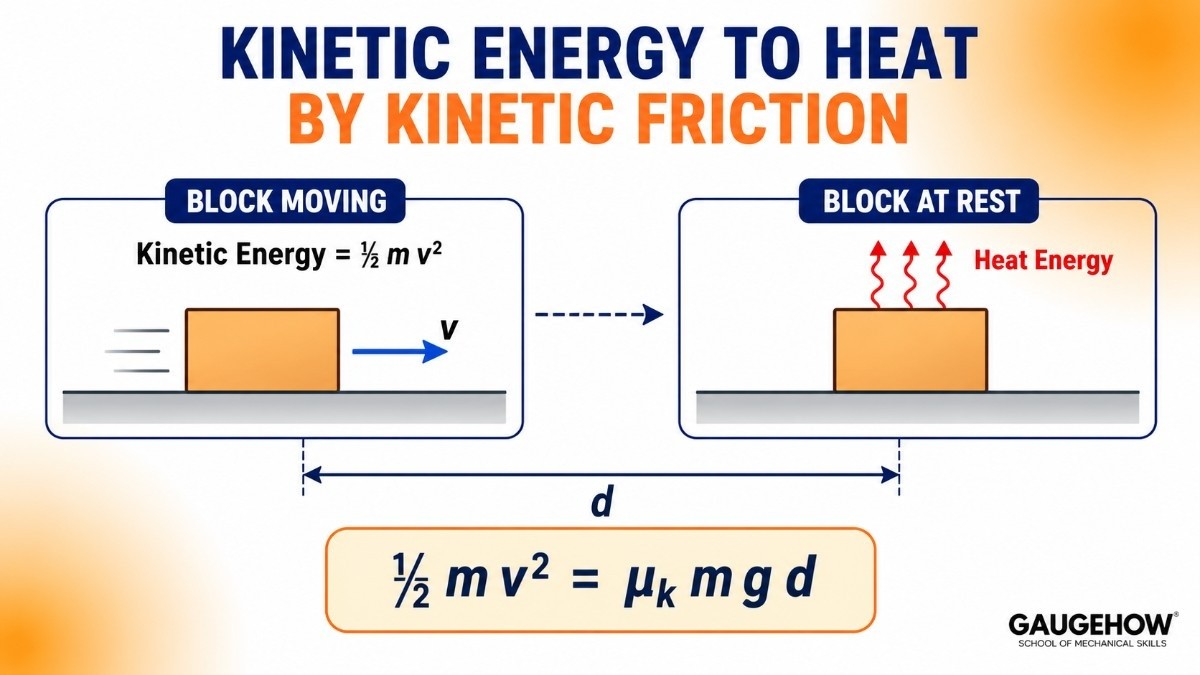
Here is something static friction never does. Because kinetic friction acts over a real sliding distance, it does work, and that work is always negative.
W_friction = − F_k × d = − μk × N × d
Where W_friction is work done in joules (J), F_k is kinetic friction in newtons, and d is the sliding distance in metres.
That energy does not vanish. It turns into heat at the contact surface, plus a little sound and wear.
Take the 20 kg crate again, with μk = 0.25 and F_k = 49.1 N. Drag it 5 m and you have converted 49.1 × 5 = 245 J into heat. The floor and the crate base both get slightly warmer.
This is the whole working principle of a brake. A disc brake takes the kinetic energy of a moving car and deliberately converts it to heat through kinetic friction between pad and rotor. A 1500 kg car at 25 m/s carries roughly 469 kJ of kinetic energy, and every joule of it has to leave through those four small contact patches.
That is also why brake discs are ventilated, why they glow on a race car, and why brake fade exists.
Kinetic Friction Examples in Real Life and Engineering
Braking systems. Disc and drum brakes rely entirely on kinetic friction between the pad and the rotating surface to convert motion into heat.
Skidding tyres. Once a wheel locks, the tyre stops rolling and starts sliding, so kinetic friction replaces static friction. Since μk is lower, the stopping distance increases. Preventing exactly this is what ABS does.
Machine slideways. A lathe carriage or a CNC axis sliding on hardened ways experiences kinetic friction every second it moves. It wastes power, generates heat and causes wear, so the guideways are lubricated to push μk down.
Sanding, grinding and polishing. Here friction is the point. Material removal happens because abrasive particles slide against the workpiece under load.
Conveyor chutes. Bulk material sliding down a chute reaches a steady speed when the friction force balances the gravity component. Chute angles are chosen from μk values, not guesses.
Clutches during engagement. For the brief moment a clutch slips, kinetic friction transmits torque and burns energy as heat. Riding the clutch overheats it for exactly this reason.
Bearings and seals. Every rotating shaft loses some power to friction at the seal lip. It looks small, but across a plant with hundreds of motors it adds up on the electricity bill.
If you want to see how friction coefficients are actually entered into contact settings and how they change stress and heat results, the FEA with ANSYS course walks through contact definition properly.
Common Mistakes Students Make
Using μs when the body is already sliding. If the question says moving, sliding or dragged, you need μk.
Assuming N = mg every time. Tilt the surface or pull at an angle and the normal reaction changes. Always find N from the perpendicular direction first.
Pointing friction opposite the applied force. It opposes velocity, not the push. On a body sliding backwards while being pushed forwards, both the push and friction point the same way.
Forgetting that the body is not in equilibrium. Once it slides, use ΣF = ma, not ΣF = 0, unless the question specifically says constant velocity.
Treating friction work as positive. Work done against friction is always negative, and it always ends up as heat.
Mixing mass and weight. The formula needs newtons. Multiply mass by 9.81 before it goes anywhere near μk.
Key Takeaways
Kinetic friction acts only when two surfaces are actually sliding against each other.
It always opposes the direction of motion, not the direction of the applied force.
The formula is a straight equation, F_k = μk N, with no inequality.
The coefficient of kinetic friction is dimensionless and is always smaller than the static value.
Friction is independent of apparent contact area and roughly independent of sliding speed.
Once a body slides it is not in equilibrium, so use ΣF = ma.
On an incline, a = g(sin θ − μk cos θ) when sliding down.
In many stopping problems the mass cancels, so stopping distance does not depend on how heavy the object is.
Work done against kinetic friction is negative and appears as heat, which is exactly how brakes work.
Practice Corner
A 15 kg block slides on a level floor with μk = 0.20. Find the kinetic friction force acting on it.
A car skids to a stop from 20 m/s on a road where μk = 0.70. Find the skidding distance.
A 25 kg crate is pushed with 100 N while sliding on a floor with μk = 0.30. Find its acceleration.
An ice hockey puck slides along the rink and eventually stops even though nobody touches it. Explain why in two lines.
A block slides 4 m across a bench against a kinetic friction force of 18 N. How much heat is generated?
<details> <summary><strong>Answers</strong></summary>
N = 15 × 9.81 = 147.2 N. F_k = 0.20 × 147.2 = 29.4 N
a = μk g = 0.70 × 9.81 = 6.87 m/s². s = v² / 2a = 400 / 13.73 = 29.1 m
N = 25 × 9.81 = 245.3 N. F_k = 0.30 × 245.3 = 73.6 N. Net force = 100 − 73.6 = 26.4 N. a = 26.4 / 25 = 1.06 m/s²
Kinetic friction between the puck and the ice acts opposite to its motion and steadily removes kinetic energy as heat. The coefficient is very small, around 0.02, so the puck travels a long way before that energy runs out.
Heat = F_k × d = 18 × 4 = 72 J
</details>
Frequently Asked Questions
What is kinetic friction in simple words?
Kinetic friction is the resistance you feel when two surfaces are already sliding across each other. It acts along the surface and always points opposite to the direction of motion. It is also called sliding friction or dynamic friction.
What is the formula for kinetic friction?
F_k = μk × N, where F_k is the kinetic friction force in newtons, μk is the coefficient of kinetic friction with no unit, and N is the normal reaction in newtons. Unlike static friction, this is an exact equation rather than an inequality.
Is kinetic friction greater or less than static friction?
It is always less for the same pair of surfaces. When surfaces are stationary the microscopic peaks settle and form tiny bonds, and extra force is needed to break them. During sliding those bonds cannot form fully, so the resistance drops.
Does kinetic friction depend on speed?
For normal engineering conditions it is treated as independent of speed, and that assumption is accurate enough for exams and most design work. At high speeds and high temperatures the value does drift, which is what causes brake fade in vehicles.
Does the weight of an object affect how far it slides before stopping?
No, and this catches people out. In the stopping distance formula s = v² / 2μk g, the mass cancels out. A light and a heavy block sliding at the same speed on the same surface stop in the same distance.
Where does the energy lost to kinetic friction go?
It converts almost entirely into heat at the contact surface, with a small part becoming sound and material wear. Brakes are simply devices designed to do this on purpose, turning a vehicle's kinetic energy into heat at the pad and disc.
Can kinetic friction ever be useful?
Constantly. Brakes, clutches during engagement, grinding and sanding, drum drives, friction dampers and even writing with a pencil all depend on it. It is unwanted only in bearings, slideways and gears, where lubrication is used to reduce it.
Conclusion
Kinetic friction only looks harder than static friction because it comes with motion attached. The force itself is a one line formula.
Get into the habit of asking three questions in order. Is it actually sliding? What is the normal reaction? What does the net force do next, accelerate the body, slow it down, or turn into heat?
Answer those three and you can handle any kinetic friction problem an exam or an interview throws at you.
Want to take this further into real components and simulations? Start with the FEA with ANSYS course, or sharpen your numericals on the practice tests.
Internal links:
Mechanical Engineer Hub: anchor in the introduction, topic hub for the target reader
FEA with ANSYS: anchor in the engineering applications section, contact and friction inputs
Fusion 360: anchor near the applications section, motion study with friction
Interview Q&A Hub: anchor near the FAQ section, friction is a standard interview question
Practice / MCQ Tests: anchor in the Practice Corner and closing CTA
Free Course: anchor in the closing CTA for beginners