Engineering Mechanics
Laws of Friction Explained Simply with Examples
Ask ten students to state the laws of friction and you will get ten slightly different lists. Some mix static and kinetic together. Some leave out the one about contact area. Almost nobody can say where the laws came from or when they stop working.
That is a shame, because these laws are not arbitrary rules invented to fill a syllabus page. Each one came from somebody actually dragging blocks across surfaces and writing down what happened.
Once you understand why each law exists, you stop memorising and start predicting. This guide covers the full set for both static and kinetic friction, explains the area law that trips everyone up, walks through solved examples, and finishes with the situations where these laws simply do not apply.
What Are the Laws of Friction
The laws of friction are a set of experimental rules that describe how the friction force between two dry solid surfaces behaves. They tell you which direction friction acts, what it depends on, and just as usefully, what it does not depend on.
Three things matter about them.
They are experimental, not derived. Nobody proved them from first principles. People measured them, repeatedly, and the pattern held.
They apply to dry friction only, meaning two solid surfaces touching directly with no oil or grease film between them. This is why the topic is also called dry friction or Coulomb friction.
They are approximations. Very good ones for normal engineering conditions, but they do break down, and knowing where is what separates a real understanding from rote learning.
A quick note on who discovered them
Leonardo da Vinci worked out the basic relationships around 1493, but his notebooks stayed unpublished for centuries so nobody benefited.
Guillaume Amontons rediscovered them independently in 1699. He established that friction is proportional to the normal load and independent of the apparent contact area. These two are still called Amontons' laws.
Charles Augustin de Coulomb added the third piece in 1781, showing that kinetic friction is essentially independent of sliding speed, and separating static from kinetic behaviour clearly. His name ended up attached to the whole model.
Laws of Static Friction
Static friction acts when the surfaces are not yet sliding but something is trying to make them slide. Five laws describe it.
Law 1. Direction. The friction force acts along the surface of contact, tangential to it, and opposite to the direction in which the body tends to move.
The word tends is doing real work there. Nothing has to move for static friction to exist. A tendency is enough.
Law 2. Self adjusting magnitude. Static friction is exactly equal to the applied force trying to cause motion, up to a maximum.
Push a crate with 40 N and friction is 40 N. Push with 90 N and friction becomes 90 N. Friction never supplies more than the situation needs.
Law 3. Proportional to normal reaction. The limiting friction is directly proportional to the normal reaction between the surfaces.
F_max ∝ N, which becomes F_max = μs N once you introduce the coefficient.
Law 4. Independent of contact area. Limiting friction does not depend on the apparent area of contact, provided the normal reaction stays the same.
Law 5. Depends on the surfaces. Limiting friction depends on the material and surface condition of both bodies in contact.
Rough cast iron on rough cast iron is one number. Polished steel on PTFE is a completely different one. This is why coefficient tables always list pairs, never single materials.
What limiting friction actually means
Limiting friction is the largest value static friction can reach for a given pair of surfaces and normal load. At that exact instant the body has not moved, but any extra force will move it. Engineers say motion is impending.
Below the limit, use equilibrium to find friction. At the limit, and only at the limit, use F = μs N.
Laws of Kinetic Friction
Once sliding actually starts, a different but related set applies.
Law 1. Kinetic friction acts opposite to the direction of motion, not opposite to the applied force. If a block is sliding left while being pushed right, friction acts right.
Law 2. Kinetic friction is proportional to the normal reaction, so F_k = μk N.
Law 3. Kinetic friction is independent of the apparent area of contact.
Law 4. Kinetic friction is nearly independent of the sliding velocity, at ordinary engineering speeds.
Law 5. Kinetic friction is always less than limiting friction for the same pair of surfaces, which means μk is always less than μs.
That last one has a consequence you have felt. Push heavy furniture and the resistance builds until it suddenly gives way and the piece lurches forward, then slides more easily than expected. That lurch is the drop from μs to μk.
Coulomb's Laws of Friction Explained
When a question asks for "Coulomb's laws of friction", it is asking for the same set above, packaged as the classical dry friction model. Three statements carry the whole thing.
One. Friction is proportional to the normal load. Double the load and you double the friction.
Two. Friction is independent of the apparent contact area.
Three. Kinetic friction is independent of sliding speed.
Everything else, the coefficient of friction, the angle of friction, the angle of repose, is a consequence of these three.
Why Friction Does Not Depend on Contact Area
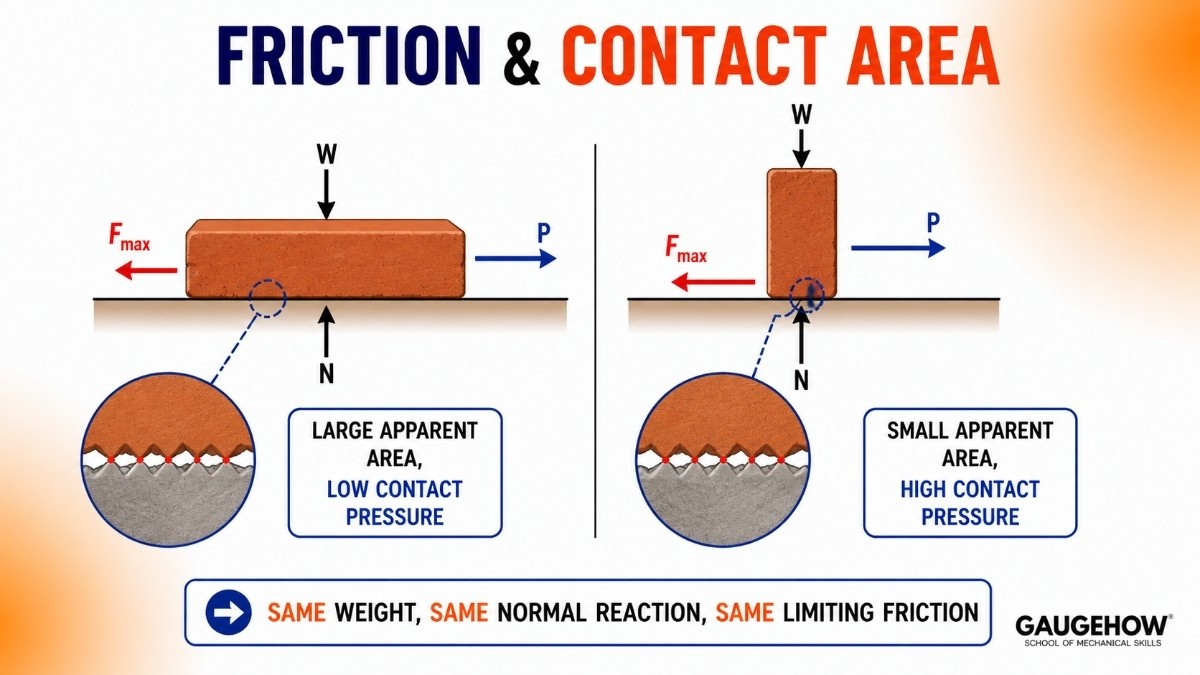
This is the law students refuse to believe, and honestly they are right to question it. It sounds wrong.
Take a brick. Lay it flat and drag it, then stand it on its narrow edge and drag it again. Same brick, same floor, same weight. The narrow position has maybe a third of the contact area. Yet the force needed to start it sliding is the same in both cases.
Here is why.
No surface is truly flat. Zoom in far enough and every surface looks like a mountain range of microscopic peaks called asperities. When two bodies rest against each other, only these peaks touch. The genuine contact area is a tiny fraction of the area you can see, often less than one percent.
That real contact area is set by the normal load, not by the visible footprint. Stand the brick on its edge and the same weight now presses through a smaller region, so the local pressure rises. Higher pressure flattens the asperities more, and the real contact area ends up almost the same.
Smaller footprint, higher pressure. Larger footprint, lower pressure. The product stays roughly constant, and so does the friction.
The Coefficient of Friction and the Angle of Friction
The laws describe behaviour. These two quantities turn them into numbers you can calculate with.
The coefficient of friction is the constant of proportionality from the second law.
For impending motion: F_max = μs × N For sliding: F_k = μk × N
Where F is the friction force in newtons (N), N is the normal reaction in newtons (N), and μ is the coefficient of friction, which is dimensionless. It has no unit because it is one force divided by another force. If your answer for mu comes out in newtons, go back and check the working.
The angle of friction, written as φ, is the angle between the resultant reaction and the normal reaction when motion is impending.
tan φ = μs
The angle of repose is the steepest slope on which a body will rest without sliding down under its own weight.
tan θ = μs, so θ = tan⁻¹(μs)
For dry friction, the angle of repose is numerically equal to the angle of friction. Both are just the coefficient of friction wearing a different hat.
Experiment to Verify the Laws of Friction
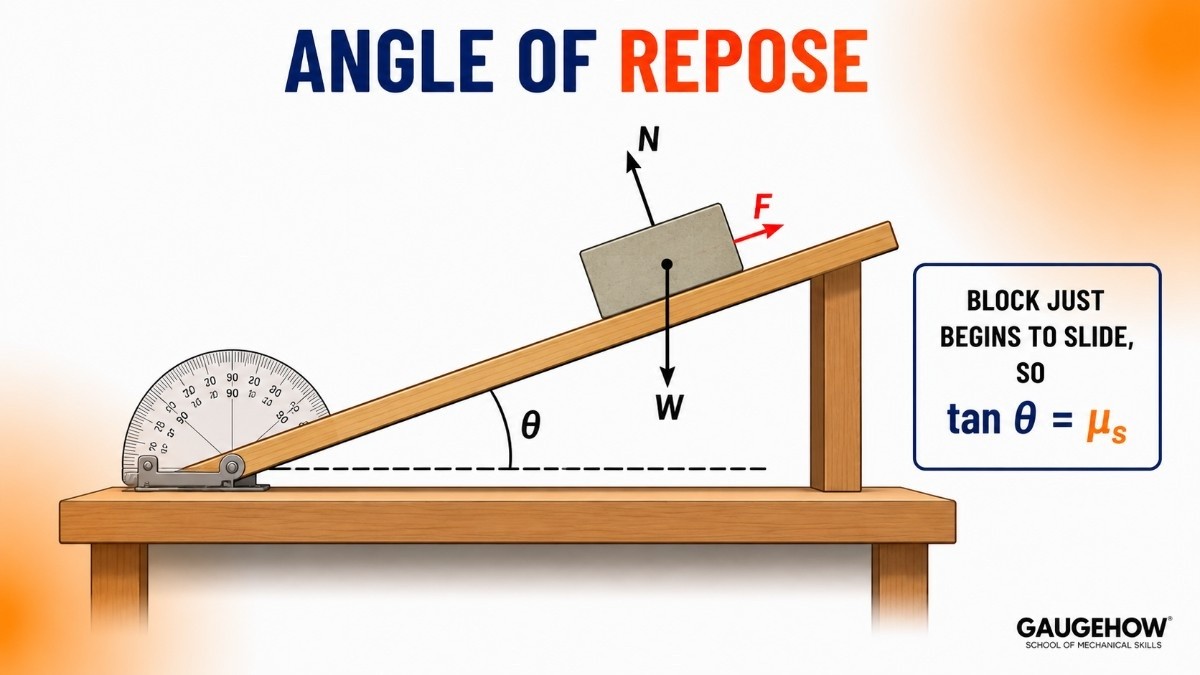
The classic inclined plane experiment is worth understanding because it is the cleanest way to see the laws in action, and it appears in practical exams.
Place a block on a hinged board that starts horizontal. Slowly raise one end while watching the block. At some angle the block begins to slide on its own. Measure that angle with a protractor.
That angle is the angle of repose, and tan of it gives you the coefficient of static friction directly. No force measurement needed, no spring balance, no mass value.
Now here is what makes it a proper verification of the laws.
Repeat with a heavier block of the same material. The angle does not change, because weight cancels out of the sliding condition. That confirms the proportionality law.
Repeat with the same block resting on a different face. The angle still does not change. That confirms the area law.
Now swap the block for a different material and the angle shifts immediately. That confirms the law about surface nature.
Three laws demonstrated with a board and a protractor.
Solved Examples Using the Laws of Friction
Example 1: testing the area law
An 8 kg steel block rests on a steel plate with μs = 0.35. Find the force needed to start it sliding when it lies on its 200 mm by 100 mm face, and again when it stands on its 100 mm by 50 mm face.
Step 1. Weight, W = 8 × 9.81 = 78.5 N
Step 2. In both positions the plate is horizontal and nothing pulls upward, so N = 78.5 N either way
Step 3. F_max = 0.35 × 78.5 = 27.5 N
Answer: Identical in both cases. The contact area changed by a factor of four and the answer did not move at all. That is Law 4 in action.
Example 2: using the proportionality law
A block needs 40 N to start sliding when the normal reaction is 100 N. What force is needed if the normal reaction is increased to 250 N by stacking extra weight on top?
Step 1. From the first condition, μs = 40 / 100 = 0.40
Step 2. The coefficient depends on the surface pair, not on the load, so it stays at 0.40
Step 3. F_max = 0.40 × 250 = 100 N
Friction scaled up in exact proportion with the normal reaction.
Example 3: finding mu from the angle of repose
In a lab experiment, a block on a tilting board just begins to slide when the board reaches 21°. Find the coefficient of static friction.
Step 1. At the angle of repose, tan θ = μs
Step 2. μs = tan 21° = 0.384
No mass, no force measurement, no spring balance. Just an angle.
Example 4: separating static from kinetic
A 20 kg crate needs 68 N to start moving and only 52 N to keep moving at constant velocity. Find both coefficients and check the fifth law.
Step 1. N = 20 × 9.81 = 196.2 N
Step 2. μs = 68 / 196.2 = 0.347
Step 3. μk = 52 / 196.2 = 0.265
Step 4. μk is smaller than μs, which agrees with the fifth law. Kinetic friction here is about 76 percent of limiting friction, right in the usual range.
Limitations of the Laws of Friction
These laws are approximations that work well in a specific window. Outside it, they fail. Examiners like this section because most students skip it.
Very high normal loads. As the load rises, the asperities flatten until the real contact area approaches the apparent area. Once that happens, friction stops rising in proportion to the load and the second law breaks.
Very clean surfaces in vacuum. With no oxide layer or contamination between them, two clean metal surfaces can cold weld together. Coefficients above 5 have been measured. This matters seriously in spacecraft design.
Lubricated contacts. Once a fluid film separates the surfaces, resistance comes from the viscosity of the oil, not from asperity contact. It becomes strongly speed dependent, so the entire dry friction model no longer applies.
Rubber and other elastomers. Rubber deforms and adheres rather than just interlocking, so its friction does depend on contact area and on speed. Tyre engineering does not run on these simple laws.
High sliding speeds and temperatures. Frictional heating softens the surface layer and the coefficient drops. This is exactly what brake fade is.
Rolling contact. A rolling wheel is governed by rolling resistance, which comes from material deformation, not sliding. Completely different mechanism.
Very small scales. At micro and nano scale, adhesion and surface forces dominate and the classical laws stop being useful.
Where Engineers Use These Laws
Every brake and clutch design starts from F = μN, because stopping torque is set by the lining coefficient and the clamping force.
Bolted friction grip joints are sized so that the shear load stays below the limiting friction generated by bolt tension. If the joint slips, the bolts see shear they were never designed for.
Conveyor and chute angles are chosen from the angle of repose of the material being handled. Too shallow and material stalls, too steep and it runs away.
Belt drives transmit power through friction at the contact arc, and slip begins the moment demand exceeds the limit.
Soil and retaining wall stability rests directly on the angle of repose. So does the stack angle for aggregate piles on any construction site.
If you want to see how friction coefficients get entered into contact settings and how they change the results, the FEA with ANSYS course covers contact definition properly.
Common Mistakes to Avoid
Stating F = μN as a law that always holds. It only applies at impending motion or during sliding. In a general static problem, friction comes from equilibrium.
Mixing the static and kinetic lists in an exam answer. If the question asks for the laws of static friction, do not include the speed independence law, since that one belongs to kinetic friction.
Saying friction is independent of area without being able to explain why. The explanation about real versus apparent contact area is usually worth more marks than the statement itself.
Forgetting that the coefficient belongs to a pair of surfaces, never to a single material.
Assuming N always equals mg. Tilt the surface or pull at an angle and it changes.
Believing mu can never exceed 1. It regularly does for rubber on clean tarmac and for clean metals in vacuum.
Key Takeaways
The laws of friction are experimental rules for dry, unlubricated contact between solids.
Friction always acts along the surface, opposing motion or the tendency of motion.
Static friction is self adjusting and rises only to a maximum called limiting friction.
Limiting friction is proportional to the normal reaction, giving F_max = μs N.
Friction is independent of the apparent contact area, because real contact happens only at microscopic peaks.
Friction depends on the material and surface condition of both bodies in the pair.
Kinetic friction is proportional to N, roughly independent of speed, and always less than limiting friction.
The angle of friction and the angle of repose both satisfy tan of the angle equals μs.
The laws break down under very high loads, in vacuum, with lubrication, with rubber, and in rolling contact.
Quick Revision
Limiting friction: F_max = μs × N, in newtons
Kinetic friction: F_k = μk × N, in newtons
General static condition: F ≤ μs × N
Relation between coefficients: μk is always less than μs
Coefficient of friction: μ = F / N, dimensionless, no unit
Angle of friction: tan φ = μs
Angle of repose: θ = tan⁻¹(μs), numerically equal to φ
Weight: W = m × g, with g = 9.81 m/s²
On an incline, normal reaction: N = W cos θ
On an incline, driving force: W sin θ
Body stays at rest on an incline when: tan θ ≤ μs
Amontons' laws: proportional to load, independent of area
Coulomb's addition: kinetic friction independent of sliding speed
Practice Corner
State any four laws of static friction.
A 20 kg body needs 60 N to start moving and 45 N to keep moving at steady speed. Find μs and μk.
A block just begins to slide when a tilting board reaches 18°. Find the coefficient of static friction.
Explain in two lines why doubling the contact area does not double the friction force.
Name three situations in which the classical laws of friction stop being valid.
<details> <summary><strong>Answers</strong></summary>
Any four from: friction acts tangential to the surface and opposes the tendency of motion; static friction is self adjusting up to a maximum; limiting friction is proportional to the normal reaction; limiting friction is independent of the apparent contact area; limiting friction depends on the nature of the surfaces in contact.
N = 20 × 9.81 = 196.2 N. μs = 60 / 196.2 = 0.306. μk = 45 / 196.2 = 0.229
μs = tan 18° = 0.325
Real contact happens only at microscopic asperities, and the total real contact area is set by the normal load rather than the visible footprint. Spreading the same load over a larger area lowers the contact pressure in proportion, so the real contact area and the friction stay the same.
Any three from: very high normal loads, clean surfaces in vacuum where cold welding occurs, lubricated contacts with a full fluid film, rubber and other elastomers, high sliding speeds with significant heating, rolling contact, and micro or nano scale contact.
</details>
Frequently Asked Questions
What are the laws of friction in simple words?
They are experimental rules describing how friction behaves between two dry solid surfaces. The main points are that friction acts along the surface opposing motion, is proportional to the normal reaction, does not depend on the apparent contact area, and depends on the materials in contact.
How many laws of friction are there?
Engineering mechanics normally states five laws of static friction and five laws of kinetic friction. When they are compressed into the classical Coulomb model, three statements cover the essentials: proportionality to load, independence from contact area, and independence from sliding speed.
Why is friction independent of the area of contact?
Because only microscopic surface peaks actually touch, and the real contact area is set by the normal load rather than by the visible footprint. Reduce the apparent area and the contact pressure rises in proportion, so the number of real contact points stays roughly the same.
What is the difference between the laws of static and kinetic friction?
The static laws describe a self adjusting force that rises to a maximum before motion begins. The kinetic laws describe an essentially constant force during sliding, add the point that it is independent of speed, and state that it is always smaller than limiting friction.
Are Coulomb's laws and Amontons' laws the same thing?
They overlap. Amontons established the two load and area laws in 1699. Coulomb added the speed independence of kinetic friction in 1781 and separated static from kinetic behaviour. The complete model is usually credited to Coulomb.
When do the laws of friction fail?
Under very high contact loads, for atomically clean surfaces in vacuum, in fully lubricated contacts, for rubber and other elastomers, at high sliding speeds where heating changes the surface, and in rolling contact where resistance comes from deformation instead of sliding.
Can the coefficient of friction be greater than 1?
Yes. Values above 1 simply mean the friction force can exceed the normal reaction. Clean rubber on rough dry tarmac reaches it, and clean metals in vacuum can go far higher because the surfaces begin to cold weld together.
Conclusion
The laws of friction are short enough to memorise in an evening, but the value comes from understanding what sits behind each one. Friction is proportional to the load and blind to contact area because real contact happens only at a few microscopic peaks.
Hold on to that single idea and every law on the list follows naturally, including the situations where the laws stop working.
Want to see these principles applied to real components and simulations? Start with the FEA with ANSYS course, or test yourself on the practice tests before your next exam.
Internal links:
Mechanical Engineer Hub: anchor in the introduction, topic hub for the target reader
FEA with ANSYS: anchor in the engineering applications section, contact and friction inputs
Fusion 360: anchor near the applications section, motion study with friction
Interview Q&A Hub: anchor near the FAQ section, laws of friction are a standard viva and interview question
Practice / MCQ Tests: anchor in the Practice Corner and closing CTA
Free Course: anchor in the closing CTA for beginners