Engineering Mechanics
Moment of a Force: Why It Is Easier to Open a Door at the Handle
Try this. Push a door open near the handle. It swings easily. Now push it with the same effort close to the hinge. It barely moves.
Same push, very different result. The secret is a simple idea called the moment of a force. It explains why door handles are far from hinges and why longer spanners loosen tight bolts.
In this lesson you will learn what a moment of a force is, the formula to find it, what a moment arm means, and how clockwise and anticlockwise moments work. By the end you will understand the turning power behind almost every tool you use.
This follows the last lesson on couples. Quick recall: a couple is two equal and opposite forces that cause pure rotation. Now we look at the turning effect of a single force.
What Is the Moment of a Force?
The moment of a force is the turning effect produced by a force about a point.
When a force acts on a body that can rotate, it tries to turn that body around a pivot. That turning action is the moment. The door swings around its hinge, and the spanner turns around the bolt.
So a moment is not a new force. It is what a force does when it tries to rotate something about a point.
Why Does a Moment Depend on Distance?
Here is the part that surprises many students. The turning effect depends not only on how hard you push, but also on where you push.
Go back to the door. Pushing near the handle gives a big turning effect because you are far from the hinge. Pushing near the hinge gives almost none, because you are close to it. The force was the same, but the distance changed everything.
This is why a moment always involves two things, the size of the force and its distance from the pivot. Increase either one, and the turning effect grows.
What Is the Formula for a Moment?
The moment of a force is found with a simple formula:
M = F × d
Where:
M is the moment, in newton metres (N·m)
F is the force, in newtons (N)
d is the perpendicular distance from the pivot to the line of action of the force, in metres (m)
The important word is perpendicular. The distance d is measured straight from the pivot to the line along which the force acts, at a right angle. Using the wrong distance is the most common mistake in moment problems.
What Is the Unit of a Moment?
Since a moment is a force multiplied by a distance, its SI unit is the newton metre (N·m).
For example, a force of 10 newtons acting at a perpendicular distance of 2 metres gives a moment of 20 N·m. Larger machines and structures may use the kilonewton metre (kN·m) for bigger moments.
Do not confuse the newton metre of a moment with the joule used for energy. They look similar but describe completely different things.
What Is the Moment Arm?
The moment arm, also called the lever arm, is the perpendicular distance from the pivot to the line of action of the force. It is the d in the formula.
Think of the moment arm as the leverage you have. A longer moment arm gives a bigger turning effect for the same force. This is exactly why a long spanner loosens a stiff bolt more easily than a short one.

So if you ever need more turning power, you have two choices. Push harder, or increase the moment arm. Engineers usually choose the longer arm, because it is easier.
What Are Clockwise and Anticlockwise Moments?
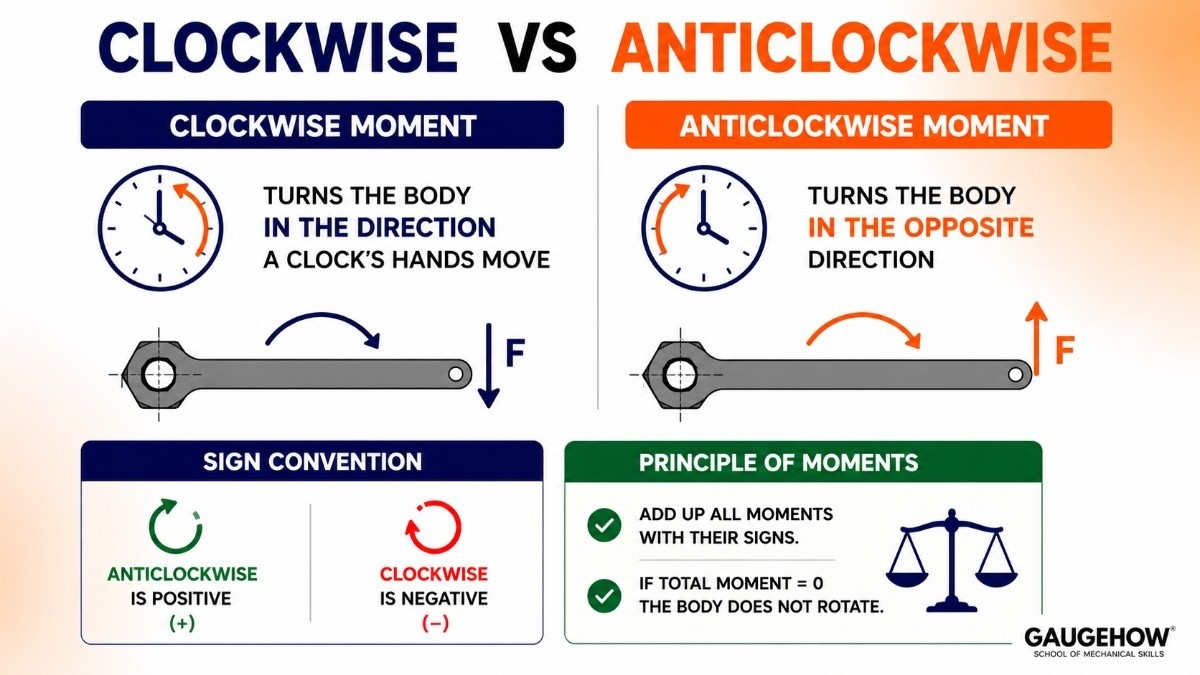
A moment has a direction. It can turn a body one of two ways.
A clockwise moment turns the body in the direction a clock's hands move. An anticlockwise moment turns it the opposite way. To keep things clear, engineers pick one direction as positive and the other as negative.
A common choice is to take anticlockwise as positive and clockwise as negative. When several forces act on a body, you add up all the moments with their signs. If the total is zero, the body does not rotate. This balance is the base of the principle of moments, which you will study soon.
Moment of a Force Example
Let us find a moment with real numbers.
A worker applies a force of 50 newtons at the end of a spanner. The perpendicular distance from the bolt to the line of the force is 0.8 metres. Find the moment about the bolt.
Step 1. Note the force: F = 50 N. Step 2. Note the perpendicular distance: d = 0.8 m. Step 3. Apply the formula: M = F × d. Step 4. M = 50 × 0.8 = 40 newton metres.
So the spanner produces a turning effect of 40 N·m on the bolt. If the worker used a longer spanner, the same push would give an even bigger moment.
What Is the Difference Between a Moment and a Couple?
You met couples in the last lesson, so let us settle the difference clearly.
A moment is the turning effect of a single force about a point. It depends on where you choose the pivot. A couple is the turning effect of two equal and opposite forces, and it is the same about any point.
In short, a moment needs a pivot and one force, while a couple needs two balanced forces and no fixed pivot. Both cause rotation, but they arise in different ways.
What Are Real Life Examples of a Moment?
Moments are everywhere in daily life:
Opening a door by pushing far from the hinge.
Loosening a bolt with a spanner.
A seesaw tipping when one child sits farther from the centre.
Using a bottle opener to lift a cap.
Pressing a door handle or a light switch.
In every case, a force acts at a distance from a pivot and creates a turning effect.
Where Do Engineers Use Moments?
Moments are central to almost all of mechanics and design.
Structural engineers calculate moments to find how much a beam bends and whether it will fail. Mechanical engineers work out the moment, or torque, on shafts, gears, and levers to size them correctly. The principle of moments is used to check that structures and machines stay balanced.
When these moments act on complex parts, engineers use simulation to find the effect across the whole component. That skill is developed in the FEA with ANSYS course.
Frequently Asked Questions
Q: What is the moment of a force? A: The moment of a force is the turning effect it produces about a point. It depends on the size of the force and its perpendicular distance from the pivot.
Q: What is the formula for a moment? A: The formula is M = F × d, where F is the force and d is the perpendicular distance from the pivot to the line of action of the force. The unit is the newton metre (N·m).
Q: What is a moment arm? A: The moment arm is the perpendicular distance from the pivot to the line of action of the force. A longer moment arm gives a bigger turning effect.
Q: What is the difference between clockwise and anticlockwise moments? A: A clockwise moment turns a body the way clock hands move, and an anticlockwise moment turns it the other way. Engineers give them opposite signs when adding moments.
Q: What is the difference between a moment and a couple? A: A moment is the turning effect of a single force about a point. A couple is the turning effect of two equal and opposite forces and is the same about any point.
Key Takeaways
The moment of a force is its turning effect about a point.
It depends on both the force and its perpendicular distance from the pivot.
The formula is M = F × d, with the unit newton metre (N·m).
The moment arm is the perpendicular distance and gives leverage.
Moments can be clockwise or anticlockwise, with opposite signs.
A moment needs a pivot, while a couple does not.
Quick Revision Box
Moment of a force: turning effect about a point
Formula: M = F × d
d: perpendicular distance from pivot to line of action (moment arm)
Unit: newton metre (N·m)
Direction: clockwise or anticlockwise, given opposite signs
Bigger moment: increase the force or the moment arm
Practice Corner
In your own words, what is the moment of a force?
Why is it easier to open a door by pushing near the handle?
Write the formula for a moment and name its unit.
A force of 30 N acts at a perpendicular distance of 1.5 m from a pivot. Find the moment.
What is the difference between a moment and a couple?
Answers
It is the turning effect a force produces about a point, depending on the force and its perpendicular distance from the pivot.
Because the handle is far from the hinge, giving a longer moment arm and a bigger turning effect for the same push.
M = F × d, and the unit is the newton metre (N·m).
M = 30 × 1.5 = 45 newton metres.
A moment is the turning effect of a single force about a point, while a couple is the turning effect of two equal and opposite forces and is the same about any point.
What's Next
That completes the Force System module. Next we begin Resolution and Composition of Forces, starting with how to split a force into components and combine several forces into a single resultant.
Conclusion
The moment of a force is one of the most useful ideas in mechanics. It explains why door handles sit far from hinges, why long spanners win, and how beams and levers work. Remember M = F × d, always use the perpendicular distance, and track the direction. With this, you have finished the Force System module and are ready to combine and resolve forces next.
Want to lock in these fundamentals? Explore the free tools on the GaugeHow Learn Hub and test yourself with the Practice and MCQ tests.
Internal links:
FEA with ANSYS (bending moments and torque on real parts) → https://gaugehow.com/course/fea-finite-element-analysis-with-ansys
Mechanical Engineer Hub → https://gaugehow.com/mech
Learn Hub → https://gaugehow.com/learn
Practice and MCQ Tests → https://gaugehow.com/practice
Interview Q&A Hub → https://gaugehow.com/interview