Engineering Mechanics
Multiple Loads on a Beam Explained Simply (Solved Examples)
Real beams rarely carry just one neat load. A floor beam holds several columns pressing down, plus the spread out weight of the slab, all at once. So how do you find the reactions when many loads act together? The method is simpler than it looks, and this lesson walks you through it.
This lesson continues the Equilibrium of Rigid Bodies module in the GaugeHow Engineering Mechanics series. We have solved beams with single loads and learned to convert distributed loads. Now we combine several loads on one beam.
By the end, you will handle any mix of point and distributed loads with confidence. Let us keep it clear.
What Are Multiple Loads on a Beam?
Multiple loads simply means more than one load acting on the same beam at the same time. They can be several point loads, several distributed loads, or a mix of both.
Each load pushes the beam and tries to turn it about the supports. The supports react to hold everything balanced. The good news is that all these loads follow the same balance rules we already know.
The trick is to treat every load separately when you write the balance equations, then add up their effects. Nothing new is needed, just careful bookkeeping.
Types of Loads on a Beam
Before solving, recall the load types you might see together.
Point load. Acts at one exact spot, measured in newtons or kilonewtons.
Uniformly distributed load (UDL). Spread evenly along a length, measured in kN/m.
Uniformly varying load (UVL). Changes at a steady rate, shaped like a triangle.
When these appear together, you first turn every distributed load into an equal point load, as we learned last lesson. After that, the whole beam is just a set of point loads, which is easy to solve.
How to Find Reactions with Multiple Loads
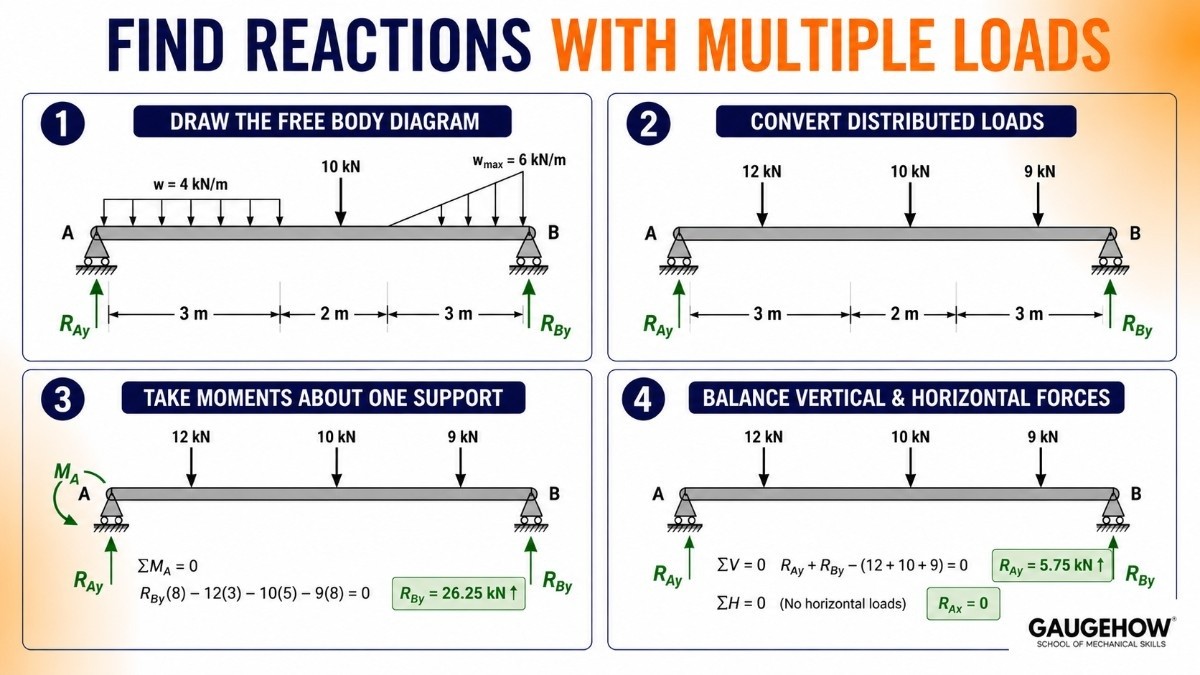
Here is a clear recipe that works every time.
Draw the free body diagram. Show the beam with all loads and the support reactions.
Convert distributed loads. Replace each UDL or UVL with a single point load at its centre.
Take moments about one support. Add the moment of every load about that support, then solve for the other reaction.
Balance the vertical forces. Add all downward loads and set them equal to the upward reactions to find the last one.
Balance the horizontal forces. Find any horizontal reaction if horizontal loads exist.
The key idea in step 3 is that every load adds its own moment. You multiply each load by its own distance from the chosen support, then add them all up.
[IMAGE: a horizontal beam with a pin at A and a roller at B carrying three downward point loads at different positions, with reaction arrows at both supports, drawn as a free body diagram]
Beam with Multiple Point Loads Example
Let us solve a beam carrying three point loads.
Problem: A beam AB is 8 m long, with a pin at A and a roller at B. Three downward loads act on it, 10 kN at 2 m, 15 kN at 5 m, and 5 kN at 7 m from A. Find the reactions.
Step 1. Take moments about A to find By. Each load adds its own moment. By × 8 = (10 × 2) + (15 × 5) + (5 × 7) By × 8 = 20 + 75 + 35 By × 8 = 130 By = 16.25 kN upward.
Step 2. Balance the vertical forces to find Ay. Ay + By = 10 + 15 + 5 Ay + 16.25 = 30 Ay = 13.75 kN upward.
Step 3. Check the answer. Total up = 13.75 + 16.25 = 30 kN. Total down = 30 kN. They match, so the beam is balanced.
Notice how each load simply contributed one term to the moment equation. More loads just means more terms, nothing harder.
Beam with Point Load and Distributed Load Example
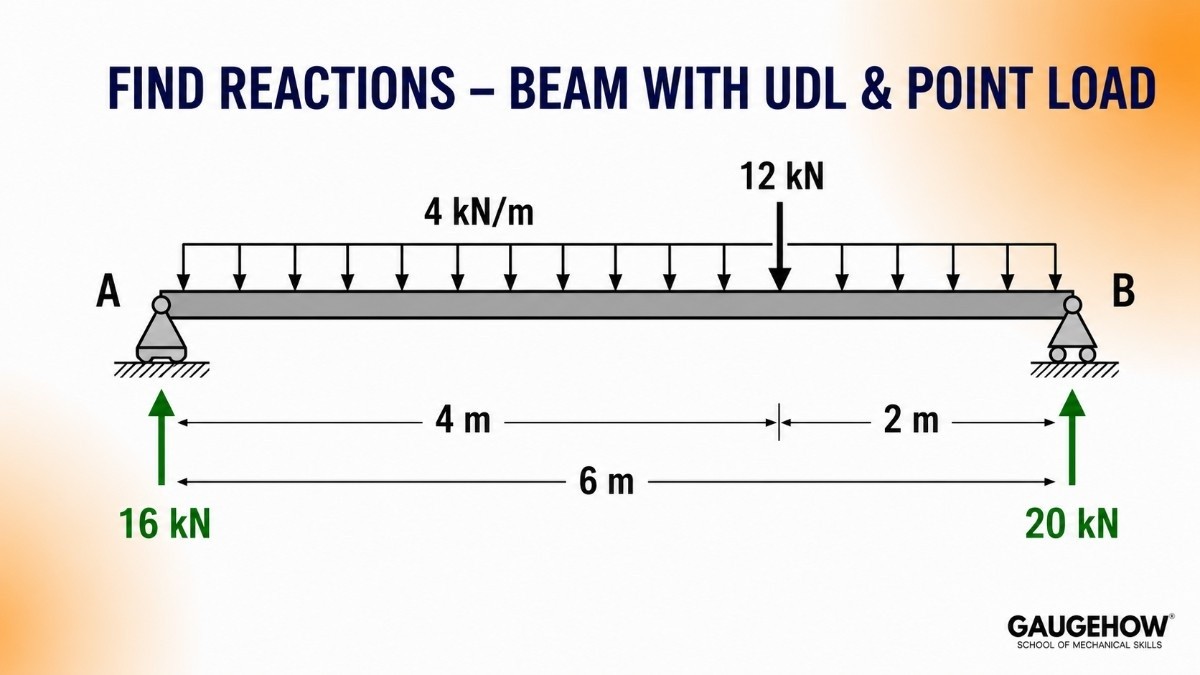
Now let us mix a point load with a UDL, which is very common in real design.
Problem: A beam AB is 6 m long, with a pin at A and a roller at B. A UDL of 4 kN/m covers the whole beam, and a point load of 12 kN acts at 4 m from A. Find the reactions.
Step 1. Convert the UDL to a point load. Total UDL = 4 × 6 = 24 kN, acting at the middle, 3 m from A.
Step 2. Take moments about A to find By. By × 6 = (24 × 3) + (12 × 4) By × 6 = 72 + 48 By × 6 = 120 By = 20 kN upward.
Step 3. Balance the vertical forces to find Ay. Ay + By = 24 + 12 Ay + 20 = 36 Ay = 16 kN upward.
Step 4. Check the answer. Total up = 16 + 20 = 36 kN. Total down = 24 + 12 = 36 kN. They match.
So the combined beam gives Ay = 16 kN and By = 20 kN. The only extra step was turning the UDL into a 24 kN point load first. After that, it solved like any other beam.
Tips to Avoid Mistakes with Multiple Loads
When many loads act together, small slips are common. These habits prevent them.
Convert distributed loads first. Turn every UDL and UVL into a point load before writing any equation.
Use one sign convention. Pick counterclockwise as positive and keep it for the whole problem.
Include every load. Do not skip any load when adding moments, even small ones.
Match each load to its own distance. Multiply each load by its distance from the chosen point, not a shared one.
Always check. Total upward forces must equal total downward forces at the end.
These simple checks catch nearly every error before it costs you marks.
Where Engineers Use This
Beams with multiple loads are the everyday reality of design.
Floor beams carry several column and wall loads plus the slab weight.
Bridge girders support many wheel loads from passing vehicles.
Crane beams carry the hook load plus the trolley and self weight.
Machine frames take loads from several mounted parts at once.
Handling many loads together is a core design skill. If you plan to work on real structures, you will use it constantly. You can explore role based learning on the Mechanical Engineer hub, and later see full beam analysis in the Fusion 360 and FEA with ANSYS courses.
Frequently Asked Questions
What does multiple loads on a beam mean?
It means more than one load acts on the same beam at once, such as several point loads, several distributed loads, or a mix of both.
How do you find reactions when a beam has many loads?
Convert any distributed loads to point loads, take moments about one support adding every load's moment, then balance the vertical forces to find the remaining reaction.
Do you add the moments of all the loads?
Yes. Each load creates its own moment about the chosen point, and you add them all together, multiplying each load by its own distance.
How do you handle a mix of point and distributed loads?
First replace each distributed load with an equal point load at its centre. Then the beam becomes a simple set of point loads that you solve the usual way.
How can I check my answer for a multi load beam?
Add all the upward reactions and all the downward loads. If the two totals are equal, the beam is balanced and the answer is consistent.
What is the most common mistake with multiple loads?
Forgetting to convert a distributed load, or multiplying a load by the wrong distance. Converting first and matching each load to its own distance avoids both.
Key Takeaways
Multiple loads means more than one load acts on a beam at the same time.
The same balance rules apply, just with more terms.
Convert every distributed load to a point load before writing equations.
Take moments about one support, adding the moment of each load.
Each load is multiplied by its own distance from the chosen point.
Balance the vertical forces to find the last reaction.
Always check that total upward forces equal total downward forces.
Quick Revision Box
Convert distributed loads to point loads first
Moment equation: add each load times its own distance
Reaction step: take moments about one support
Vertical balance: total up = total down
Sign convention: counterclockwise positive, kept throughout
Final check: upward reactions equal downward loads
Practice Corner
Try these before moving on. Answers are at the bottom.
What does it mean for a beam to carry multiple loads?
What is the first thing you do if a beam has a distributed load among others?
A 6 m beam, pin at A and roller at B, carries 8 kN at 2 m and 12 kN at 4 m. Find the reactions.
Why do you multiply each load by its own distance in the moment equation?
How do you quickly check a multi load answer?
<details> <summary>Answers</summary>
It means more than one load acts on the same beam at the same time, which can be point loads, distributed loads, or a mix.
Convert the distributed load into an equal point load at its centre before writing any equation.
Moments about A: By × 6 = 8 × 2 + 12 × 4 = 16 + 48 = 64, so By = 10.67 kN. Vertical balance: Ay = 20 - 10.67 = 9.33 kN.
Because each load acts at a different distance from the chosen point, so it creates a different moment. Using its own distance gives the correct turning effect.
Add all upward reactions and all downward loads. If the two totals are equal, the answer is consistent.
</details>
Want more practice? Try the GaugeHow practice tests and browse common interview questions once you feel ready.
What's Next
Next we will look at Engineering Structures, where these support and load ideas come together in real frames, trusses, and machines.
Internal links: Mechanical Engineer hub (https://gaugehow.com/mech), Fusion 360 course (https://gaugehow.com/course/fusion-360), FEA with ANSYS course (https://gaugehow.com/course/fea-finite-element-analysis-with-ansys), Practice tests (https://gaugehow.com/practice), Interview Q&A (https://gaugehow.com/interview)