Engineering Mechanics
Parallelogram Law of Forces Explained with Examples
Two tugboats pull a ship, ropes spreading outward at an angle. The ship does not zigzag between them. It moves along one path, somewhere in the middle, closer to whichever rope pulls harder.
The parallelogram law of forces tells you exactly where that path lies. Draw both forces from the same point, complete the parallelogram, and the diagonal is your answer.
This guide covers the statement of the law, how to construct it, the full derivation of the resultant formula from basic geometry, the special cases worth memorising, how the law is verified in a lab, and where it stops applying. Simple language and worked numbers throughout.
What Is the Parallelogram Law of Forces?
The parallelogram law of forces states that if two forces acting simultaneously at a point are represented in magnitude and direction by the two adjacent sides of a parallelogram, then their resultant is represented in magnitude and direction by the diagonal of the parallelogram drawn from that same point.
Take that apart piece by piece.
Acting simultaneously at a point means both forces are applied at the same place at the same time, such as two cables meeting at one hook.
Represented in magnitude and direction means each force becomes a line whose length equals its size at a chosen scale, and whose angle equals its direction.
The two adjacent sides are the two sides that share the starting corner. Both forces are drawn outward from that same corner.
The diagonal from that point is the line running from the starting corner to the opposite corner. Not the other diagonal, which is a common slip.
The everyday version is a swimmer crossing a river. The swimmer pushes straight across while the current pushes downstream. The actual path taken is neither of those two directions but the diagonal between them, and that is exactly what the law describes.
Statement in Simple Words
Keep this version if you keep only one.
Draw both forces from the same corner. Complete the parallelogram. The diagonal from that corner is the resultant.
Its length gives the magnitude and its angle gives the direction.
How to Construct the Parallelogram of Forces
Six steps with a ruler, protractor and sharp pencil.
Choose a scale and write it on the drawing, such as 1 cm = 20 N. Aim for the larger force to be 6 cm to 12 cm long.
Draw the first force from your chosen point, at its correct angle and scaled length. Call it P.
Draw the second force from the same point, at its correct angle and scaled length. Call it Q.
From the head of P, draw a light construction line parallel to Q and the same length.
From the head of Q, draw a light construction line parallel to P and the same length. The two construction lines meet at the fourth corner.
Draw the diagonal from the starting point to that fourth corner. Measure its length, convert with your scale, and read its angle with a protractor.
The construction lines are not forces. Keep them light or dashed so nobody mistakes them for real ones, and put an arrowhead only on the diagonal and the two original forces.
Worked construction
Two forces act at a bolt: 70 N horizontally and 50 N at 65 degrees to it.
Scale: 1 cm = 10 N.
Draw 7.0 cm horizontally from the point.
Draw 5.0 cm at 65 degrees from the same point.
Complete the parallelogram with two light parallel lines.
Draw and measure the diagonal: about 10.1 cm at roughly 26.6 degrees.
Convert: 10.1 × 10 = 101 N at about 27 degrees from the 70 N force.
The calculated value is 100.9 N at 26.6 degrees, so careful drawing gets you within one percent.
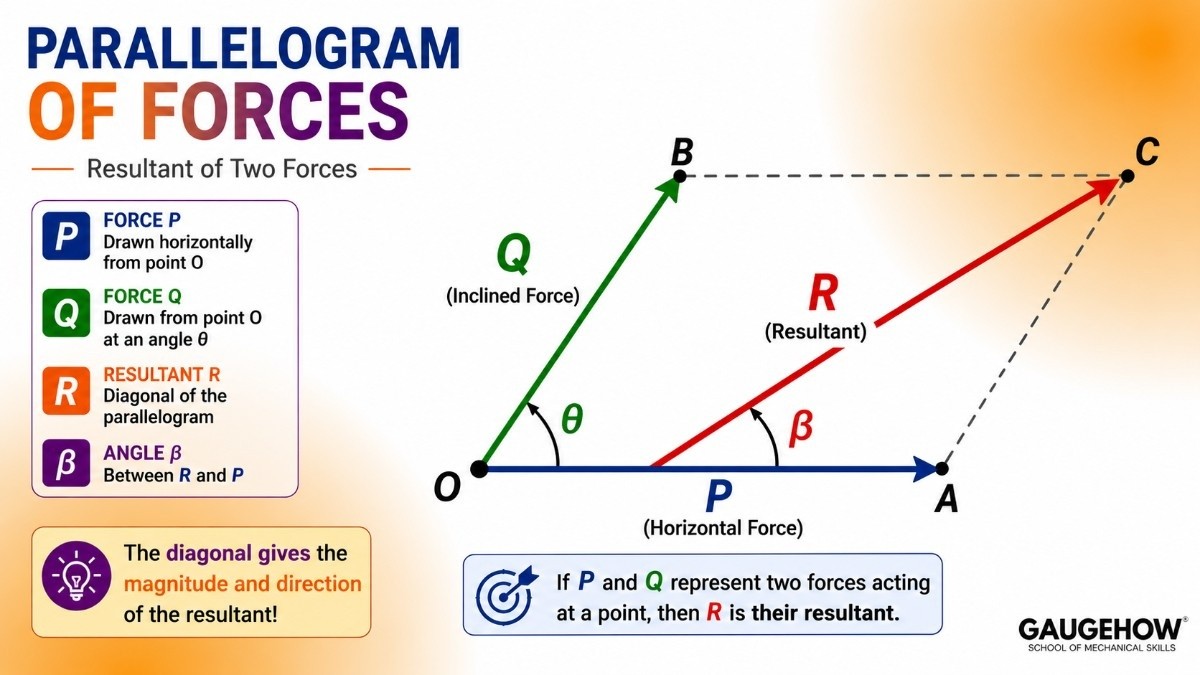
Parallelogram Law Formula
For two forces P and Q acting at a point with angle θ between them:
R = √(P² + Q² + 2PQ cos θ)
And the direction of the resultant, measured from force P:
tan β = (Q sin θ) / (P + Q cos θ)
Where:
P and Q are the two force magnitudes, in newtons (N)
θ (theta) is the angle between the two forces, in degrees
R is the resultant force, in newtons (N)
β (beta) is the angle between the resultant and force P, in degrees
Note that θ is the angle between the forces as they actually act, both measured outward from the common point. Students often use the angle from the construction line instead, which produces the wrong sign inside the square root.
Derivation of the Parallelogram Law Formula
This derivation appears in exams regularly, and it only needs Pythagoras and basic trigonometry. Nothing advanced.
Set up the figure. Let the two forces act from point O. Draw OA = P along the horizontal and OB = Q at angle θ. Complete the parallelogram OACB, so the resultant is the diagonal OC = R.
Now extend the line OA beyond A, and drop a perpendicular from C down onto that extended line, meeting it at point D.
Look at the small right-angled triangle ACD. The side AC is parallel to OB and equal to Q, and it makes the same angle θ with the horizontal. So:
AD = Q cos θ
CD = Q sin θ
Now look at the large right-angled triangle ODC. Its base is OD = OA + AD = P + Q cos θ, and its height is CD = Q sin θ.
Apply Pythagoras:
R² = (P + Q cos θ)² + (Q sin θ)²
Expand the bracket:
R² = P² + 2PQ cos θ + Q² cos²θ + Q² sin²θ
Group the last two terms and use the identity cos²θ + sin²θ = 1:
R² = P² + 2PQ cos θ + Q²
Which gives the standard result:
R = √(P² + Q² + 2PQ cos θ)
For the direction, take the tangent of angle β in triangle ODC, which is opposite over adjacent:
tan β = CD / OD = (Q sin θ) / (P + Q cos θ)
That is the whole derivation. Two right-angled triangles and one trigonometric identity.

Solved Examples
Example 1
Two forces of 150 N and 100 N act at a point with 60 degrees between them.
R = √(150² + 100² + 2 × 150 × 100 × cos 60°)
R = √(22500 + 10000 + 30000 × 0.5)
R = √(22500 + 10000 + 15000) = √47500 = 217.9 N
tan β = (100 × sin 60°) / (150 + 100 × cos 60°) = 86.6 / 200 = 0.433
β = 23.4 degrees from the 150 N force
Check the limits. The sum is 250 N, the difference is 50 N, and 217.9 N sits between them, so the answer is plausible.
Example 2
The resultant of two forces is 100 N. One force is 60 N and the angle between the forces is 90 degrees. Find the other force.
At 90 degrees, cos θ = 0, so R² = P² + Q²
100² = 60² + Q²
Q² = 10000 − 3600 = 6400
Q = 80 N
The familiar 3, 4, 5 triangle scaled up. Exam setters use it constantly, so it is worth recognising on sight.
Special Cases Worth Memorising
Each of these comes straight from the main formula, and knowing them saves calculator time.
When θ = 0 degrees (forces in the same direction): cos 0 = 1, so R = P + Q. This is the maximum possible resultant.
When θ = 90 degrees (perpendicular forces): cos 90 = 0, so R = √(P² + Q²). Plain Pythagoras.
When θ = 180 degrees (directly opposite): cos 180 = −1, so R = P − Q. This is the minimum possible resultant.
When θ = 120 degrees and P = Q: R = P. Two equal forces at 120 degrees give a resultant equal to either one of them, which is why three equal forces at 120 degrees apart balance perfectly.
When P = Q at any angle: R = 2P cos(θ/2), and the resultant always bisects the angle between them.
That last one is useful for symmetric problems such as two identical slings on a hook, where it turns a messy calculation into one line.
How the Parallelogram Law Is Verified in the Lab
This experiment appears in nearly every first year lab manual, so it is worth knowing how it works.
The apparatus is a Gravesand's apparatus, which is a vertical board with two pulleys mounted at the top corners. A sheet of paper is pinned to the board.
The setup goes like this. Two strings pass over the pulleys with weights hanging from them. Both strings are tied to a third string that carries its own weight hanging straight down. All three strings meet at a single knot, and the knot settles into a position where everything balances.
The procedure:
Mark the directions of all three strings on the paper.
Choose a scale and draw the two upper forces from the knot position, using their known weights.
Complete the parallelogram and draw the diagonal.
Measure the diagonal and convert it back into newtons.
The result you should find is that the diagonal comes out equal in size to the third weight but pointing in the exactly opposite direction. That third weight is the equilibrant, the force that cancels the other two.
Since the knot is in equilibrium, the resultant of the two upper forces must be exactly balanced by the hanging weight, which is precisely what the law predicts. Typical error is two to four percent, coming mainly from pulley friction and reading the string directions off the paper.
Difference Between the Parallelogram and Triangle Laws
They give the same answer and the same formula, so the difference is only in construction.
Parallelogram law: both forces are drawn outward from a common point. You add two construction lines to complete the shape, then draw the diagonal from that point. Five lines in total.
Triangle law: the forces are drawn head to tail, the second starting where the first ends. The closing side is the resultant. Three lines in total.
The parallelogram version matches physical reality more closely, because two forces on a bolt really do both act from that bolt. The triangle version is faster to draw and extends directly to any number of forces, where it becomes the polygon law.
Both produce R = √(P² + Q² + 2PQ cos θ), which is the clearest evidence they are the same result drawn two ways. Use whichever the question asks for, and whichever is clearer when the choice is yours.
Where Engineers Use the Parallelogram Law
Crane and rigging work. Two slings meeting at a hook is the textbook case, and the sling angle changes the load on each leg dramatically.
Cable-stayed structures. Anchor points where two cables meet need the combined pull on the anchor, not the individual tensions.
Towing and marine work. Two tugs on one vessel is the original textbook illustration for good reason.
Machine design. Bearing loads from two shafts or two belt tensions combine this way.
Wind and gravity loads. A vertical weight and a horizontal wind load on a sign or mast combine into one design load.
One practical warning from rigging that follows directly from the formula. As the angle between two slings increases, the resultant they can produce for a given tension drops, which means each sling has to carry far more load to lift the same weight. Wide sling angles are dangerous, and the formula shows exactly why.
Limitations of the Parallelogram Law
Two forces only. For three or more, use the polygon law instead.
Concurrent forces only. Both forces must act through the same point. Forces at different points produce turning effects the law cannot describe.
Coplanar forces only. The construction is flat and cannot represent three-dimensional systems on paper.
No moment information. It handles the combined push or pull, but says nothing about rotation, which needs ΣM = 0.
Drawing accuracy. Graphical use is limited to roughly one to three percent by ruler and protractor.
Common Mistakes to Avoid
Using the wrong angle. θ is measured between the two forces as they act outward from the common point, not between a force and a construction line.
Drawing the wrong diagonal. The resultant runs from the starting corner to the opposite corner. The other diagonal represents the difference of the two forces, not their sum.
Treating construction lines as forces. They complete the shape only. Draw them lightly and leave them without arrowheads.
Forgetting to write the scale. Without it, the measured diagonal cannot be converted back into newtons.
Quoting a magnitude with no direction. The resultant is a vector, so both parts are needed.
Skipping the plausibility check. The resultant must lie between the sum and the difference of the two forces.
Applying it to more than two forces. Two at a time only, or switch to the polygon law.
Key Takeaways
The parallelogram law finds the resultant of two concurrent forces as the diagonal of the parallelogram they form.
Both forces are drawn from the same point, unlike the head to tail triangle construction.
The formula is R = √(P² + Q² + 2PQ cos θ), derived using Pythagoras and one trigonometric identity.
Direction comes from tan β = (Q sin θ) / (P + Q cos θ).
Maximum resultant occurs at 0 degrees, minimum at 180 degrees.
Two equal forces give a resultant that bisects the angle, with R = 2P cos(θ/2).
The law is verified experimentally with Gravesand's apparatus using three balanced strings.
It applies only to two coplanar concurrent forces and says nothing about moments.
Quick Revision Box
Statement: two forces as adjacent sides, resultant as the diagonal from the same point
Resultant magnitude: R = √(P² + Q² + 2PQ cos θ)
Resultant direction: tan β = (Q sin θ) / (P + Q cos θ)
Same direction (θ = 0): R = P + Q, the maximum
Perpendicular (θ = 90): R = √(P² + Q²)
Opposite (θ = 180): R = P − Q, the minimum
Equal forces: R = 2P cos(θ/2), bisecting the angle
Equal forces at 120 degrees: R = P
Plausibility check: (P − Q) ≤ R ≤ (P + Q)
Valid for: two coplanar concurrent forces only
Frequently Asked Questions
What is the parallelogram law of forces in simple words?
If two forces act at the same point, draw both as arrows from that point and complete the parallelogram. The diagonal starting at that same point is their combined effect, in both size and direction.
How is the parallelogram law formula derived?
Extend the line of one force, drop a perpendicular from the far corner of the parallelogram onto it, and apply Pythagoras to the resulting right-angled triangle. Using cos²θ + sin²θ = 1 tidies the result into R = √(P² + Q² + 2PQ cos θ).
What is the difference between the parallelogram law and the triangle law?
Only the construction. The parallelogram law draws both forces from a common point and uses the diagonal, while the triangle law joins them head to tail and uses the closing side. Both give the same formula and the same answer.
When is the resultant of two forces maximum and minimum?
Maximum when the angle between them is 0 degrees, giving P + Q. Minimum when the angle is 180 degrees, giving P − Q. Every other angle falls between those two values.
Can the parallelogram law be used for three forces?
Not in one step. You can apply it twice, combining two forces first and then combining that resultant with the third, but the polygon law handles all three at once and is quicker.
Why does the diagonal represent the resultant and not the other diagonal?
Because the resultant must act from the same point as the two original forces. The diagonal starting at that corner does. The other diagonal joins the two force heads and represents their difference instead.
Practice Corner
State the parallelogram law of forces in your own words.
Two forces of 40 N and 30 N act at a point with 90 degrees between them. Find the resultant and its direction.
Two equal forces of 25 N act with 60 degrees between them. Find the resultant using the equal-force shortcut.
The resultant of two perpendicular forces is 130 N and one force is 50 N. Find the other.
Why does the resultant lie closer to the larger of the two forces?
Answers
If two forces acting at a point are drawn as the two adjacent sides of a parallelogram, then the diagonal drawn from that same point represents their resultant in both magnitude and direction.
R = √(1600 + 900 + 0) = √2500 = 50 N, at tan β = 30/40 = 0.75, giving 36.9 degrees from the 40 N force.
R = 2 × 25 × cos 30° = 2 × 25 × 0.866 = 43.3 N, bisecting the angle at 30 degrees from each force.
130² = 50² + Q², so Q² = 16900 − 2500 = 14400 and Q = 120 N.
Because the larger force contributes more to both component sums, so the diagonal is pulled toward it. In the direction formula, a bigger P makes the denominator larger and β smaller, tilting the resultant toward P.
Where to Practise This Further
Parallelogram law problems become quick once the formula and its special cases are automatic. Drill resultant and equilibrium questions with the free MCQ practice tests, and see how they appear in placement rounds in the engineering interview question bank.
The same vector addition runs inside every modern solver. The Fusion 360 course shows how load directions are applied to a model, and the FEA with ANSYS course carries this logic into full static structural analysis. If you would rather calculate and plot force parallelograms from code, Python for Mechanical Engineers covers both.
Students planning a design career can also browse the Mechanical Engineer hub and the Design Engineer track to see where statics fits into the wider skill set.
Internal links:
Triangle law of forces explained with examples
Polygon law of forces explained with examples
Resultant force formula and examples
Practice tests: https://gaugehow.com/practice
Interview Q&A hub: https://gaugehow.com/interview