Engineering Mechanics
Pin Support Explained Simply (Hinged Support And Reactions)
Look at any door. It swings open and shut all day, yet it never falls off or slides sideways. The hinge holds it firmly in place while still letting it turn. That hinge is a perfect everyday picture of a pin support, one of the most important supports in engineering.
This lesson continues the Equilibrium of Rigid Bodies module in the GaugeHow Engineering Mechanics series. In the last lesson we studied the roller support and its single reaction. Now we look at the pin support, which holds a point firmly and gives two reactions.
By the end, you will know how a pin support works, the reactions it produces, and how to find them in a beam problem. Let us keep it clear.
What Is a Pin Support?
A pin support, also called a hinged support, holds a structure at a point and lets it rotate freely about that point. But it stops the point from moving, both sideways and up or down.
Think of a door hinge again. The door can swing around the hinge, which is rotation. But the hinge does not let the door drift left, right, up, or down. It locks the position while allowing the turn.
So a pin support is more restrictive than a roller. A roller allows sliding, but a pin does not. A pin allows only rotation and nothing else.
Pin Support Reactions
A pin support gives two reaction forces, one horizontal and one vertical. Together these can resist a push from any direction in the plane.
Why two? Because the pin blocks movement both sideways and up or down. To stop sideways motion it needs a horizontal reaction. To stop vertical motion it needs a vertical reaction. Any slanted load is simply handled by these two working together.
But the pin allows rotation, so it gives no moment. This is the key point. A pin resists forces in two directions but never resists turning.
[IMAGE: a pin or hinged support shown as a triangle with a pin at its top holding a beam, with a horizontal reaction arrow and a vertical reaction arrow at the support, and a small door hinge sketch beside it for comparison]
Pin Support Symbol
In drawings, a pin support has a simple and clear symbol.
It is usually shown as a plain triangle with its tip touching the structure, sometimes with a small circle at the tip to show the pin. The base of the triangle sits on the ground or wall.
The meaning is always the same. The point can rotate but cannot move in any direction, and the support supplies a horizontal and a vertical reaction.
Real Life Examples of Pin Support
Once you know the pin, you will spot it in many structures.
Door and window hinges, which let the leaf swing while holding it in place.
Truss joints, where members meet and are pinned together.
Bridge bearings at one end of a span, which carry load while allowing rotation.
Cranes and booms, which pivot about a strong pinned joint.
Foldable and rotating machine parts, joined by pins so they can turn.
In each case, the pin keeps the point fixed in position but free to rotate. That is exactly what many joints need.
Pin Support vs Roller Support

Students often confuse these two, so here is the clean difference.
A pin support gives two reactions, one horizontal and one vertical, and it holds the point so it cannot move. A roller support gives only one reaction, perpendicular to its surface, and it lets the point slide along that surface.
Both supports allow rotation, so neither gives a moment. The real difference is how many directions they block. A pin blocks two directions, a roller blocks one. That is why a common beam uses a pin to lock its position and a roller at the other end to allow thermal movement.
How to Find Pin Support Reactions
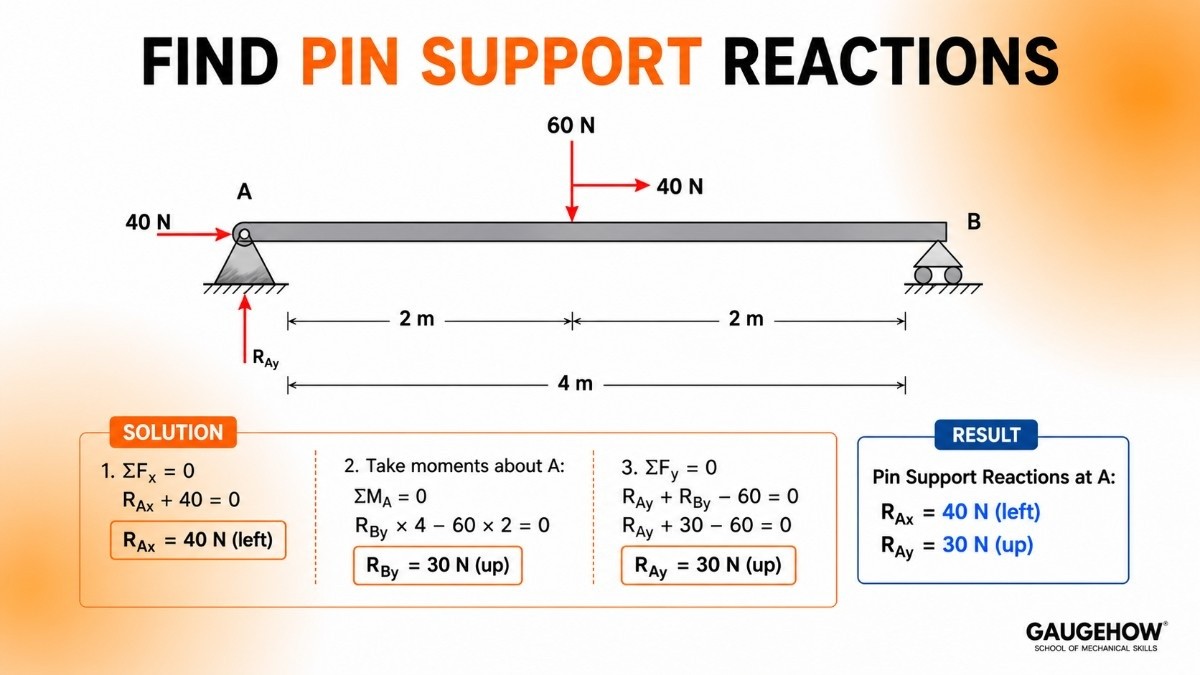
Let us solve a beam problem where the pin's two reactions clearly appear. We use the three balance rules for a body at rest. The horizontal forces balance, the vertical forces balance, and the moments balance.
Problem: A beam AB is 4 m long, with a pin support at A and a roller support at B. At the midpoint, 2 m from A, a load acts that has a horizontal part of 40 N pushing right and a vertical part of 60 N pushing down. Find the reactions at the pin A.
Step 1. Balance the horizontal forces. The roller gives no horizontal reaction, so the pin must resist the 40 N push. Ax = 40 N, acting to the left.
Step 2. Take moments about A to find the roller reaction. By × 4 = 60 × 2 By × 4 = 120 By = 30 N upward.
Step 3. Balance the vertical forces. Ay + By = 60 Ay + 30 = 60 Ay = 30 N upward.
Step 4. State the pin reactions. The pin at A gives a horizontal reaction of 40 N and a vertical reaction of 30 N.
So the pin supplies two forces, which is exactly what makes it different from a roller. The roller at B only gave the single 30 N vertical force.
Advantages of a Pin Support
The pin support is popular for good reasons.
It holds a point firmly in both directions, giving good stability.
It still allows rotation, so it does not force unwanted bending into the joint.
It is simple to build and easy to analyse, since it has no moment.
Paired with a roller, it forms the classic simply supported beam used everywhere.
This balance of firmness and freedom is why pins appear in bridges, trusses, and machines all the time.
Where Engineers Use Pin Supports
Pin supports show up wherever a joint must stay in place but still turn.
Roof and bridge trusses, where every joint is treated as a pin.
Bridge spans, using a pin at one end to carry load and allow rotation.
Crane pivots and booms, which swing about a heavy pinned joint.
Linkages and mechanisms, where parts rotate around pins.
Placing a pin in the right spot gives a structure both strength and the freedom to rotate. If you plan to design real structures, this is a core skill. You can explore role based learning on the Mechanical Engineer hub, and later see joints modelled in the Fusion 360 and FEA with ANSYS courses.
Frequently Asked Questions
What is a pin support in simple words?
A pin support, also called a hinged support, holds a point in place but lets it rotate freely. A door hinge is a familiar example.
How many reactions does a pin support have?
Two reactions, one horizontal and one vertical. Together they can resist a load coming from any direction in the plane.
Does a pin support resist a moment?
No. A pin allows rotation, so it gives no resisting moment, only two forces.
What is the difference between a pin and a roller support?
A pin gives two reactions and holds the point so it cannot move. A roller gives one reaction and lets the point slide. Both allow rotation.
Why is a pin support also called a hinged support?
Because it works like a hinge. It holds the joint in position while letting it turn, just as a door hinge holds a door yet lets it swing.
Where are pin supports used?
In truss joints, bridge bearings, crane pivots, door hinges, and mechanical linkages, wherever a joint must stay fixed in place but free to rotate.
Key Takeaways
A pin support, or hinged support, holds a point in place and allows only rotation.
It gives two reactions, one horizontal and one vertical.
It provides no moment, because rotation is allowed.
It is more restrictive than a roller, which allows sliding.
Its symbol is a plain triangle, sometimes with a pin circle at the tip.
A pin at one end and a roller at the other form a simply supported beam.
Find its reactions using horizontal balance, vertical balance, and moment balance.
Quick Revision Box
Pin or hinged support: 2 reactions, horizontal and vertical
Allows: rotation only
Resists: horizontal and vertical movement
Moment at pin: zero
Symbol: plain triangle, tip touching the structure
Balance rules: sum of Fx = 0, sum of Fy = 0, sum of moments = 0
Practice Corner
Try these before moving on. Answers are at the bottom.
What movements does a pin support allow and prevent?
How many reactions does a pin support give, and in which directions?
Why does a pin support provide no moment?
A 4 m beam has a pin at A and a roller at B. A 50 N downward load acts 1 m from A. Find the roller reaction and the pin's vertical reaction.
Give one everyday example of a pin support.
<details> <summary>Answers</summary>
A pin support allows rotation but prevents movement in both the horizontal and vertical directions.
Two reactions, one horizontal and one vertical.
Because it allows the structure to rotate, so there is nothing to resist turning and no moment is produced.
Moments about A: By × 4 = 50 × 1, so By = 12.5 N upward. Vertical balance: Ay + 12.5 = 50, so Ay = 37.5 N upward.
A door hinge, a window hinge, or a truss joint.
</details>
Want more practice? Try the GaugeHow practice tests and browse common interview questions once you feel ready.
What's Next
Next we will study the Fixed Support, the strongest support of all, which gives three reactions and even resists rotation.
Internal links:
Mechanical Engineer hub (https://gaugehow.com/mech),
Fusion 360 course (https://gaugehow.com/course/fusion-360),
FEA with ANSYS course (https://gaugehow.com/course/fea-finite-element-analysis-with-ansys),
Practice tests (https://gaugehow.com/practice),
Interview Q&A (https://gaugehow.com/interview)