Engineering Mechanics
Principle of Moments Explained Simply (With Examples)
How does a seesaw stay perfectly level when a small child sits on one side and a bigger child sits on the other? The bigger child does not sit at the very end. They sit closer to the middle. That small adjustment is the principle of moments working in real life.
This lesson continues the GaugeHow Engineering Mechanics series. In the last lesson we learned the moment of force, the turning effect of a single force. Now we look at what happens when two or more forces try to turn the same object, and how they balance.
By the end, you will know the statement, the formula, and how to solve balance problems with confidence. Let us start with the seesaw idea and build up.
What Is the Principle of Moments?
The principle of moments deals with objects that are balanced and not turning. It compares the forces trying to rotate an object one way against the forces trying to rotate it the other way.
Quick recap from the last lesson. A moment is the turning effect of a force, found using M = F × d, where F is the force and d is the perpendicular distance from the pivot.
Now imagine two forces acting on the same beam. One tries to spin it clockwise. The other tries to spin it anticlockwise. If these two turning effects are equal, the beam does not move. It stays balanced.
That balanced state is exactly what the principle of moments describes.
Principle of Moments Statement
Here is the principle stated in simple words.
When a body is balanced, the total clockwise moment about a point equals the total anticlockwise moment about the same point.
In other words, for a body that is not rotating, the turning effects on both sides cancel out. Neither side wins, so the body stays still.
This is also called the law of the lever, because it is the same idea that makes see-saws, crowbars, and weighing balances work.
Principle of Moments Formula
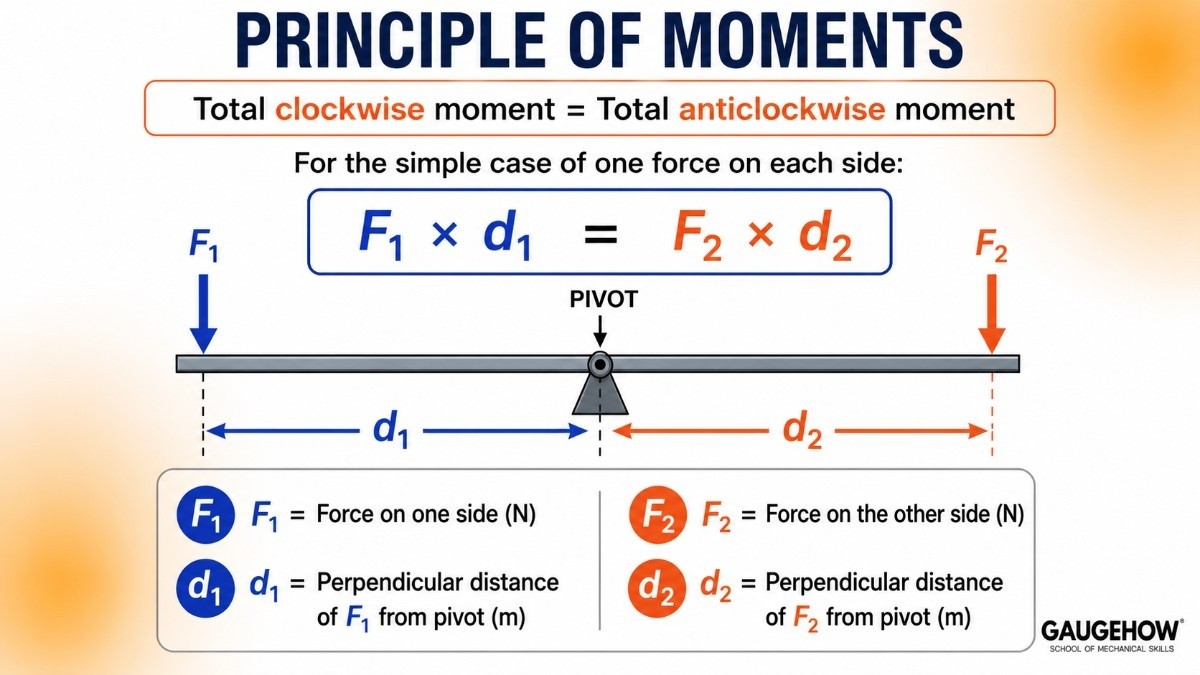
The principle is written as a short and clean equation.
Total clockwise moment = Total anticlockwise moment
For the simple case of one force on each side, it becomes:
F1 × d1 = F2 × d2
Here is what each symbol means:
F1 is the force on one side, in newtons (N).
d1 is the perpendicular distance of F1 from the pivot, in metres (m).
F2 is the force on the other side, in newtons (N).
d2 is the perpendicular distance of F2 from the pivot, in metres (m).
Both sides of this equation are moments, so both are measured in newton metre (N·m). If one side is bigger, the object turns in that direction. If they are equal, it stays balanced.
Clockwise and Anticlockwise Moments
To use the principle, you first need to sort the moments into two groups.
A clockwise moment turns the body the way clock hands move.
An anticlockwise moment turns it the opposite way.
Add up all the clockwise moments into one total. Add up all the anticlockwise moments into another total. Then compare the two totals.
If the two totals are equal, the body is in balance. If they are not, the body rotates towards the larger moment. This simple sorting step is the heart of every moment problem you will solve.
Seesaw Example: Principle of Moments in Real Life
The seesaw is the easiest example to picture, so let us use real numbers.
Suppose a 30 kg child sits 2 m from the pivot on the left. On the right, a 20 kg child needs to balance the seesaw. How far from the pivot should the lighter child sit?
We compare the two turning effects. To keep it simple we can work with weight in a proportional way, since gravity acts equally on both sides.
Left side moment = 30 × 2 = 60 units Right side moment must also be 60 units to balance.
So for the 20 kg child: 20 × d = 60, which gives d = 3 m.
The lighter child sits farther out, at 3 m, while the heavier child sits closer, at 2 m. That is why on a real seesaw the bigger person always slides towards the centre. They are balancing the moments without even knowing the formula.
How to Solve Principle of Moments Problems

Let us solve a proper beam problem step by step, the kind you will see in exams.
Problem: A uniform beam is balanced on a pivot at its centre. A force of 40 N acts downward at 1.5 m to the left of the pivot. On the right side, a force F acts downward at 2 m from the pivot. Find F needed to keep the beam balanced.
Step 1. Identify the two moments. Left force creates an anticlockwise moment. Right force creates a clockwise moment.
Step 2. Write the principle of moments. Clockwise moment = Anticlockwise moment F × 2 = 40 × 1.5
Step 3. Simplify the right side. F × 2 = 60
Step 4. Solve for F. F = 60 ÷ 2 F = 30 N
So a 30 N force at 2 m balances the 40 N force at 1.5 m. Notice the heavier force sits closer and the lighter force sits farther, just like the seesaw.
Applications of the Principle of Moments
This principle is not only a school topic. Engineers use it every day.
Weighing balances use equal moments on both arms to compare masses.
Cranes are designed so the load moment never beats the counterweight moment, or the crane would tip over.
Levers and crowbars let a small force move a heavy load by using a longer distance.
Beam and bridge design relies on balanced moments so the structure does not rotate or collapse.
Door closers and lever handles are sized using the same balance idea.
If you plan to design real structures and machines, this idea keeps coming back. You can explore role based learning on the Mechanical Engineer hub, and later see how tools like Fusion 360 and FEA with ANSYS calculate these moments for full designs.
Key Takeaways
The principle of moments describes objects that are balanced and not turning.
Statement: total clockwise moment equals total anticlockwise moment about the same point.
Formula for the simple case: F1 × d1 = F2 × d2.
Both sides are moments, measured in newton metre (N·m).
Sort moments into clockwise and anticlockwise, add each group, then compare.
A heavier force sits closer to the pivot and a lighter force sits farther to stay balanced.
It is the same idea behind seesaws, levers, weighing balances, and cranes.
Quick Revision Box
Moment of a force: M = F × d
Principle of moments: Total clockwise moment = Total anticlockwise moment
Simple balance form: F1 × d1 = F2 × d2
F = force in newtons (N)
d = perpendicular distance in metres (m)
Moment unit: newton metre (N·m)
Practice Corner
Try these before moving on. Answers are at the bottom.
State the principle of moments in your own words.
What is the SI unit of a moment?
A 50 N force acts 2 m left of a pivot. What force at 2.5 m on the right will balance it?
On a seesaw, why does the heavier person sit closer to the centre?
Give two real machines that use the principle of moments.
When a body is balanced, the total clockwise moment about a point equals the total anticlockwise moment about the same point.
The newton metre, written as N·m.
F × 2.5 = 50 × 2, so F × 2.5 = 100, which gives F = 40 N.
Sitting closer reduces their distance from the pivot, which lowers their moment so it can match the lighter person's moment and balance the seesaw.
Any two of: weighing balance, crane, lever or crowbar, or a balanced beam.
Want more practice? Try the GaugeHow practice tests and browse common interview questions once you feel ready.
What's Next
Next we will study Varignon's Theorem, a neat shortcut that lets you replace one tricky moment with the sum of easy component moments.
Internal links:
Mechanical Engineer hub (https://gaugehow.com/mech),
Fusion 360 course (https://gaugehow.com/course/fusion-360),
FEA with ANSYS course (https://gaugehow.com/course/fea-finite-element-analysis-with-ansys),
Practice tests (https://gaugehow.com/practice),
Interview Q&A (https://gaugehow.com/interview)