Engineering Mechanics
Principle of Transmissibility Explained for Students
Imagine a heavy box on the floor. You can pull it forward with a rope tied to the front, or you can stand behind it and push it with a rod. If the push and pull line up, the box moves the same way in both cases.
That simple idea is the principle of transmissibility. It says a force can be moved along its line without changing what it does to the body.
In this lesson you will learn what the principle of transmissibility means, see a clear real-life example, understand why it works only for rigid bodies, and learn where it fails. By the end you will be able to slide forces confidently while solving mechanics problems.
This builds straight on the last lesson. Quick recall: the line of action is the straight line along which a force acts. That line is the key to this whole topic.
What Is the Principle of Transmissibility?
The principle of transmissibility states that the effect of a force on a rigid body stays the same if the force is moved to any other point along its line of action, as long as the magnitude and direction do not change.
In short, you can slide a force back and forth along its own line, and the body will behave exactly the same.
The important words here are "rigid body" and "line of action." Keep both in mind. They decide when the principle can be used and when it cannot.
The Principle of Transmissibility in Simple Words
Here is the plain idea. A force does not care where along its line you apply it, provided the body does not bend or stretch.
Think of the force arrow. As long as you keep the arrow on the same line, pointing the same way, with the same length, you can start it from any point on that line. The turning effect, the reactions, and the motion of the rigid body all stay the same.
So the position of the force along the line is free to change. Only the line itself, the direction, and the size must stay fixed.
Real Life Example of Transmissibility
Picture a stalled car on a flat road.
You can stand at the front and pull the car forward with a strong rope. Or a friend can stand at the back and push it forward with the same force. If the pull and the push act along the same straight line through the car, the car moves forward in exactly the same way.
The force was applied at two different points, the front and the back. Yet the result was identical because both forces shared the same line of action. That is the principle of transmissibility working in real life.

Why It Works Only for Rigid Bodies
A rigid body is one that does not change shape when a force acts on it. It does not bend, stretch, or squash.
The principle of transmissibility works only for rigid bodies. On such a body, sliding the force along its line changes nothing about the overall motion or the support reactions.
Real materials do deform a little, but in many mechanics problems we treat parts as rigid to keep the analysis simple. As long as that assumption holds, the principle is a safe and powerful shortcut.
Push vs Pull Along the Same Line
This is where the principle really saves time. A push from one side and a pull from the other can be treated as the same force if they act along the same line.
That means you can replace an awkward push with an easier pull in your diagram, or move a force to a more convenient point, without getting a wrong answer. Engineers do this all the time to simplify a problem before solving it.
The only rule is discipline. Keep the same magnitude, the same direction, and stay on the same line. Break any of those and the trick no longer works.
Limitations of the Principle of Transmissibility
The principle is useful, but it has clear limits. You must know them.
It applies to rigid bodies only. If the body bends or stretches, the principle does not hold.
It preserves the external effect, such as motion and support reactions, but not the internal effect. The forces inside the material do change when you move the load.
It cannot be used when you study stress, strain, or deformation inside a part.
Here is a simple way to remember it. Transmissibility is fine when you look at the body from the outside. It is not fine when you look at what happens inside the material.
Difference Between External and Internal Effects
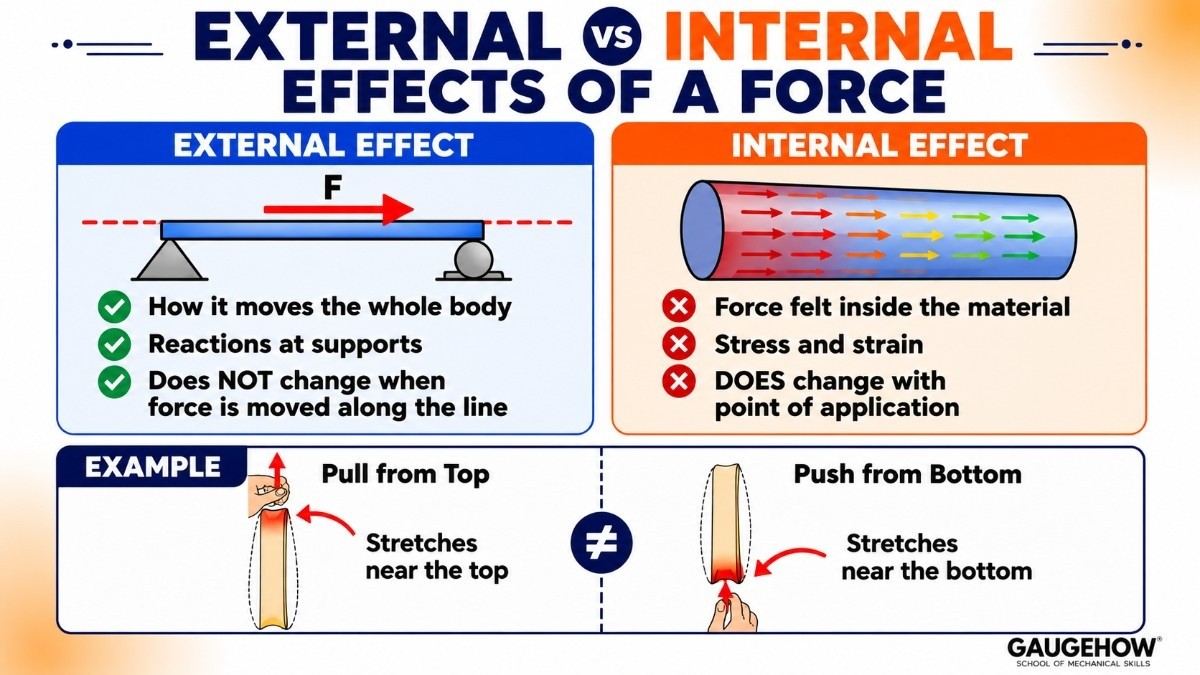
This point causes the most confusion, so let us make it clear.
The external effect of a force is how it moves the whole body and what reactions appear at the supports. The principle of transmissibility keeps this unchanged when you slide the force.
The internal effect is the force felt inside the material, part by part. This does change when you move the load, even along the same line.
Example. Pull a rubber band from the top and it stretches near the top first. Push it from the bottom along the same line and the stretch pattern is different, even though the overall motion could match. So for deformation, where you apply the force truly matters.
Where Do Engineers Use the Principle of Transmissibility?
This principle quietly powers a lot of everyday analysis.
Structural engineers slide forces along their lines of action to simplify beam and truss problems before solving them. Mechanical engineers use it to shift loads to convenient points when checking whether a machine part is balanced. It is one of the first tools used to turn a messy force diagram into a clean, solvable one.
When deformation and internal stress do matter, engineers switch to detailed methods like finite element analysis, which tracks internal forces point by point. That skill is covered in the FEA with ANSYS course.
Frequently Asked Questions
Q: What is the principle of transmissibility? A: It states that the effect of a force on a rigid body does not change if the force is moved to another point along its line of action, keeping the same magnitude and direction.
Q: Does the principle of transmissibility work for all bodies? A: No. It works only for rigid bodies. For bodies that bend or stretch, it does not hold true.
Q: What stays the same when a force is moved along its line of action? A: The external effects stay the same, meaning the overall motion of the body and the reactions at its supports.
Q: What changes when a force is moved along its line of action? A: The internal effects change. The forces inside the material differ depending on where the load is applied.
Q: Why is the principle of transmissibility useful? A: It lets engineers slide a force to a convenient point, or swap a push for a pull, to make force problems simpler to solve.
Key Takeaways
A force can be moved along its line of action without changing its effect on a rigid body.
The magnitude, direction, and line of action must stay the same.
The principle works only for rigid bodies, not for bodies that deform.
It keeps external effects the same but changes internal effects.
It is a handy shortcut to simplify force diagrams before solving.
Quick Revision Box
Statement: A force acting on a rigid body can be moved along its line of action without changing its external effect.
Conditions: same magnitude, same direction, same line of action, rigid body
Preserved: external effect (motion and support reactions)
Not preserved: internal effect (forces and stress inside the material)
Fails for: deformable bodies and stress or strain analysis
Practice Corner
State the principle of transmissibility in your own words.
Why does the principle work only for rigid bodies?
What is the difference between the external and internal effect of a force?
A crate can be pushed from behind or pulled from the front along the same line. Will the motion differ? Explain.
Give one situation where the principle of transmissibility cannot be used.
Answers
A force on a rigid body can be slid along its line of action without changing its overall effect, as long as magnitude and direction stay the same.
Because a rigid body does not deform, so moving the force along its line does not change the way the whole body responds.
External effect is the motion of the whole body and the support reactions. Internal effect is the force inside the material, which does change.
No, the motion will be the same because both forces share the same line of action, magnitude, and direction.
When studying stress, strain, or deformation inside a part, since the internal effect depends on where the force is applied.
What's Next
Next we look at Force Representation, how to draw and write forces correctly, followed by the different Types of Forces you will meet throughout the course.
Conclusion
The principle of transmissibility is a small idea with big value. On a rigid body, a force can slide freely along its line of action without changing the outcome. Remember the two limits, rigid bodies only and external effects only, and you will use this shortcut correctly every time. It is one of the cleanest tools in mechanics for simplifying tough problems.
Want to strengthen these fundamentals? Explore the free tools on the GaugeHow Learn Hub and test yourself with the Practice and MCQ tests.
Internal links:
FEA with ANSYS (internal force and stress analysis) → https://gaugehow.com/course/fea-finite-element-analysis-with-ansys
Mechanical Engineer Hub → https://gaugehow.com/mech
Learn Hub → https://gaugehow.com/learn
Practice and MCQ Tests → https://gaugehow.com/practice
Interview Q&A Hub → https://gaugehow.com/interview