Engineering Mechanics
Static Friction Explained Simply: Formula, Examples and Uses
A parked car on a slope does not roll away. A book on a tilted desk stays put. A ladder against a wall holds your weight.
In every one of these cases nothing is moving, yet a force is clearly doing the holding. That force is static friction.
Static friction is the most misunderstood force in engineering mechanics, because it is the only common force that changes its own value to suit the situation. Most students memorise F = μN and apply it everywhere, which is exactly where marks are lost.
By the end of this guide you will know what static friction is, how to calculate it correctly, why it is not a fixed number, how it behaves on an inclined plane, and where engineers deliberately design for it.
What Is Static Friction
Static friction is the friction force that acts between two surfaces in contact when there is no relative sliding between them, but a force is trying to cause sliding.
In simple words, it is the force that stops something from starting to move.
It acts along the surface of contact, parallel to it, and always in the direction opposite to the way the body is being pushed or pulled.
The important word is tendency. Static friction appears the moment there is a tendency of motion, even if nothing actually moves.
Static friction is a self-adjusting force
This is the idea that separates a good answer from a wrong one.
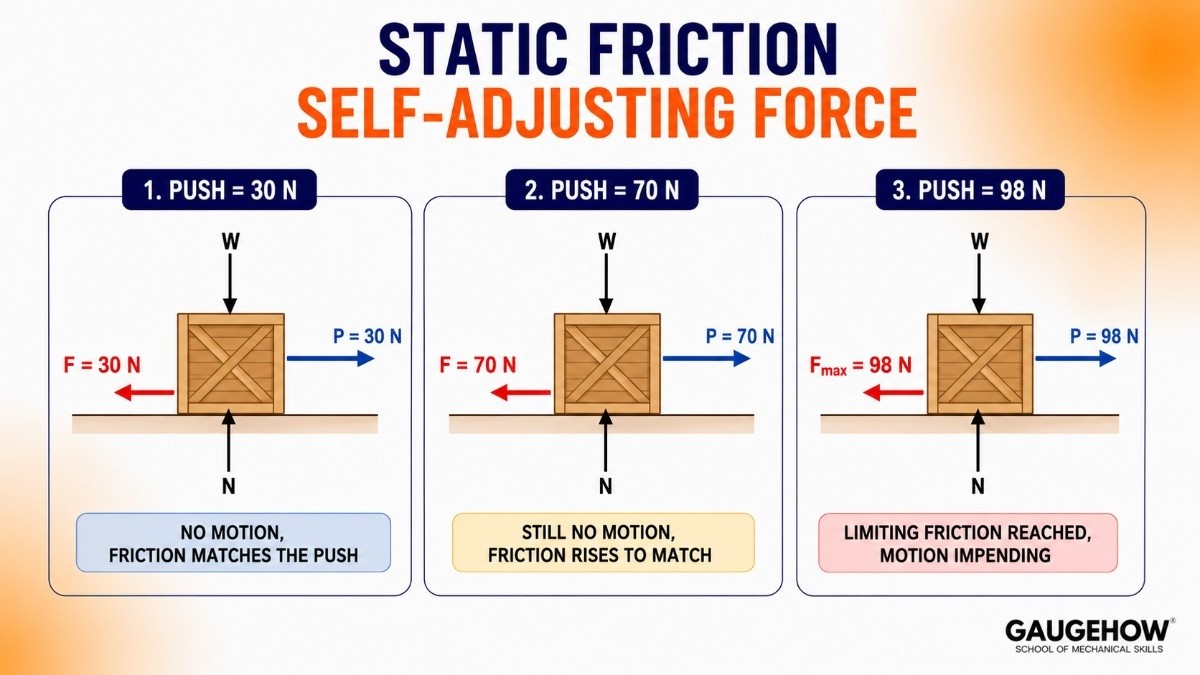
Push a crate with 30 N and it does not move. Static friction is exactly 30 N. Push with 70 N and it still does not move. Static friction is now exactly 70 N.
Friction is not sitting at some fixed maximum waiting for you. It supplies only as much force as is needed to keep the body in equilibrium, and no more.
It behaves like a rope that only pulls as hard as you pull on it. That is why static friction is called a self-adjusting or passive force.
It has an upper limit
This adjustment cannot go on forever. Every surface pair has a ceiling.
The largest value static friction can reach is called limiting friction. At that point the body is on the verge of moving, and engineers say motion is impending.
Push even slightly harder and the body breaks free, and kinetic friction takes over.
Why Static Friction Exists
No surface is truly flat. A machined steel plate that feels mirror smooth to your finger looks like a mountain range under a microscope.
These tiny peaks are called asperities. When two bodies rest against each other, only the peaks actually touch, so the real contact area is a small fraction of the visible area.
At those peaks the contact pressure is huge. The material deforms, the peaks interlock, and tiny cold welds form at the atomic level.
To start sliding, you must first break or shear these micro joints. The force needed to do that is static friction.
This also explains why static friction is larger than kinetic friction. When surfaces sit still, the junctions have time to settle and bond. Once sliding starts, the peaks skip across each other and never fully bond again.
Static Friction Formula and How to Calculate It
The correct formula is an inequality, not an equation. This single point is worth more marks than any other in the topic.
General static condition:
F ≤ μs × N
At impending motion only (limiting friction):
F_max = μs × N
Where:
F is the actual static friction force acting right now, in newtons (N)
F_max is limiting friction, the maximum possible static friction, in newtons (N)
N is the normal reaction perpendicular to the contact surface, in newtons (N)
μs is the coefficient of static friction, dimensionless with no unit
Mu has no unit because it is one force divided by another force. If a numerical answer for mu carries newtons, the working is wrong.
The correct three step method
Step 1. Find the normal reaction N from vertical equilibrium. Do not assume N = mg until you have checked for vertical components of applied force or an inclined surface.
Step 2. Calculate the ceiling, F_max = μs × N.
Step 3. Compare F_max with the force that is trying to cause motion. If the driving force is smaller, the body stays still and friction equals the driving force. If it is larger, the body moves and you switch to kinetic friction.
Solved example 1: does the crate move
A 25 kg crate sits on a horizontal floor with μs = 0.40. A worker pushes horizontally with 60 N.
Step 1. W = m × g = 25 × 9.81 = 245.3 N, and since the push is horizontal, N = W = 245.3 N
Step 2. F_max = 0.40 × 245.3 = 98.1 N
Step 3. The push of 60 N is less than 98.1 N, so the crate does not move.
Answer: The crate stays at rest, and the friction acting on it is 60 N, not 98.1 N. Friction only supplies what is needed.
Solved example 2: when the normal reaction is not the weight
A 40 kg crate is pulled by a rope at 25° above the horizontal. The coefficient of static friction is 0.35. Find the minimum pull needed to start it moving.
Step 1. W = 40 × 9.81 = 392.4 N. The rope has an upward component, so it lifts part of the load off the floor. Vertical equilibrium gives N = 392.4 − P sin 25°
Step 2. At impending motion the horizontal components balance, so P cos 25° = μs × N = 0.35 × (392.4 − P sin 25°)
Step 3. Expand. 0.9063 P = 137.34 − 0.1479 P
Step 4. Collect terms. 1.0542 P = 137.34
Answer: P = 130.3 N. If you had wrongly used N = 392.4 N, you would have got 151.5 N, an error of over 16 percent.
Coefficient of Static Friction Values
The coefficient of static friction depends on the pair of materials and their surface condition, not on the size or weight of the body.
Useful values to remember for exams and quick checks:
Rubber on dry concrete: 0.70 to 0.90
Rubber on wet concrete: 0.40 to 0.60
Steel on steel, dry: 0.60 to 0.80
Steel on steel, lubricated: 0.10 to 0.15
Wood on wood: 0.30 to 0.50
Aluminium on steel: around 0.60
PTFE on steel: 0.04 to 0.10
Ice on steel: around 0.03
Two things surprise people here. First, mu can be greater than 1, as it is for clean rubber on rough tarmac or for very clean metal pairs in vacuum. Second, mu does not depend on how large the contact patch looks.
A brick lying flat and the same brick standing on its narrow side need the same force to start sliding. The narrow face carries a higher contact pressure, so the number of real contact points stays about the same.
Static Friction vs Kinetic Friction
Both are dry friction, but they behave differently and mixing them up is a classic exam trap.
Static friction acts before motion begins. Its value is variable, ranging from zero up to μs N. It is calculated by equilibrium, not by the formula, unless motion is impending.
Kinetic friction acts while the body is sliding. Its value is essentially constant at μk N, and it is calculated directly from the formula every time.
For almost every material pair, μk is smaller than μs. Typically kinetic friction runs about 20 to 30 percent lower than limiting friction.
You feel this every time you shift furniture. The push builds and builds, the piece suddenly breaks free, and it then slides more easily than expected. That sudden drop from limiting friction to kinetic friction is the reason.
This same drop causes stick slip, the juddering and squealing you hear from a badly lubricated machine slide, a chalk on a board, or a door hinge. The surface repeatedly sticks, breaks free, then sticks again.
Static Friction on an Inclined Plane
Inclines are where static friction questions get interesting, because both the normal reaction and the driving force change with the angle.
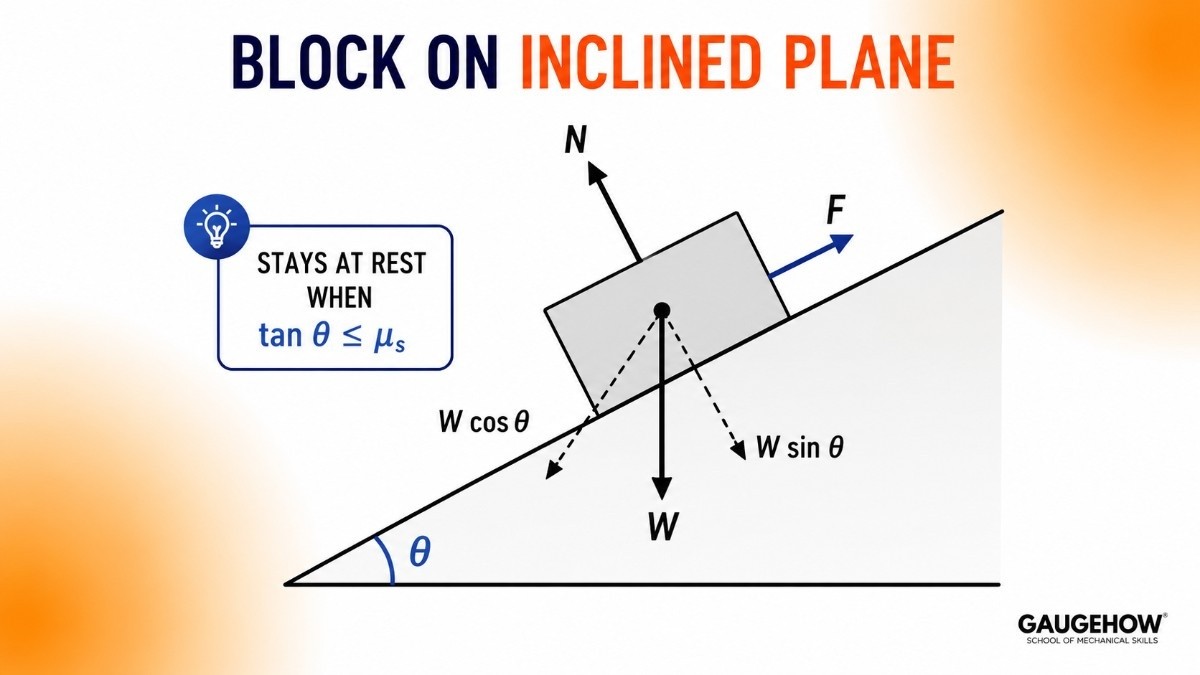
For a body of weight W resting on a plane inclined at angle θ:
Normal reaction N = W cos θ Driving force W sin θ Available friction F_max = μs W cos θ
The body stays at rest as long as the driving force stays below the ceiling.
Condition to stay at rest: W sin θ ≤ μs W cos θ Simplify: tan θ ≤ μs
Notice that the weight cancels out completely. Whether the block is 2 kg or 200 kg makes no difference to whether it slides. Only the angle and the material pair matter.
Angle of repose
The steepest angle at which a body just stays without sliding is called the angle of repose.
tan θ_repose = μs θ_repose = tan⁻¹(μs)
Where θ_repose is in degrees and μs is the coefficient of static friction.
This is a fast one line test. Compare the slope angle with the angle of repose and you have your answer without calculating a single force.
Dry sand shows this beautifully. Pour it into a heap and the sides always settle at the same slope, because that angle is exactly where gravity and static friction balance.
Solved example 3: incline check
A 15 kg block rests on a 22° slope with μs = 0.45. Does it slide down?
Step 1. Angle of repose = tan⁻¹(0.45) = 24.2°
Step 2. The slope is 22°, which is less than 24.2°
Answer: The block stays at rest. Checking with forces: W = 147.2 N, driving force = W sin 22° = 55.1 N, and available friction = 0.45 × W cos 22° = 61.4 N. Since 55.1 N is less than 61.4 N, it holds, and the friction actually acting is 55.1 N.
Static Friction Examples in Real Engineering
Walking and tyre traction. You walk forward because static friction between your shoe and the ground pushes you forward. The contact patch is not sliding, so it is static, not kinetic. The same is true of a rolling tyre under normal driving.
Braking distance. Maximum braking happens just before the wheels lock, while the tyre is still in the static regime. Once the wheels lock and skid, kinetic friction takes over and stopping distance increases. That is the entire principle behind ABS.
Bolted joints. Two plates in a friction grip joint do not slide across each other because bolt tension creates a large normal reaction. The joint is designed so that the working shear load stays below limiting friction.
Clamping and workholding. A part held in a vice or on a magnetic chuck resists cutting forces purely through static friction. Under sizing the clamping force is a common cause of scrap parts.
Belt drives and conveyors. Power transmits from pulley to belt through static friction at the contact arc. When the load exceeds the limit, the belt slips and drive efficiency collapses.
Structures on slopes. Retaining walls, soil embankments and stacked material all depend on the angle of repose staying above the natural slope angle.
If you want to see how contact and friction coefficients are actually entered into a solver and how they change stress results, the FEA with ANSYS course covers contact definition step by step.
Common Mistakes to Avoid
Using F = μs N in every problem. That equation only holds at impending motion. In a general static problem, friction comes from equilibrium.
Assuming N = mg automatically. If the applied force has a vertical component, or the surface is inclined, the normal reaction is different.
Believing a wider contact area gives more friction. It does not, as long as the normal reaction is unchanged.
Using μk when the body has not started moving yet.
Forgetting that friction direction opposes the tendency of motion. On an incline, if the body tends to slide down, friction acts up the slope.
Mixing units. Convert mass in kilograms to weight in newtons before touching the friction formula.
Key Takeaways
Static friction acts between surfaces that are not sliding but have a tendency to slide.
It is self-adjusting, supplying only the force needed for equilibrium.
The correct general relation is F ≤ μs N, and F = μs N applies only at impending motion.
Limiting friction is the maximum value static friction can reach.
The coefficient of static friction is dimensionless and can exceed 1.
Friction does not depend on the apparent area of contact.
On an incline, a body stays at rest as long as tan θ is less than or equal to μs.
The angle of repose equals tan⁻¹(μs) and gives a one line stability check.
Static friction is always slightly larger than kinetic friction for the same pair.
Practice Corner
A 12 kg block on a level floor just begins to move when the horizontal push reaches 47 N. Find the coefficient of static friction.
A 20 kg block rests on a floor with μs = 0.50. It is pushed horizontally with 30 N. What is the friction force acting on it?
A block rests on a plane inclined at 18° with μs = 0.30. Will it slide down? Answer using the angle of repose.
Why is static friction usually greater than kinetic friction? Answer in two lines.
A crate is dragged by a rope at 20° above the horizontal. Does the required pull increase or decrease compared with a purely horizontal pull, and why?
<details> <summary><strong>Answers</strong></summary>
N = 12 × 9.81 = 117.7 N. μs = 47 / 117.7 = 0.40
F_max = 0.50 × (20 × 9.81) = 0.50 × 196.2 = 98.1 N. The push of 30 N is well below this, so the block stays still and friction is exactly 30 N.
Angle of repose = tan⁻¹(0.30) = 16.7°. The slope of 18° is steeper than 16.7°, so the block slides down.
When surfaces are at rest, the microscopic contact points have time to settle and form small cold welds. Once sliding starts, the peaks skip across each other and cannot bond fully, so less force is needed to keep it moving.
It decreases. The upward component of the pull reduces the normal reaction, which reduces limiting friction, so a smaller total force is needed to start motion.
</details>
Frequently Asked Questions
What is static friction in simple words?
Static friction is the force that stops two touching surfaces from starting to slide over each other. It acts along the contact surface and opposes the direction in which the body is being pushed. It exists only while the body is still at rest.
What is the formula for static friction?
The correct relation is F ≤ μs N, where F is the friction force, μs is the coefficient of static friction and N is the normal reaction in newtons. The equality F = μs N holds only at the instant motion is impending, which gives the limiting friction value.
Is static friction constant?
No. Static friction is a self-adjusting force. It equals whatever force is trying to cause motion, growing from zero up to a maximum of μs N. Once that maximum is passed, the body slides and kinetic friction takes over.
Why is static friction greater than kinetic friction?
At rest, the microscopic peaks on both surfaces settle into each other and form tiny bonds. Breaking these bonds requires extra force. During sliding, the peaks move too quickly to bond fully, so the resistance is lower.
Can static friction cause motion?
Yes. Walking, driving and cycling all depend on it. The tyre contact patch or shoe sole does not slide against the ground, so the friction acting is static, and it is this force that pushes the body forward.
Does static friction depend on contact area?
No. It depends only on the normal reaction and the coefficient of static friction for that material pair. A larger apparent area spreads the same load over more surface, so the contact pressure falls in proportion and the total friction stays the same.
What is the difference between limiting friction and static friction?
Static friction is the general force acting at any moment before sliding begins, and it varies. Limiting friction is one specific value, the maximum that static friction can reach, at the instant motion is about to start.
Conclusion
Static friction is simple once you stop treating F = μs N as a universal equation. It is a ceiling, not a value.
Find the normal reaction first, calculate the ceiling, then compare it with whatever is trying to cause motion. That order solves almost every static friction problem you will meet in exams, interviews or design work.
Ready to apply this to real components and simulations? Start with the FEA with ANSYS course, or test yourself on the practice tests before your next exam.
Internal links:
Mechanical Engineer Hub: anchor in the introduction, topic hub for the target reader
FEA with ANSYS: anchor in the real engineering applications section, contact and friction inputs
Fusion 360: anchor near the applications section, motion study with friction
Interview Q&A Hub: anchor near the FAQ section, friction is a standard interview question
Practice / MCQ Tests: anchor in the Practice Corner and closing CTA
Free Course: anchor in the closing CTA for beginners