Engineering Mechanics
Subtraction Explained Simply for Engineering Mechanics
You are on a train moving at 60 km/h. A car outside is also going 60 km/h in the same direction. To you, that car looks like it is barely moving. But to a person standing on the road, the car is racing past.
Same car, two different "speeds seen." The difference comes from vector subtraction, which finds how one vector looks compared to another.
In our last lesson we added vectors to find a resultant. Now we subtract them. Subtraction answers a different question: not "what is the total effect," but "what is the difference between these two?" That question shows up everywhere, from relative velocity to comparing two forces.
By the end of this lesson you will be able to subtract vectors using the negative-vector idea, the head-to-head drawing rule, and the component method, and you will understand where each one is used.
What Is Vector Subtraction?
Vector subtraction is the process of finding the difference between two vectors. Writing A minus B means "how do you get from B to A."
The clever trick is that we never really invent a new operation. Subtracting a vector is just adding its opposite:
A − B = A + (−B)
So once you know vector addition from the last lesson, you already know most of subtraction. You just need to understand what the "minus" does to a vector. That is our next step.
Keep this in mind: subtraction is not about smaller numbers, it is about difference and direction. The result still has a size and a direction, like any vector.
Why Subtraction Matters in Engineering Mechanics
Here is a real-life picture. You are standing at your front door (point B) and your friend is at the shop (point A). The straight arrow pointing from you to your friend is the difference of your two positions. That arrow is vector subtraction in action, and engineers call it a displacement vector.
The same idea shows up everywhere in mechanics. It tells you how far apart two points are and in which direction. It tells you how fast one car moves compared to another. It tells you the leftover force on a machine part after two pushes fight each other.
If you cannot subtract vectors cleanly, later topics like relative velocity, resultant force, and equilibrium become much harder. So this small skill pays off through the whole course.
The Simple Rule: Add the Negative
Here is the one rule that makes everything easy.
To subtract a vector, flip its direction and then add it.
In plain symbols:
A - B = A + (-B)
Where:
A is the first vector
B is the second vector
(-B) is vector B with the same length but pointing the opposite way
So the minus sign is really an instruction: turn B around by 180 degrees, then use normal vector addition. Nothing new to memorise. You already know addition, and now you just reverse one arrow first.
Vector Subtraction Using the Triangle Method
You can do subtraction with a drawing, no formula needed. This helps you see what is going on.
Follow these steps:
Draw vector A as an arrow.
Draw vector B, then reverse it to get -B (same length, opposite direction).
Place -B head to tail after A.
Draw a new arrow from the start of A to the tip of -B. That arrow is A - B.
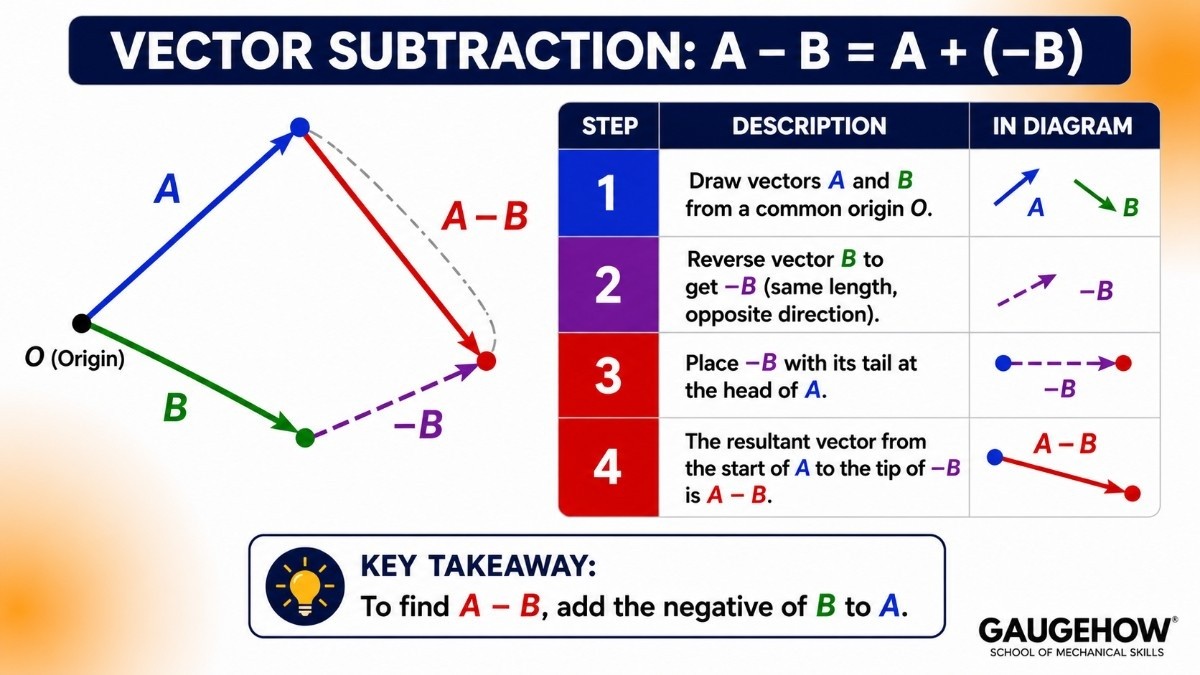
A quick shortcut worth remembering: if A and B both start from the same point, then A - B is simply the arrow drawn from the tip of B to the tip of A. This is the fastest way to sketch a difference vector.
Vector Subtraction Using Components
Drawing is great for understanding, but for real problems engineers use components. Components are just the parts of a vector along the x, y, and z axes.
If:
A = (Ax, Ay, Az)
B = (Bx, By, Bz)
Then:
A - B = (Ax - Bx, Ay - By, Az - Bz)
In words: subtract each part on its own. Subtract the x parts, then the y parts, then the z parts. That is the whole method.
To find the length (magnitude) of the result, use:
|A - B| = square root of [(Ax - Bx)² + (Ay - By)² + (Az - Bz)²]
Every value here is in SI units. Positions are in metres (m), velocities in metres per second (m/s), and forces in newtons (N). The unit of the answer is always the same as the vectors you started with.
Vector Subtraction Example (Step by Step)
Let us subtract two position vectors and find the distance between two points.
Given:
A = (5, 2) metres
B = (2, 6) metres
Find A - B and its magnitude.
Step 1. Subtract the x parts: 5 - 2 = 3 Step 2. Subtract the y parts: 2 - 6 = -4 Step 3. So A - B = (3, -4) metres Step 4. Magnitude: |A - B| = square root of (3² + (-4)²) = square root of (9 + 16) Step 5. = square root of 25 = 5 metres
So the two points are 5 metres apart, and the difference vector points 3 m along x and 4 m in the negative y direction. Clean and done.
A Real Engineering Use: Relative Velocity
Vector subtraction shines in relative velocity problems. Relative velocity answers the question: how fast does object A move as seen by someone riding on object B?
The formula is a subtraction:
Velocity of A relative to B = Velocity of A - Velocity of B
Example. Car A moves east at 60 km/h, so its velocity is (60, 0). Car B moves north at 40 km/h, so its velocity is (0, 40).
Velocity of A relative to B = (60 - 0, 0 - 40) = (60, -40)
Magnitude = square root of (60² + 40²) = square root of (3600 + 1600) = square root of 5200, which is about 72.1 km/h.
So to the driver of car B, car A appears to move at roughly 72 km/h. Same subtraction rule, new use.
Vector Subtraction vs Vector Addition
Students often mix these up, so here is a side-by-side view.
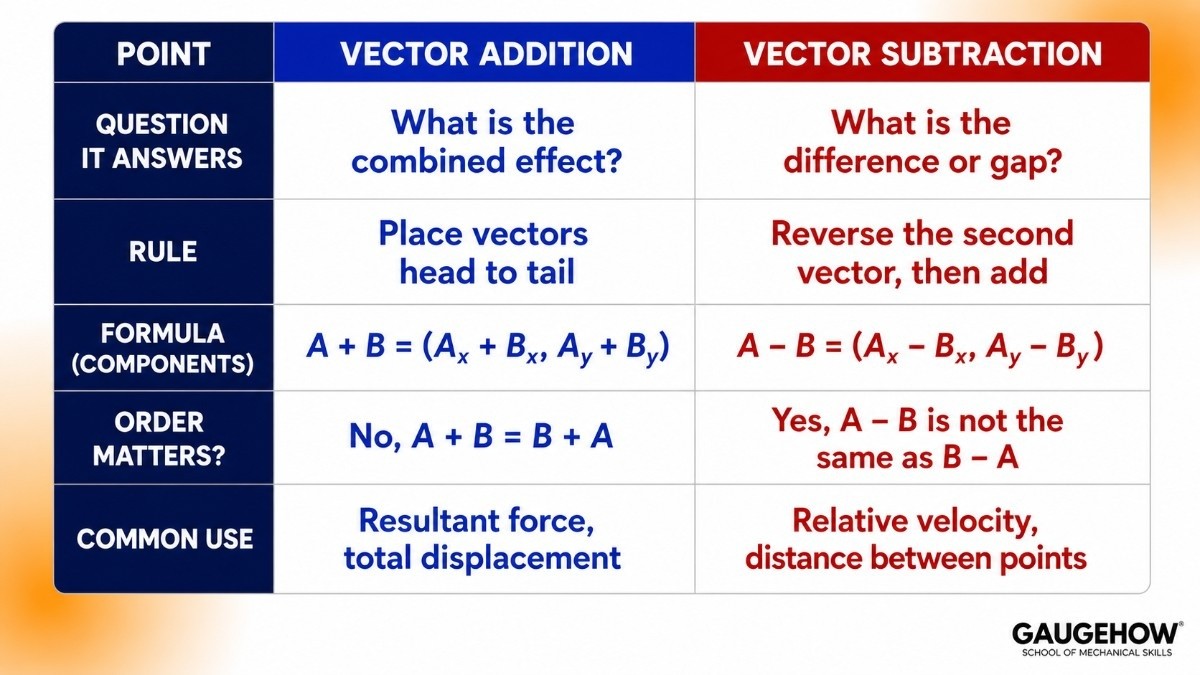
The most important row is the fourth one. Order matters in subtraction. A - B and B - A have the same length but point in opposite directions. Always subtract in the order the question asks.
Common Mistakes Students Make
A few small slips cause most wrong answers. Watch out for these:
Forgetting to reverse the second vector before adding. The minus sign is not optional.
Swapping the order and computing B - A when the question wants A - B.
Subtracting magnitudes instead of components. You cannot just do 5 minus 3 unless both vectors point the same way.
Dropping the negative sign in a component, which flips the direction of the answer.
Mixing units, such as one vector in metres and another in centimetres. Convert first, then subtract.
Where Engineers Use Vector Subtraction
This is not just exam maths. Real work depends on it.
Design and robotics engineers subtract position vectors to find how far a robot arm must travel from one point to the next. Automotive and aerospace engineers use velocity subtraction to study how vehicles move relative to each other, which matters for safety and control. Structural engineers subtract force vectors to find the net force left on a joint, which decides whether a part is safe.
If you plan to write these calculations in code later, tools like Python and MATLAB handle vector subtraction in a single line, which is why so many mechanical engineers learn a little programming.
Frequently Asked Questions
Q: What does vector subtraction actually mean?
A: It means finding the difference between two vectors. A - B is the vector you would add to B to reach A. It has both a size and a direction.
Q: What is the formula for vector subtraction?
A: Subtract the components one by one. If A = (Ax, Ay) and B = (Bx, By), then A - B = (Ax - Bx, Ay - By). The same pattern works in three dimensions.
Q: Is A - B the same as B - A?
A: No. They have the same length but point in opposite directions. Subtraction depends on order, so always follow the order given in the problem.
Q: How do you subtract vectors graphically?
A: Reverse the second vector to get its negative, place it head to tail after the first vector, and draw the resultant from the start of the first to the tip of the reversed one.
Q: Where is vector subtraction used in real engineering?
A: It is used for relative velocity between moving objects, finding the distance and direction between two points, and calculating net force on a structural joint.
Key Takeaways
A vector has size and direction; subtraction finds the difference between two of them.
The core rule: A - B = A + (-B). Reverse the second vector, then add.
With components, subtract x from x, y from y, and z from z.
Magnitude of the result comes from the square root of the sum of squared differences.
Order matters. A - B and B - A point opposite ways.
Relative velocity and displacement are the two most common uses in mechanics.
Keep units consistent and never subtract magnitudes directly.
Quick Revision Box
Rule: A - B = A + (-B)
Components (2D): A - B = (Ax - Bx, Ay - By)
Components (3D): A - B = (Ax - Bx, Ay - By, Az - Bz)
Magnitude: |A - B| = square root of [(Ax - Bx)² + (Ay - By)² + (Az - Bz)²]
Relative velocity: V(A relative to B) = V(A) - V(B)
Practice Corner
In your own words, why does subtracting a vector mean reversing its direction?
True or false: A - B always has the same direction as B - A.
Given P = (7, 3) and Q = (2, 3), find P - Q and its magnitude.
A boat moves at (5, 0) m/s and the river current is (0, 3) m/s. Find the boat velocity relative to the water.
Explain one real situation where an engineer would subtract two force vectors.
Answers
Because A - B means adding the opposite of B. Reversing B turns subtraction into ordinary addition.
False. They have equal length but opposite direction.
P - Q = (5, 0); magnitude = 5.
(5, -3) m/s; magnitude = square root of 34, about 5.83 m/s.
Any sensible case, such as finding the net force on a bracket when two forces push in different directions.
What's Next
Next up is the Dot Product, where two vectors give you a single number that tells you how much they point the same way. It is the key to work, projections, and angles.
Conclusion
Vector subtraction comes down to one habit: reverse the second vector, then add. Do it with a drawing to understand it, and with components to solve it fast. Master this small step now and relative velocity, displacement, and force balance will feel natural later.
Want to sharpen these fundamentals with more lessons and practice? Explore the resources on the GaugeHow Learn Hub and test yourself with the Practice and MCQ tests.
Internal links:
Mechanical Engineer Hub (career and study hub) → https://gaugehow.com/mech
Python for Mechanical Engineers and Robotics (vectors in code) → https://gaugehow.com/course/python-for-mechanical-engineers-robotics
MATLAB Programming (vector math in software) → https://gaugehow.com/course/matlab
Learn Hub → https://gaugehow.com/learn
Practice and MCQ Tests → https://gaugehow.com/practice