Engineering Mechanics
Triangle Law of Forces Explained with Examples
Two ropes pull a boat at different angles. The boat moves in one direction only. Finding that direction is one of the oldest problems in mechanics, and it has one of the neatest answers.
The triangle law of forces says that two forces joined head to tail form two sides of a triangle, and the third side is their combined effect. Three lines on paper, and the problem is solved.
This guide covers the statement of the law, how to draw it, how the standard resultant formula is derived from it using the cosine rule, what happens when three forces form a closed triangle, how it connects to Lami's Theorem, and where it stops being valid. Plain language and worked numbers throughout.
What Is the Triangle Law of Forces?
The triangle law of forces states that if two forces acting at a point are represented in magnitude and direction by two sides of a triangle taken in order, then the third side taken in the opposite order represents their resultant in magnitude and direction.
Break that sentence into its parts.
Represented in magnitude and direction means each force becomes a line whose length matches its size at a chosen scale, and whose angle matches its direction.
Taken in order means head to tail. The second force starts exactly where the first one ends.
The third side in the opposite order is the line joining the tail of the first force to the head of the second, and it points from start to finish, which is the opposite sense to the way you travelled.
Here is the everyday version. Walk 40 paces east, then 30 paces north. You walked 70 paces in total, but you are only 50 paces from where you started, in a north-easterly direction. That straight line from start to finish is the resultant, and the two legs plus that line make a triangle.
Statement in Simple Words
If you keep only one version in your head, keep this one.
Draw the two forces head to tail. The line that closes the triangle is their resultant.
Its length gives the magnitude, its angle gives the direction, and it points from where you started to where you ended up.
How to Construct the Triangle of Forces
Five steps with a ruler, a protractor and a sharp pencil.
Choose a scale and write it on the drawing, for example 1 cm = 20 N. Pick it so the larger force is somewhere between 6 cm and 12 cm.
Draw the first force to scale at its correct angle, with an arrowhead showing direction.
Start the second force at the head of the first, keeping its own true length and angle. Slide the arrow across, but never rotate it.
Draw the closing line from the tail of the first force to the head of the second, with the arrowhead at the second force's head.
Measure and convert. Multiply the closing length by the scale for the magnitude, and read the angle with a protractor.
Worked construction
Two forces act at a point: 80 N horizontally and 60 N at 70 degrees to the horizontal.
Scale: 1 cm = 10 N.
Draw 8.0 cm horizontally to the right.
From its head, draw 6.0 cm at 70 degrees.
Join the original start to the final head. Measure about 11.7 cm at roughly 28.7 degrees.
Convert: 11.7 × 10 = 117 N at about 29 degrees above the horizontal.
The calculated answer is 116.9 N at 28.8 degrees, so a careful drawing gets you within a fraction of a percent. That is what good graphical technique looks like.

Triangle Law of Vector Addition
The triangle law is not really a rule about forces. It is a rule about vectors, and forces just happen to be vectors.
A vector is any quantity that has both size and direction. Force, velocity, displacement and acceleration all qualify. Every one of them adds by the same head to tail construction.
That is why the walking example earlier works so cleanly. Displacement is a vector, so two walks add exactly the way two forces do. If you have already met vector addition in maths, you have already met the triangle law under a different name.
One consequence is worth noting. The order does not matter. Draw the 60 N force first and the 80 N force second, and you get a different looking triangle with an identical closing side. Vector addition is commutative, and swapping the order is a quick way to check a drawing.
Deriving the Resultant Formula from the Triangle
The drawing is useful, but the formula behind it is what you will use in exams. It comes straight out of the triangle using the cosine rule.
Suppose two forces P and Q act at a point with an angle θ between them. When you draw them head to tail, the internal angle of the triangle is not θ but 180 − θ, because the second force has been swung round to start at the first one's head.
Apply the cosine rule to that triangle:
R² = P² + Q² − 2PQ cos(180 − θ)
And since cos(180 − θ) = −cos θ, the minus signs cancel:
R = √(P² + Q² + 2PQ cos θ)
For the direction, use the sine rule on the same triangle to get the angle β between the resultant and force P:
tan β = (Q sin θ) / (P + Q cos θ)
Where:
P and Q are the two force magnitudes, in newtons (N)
θ (theta) is the angle between the two forces, in degrees
R is the resultant force, in newtons (N)
β (beta) is the angle between the resultant and force P, in degrees
This is the same formula usually quoted under the parallelogram law, which is no accident. Both laws describe the same vector addition, so they must produce the same equation.
Solved example
Two forces of 120 N and 90 N act at a point with 55 degrees between them.
R = √(120² + 90² + 2 × 120 × 90 × cos 55°)
R = √(14400 + 8100 + 21600 × 0.574)
R = √(14400 + 8100 + 12398) = √34898 = 186.8 N
tan β = (90 × sin 55°) / (120 + 90 × cos 55°) = 73.7 / 171.6 = 0.430
β = 23.3 degrees from the 120 N force
Always sanity check the magnitude. The two forces sum to 210 N and differ by 30 N, so any correct resultant must lie between those values. 186.8 N does.
Two special cases fall out of the same formula. If θ = 0 the forces point the same way and R = P + Q. If θ = 180 they oppose and R = P − Q. Those two limits bracket every possible answer.
Triangle Law of Equilibrium
Now the version engineers actually use day to day.
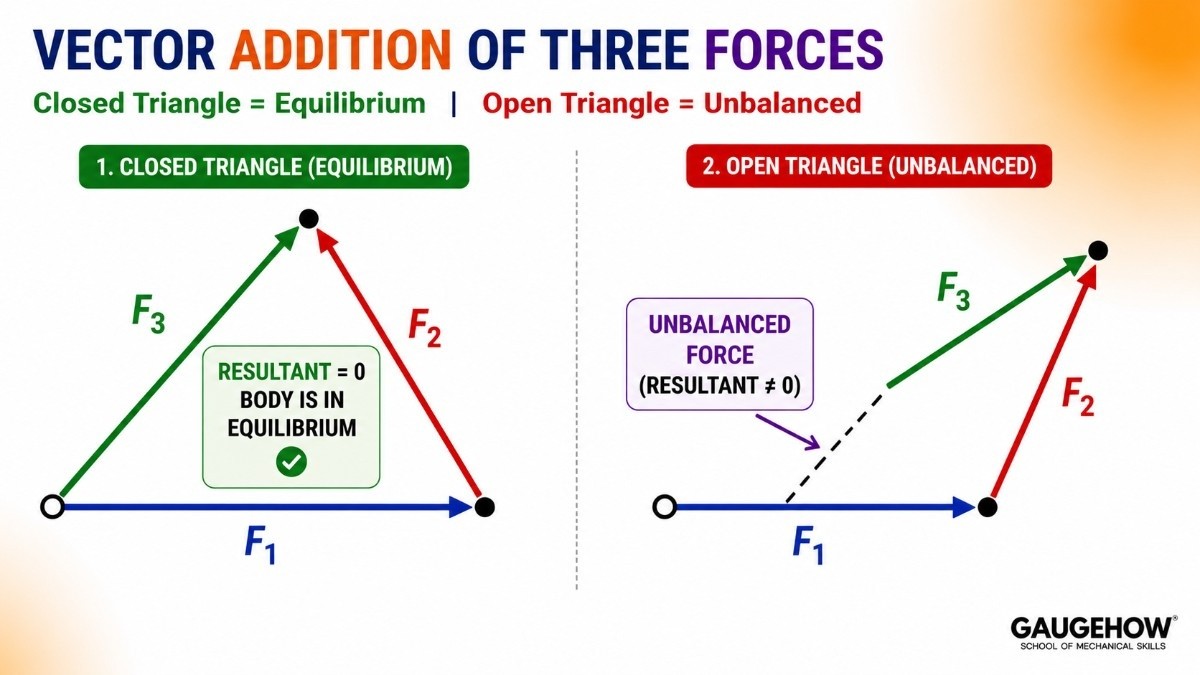
If three forces acting at a point can be represented in magnitude and direction by the three sides of a triangle taken in order, then those three forces are in equilibrium.
This is the converse of the triangle law, and it says something powerful. When the triangle closes completely, with the third arrow landing exactly on the first tail, the resultant is zero and the body will not accelerate.
Think about why. Two of the forces combine into a resultant equal to the closing side. If the third force happens to be exactly that closing side reversed, it cancels the other two perfectly. That reversed force has a name: the equilibrant.
The resultant and the equilibrant have the same magnitude and the same line of action, but they point in opposite directions. One replaces the force system, the other cancels it.
In practice this gives a one-glance balance test. Draw the three forces at a joint head to tail. Closed triangle means balanced. A visible gap means unbalanced, and the gap itself gives both the size and the direction of the problem.
Triangle Law and Lami's Theorem
These two are close cousins, and understanding the link saves memorising them separately.
Lami's Theorem states that if three forces acting at a point are in equilibrium, each force is proportional to the sine of the angle between the other two:
P / sin α = Q / sin β = R / sin γ
Where P, Q and R are the three forces in newtons, and α, β and γ are the angles opposite each of them, in degrees.
Where does that come from? Directly from the triangle law. If the three forces are in equilibrium, they form a closed triangle. Apply the ordinary sine rule to that triangle and Lami's Theorem drops out.
So the triangle law is the picture and Lami's Theorem is the equation. The triangle law lets you see whether three forces balance. Lami's Theorem lets you calculate an unknown force when you know they do.
Use Lami's when you have three concurrent forces in equilibrium and two known quantities. It is usually faster than resolving into components for that specific case, which is exactly why it stays in the syllabus.
Difference Between Triangle Law and Parallelogram Law
They give identical answers, so this is a question about drawing rather than physics.
Triangle law: the two forces are drawn head to tail, one after the other. The resultant is the closing third side. It uses three lines in total.
Parallelogram law: both forces are drawn from the same starting point. You then complete the parallelogram with two construction lines, and the diagonal from that point is the resultant. It uses five lines in total.
The parallelogram construction feels more natural when the two forces genuinely act from one physical point, such as a bolt or a hook, because that is how they actually exist in the structure. The triangle construction is quicker and uses less paper, and it extends directly to three or more forces, where it becomes the polygon law.
Both produce R = √(P² + Q² + 2PQ cos θ), which is the clearest proof that they are the same result wearing different clothes.
Where Engineers Use the Triangle Law
It survives because three-force problems are everywhere.
Roof truss joints. Many nodes carry exactly three member forces, and a closed triangle confirms the joint balances.
Two-rope lifting. A load hanging from two slings involves three forces: the weight and the two tensions. Textbook triangle law.
Tent and mast guy wires. A pole held by two cables against wind load is the same three-force problem.
Wall brackets and jib arms. A tie, a strut and a load form a triangle, which is why the sign convention for tension and compression falls out so naturally.
Checking simulation output. A quick sketch tells you whether a computed reaction points in a sensible direction.
The pattern is consistent. Draw to see and to verify. Calculate to produce the number you would put your name to.
Limitations of the Triangle Law
It is a clean tool, but it has boundaries.
Two forces only for finding a resultant, or three forces for the equilibrium version. Beyond that you need the polygon law.
Concurrent forces only. All forces must pass through one point. Forces at different points create turning effects the triangle cannot show.
Coplanar forces only. The construction is flat, so it cannot handle three-dimensional force systems on paper.
No moment information. A closed triangle proves the forces balance in translation. It does not prove the body will not rotate, which needs ΣM = 0 as well.
Drawing accuracy. Expect one to three percent error from ruler, protractor and pencil width combined.
Common Mistakes to Avoid
Using θ instead of 180 − θ in the cosine rule. The angle inside the triangle is not the angle between the forces as they physically act. Getting this wrong flips the sign of the middle term.
Rotating a force while moving it. Sliding an arrow to a new starting point is fine. Changing its angle is not.
Drawing the resultant the wrong way round. It runs from the first tail to the last head, against the direction you travelled.
Forgetting to write the scale. Without it, your measurement cannot be converted back into newtons.
Assuming a nearly closed triangle means equilibrium. A small gap is still a real unbalanced force.
Quoting a magnitude with no direction. The resultant is a vector, so both halves are required.
Applying it to non-concurrent forces. If the lines of action do not meet at a point, the triangle alone cannot settle the question.
Key Takeaways
The triangle law says two forces drawn head to tail have a resultant equal to the closing third side.
It is really the triangle law of vector addition, so it works for any vector quantity.
The cosine rule applied to that triangle gives R = √(P² + Q² + 2PQ cos θ).
The internal triangle angle is 180 − θ, which is why the formula has a plus sign.
If three forces form a closed triangle, they are in equilibrium and the resultant is zero.
The equilibrant is the resultant reversed, and it is what actually holds a joint still.
Lami's Theorem comes from applying the sine rule to that same closed triangle.
It applies only to coplanar concurrent forces and says nothing about moments.
Quick Revision Box
Statement: two forces as two sides in order, resultant as the third side in the opposite order
Resultant magnitude: R = √(P² + Q² + 2PQ cos θ)
Resultant direction: tan β = (Q sin θ) / (P + Q cos θ)
Internal triangle angle: 180 − θ
Same direction: R = P + Q, opposite directions: R = P − Q
Plausibility check: (P − Q) ≤ R ≤ (P + Q)
Triangle law of equilibrium: three forces forming a closed triangle are balanced
Equilibrant: same size as the resultant, opposite direction
Lami's Theorem: P / sin α = Q / sin β = R / sin γ
Valid for: coplanar concurrent forces only
Frequently Asked Questions
What is the triangle law of forces in simple words?
Draw two forces head to tail as arrows to scale. The line needed to get from the start of the first arrow to the end of the second is their resultant, in both size and direction.
What is the difference between the triangle law and the triangle law of equilibrium?
The first finds the resultant of two forces using the third side of a triangle. The second says that if three forces form a fully closed triangle, they cancel out and the body is in equilibrium.
Why does the resultant formula have a plus sign before 2PQ cos θ?
Because the angle inside the head to tail triangle is 180 − θ, not θ. The cosine rule normally carries a minus, and cos(180 − θ) equals −cos θ, so the two minus signs cancel into a plus.
Is the triangle law the same as the parallelogram law?
They give the same answer and the same formula. Only the construction differs, since the triangle law joins the forces head to tail while the parallelogram law draws both from a common point and uses the diagonal.
How is Lami's Theorem related to the triangle law?
Lami's Theorem is what you get when you apply the sine rule to the closed triangle formed by three forces in equilibrium. The triangle law gives the picture, Lami's gives the calculation.
Can the triangle law handle more than two forces?
Not directly. For three or more forces the same head to tail idea is extended into the polygon law, which works with any number of sides.
Practice Corner
State the triangle law of forces in your own words.
Two forces of 50 N and 70 N act at a point with 90 degrees between them. Find the resultant.
Why is the angle used inside the triangle equal to 180 minus the angle between the forces?
Three forces drawn head to tail form a perfectly closed triangle. What can you conclude?
Two forces of 40 N and 40 N act with 120 degrees between them. Find the magnitude of the resultant.
Answers
If two forces at a point are drawn as two sides of a triangle taken head to tail, then the third side, drawn in the opposite sense, represents their resultant in both magnitude and direction.
R = √(50² + 70² + 2 × 50 × 70 × cos 90°) = √(2500 + 4900 + 0) = √7400 = 86.0 N, at tan β = 70/50, giving 54.5 degrees from the 50 N force.
Because in the head to tail construction the second force is moved to start at the head of the first, which swings it round so that the angle enclosed inside the triangle becomes the supplement of the original angle.
The resultant is zero, so the three forces are in equilibrium and the body will not accelerate in a straight line.
R = √(1600 + 1600 + 2 × 40 × 40 × cos 120°) = √(3200 − 1600) = √1600 = 40 N. Two equal forces at 120 degrees always give a resultant equal to either one of them.
Where to Practise This Further
Triangle law problems only become quick once the cosine rule setup is automatic, and that takes repetition. Drill resultant and equilibrium questions with the free MCQ practice tests, and see how they get asked in placement rounds in the engineering interview question bank.
The same vector addition sits inside every modern solver. The Fusion 360 course shows how load directions are applied to a model, and the FEA with ANSYS course carries this logic into full static structural analysis. If you would rather calculate and plot force triangles from code, Python for Mechanical Engineers covers both.
Students planning a design career can also browse the Mechanical Engineer hub and the Design Engineer track to see where statics fits into the wider skill set.
Internal links:
Polygon law of forces explained with examples
Graphical method of finding the resultant force
Resultant force formula and examples
Practice tests: https://gaugehow.com/practice
Interview Q&A hub: https://gaugehow.com/interview