Engineering Mechanics
Varignon's Theorem Explained Simply (Statement And Proof)
Some forces act at an angle, and finding their perpendicular distance from a point needs messy geometry. What if you could skip that geometry completely and still get the correct moment? That shortcut is Varignon's theorem, and it is one of the most useful tricks in engineering mechanics.
This lesson is part of the Moments and Couples module in the GaugeHow Engineering Mechanics series. In the last lesson we studied the principle of moments, which balances clockwise and anticlockwise turning effects. Varignon's theorem builds on the same moment idea but gives you a faster way to calculate.
By the end, you will know the statement, the formula, a simple proof, and how to solve a real problem with it. Let us keep it clear and practical.
What Is Varignon's Theorem?
Varignon's theorem says that the moment of a force about a point is equal to the sum of the moments of its parts about the same point.
In plain words, you can break one force into smaller pieces, find the easy moment of each piece, and add them up. The total will match the moment of the original force.
It was given by the French mathematician Pierre Varignon back in 1687. It works for concurrent forces, which simply means forces that meet or act at the same point.
The big reason we love it. Some forces are slanted, and their perpendicular distance is hard to measure. Varignon's theorem lets us avoid that distance and use easy horizontal and vertical parts instead.
[IMAGE: two concurrent forces P and Q meeting at point A, their resultant R drawn as a diagonal, and a separate point O marked below with dashed perpendicular distances from O to each force line]
Varignon's Theorem Statement
Here is the theorem stated in exam-ready words.
If several forces act together at a point, the algebraic sum of their moments about any point equals the moment of their resultant about that same point.
The word algebraic matters here. It means you add the moments with their signs. Anticlockwise moments are usually taken as positive and clockwise moments as negative. So you are adding and subtracting, not just adding blindly.
Read the statement in reverse too, because that is how engineers actually use it. The moment of a single force equals the sum of the moments of its components. This reverse reading is the real workhorse.
Varignon's Theorem Formula
The theorem is written as a short sum.
Moment of resultant = Sum of moments of components
For a force split into a horizontal part and a vertical part, the moment about point O becomes:
M = (x × Fy) - (y × Fx)
Here is what each symbol means:
M is the moment about point O, in newton metre (N·m).
Fx is the horizontal component of the force, in newtons (N).
Fy is the vertical component of the force, in newtons (N).
x is the horizontal distance of the force's point from O, in metres (m).
y is the vertical distance of the force's point from O, in metres (m).
Anticlockwise is taken as positive here. The vertical part times its horizontal distance gives one moment, and the horizontal part times its vertical distance gives the other. You combine them with the correct signs.
Varignon's Theorem Proof (Simple Version)
You do not need heavy maths to see why the theorem works. Here is the idea in plain steps.
Take a force R acting at a point. Split it into two parts, a horizontal part Fx and a vertical part Fy. Together these two parts are exactly the same as R.
Now pick any point O and find the moment of each part about O. The moment of Fx is Fx times its distance from O. The moment of Fy is Fy times its distance from O.
When you add these two moments, the result comes out exactly equal to the moment of the full force R about O. This is because the components and the resultant describe the same push, just written in two pieces. So their turning effects must also add up to the same total.
That is the whole logic. The parts and the whole always agree on the moment.
Varignon's Theorem Example
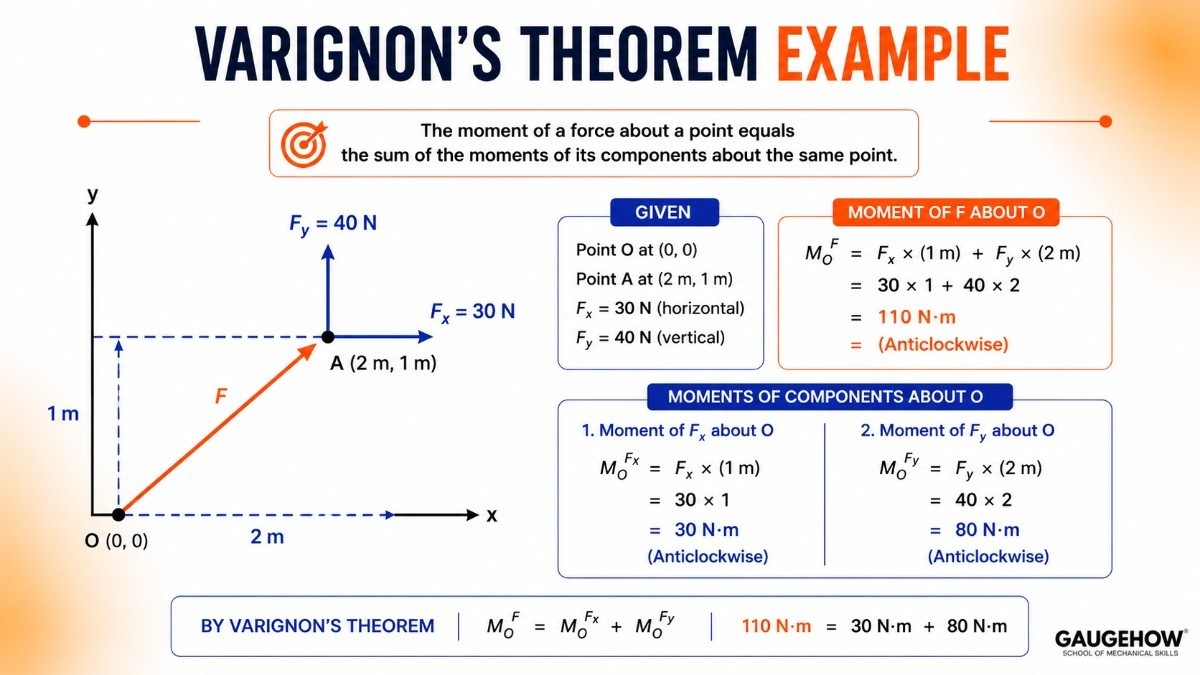
Let us solve a problem where finding the perpendicular distance directly would be annoying.
Problem: A force acts at point A. Point A is located 2 m to the right and 1 m above point O. The force has a horizontal part Fx = 30 N (pointing right) and a vertical part Fy = 40 N (pointing up). Find the moment about O.
Step 1. Note the distances of point A from O. Horizontal distance, x = 2 m Vertical distance, y = 1 m
Step 2. Find the moment of the vertical part. An upward force to the right of O turns it anticlockwise. Moment of Fy = x × Fy = 2 × 40 = 80 N·m (anticlockwise, positive)
Step 3. Find the moment of the horizontal part. A rightward force above O turns it clockwise. Moment of Fx = y × Fx = 1 × 30 = 30 N·m (clockwise, negative)
Step 4. Add them with signs. M = 80 - 30 = 50 N·m (anticlockwise)
So the moment about O is 50 N·m anticlockwise. We never had to measure the slanted force's perpendicular distance. The two easy component moments did the job.
Applications of Varignon's Theorem
Engineers reach for this theorem whenever a force is slanted or hard to measure directly.
Finding the moment of an inclined force without measuring its awkward perpendicular distance.
Locating where a resultant force acts on a body, which is common in beam and bracket problems.
Analysing brackets, levers, and machine parts loaded by angled forces.
Truss and frame calculations, where forces rarely line up with the axes.
Setting up equilibrium equations faster by working with components.
Simulation tools use the same component logic under the hood. If you want to see it applied to full designs, explore role based learning on the Mechanical Engineer hub, and later the Fusion 360 and FEA with ANSYS courses.
Varignon's Theorem vs Principle of Moments

Students often mix these two up, so here is the clean difference.
The principle of moments is about balance. It says that for an object that is not turning, the total clockwise moment equals the total anticlockwise moment. You use it to check equilibrium.
Varignon's theorem is about calculation. It says the moment of a force equals the sum of the moments of its components. You use it to find a moment more easily.
They are closely related and some books even use the names loosely. For your exams, remember it this way. Principle of moments balances, Varignon's theorem calculates.
Frequently Asked Questions
What is Varignon's theorem in simple words?
It says the moment of a force about a point equals the sum of the moments of its component forces about the same point. So you can split a force, find each part's moment, and add them.
What is the formula for Varignon's theorem?
About a point O, M = (x × Fy) - (y × Fx), where Fx and Fy are the horizontal and vertical parts of the force and x and y are the distances of the force's point from O. Anticlockwise is taken as positive.
Why is Varignon's theorem useful?
Because it lets you avoid measuring the awkward perpendicular distance of a slanted force. You split the force into easy horizontal and vertical parts and add their moments instead.
What does algebraic sum mean in the theorem?
It means you add the moments with their signs. Anticlockwise moments are positive and clockwise moments are negative, so you add and subtract as needed.
Who gave Varignon's theorem?
The French mathematician Pierre Varignon, who published it in 1687.
How is Varignon's theorem different from the principle of moments?
The principle of moments checks whether a body is balanced, while Varignon's theorem is used to calculate a moment more easily. In short, one balances and the other calculates.
Key Takeaways
Varignon's theorem: the moment of a force equals the sum of the moments of its components about the same point.
It works for concurrent forces, meaning forces acting at one point.
Formula about point O: M = (x × Fy) - (y × Fx), with anticlockwise taken as positive.
It saves you from measuring the perpendicular distance of a slanted force.
Read it in reverse to split a hard force into easy horizontal and vertical parts.
It is heavily used for inclined forces, brackets, trusses, and locating resultants.
Principle of moments checks balance, while Varignon's theorem speeds up calculation.
Quick Revision Box
Varignon's theorem: Moment of resultant = Sum of moments of components
Working formula: M = (x × Fy) - (y × Fx)
Fx, Fy = horizontal and vertical force components in newtons (N)
x, y = distances of the force point from O in metres (m)
Moment unit: newton metre (N·m)
Sign rule used here: anticlockwise positive, clockwise negative
Practice Corner
Try these before moving on. Answers are at the bottom.
State Varignon's theorem in your own words.
Why is Varignon's theorem useful for inclined forces?
A force acts at a point 3 m right and 2 m above O, with Fx = 20 N right and Fy = 50 N up. Find the moment about O.
What does the word algebraic mean in the theorem's statement?
In one line, how is Varignon's theorem different from the principle of moments?
<details> <summary>Answers</summary>
The moment of a force about a point equals the sum of the moments of its component forces about the same point.
Because you can split the slanted force into easy horizontal and vertical parts and avoid measuring its awkward perpendicular distance.
Moment of Fy = 3 × 50 = 150 N·m anticlockwise. Moment of Fx = 2 × 20 = 40 N·m clockwise. M = 150 - 40 = 110 N·m anticlockwise.
It means you add the moments with their signs, treating anticlockwise as positive and clockwise as negative.
The principle of moments checks balance, while Varignon's theorem is used to calculate a moment more easily.
</details>
Want more practice? Try the GaugeHow practice tests and browse common interview questions once you feel ready.
What's Next
Next we will look at Clockwise and Counterclockwise Moments in detail, and learn a clean way to keep their signs straight in any problem.
Internal links: Mechanical Engineer hub (https://gaugehow.com/mech), Fusion 360 course (https://gaugehow.com/course/fusion-360), FEA with ANSYS course (https://gaugehow.com/course/fea-finite-element-analysis-with-ansys), Practice tests (https://gaugehow.com/practice), Interview Q&A (https://gaugehow.com/interview)